The Impacts of Same and Opposite Gender Alumni Speakers on Interest in Economics
What is the impact of male and female alumni speaker interventions in introductory microeconomics courses on student interest in economics? Using student-level transcript data, we estimate the effect of speakers on future course-taking in models which use untreated lectures as control groups, including professor and semester fixed effects and student-level covariates. Alumni speakers increase intermediate economics course take-up by 2.1 percentage points (11%). Students are more responsive to same-gender speakers, with male speakers increasing men’s course take-up by 36% and female speakers increasing women’s course take-up by 40%, implying that the effect of alumni speakers is strongly gendered.
That is from a new NBER working paper by Arpita Patnaik, Gwyn C. Pauley, Joanna Venator, and Matthew J. Wiswall.
Willingness to pay for upper-caste status
How much are individuals willing to pay for privileged status in a society with systemic discrimination? Utilizing unique data on indentured Indians in Fiji paying to return to India, I calculate how much upper-caste individuals were willing to pay historically for their status. I show the lower bound of the value of the uppermost castes in north India equaled almost 2.5 years’ gross wages. The ordering follows hypothesized inter-caste hierarchies and shows diminishing effects as caste status falls. Men entirely drive the effects. My results show some of the first evidence quantifying caste status values and speak to caste’s persistence.
Here is the paper by Alexander Persaud, with data from the turn of the 20th century, via the excellent Kevin Lewis.
ChatGPT vs. the experts (Department of Uh-Oh)
ChatGPT’s answers are generally considered to be more helpful than humans’ in more than half of questions, especially for finance and psychology areas.
Most of all, ChatGPT does better in terms of concreteness. Note also that ChatGPT uses more nouns and deploys a more neutral tone than do the human experts. ChatGPT fares worst in the medical domain, but its biggest problem (from the point of view of the human evaluators) is giving too much information and not enough simple instructions. Hmm… In any case, here is the link.
I wonder how well the upgrades are going to do.
What should I ask Simon Johnson?
Other than “why don’t you have a better Wikipedia page?” Here is one excerpt:
Simon H. Johnson…is the Ronald A. Kurtz Professor of Entrepreneurship at the MIT Sloan School of Management… From March 2007 through the end of August 2008, he was Chief Economist of the International Monetary Fund. He is the author of the 2010 book 13 Bankers: The Wall Street Takeover and the Next Financial Meltdown along with James Kwak, with whom he has also co-founded and regularly contributes to the economics blog The Baseline Scenario.
He has an extensive publication record, including in political economy, economic history, and economic growth, he studied earlier Russian reforms, and he has books on science policy (with Jonathan Gruber) and the national debt (with Kwak). Most notably his forthcoming book is with Daron Acemoglu and is titled Power and Progress: Our Thousand-Year Struggle Over Technology and Prosperity, due out in May. He is a Brit of course.
So what should I ask him?
Sunday assorted links
1. Ask questions of a research paper, using GPT.
2. Reupping Katja Grace on AGI risk.
3. The early decline of fertility in France.
4. The demand for opioids, over time.
5. Fascinating thread on jailbreaking, ethics, and the future of LLMs.
6. Germany’s very ambitious plan to move toward green energy (Bloomberg).
7. Niall Ferguson on mental health issues and drug abuse problems (Bloomberg).
The Inflationary Effects of Sectoral Reallocation
The COVID-19 pandemic has led to an unprecedented shift of consumption from services to goods. We study this demand reallocation in a multi-sector model featuring sticky prices, input-output linkages, and labor reallocation costs. Reallocation costs hamper the increase in the supply of goods, causing inflationary pressures. These pressures are amplified by the fact that goods prices are more flexible than services prices. We estimate the model allowing for demand reallocation, sectoral productivity, and aggregate labor supply shocks. The demand reallocation shock explains a large portion of the rise in U.S. inflation in the aftermath of the pandemic.
That is from a new paper by Francesco Ferrante, Sebastian Graves, and Matteo Iacoviello. From the Board of Governors, 3.5 percentage points if you had to say how much. Via Nick Timiraos.
Saturday assorted links
1. How to date recordings, using background electrical noise.
2. Visiting Kabul under Taliban rule.
4. Permission-slip culture is hurting America.
5. Old Corpse Road.
6. Amit Varma podcast with Rohini Nilekani.
7. Plastic roads? From the new edition of Works in Progress.
Give Cash, Proverb Contest
Give Directly is looking for a proverb to promote the idea of giving directly:
The most common critique of giving cash without conditions is a fear of dependency, which comes in the form of: “Give a man a fish, feed him for a day. Teach a man to fish, feed him for a lifetime.”
We’ve tried to disabuse folks of this paternalistic idea by showing that often people in poverty know how to fish but cannot afford the boat. Or they don’t want to fish; they want to sell cassava. Also, we’re not giving fish; we’re giving money, and years after getting it, people are better able to feed themselves. Oh, and even if you do teach them skills, it’s less effective than giving cash. Phew!
Yet, despite our efforts, the myth remains.
The one thing we haven’t tried: fighting proverb with (better) proverb. That’s where you come in. We’re crowdsourcing ideas that capture the dignity and logic of giving directly.
Submit your direct giving proverb.
The best suggestions are not a slogan, but a saying — simple, concrete, evocative (e.g.). Submit your ideas by next Friday, March 3, and then we’ll post the top 3 ideas on Twitter for people to vote on the winner.
From my WhatsApp
Tyler Cowen: I am, by the way, not so convinced by the Jon Haidt piece on social media and mental illness: https://jonathanhaidt.substack.com/p/social-media-mental-illness-epidemic?utm_source=post-email-title&publication_id=1221094&post_id=104255435&isFreemail=true&utm_medium=email
Tyler Cowen: He readily admits that across individuals social media use explains only a tiny portion of the variation in happiness. His response is that it is other people’s usage of social media that makes you unhappy, because you can’t go talk to them.
Tyler Cowen: So there are (in his view) only system-wide effects, nothing that can be verified at the micro level. [TC: note the “to the point” style of WhatsApp leads to certain exaggerations and inaccuracies]
Tyler Cowen: It seems to me that if the stuff makes you so miserable, young people should be able to build small social “pods” of individuals who don’t do the stuff so much, hang out together, and are just way happier.
Tyler Cowen: Furthermore, if a lot of the problem is “young girls comparing themselves to thinner others on Instagram” and the like, that should show up as an individual-level effect. Not a group effect. There can be those beautiful, envy-inducing models on Instagram even if only a small percentage of one’s peers are on Instagram.Tyler Cowen: I agree the problem is larger with girls. And I think it is a mix of bullying, cyberbullying, envy, and unrealistic expectations. I just don’t think it is nearly as a large a problem as he claims.
Tyler Cowen: And I think that often “going to talk to other people” — you know the “Mean Girls” — is the problem itself. In that sense his various hypotheses contradict each other.
You will note also the recent result that school closures lower not raise the rate of youth suicide. It is thus hard for me to string together the hypothesis of a) “youth suicide rates are way up,” b) “this is because of social media,” and c) “social media make us miserable by taking away people to talk to and hang out with.”
Update on the New York Times Word Frequency Chart
By David Rozado, who has hit a bunch of home runs lately. Look at his charts, to my eyes they show woke terminology in the NYT as having peaked and as now declining. Here goes, they are very different from the earlier charts (also at the link) ending in 2019:
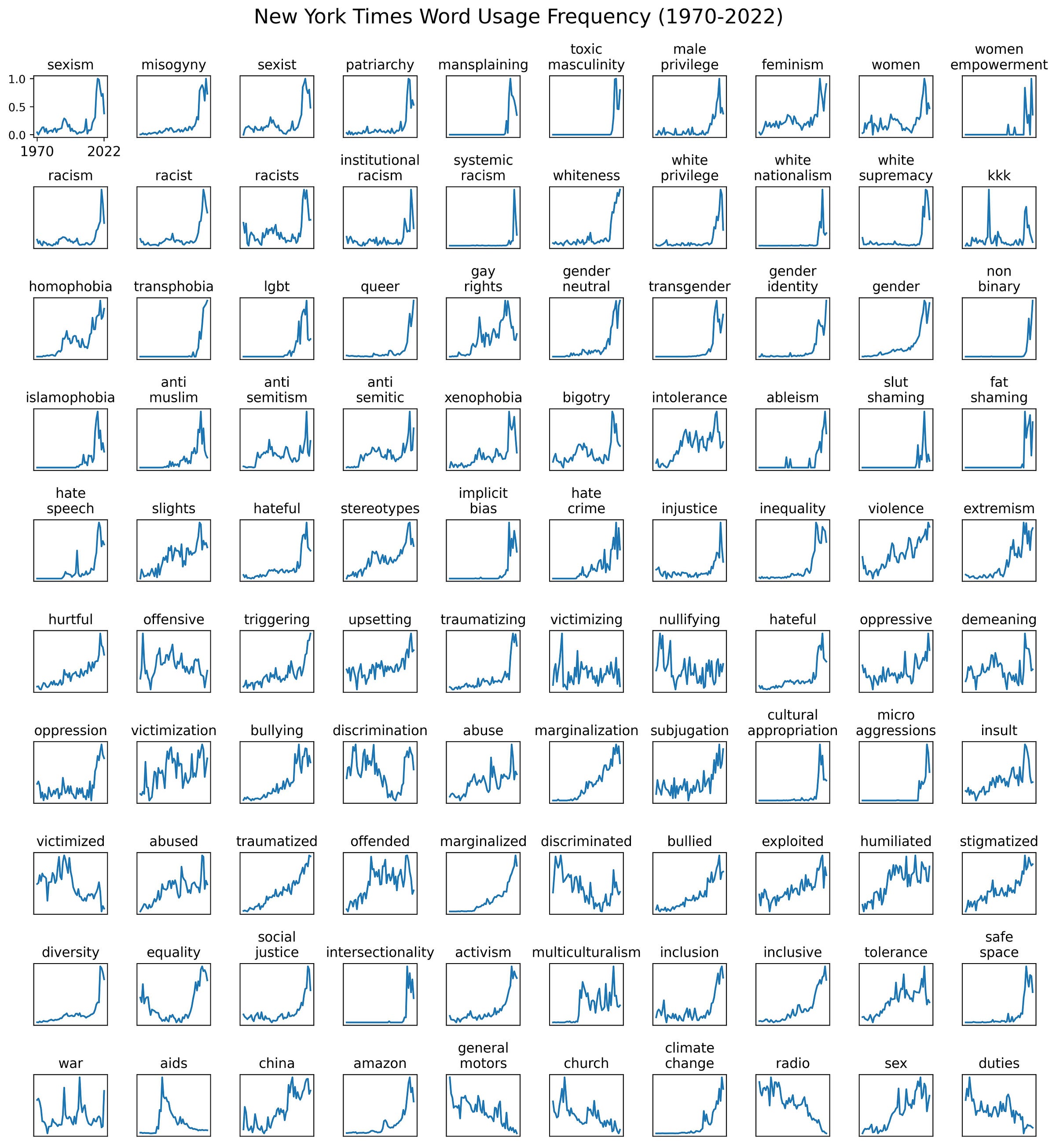
Climate change issues, however, continue to receive more coverage. Not all of the charts “go my way,” but this is hardly what you would expect if Wokeness were simply rising, rising, rising out of control. Oh, and check out these trends in pronoun usage. Also here is more from Rozado, mostly on how the positive sides of woke rhetoric are gaining at the expense of the negative sides.
Advice for the new World Bank chief
From my latest Bloomberg column:
First, contrary to the prevailing wisdom, the World Bank should not make climate change more of a priority. Climate-change issues are more closely associated with rich and middle-income countries than with the poorest countries. The very poorest countries, because they have small economies, do not as a rule emit much carbon. Indoor air pollution, such as burning wood or fuel for heat or cooking, is usually more of a problem. Those emissions can be toxic, and the World Bank should try to help reduce them. But that won’t do much to cut carbon emissions.
The World Health Organization estimates that about seven million people die each year from the direct effects of air pollution. For poorer countries, alleviating that problem should be a greater priority than fighting global climate change.
The reality is that if the World Bank can help elevate some very poor countries into middle-income countries, climate-change problems will become somewhat worse — at least in the short to medium run. “We make climate-change problems worse” is not a marketable slogan. But it is selfish to try to get the World Bank to do more good for the wealthiest nations and less good for the poorest nations, which is essentially what prioritizing climate change would do. And of course the world’s wealthier nations are broadly coincidental with the major shareholders of the World Bank…
If there is any area where the World Bank should double down, it is in public-health interventions. Over the last several decades, the successes have been extraordinary. In Africa, for instance, child mortality rates have plummeted, and many public-health indicators have improved considerably, especially outside of major conflict zones. Why not invest more in what is working?
Recommended, with further arguments at the link.
New Facebook/Meta LLMs — researchers can apply for access
Today we release LLaMA, 4 foundation models ranging from 7B to 65B parameters.
LLaMA-13B outperforms OPT and GPT-3 175B on most benchmarks. LLaMA-65B is competitive with Chinchilla 70B and PaLM 540B.
The weights for all models are open and available at https://t.co/q51f2oPZlE
1/n pic.twitter.com/DPyJFBfWEq— Guillaume Lample (@GuillaumeLample) February 24, 2023
Friday assorted links
MRU One Million Users!
Marginal Revolution University hit a milestone last week: the one millionth use of our interactive econ practice tools!
Interactive tools help students learn economics and help teachers deliver great econ education. To celebrate, the MRU team has just released a 6-day high school unit plan on inflation complete with lecture slides, videos, and interactive practice and we’re offering high school teachers a chance to win billions of dollars to check it out. (Ok, Zimbabwean billions but still pretty cool!)
More generally, check out our free economics courses and teaching resources at MRU and our superb principles of economics textbook, Modern Principles of Economics. Next stop: Ten million!
Which weapons in a major conflict can be most easily scaled?
Classic artillery and bombs end up being the default because they have more than enough range for the modern battlefield and are some of the few mass producible weapons.
And:
At the beginning of a war, both sides will have stocks of long-range weapons, satellites, and other recon assets. Most of those will likely be gone within a few weeks.
And:
Ammunition will be the most voracious microchip user.
Here is more from Austin Vernon on what the next major war will look like.