The EU’s carbon tariffs
That is the topic of my latest Bloomberg column. Here is one excerpt, starting with the basic idea:
Importers would have to register to receive authorization to import goods, and they would pay a tax per ton of carbon dioxide produced. These fees are intended to match those already applied within the EU, which are currently about 90 euros per ton. The policy is also intended to place EU industry on a more competitive footing and encourage foreign countries to adopt greener energy policies.
But will it work?:
But would it? Economic changes take place at the margin, and currently the EU is engaged in substitution toward coal, a very dirty energy source.
In light of that reality, consider the proposed tariffs as having (at least) two effects. First, they will push some production out of foreign nations and into the EU. Second, they will induce some foreign nations to move to greener energy sources over time, to avoid the tax.
In the short run, the first effect dominates: The tariffs will lead to more coal use and a dirtier energy supply.
Be suspicious of green energy policies which at first make the problem worse. However promising the longer-run promises may sound, there is always the risk that bureaucratic inertia will intervene and the short-run policy effects will dominate.
The rationale for the beneficial long-run effects of the tariffs is that foreign nations, including some relatively poor nations such as India, will move toward greener energy at a more rapid pace. That might happen. But look at the EU itself over the past year. Its energy prices went up, due to the Russian attack on Ukraine, but the EU did not move toward greener energy, such as more nuclear or wind power. It moved toward dirtier energy, in part because domestic interest groups opposed the more beneficial adjustments.
So, despite about as strong an incentive as possible — a war — the EU made the harmful rather than the beneficial adjustment. Now it is expecting that much poorer nations, often with worse governance structures, to do better. Not only is this naïve, but it is also protectionist.
And this:
Even the positive long-run effects are up for grabs. On one hand, the tariff hike provides an incentive to move toward greener energy. On the other, it makes the exporting nations poorer than they otherwise would be. Poorer nations tend to be less interested in improving their environments, as clean environments are largely a luxury good. And extreme poverty worsens other global problems, including issues stemming from migration. Should EU policy make it more difficult for Africa to industrialize?
One also has to wonder whether the promise of lower tariffs in return for greener energy is credible. Once protectionist measures are in place, they are hard to reverse. The EU would be reaping tariff revenue, and domestic EU industries would be receiving trade protection. Any reclassification of the imports as fundamentally “greener” would require an investigation across borders and clearance through multiple levels of bureaucracy. Such changes will not be easy to accomplish, especially in an era increasingly enamored of trade restrictions.
Worth a ponder. EU coal consumption has been up over the last two years. And what is relevant here is energy supply at the margin.
Friday assorted links
1. Comparative data on Australian shepherds and other breeds.
2. New paper on Hayek and Schmitt.
3. Zhengdong Wang starts by surveying the year in AI…
4. David Brooks, The Sidney Awards (NYT).
5. Third Triple Crown for Magnus.
6. How is GPT-3 doing on IQ tests?
7. Are Millennials political different and will not age into conservatism?
What to Watch: Holiday Edition 2022
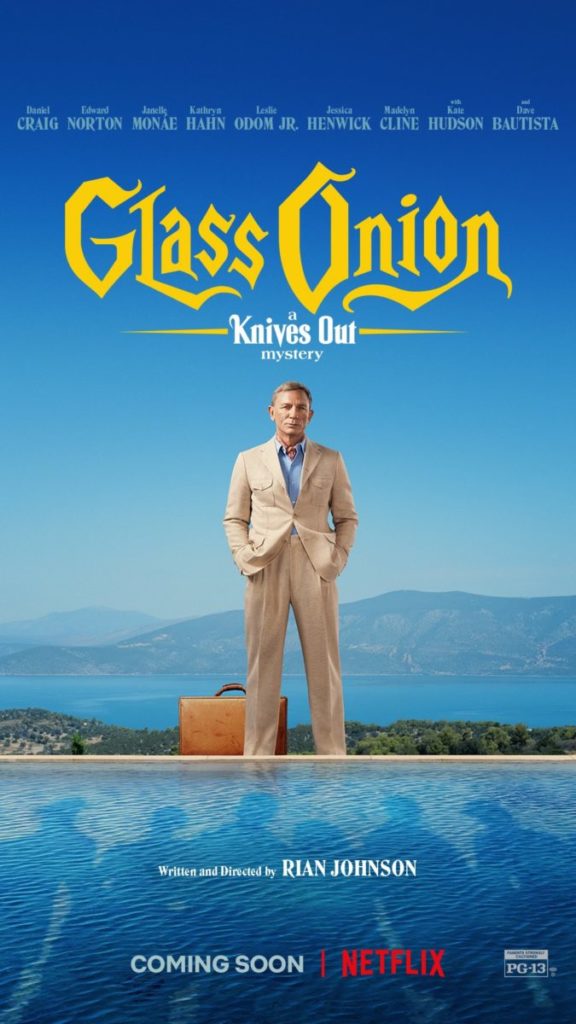 Glass Onion is a con job. It temporarily fools the viewer into thinking it original and clever and yet it is actually derivative and dumb. The ending left me bitter. It should be noted, however, that it is artfully constructed and the authors knew what they were doing. Benoit Blanc, the detective, stands in for the audience and comes to the same conclusion, “it’s all so obvious and also so stupid.” The name also gives a clue—it appears to be multi-layered but it’s glass so you can just look and see what is going on.
The Fabelmans—a paean to movie making and a close biography of Spielberg. He waited till his parents had died to make this movie. Yes, his mother actually brought home a monkey as a pet. The parents, the arty, flighty wife and the analytical, scientific husband couldn’t make it together but produced Spielberg who can and does—the opening scene with Spielberg watching his first movie between his parents says it all.
Avatar 2 I saw it in IMAX 3D. As spectacle it was great, especially the quieter water scenes. As movie it was good but broke no new ground. Indeed, Avatar 2 was exactly the same as Avatar only with more water. If you can’t see it in 3D or at least on a giant screen don’t bother.
The Recruit (Netflix): A fun CIA series which is ridiculous but rises a bit above the genre with some insight into the functions of a bureaucracy which kills people but attempts to do so legally.
 Acapulco (Apple TV). On the surface it’s a situation comedy about Maximo, a young Mexican man who sees opportunity in Los Colinas, the local resort run by a coterie of oddball characters, including the aging ex-starlet owner, Diane, who is fast approaching Norma Desmond territory. The situation is narrated by an older Maximo who has become rich and fabulously successful. At first the narration seems to be a mere device, but, over time, we begin to see that the writers are aiming at something bigger. How did Maximo become so rich? What lessons about life and business did he learn at Las Colinas? The second, hidden story line gives deeper meaning to the events of the first. Season one of Acapulco is almost entirely about Las Colinas. Only in season two do the two stories begin to converge. Can the writers pull off a denouement that brings everything together? I don’t know but the purposeful pacing and the fact that the writers aren’t showing all their cards makes me think we are seeing more than we first imagine. The opposite of Glass Onion in many ways.
The future of public transit?
Another indicator that #WFH is permanent: public transit journeys stabilizing at 35% below 2019 levels.
This raises concerns over the survival of public transit systems. Costs are heavily fixed – think train and subway networks – but revenue is way down with 35% less journeys. pic.twitter.com/JnJtuPYCg5
— Nick Bloom (@I_Am_NickBloom) December 29, 2022
Via the excellent Samir Varma.
The return of economic orthodoxy
That is the theme of my latest Bloomberg column, here is one excerpt:
This year has turned out to be a very good one for classical and traditional approaches to economics. Exotic doctrines have performed poorly, while standard predictions — based on common sense and straightforward mechanisms of operation — have done well.
Start with macroeconomics. The big story of the year has been inflation, and the two biggest culprits are in line with standard theory: growth in the money supply and hikes in energy prices. Over a recent two-year period, the US Federal Reserve allowed the M2 money supply to rise by about 40%. It is no surprise that prices increased so much…
One of the most classical of economic lessons is that supply constraints truly matter. Along these lines, energy price hikes, most of all in Europe, showed that downturns and recessions can be brought on by old-fashioned scarcity. Sadly, this was the year that Nobel Laureate Edward C. Prescott passed away. Critics mocked Prescott for emphasizing the supply side as a force behind business cycles, but this year showed that Prescott was right. If not for the war in Ukraine and its associated energy supply disruptions, the global economy would be in much better shape.
And the close:
As for the UK: Economists predicted that a move away from free trade with the EU would hurt the British economy. And it has.
Some years induce us to question established theory, and to see new and unusual possibilities for the future. Not 2022. This is the year that orthodoxy took its revenge.
Next year will perhaps be doctrinally weirder! Or maybe not.
Thursday assorted links
1. Marc Thiessen on the best things Biden did in 2022. Not all will approve, but a perspective you don’t usually hear.
2. The famous pupils of Hawick High School in Scotland.
3. How easy is it to convert office space into apartments? (NYT, can’t say I am convinced by the pessimism but interesting).
4. New Mark Calabria book on mortgage policy during the pandemic.
5. My most liked tweets of 2022.
6. A weird essay about Captain Kirk, link now fixed. Too weird, as it should be.
7. Magnus shows up 2.5 minutes late for a 3-minute blitz games against a strong GM. And wins (video).
Year summary CWT episode, Jeff Holmes interviews Tyler
Here is the audio, transcript, and video. Here is part of the episode summary:
On this special year-in-review episode, Tyler and producer Jeff Holmes talk about the past year on the show, including which guests he’d like to have on in 2023, what stands out to him now about his conversation with Sam Bankman-Fried in light of the collapse of FTX, the most popular and most underrated episodes of the year, what makes a guest authentic, why he hasn’t asked the “production function” question much this year, his essay on Marginal Revolution on the New Right, and what he’s working on next. They also evaluate Tyler’s pop culture picks from 2012 and answer listener questions from Twitter.
Excerpt:
COWEN: Vaughn Smith, the polyglot and carpet cleaner, probably is an underrated episode. The people who listened to it seemed to quite like it. I already mentioned Roy Foster. Ireland just doesn’t have that large a population, but that was a great take on Irish history. I liked most of them, I have to say. I think a lot of them are properly rated.
HOLMES: I had Roy Foster and Vaughn Smith. I would throw in, if you look at download counts, maybe Lydia Davis a little underperformed, but she still performed well. I personally really enjoyed Walter Russell Mead.
COWEN: Absolutely.
HOLMES: It was just a great back-and-forth.
COWEN: You could have him on an endless number of times, and he would always have something to say.
HOLMES: Absolutely.
COWEN: He’s one of those kinds of guests.
Recommended.
Combination Rapid Tests
Once again, the US is behind on at-home rapid antigen tests–this time on combination tests that let you test for COVID, Influenza, and RSV all at once. These tests are widely available in Europe but have not been approved by the FDA. Rapid flu tests especially are potentially very useful in assigning appropriate treatment and reducing the overuse of antibiotics.

Does reducing lead exposure limit crime?
These results seem a bit underwhelming, and furthermore there seems to be publication bias, this is all from a recent meta-study on lead and crime. Here goes:
Does lead pollution increase crime? We perform the first meta-analysis of the effect of lead on crime by pooling 529 estimates from 24 studies. We find evidence of publication bias across a range of tests. This publication bias means that the effect of lead is overstated in the literature. We perform over 1 million meta-regression specifications, controlling for this bias, and conditioning on observable between-study heterogeneity. When we restrict our analysis to only high-quality studies that address endogeneity the estimated mean effect size is close to zero. When we use the full sample, the mean effect size is a partial correlation coefficient of 0.11, over ten times larger than the high-quality sample. We calculate a plausible elasticity range of 0.22-0.02 for the full sample and 0.03-0.00 for the high-quality sample. Back-ofenvelope calculations suggest that the fall in lead over recent decades is responsible for between 36%-0% of the fall in homicide in the US. Our results suggest lead does not explain the majority of the large fall in crime observed in some countries, and additional explanations are needed.
Here is one image from the paper:

The authors on the paper are Anthony Higney, Nick Hanley, and Mirko Moroa. I have long been agnostic about the lead-crime hypothesis, simply because I never had the time to look into it, rather than for any particular substantive reason. (I suppose I did have some worries that the time series and cross-national estimates seemed strongly at variance.) I can report that my belief in it is weakening…
In-Person Schooling and Youth Suicide
School attendance, possibly through mechanisms of status competition and bullying, seems to raise the rate of youth suicide:
This study explores the effect of in-person schooling on youth suicide. We document three key findings. First, using data from the National Vital Statistics System from 1990-2019, we document the historical association between teen suicides and the school calendar. We show that suicides among 12-to-18-year-olds are highest during months of the school year and lowest during summer months (June through August) and also establish that areas with schools starting in early August experience increases in teen suicides in August, while areas with schools starting in September don’t see youth suicides rise until September. Second, we show that this seasonal pattern dramatically changed in 2020. Teen suicides plummeted in March 2020, when the COVID-19 pandemic began in the U.S. and remained low throughout the summer before rising in Fall 2020 when many K-12 schools returned to in-person instruction. Third, using county-level variation in school reopenings in Fall 2020 and Spring 2021—proxied by anonymized SafeGraph smartphone data on elementary and secondary school foot traffic—we find that returning from online to in-person schooling was associated with a 12-to-18 percent increase teen suicides. This result is robust to controls for seasonal effects and general lockdown effects (proxied by restaurant and bar foot traffic), and survives falsification tests using suicides among young adults ages 19-to-25. Auxiliary analyses using Google Trends queries and the Youth Risk Behavior Survey suggests that bullying victimization may be an important mechanism.
That is from a new NBER working paper by Benjamin Hansen, Joseph J. Sabia, and Jessamyn Schaller. I am reminded of my earlier Bloomberg column on Covid and school reopening.
Yoram Barzel has passed away
He was one of the great microeconomists. Here is a nice obituary. Here is a Vincent Geloso thread of appreciation.
The battle for academic standards
How bad is grade inflation at Harvard College? If trends keep up, an average student in ten years will have a perfect 4.0. https://t.co/MZ6kQw5Sgv (h/t @SoCalTaxProf) pic.twitter.com/cgGysXfJu7
— Orin Kerr (@OrinKerr) December 27, 2022
Wednesday assorted links
1. Martin Ravallion has passed away.
2. Americans are far more likely to move to Mexico than to Canada.
3. Top science advances of 2022?
5. Do social media lead to an underinvestment in boredom?
6. Follow-up post by the guy who criticized peer review.
7. Djokovic back in Australia (that was then, this is now).
Are Progressives in Denial About Progress?
That is the title of a new paper by Gregory Mitchell and Philip E. Tetlock, here is the abstract:
Scott Lilienfeld warned that psychology’s ideological uniformity would lead to premature closure on sensitive topics. He encouraged psychologists to question politically convenient results and did so himself in numerous areas. We follow Lilienfeld’s example and examine the empirical foundation beneath claims that positive illusions about societal change sustain inequalities by inducing apathy and opposition to reform. Drawing on data from a large-scale survey, we find almost the opposite: a pervasive tendency, across ideological and demographic categories, to see things as getting worse than they really are. These results cast doubt on functionalist claims that people mobilize beliefs about societal trends to support political positions and suggest a simpler explanation: Most laypeople do not organize information in ways that provide reliable monitoring of social change over time, which makes their views on progress susceptible to memory distortions and high-profile current events and political rhetoric.
This argument is also a theme in my much earlier In Praise of Commercial Culture.
Does more construction raise rents?
Matt Yglesias has a long post on that question, recommended albeit gated. Matt’s take is hard to summarize, so I will provide a somewhat different view, though one that is still pro-YIMBY though with a different slant.
Without loss of generality, we can assume that sometimes “more building” raises rents and other times lowers them, or rents stay the same.
Let’s say there are no big “ideas externalities” from a new NYC apartment building, and as we put more of those buildings in, the rents fall somewhat. Furthermore, say we keep on building until those rents in NYC equal those in Nashville. There is gain on the inframarginal units of construction, but at the final margin the new building in NYC has about the same social value as the new building in Nashville. The inframarginal gains are the relevant ones.
Now who gets those inframarginal gains? If land is the truly scarce factor, as NIMBY critics suggest, landlords get a lot of them! Nothing against that, I love landlords. Still, that is a slightly different story from what you hear from the YIMBYs. Landlords don’t get all of those gains, because the land scarcity constraint is precisely what is being relaxed. But the available evidence seems to indicate you need to build a lot before rents fall much. So landlords probably receive a healthy share of those new gains. Rents may fall, but not by that much. And so the gains for new urban entrants (who did not wish to migrate at the old rent levels) are correspondingly meh.
Again, let me repeat I love YIMBY and I love landlords. You should too.
Alternatively, say you keep on building and the new residents bring lots of information externalities to the urban area — ever been to Seoul? They have built like crazy and it is still quite expensive, all the more so in fact. By building more, they made the land more valuable. Good for them. (NB: The biggest beneficiaries may be the rest of Korea, and K-Pop consumers around the world, not Seoul residents.)
Now who do you think reaps most of those gains? Under standard NIMBY assumptions, I would think it is mainly the landlords. Which is not to deny the residents receive some gains from increased product diversity in Seoul (good Thai food there now, etc.), and other non-primary effects.
It’s not all the landlords. But still, the knowledge externalities make land in Seoul, in economic terms, more scarce. The landlords will do really well.
When I read or hear YIMBYs, I often feel they have a public choice model of politics, slanted toward recognizing the influence of the landlords and homeowners, but not a comparable model of factor price incidence to boot. They somehow want the lower rents and the positive information externalities both at the same time. That to me seems unlikely. And so it is harder to redistribute income away from landlords than you might think.
I again would stress that all the YIMBY changes are Pareto improvements here. But the extreme remedies suggested by the Georgists, which to be clear I do not favor, are quite explicable to me.