Results for “age of em” 17245 found
Italian average is over
Michele Fontefrancesco, an economic anthropologist and honorary fellow of Durham University, says: “Jobs have been getting more precarious in Italy since the late-1990s. What is becoming more and more common in Italy and other Mediterranean countries is the erratic movement of workers from firm to firm.”
He adds: “It’s becoming harder and harder to access professions with social capital. You study for three or four years longer than your father and you earn less money than him.”
For Agnese Bellieni, a 31-year-old resident of Alessandria, in Italy’s north-west, years of education are failing to pay off, and the eurozone recovery feels intangible. After finishing her doctoral studies in literature her dream was to become a full-time teacher, but in recent years she has been bogged down in a series of continuous but part-time, precarious work assignments — from market research, to Latin and ancient Greek tutoring — that, at best, have earned her €1,500 a month.
That is by Claire Jones in the FT, mostly about how the new eurozone jobs have lower wages and less job security.
John Roberts’ Commencement Speech
Supreme Court Justice John Roberts gave the commencement speech at his son’s 9th grade graduation. This section was striking:
Now the commencement speakers will typically also wish you good luck and extend good wishes to you. I will not do that, and I’ll tell you why. From time to time in the years to come, I hope you will be treated unfairly, so that you will come to know the value of justice. I hope that you will suffer betrayal because that will teach you the importance of loyalty. Sorry to say, but I hope you will be lonely from time to time so that you don’t take friends for granted. I wish you bad luck, again, from time to time so that you will be conscious of the role of chance in life and understand that your success is not completely deserved and that the failure of others is not completely deserved either. And when you lose, as you will from time to time, I hope every now and then, your opponent will gloat over your failure. It is a way for you to understand the importance of sportsmanship. I hope you’ll be ignored so you know the importance of listening to others, and I hope you will have just enough pain to learn compassion.
Whether I wish these things or not, they’re going to happen. And whether you benefit from them or not will depend upon your ability to see the message in your misfortunes.
Forget automation and AI, are goats taking away union jobs? (Malthus! arbitrage!)
University spokeswoman Cheryl Roland said a small goat crew has been on campus this summer, but not to cut grass.
“For the second summer in a row, we’ve brought in a goat crew to clear undergrowth in a woodlot, much of it poison ivy and other vegetation that is a problem for humans to remove,” Roland said. “Not wanting to use chemicals, either, we chose the goat solution to stay environmentally friendly.
“The area is rife with poison ivy and other invasive species, and our analysis showed the goats to be a sustainable and cost-effective way of removing them,” she added.
The goats were formally introduced to the campus and local community on June 2 in parking lot 51 of the Sindecuse Health Center.
Garrett Fickle and his wife, Gina, the owners of Munchers on Hooves in Coldwater, rent out their four-footed “lawn mowers” to homeowners, commercial property owners and other clients.
…The goats are ahead of schedule, said Nicholas Gooch, a university horticulturist and the project leader.
And yet:
The 400-member American Federation of State, County and Municipal Employees has filed a grievance contending that the work the goats are doing in a wooded lot is taking away jobs from laid-off union workers.
“AFSCME takes protecting the jobs of its members very seriously and we have an agreed-upon collective bargaining agreement with Western Michigan,” said Union President Dennis Moore. “We expect the contract to be followed, and in circumstances where we feel it’s needed, we file a grievance.”
Here is the full story, via Rayman Mohamed.
What is the optimal speed of email response?
A while ago I tweeted something like “If you use 2x on your podcasts, should you also aspire to speak twice as fast to others?”, or something like that. In turn I started thinking about the optimal speed of written responses.
Sometimes you won’t email back until you have something quite good to say, and discourse may be inefficiently slow. You are waiting, not only because you might be busy, but also to protect your reputation. It would be socially preferable to just “get the response over with,” even if you seem a little duncey every now and then. In fact you are a little duncey.
Alternatively, you may drum up an obviously perfunctory response, so that no one judges your intelligence by it. In equilibrium, some people will overinvest in being brusque over email for this reason.
If one has been smart or clever, it raises the bar for future interactions, raises expectations, and so slows down discourse. So often (too often?) we judge others by the trend. In that case, cleverness should ascend with time, at least in the initial stages of relationships. If that is the case, do not raise initial expectations so high, though neither can you sound too stupid at first. Perhaps the same is true for blogs and blog posts.
Or say you wish to flatter the sender of the email. What is the appropriate response pace toward that end? Not one second later, but not three years later either.
The now-defunct gmail chat eased some of these problems by lowering expectations for quality of response, by making “right away” the default pace. I suspect one does gmail chat, or whatever is replacing it now, mainly with people where “expectations of quality” already are fairly well set.
If you have a really clever email response, you might wish to send it right away, even if you could come up with a slightly better version after a day of thought. The immediate send will produce a more favorable impression.
People who are quick thinkers should answer their email right away. Some of this may be a general attachment to a propensity for “quick response.” But they will seem smarter this way too, albeit less smart once their recipients figure out this logic.
Zach Lowe invents a new wage hypothesis
The league and union introduced the super-max to give incumbent teams more of an edge in retaining superstars. If the Bulls indeed felt queasy about the possibility of spending it on Butler, he becomes the second player — alongside DeMarcus Cousins — dealt at least in part because the incumbent team didn’t really want that advantage. Paul George may mark case No. 3, though Kevin Pritchard, Indiana’s GM, sounded heartbroken Thursday about the inevitability of George playing elsewhere. The super-max may be having almost the opposite of its intended effect.
The Bulls were rather publicly uncomfortable with the idea of Butler as foundational player.
Here is the full article, by Zack Lowe, one of the best writers around. Quick, what is the dual wage hypothesis for CEO pay? For academic hiring?
The decline of academic book sales
Michael Jubb’s recent report on (UK) Academic Books and their Future (warning ! dreaded pdf format !) — part of the Academic Book of the Future-project — makes for depressing reading.
Matthew Reisz’s piece in Times Higher Education sums it up pretty well: Worst sellers: warning of existential crisis for academic books, as “the number of individual [academic] titles sold rose by 45 per cent, from 43,000 to 63,000” between 2005 and 2014 — but (Nielsen BookScan-tracked sales figures): “show a decline for academic books of 13 per cent between 2005 and 2014, from 4.34 million to 3.76 million annually”. Add it all up, and: “this meant that average sales per title fell from 100 to 60″…
The median is likely lower yet.
That is from Michael Orthofer of Literary Saloon, by the way here is my earlier Conversation with Michael.
The Minimum Wage: Evidence from a Danish Discontinuity
In addition to the Seattle study, another minimum wage paper crossed my path this week and it takes a very different approach than much of the literature. In Denmark the minimum wage jumps up by 40% when a worker turns 18. Thus the authors, Kreiner, Reck and Skov, ask what happens to the employment of young people when they hit their 18th birthday? Answer: employment drops dramatically, by one-third.
A picture tells the story. On the left is measured wages by age, the jump up due to the minimum wage law is evident at age 18. On the right is the employment rate–the jump down at age 18 is also evident as is a bit of pre-loss as workers approach their 18th birthday.
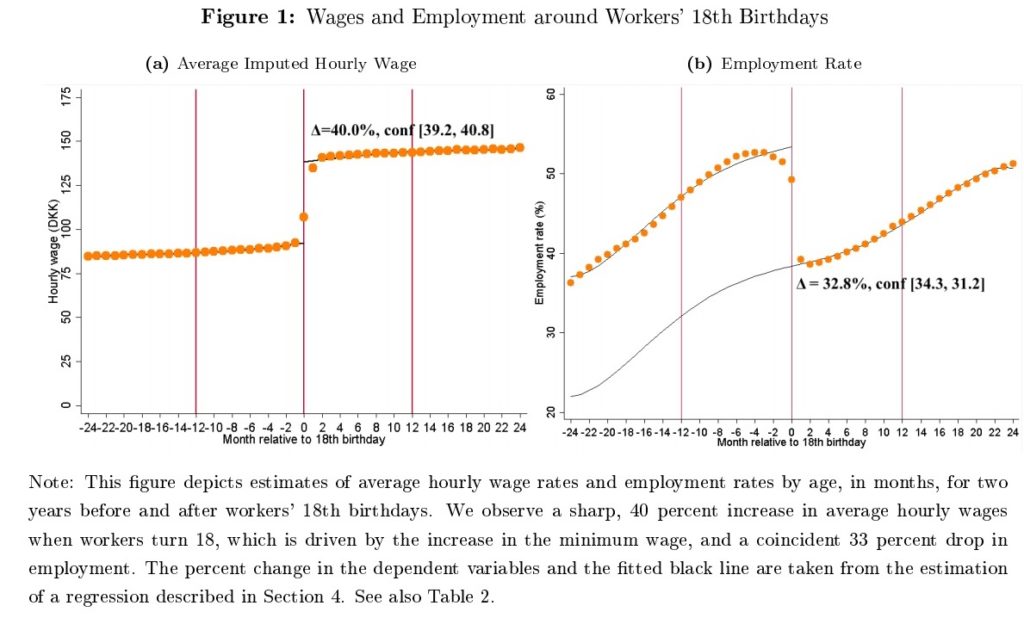
The authors have administrative data covering wages, employment and hours worked for the entire workforce of Denmark so their estimates are precise.
Denmark has laws making age discrimination illegal but these do not apply when a young person turns 18 and firms may legally search for under or over-18 age workers.
A variety of restrictions mean that under-18 age workers can do less than adults (e.g. they can’t legally lift more than 25 kilos or have a driver’s license.) Thus, productivity increases at age 18, making the employment loss at this age even more dramatic.
The authors can’t tell for certain if workers are quitting or getting fired but there are few other obvious discontinuities around exactly age 18. Students are eligible for certain benefits at age 18 but the authors are able to look at sub-samples where this objection doesn’t apply and the results are robust.
In a section of the paper that adds important new evidence to the debate, the authors look at the consequence of losing a job at age 18. One year after separation only 40% of the separated workers are employed but 75% of the non-separated workers are employed. Different interpretations of this are possible. The separated workers will tend to be of lower quality than the non-separated and maybe this is correlated with less desire to have a job. Without discounting that story entirely, however, the straightforward explanation seems to me to be the most likely. Namely, the minimum wage knocks low-skill workers off the job ladder and it’s difficult to get back on until their skills improve.
Hat tip: Ben Southwood.
The Seattle Minimum Wage Study
The Seattle Minimum Wage Study, a study supported and funded in part by the Seattle city government, is out with a new NBER paper evaluating Seattle’s minimum wage increase to $13 an hour and it finds significant dis-employment effects that on net reduce the incomes of minimum wage workers. I farm this one out to Jonathan Meer on FB.
This is the official study that was commissioned several years ago by the city of Seattle to study the impacts of raising the minimum wage, in a move that I applauded at the time as an honest and transparent attempt towards self-examination of a bold policy. It is the first study of a very high city-level minimum wage, with administrative data that has much more detail than is usually available. The first wave (examining the increase to $11/hr) last year was a mixed bag, with fairly imprecise estimates.
These findings, examining another year of data and including the increase to $13/hr, are unequivocal: the policy is an unmitigated disaster. The main findings:
– The numbers of hours worked by low-wage workers fell by *3.5 million hours per quarter*. This was reflected both in thousands of job losses and reductions in hours worked by those who retained their jobs.
– The losses were so dramatic that this increase “reduced income paid to low-wage employees of single-location Seattle businesses by roughly $120 million on an annual basis.” On average, low-wage workers *lost* $125 per month. The minimum wage has always been a lousy income transfer program, but at this level you’d come out ahead just setting a hundred million dollars a year on fire. And that’s before we get into who kept vs lost their jobs.
– Estimates of the response of labor demand are substantially higher than much of the previous research, which may have been expected given how much higher (and how localized) this minimum wage is relative to previously-studied ones.
– The impacts took some time to be reflected in the level of employment, as predicted by Meer and West (2016).
– The authors are able to replicate the results of other papers that find no impact on the restaurant industry with their own data by imposing the same limitations that other researchers have faced. This shows that those papers’ findings were likely driven by their data limitations. This is an important thing to remember as you see knee-jerk responses coming from the usual corners.
– You may also hear that the construction of the comparison group was flawed somehow, and that’s driving the results. I believe that the research team did as good of a job as possible, trying several approaches and presenting all of their findings extensively. There is no cherry-picking here. But more importantly, without getting too deep into the econometric weeds, my sense is that, given the evolution of the Seattle economy over the past two years, these results – if anything – *understate* the extent of the job losses.
This paper not only makes numerous valuable contributions to the economics literature, but should give serious pause to minimum wage advocates. Of course, that’s not what’s happening, to the extent that the mayor of Seattle commissioned *another* study, by an advocacy group at Berkeley whose previous work on the minimum wage is so consistently one-sided that you can set your watch by it, that unsurprisingly finds no effect. They deliberately timed its release for several days before this paper came out, and I find that whole affair abhorrent. Seattle politicians are so unwilling to accept reality that they’ll undermine their own researchers and waste taxpayer dollars on what is barely a cut above propaganda.
I don’t envy the backlash this team is going to face for daring to present results that will be seen as heresy. I know that so many people just desperately want to believe that the minimum wage is a free lunch. It’s not. These job losses will only get worse as the minimum wage climbs higher, and this team is working on linking to demographic data to examine who the losers from this policy are. I fully expect that these losses are borne most heavily by low-income and minority households.
Canada’s “Shortage” of Marijuana
I never imagined that Canadian finance ministers would one day worry about a shortage of marijuana. Welcome to 2017.
Bloomberg: The biggest challenge for Justin Trudeau’s forthcoming legal recreational marijuana market is a shortage of pot, the finance minister of Canada’s most-populous province says.
…Finance ministers were told demand is “quite high” for marijuana already in Canada, he said. “So we want to make certain that, when we do proceed, there is sufficient supply to accommodate the activity because what we’re trying to do is curb the illicit use and organized crime that now exists around it.”
The finance ministers’ worry, however, is misplaced. Canada’s system is not as open to entry as Colorado’s, so even with new licenses being approved rapidly, demand will increase faster than supply once legalization happens and prices will increase. That much is true. But much of the new demand will come from people who were deterred from buying illegally. As far as these buyers are concerned, the total price–including the price of possibly being caught–will have fallen, even as the money price rises. Many people who were buying illegally will also prefer to buy legally, even at the higher price. In other words, even if the price of legal pot is higher than the current illegal price, the demand for illegal pot will fall putting pressure on the criminal element.
As usual, the finance ministers forgot to think at the margin.
Hat tip: Daniel Lippman.
Temporarily postponed markets in everything, Gilligan’s Island edition
There is a restaurant in New Jersey called Tina Louise.
It’s serves “a taste of Asia.” We were thinking tropical island fare. According to the website, it is temporarily closed due to a fire. But if you someday find yourself in Carlstadt, New Jersey…
Link here, the restaurant’s home page is here, menu here (pdf, yum), here are the Yelp reviews.
I thank an anonymous MR reader for the pointer.
Shakespeare in an age of Trump is a little disconcerting
That is the topic of my latest Bloomberg column, here is just one excerpt:
I see Trump as not a ruler but rather akin to the various fools, jesters or, in the case of Lear, the character of Edgar, who appears before the king in disguise and warns him of his enemies. Don’t interpret the word “fool” too literally here. The most common features of these characters is that they speak between the cracks in the action and utter sentiments that no one else dares to voice. That’s Trump on Twitter. Would the word “covfefe” be so out of place in one of those poetic rants?
And:
And looking forward, what might a study of Shakespeare tell us to watch for in the evolution of the Trump administration? How’s this for a start?:
- Blood may be thicker than water, but nonetheless power struggles can break family bonds rather easily.
- Power cannot be given away and still retained.
- Don’t overweight legitimacy and birth order in determining succession.
- Love is a wild card.
- There is no maximum limit to chaos.
Do read the whole thing.
*The Economist* covers Econ Journal Watch symposium on regretted statements
Here is the article, here is one excerpt:
A new issue of Econ Journal Watch, an online journal, includes a symposium in which prominent economic thinkers are asked to provide their “most regretted statements”. Held regularly, such exercises might take the shame out of changing your mind. Yet the symposium also shows how hard it is for scholars to grapple with intellectual regret. Some contributions are candid; Tyler Cowen’s analysis of how and why he underestimated the risk of financial crisis in 2007 is enlightening. But some disappoint, picking out regrets that cast the writer in a flattering light or using the opportunity to shift blame.
Here again is the symposium, here is my contribution.
Libertarian Social Engineering and Solving the Public Good Problem
At Cato Unbound I argue for libertarian social engineering:
The better markets work, the less the demand for the state. By improving markets and other voluntary organizations, libertarians can make their political vision more attractive while at the same time making people better off.
Modern libertarianism began after many of the market institutions that we take for granted had already been developed. Fee simple property, for example, dates to 1290. Could we have a libertarian society without fee simple property? In theory, yes. In practice, the free society is attractive because it generates wealth. Without fee simple property it is, at the very least, more difficult to create a rich, industrialized society. The limited liability company dates much later than fee simple property, to the 19th century. Without the limited liability company, it would probably have been much more difficult to raise large amounts of capital. As a result, without limited liability, markets would be at a great disadvantage compared to the state in conducting economic activity on a large scale. Thus fee simple property and the limited liability company are among the technological/legal institutions that have made a free society possible, not because they are constitutive of a free society, but because they make a free society work better and compete better against statist alternatives.
So how can we improve markets? Public goods are one of the biggest challenges to markets and it was long thought that because of the free rider problem markets could not produce public goods. In Tabarrok (1998) I showed that such reasoning was wrong; a large class of public goods can be produced voluntarily using what today would be called a crowdfunding contract with a refund bonus or what I called at the time, the dominant assurance contract (DAC). My piece at Cato Unbound describes the DAC and also some other ideas for libertarian social engineering in more detail.
What’s important about dominant assurance contracts is not simply that they solve the public good problem but that:
Dominant assurance contracts open the provision of public goods to entrepreneurship, innovation, and the market discovery process.
Why was the Qatar cut-off so extreme and sudden?
I am considering hypotheses here, to see how game theory might apply, so don’t think of this is an actual description of the situation.
As an economist, what struck me was the quick and extreme cut-off of Qatar by the Saudis and six other supporting parties. In the simplest versions of principal-agent theory, we think of most incentives as being applied continuously and varied in small doses: was Qatar’s behavior the day before the Qatar embargo/boycott really so different than the day of and after? So why did it happen this way? I can think of a few possibilities:
1. The boycott is like suddenly firing misbehaving workers. For morale reasons, you don’t want to keep them around on lesser terms, because they will be destructive. This hypothesis implies that the cut-off of Qatar is a permanent one.
2. Demonstrations of power require large, discrete events. If the Saudis had simply tweaked the incentives facing Qatar, the Qatar citizenry might not have distinguished the effects of that tweak from random noise. This hypothesis suggests that once the Saudis have made their point, and received Qatari concessions, the cut-off will be lifted or at least modified.
Note that along this game path, Qatar may not wish to “fold” immediately, as that could make them an ongoing puppet of the Saudis, all too easily manipulated. And indeed Qatar still has significant open markets for its natural gas.
3. Donald Trump’s meeting with the Saudis gave them an unexpected green light, either explicitly or implicitly, and thus the sudden receipt of this new information motivated their sudden switch in behavior.
During my recent trip to the Middle East I stated that there can no longer be funding of Radical Ideology. Leaders pointed to Qatar – look!
— Donald J. Trump (@realDonaldTrump) June 6, 2017
#3 still may be consistent with either #1 or #2.
4. The Saudis actually are playing a game with Iran, not so much with Qatar. What appears to be a big, sudden snap to the Qataris is actually just a smallish, mid-sized tweak in the incentives being applied to Iran. Qatar, because it is so small, feels a high degree of collateral damage.
5. The punishment space is multi-dimensional. Once “duration of punishment” is viewed as a variable, even a big punishment applied for a short period of time can be viewed as a marginal tweak. In this sense there is no paradox.
6. The Saudis view the Qataris as the ones who made a “discrete break” from the previous equilibrium, by paying a $1 billion ransom to Iranian and al Qaeda-linked forces, to induce the release of some kidnapped royal family members. Discrete breaks are inefficient, but perhaps you have to respond to one discrete break with another, precisely because they are inefficient.
7. Ian Bremmer mentioned on Twitter that 90% of the Qatari food supply is imported, 40% of it from Saudi, and now that is at risk. There are some countries for which a partial degree of agricultural subsidies and protectionism may make sense, for national security reasons. In any case, the degree of allowed smuggling reintroduces the notion of a smoother punishment space.
In a rational actor model (ha), this cut-off would be lifted in about a week from now.
Perry Anderson on Kemalism
One of his main points is that secular nationalism and Islamism have never been so separate in Turkey:
Tactical and transient, the new regime’s [Kemal’s] use of Islam, when no longer required, was easily reversed. But at a deeper level, a much tighter knot tied it to the very religion it proceeded on the surface to mortify. For even when at apparent fever pitch, Turkish secularism has never been truly secular. This is in part because, as often noted, Kemalism did not so much separate religion from the state as subordinate it to the state, creating ‘directorates’ that took over the ownership of all mosques, appointment of imams, administration of pious foundations – in effect, turning the faith into a branch of the bureaucracy. A much more profound reason, however, is that religion was never detached from the nation, becoming instead an unspoken definition of it. It was this that allowed Kemalism to become more than just a cult of the elites, leaving a durable imprint on the masses themselves. Secularism failed to take at village level: nationalism sank deeper popular roots. It is possible – such is the argument of Carter Findley in his Turks in World History – that in doing so it drew on a long Turkish cultural tradition, born in Central Asia and predating conversion to Islam, that figured a sacralisation of the state, which has vested its modern signifier, devlet, with an aura of unusual potency. However that may be, the ambiguity of Kemalism was to construct an ideological code in two registers. One was secular and appealed to the elite. The other was crypto-religious and accessible to the masses. Common to both was the integrity of the nation, as supreme political value.
Here is the full LRB essay, via Alex Xenopoulos. The comments after the essay are worth reading too.