Results for “age of em” 17234 found
High School Safety in Northern Virginia
Here is a letter I wrote to the principal of my son’s high school:
Dear Principal _____,
Thank you for requesting feedback about the installation of interior cameras at the high school. I am against the use of cameras. I visited the school recently to pick up my son and it was like visiting a prison. A police car often sits outside the school and upon entry a security guard directs visitors to the main office where the visitor’s drivers license is scanned and information including date of birth is collected (is this information checked against other records and kept in a database for future reference? It’s unclear). The visitor is then photographed and issued a photo pass. I found the experience oppressive. Adding cameras will only add to the prison-like atmosphere. The response, of course, will be that these measures are necessary for “safety.” As with security measures at the airports I doubt that these measures increase actual safety, instead they are security theater, a play that we put on that looks like security but really is not.
Moreover, the truth is that American children have never been safer than they are today. Overall youth mortality (ages 5-14) has fallen from 60 per 100,000 in 1950 to 13.1 per 100,000 today (CDC, Vital Statistics). Yet we hide in gated communities, homes and schools as never before.
When we surround our students with security we are implicitly telling them that the world is dangerous; we are whispering in their ear, ‘be afraid, do not venture out, take no risks.’ When going to school requires police, security guards and cameras how can I encourage my child to travel to foreign countries, to seek new experiences, to meet people of different faiths, beliefs and backgrounds? When my child leaves school how will the atmosphere of fear that he has grown up in affect his view of the world and the choices he will make as a citizen in our democracy? School teaches more than words in books.
Yours sincerely,
Alex Tabarrok
Would Hayek have favored Obamacare?
In this video Nick Gillespie interviews Erik Angner and Erik is (with qualifications) positively inclined. A few points:
1. When Hayek wrote, health care costs were quite low as a percentage of gdp. The same can be said of early Friedman writings (it is startling how little attention Capitalism and Freedom, dating from 1962, pays to “the problems of old people”). It is not clear how views formed in that era should be extrapolated to the current day.
2. Angner-interpreting-Hayek draws a distinction between mandates — which are allowed — and price controls — which are verboten. Yet it is hard to have major government involvement in health care without price controls, or should I write “price controls,” in some manner or another. Third party payments cannot be made at any prices that suppliers might like. Single payer systems have to bargain over price. For that matter mandates have to put some limits on what suppliers can charge for the mandated good, including quality limits. The results may not literally be the same as legally mandated price maximums but a) it is hard for a health care-subsidizing government to avoid interfering with the price mechanism, and b) when viewed in these terms, it is not obvious why interfering with the price mechanism is worse per se than mandates or redistribution. Mandates and redistribution also interfere with the price mechanism, the former as shown by economic theorems about quantity-price duality and the latter once you think of an income as a price or the result of a set of prices.
3. To make it quite speculative, I believe Hayek — if fast-forwarded into the present — might favor a mix of forced savings into health savings accounts, cash transfers to the poor, and direct government provision of basic health care services for the very needy. Whether or not I am right, Hayek is far from laissez-faire on health care. But I doubt Hayek would have come close to supporting ACA. Most of all, I think he would have been horrified by the lack of legal generality and universality in the different categories of treatment, coverage, prices, subsidies, reimbursement rates, and so on. I think he would have seen this as a sign of our legal and philosophic barbarism, noting that I am not trying to put the predominance of blame on Obama here.
Pictures on ethnic menus
Blake Shurtz, a perceptive MR reader, asks:
What are your thoughts on pictures, or a lack thereof, on ethnic food menus? Do you think better dishes have pictures? Why doesn’t every dish have a picture? The logic of fast food is to show pictures/numbers for non-english speakers to be better informed, but the converse doesn’t seem to happen as often.
Pictures are most likely a good sign when they are dingy and the menu plastic is peeling off. Even then the food may be bad, but at least you know you have a mom and pop operation which is not very polished on the tech side. “Nice” pictures are a bad sign. Pictures are least likely to be a bad sign for Vietnamese food, when they are basically neutral and also fairly common. Think of the Vietnamese as trying to go mainstream with their food but in any case failing. Pictures for Thai food are becoming a worse sign over time. As more people come to learn Yam huapli thot, the pictures are coming to signal that the restaurant is making a determined appeal to uninformed buyers. There is a subset of cranky but excellent Chinese restaurants which offer (non-corporatized) pictures of some of their dishes, including those with tofu. This segment of the market is dwindling but still can be found. The choice of what gets a photo is determined by the expected quality of the image (whole fish get showcased), rather than the taste of the dish per se.

TANSTAAFL?
Love actually rings in at $43,842.08, according to RateSupermarket.ca, which has calculated the price tag of the typical modern relationship – from a one-year courtship, followed by a one-year engagement to the wedding day.
And it is itemized:
The Toronto-based independent financial products comparison website pegs the price of courtship at $6,936.74. That includes a dozen “fancy dates” (nice restaurants and theatre tickets), a dozen movie dates, 36 “casual dates” (take-out food, coffee and movie rentals), weekend getaways, a beach vacation plus random other expenses for things such as “apology flowers,” treats and new clothes.
The engagement period rings in at $9,944.34, which includes more dates, an engagement party with a price tag of $2,000 and the big ticket item, a ring with an average estimated cost of $3,500. (The popular wedding website TheKnot.com estimates that cost at around $5,000, but RateSupermarket.ca pointed that that it doesn’t consider rings purchased from lower-end retailers such as Walmart.)
Oh, and the wedding? Well that’s another $26,961.
Here is more, with the pointer from Chad R.
What do I think of Obama’s universal pre-school proposal?
Of course there are no significant details yet, but here are a few points.
1. The evidence that this can be done effectively in a scalable manner is basically zero. Aren’t massive policies (possibly universal?) supposed to be based on evidence? (How about running a large-scale RCT first, a’la the Rand health insurance experiment? And by the way, here is a quick look at the evidence we have on pre-school, and here, not nearly skeptical enough in my view. And think in terms of lasting results, not getting kids to read nine months earlier, etc. You can find evidence for persistent math gains in Tulsa, OK, but no CBA.)
2. That doesn’t mean we should do nothing.
3. Let’s say we have “the political will” to do something effective (debatable, of course). Is adding on another layer of education, and building that up more or less from scratch in many cases, better than fixing the often quite broken systems we have now? I know well all the claims about “needing to get kids early,” but is current kindergarten so late in life? Why not have much better kindergartens and first and second grade experiences in the ailing school districts? Or is the claim that by kindergarten “it is too late,” yet a well-executed government early education could fix the relevant problems if applied at ages three to four? Would such a claim mean that we are currently writing off many millions of American children, as it stands now?
4. This is what federalism is for. Let’s have an experiment emanating from the state and/or local level.
5. What should we infer from the fact that no such truly broad-based state-level experiment has happened yet? (Georgia and Oklahoma have come closest.) That the states are lacking in vision, relative to the Presidency? Or that a workable version of the idea is hard to come up with, execute, and sell to voters?
6. In Finland government education doesn’t really touch the kids until they are six years old. Don’t they have a very good system? Some call it the world’s best. Maybe the early years are very important, but perhaps pre-schooling is not the key missing piece of the puzzle. (NB: See the comments for dissenting views on Finland.)
Addendum: Here are good comments from Reihan. See also this Brookings study: “This thin empirical gruel will not satisfy policymakers who want to practice evidence-based education.”
The path of government spending
Matt Yglesias posts this chart, which I am happy to endorse, alternative scaling here, and related material from Veronique de Rugy here.

The real problem comes about ten years out, due to aging. It’s still the case that, when it comes to fiscal issues, turning on a dime can be very difficult. In the meantime, it may appear, at times, that not much is happening, but these will be a very critical ten years.
A Trapped Factors Model of Innovation
That is the new paper (pdf) by Nicholas Bloom, Paul Romer, Stephen Terry and John Van Reenen. Here is the abstract:
When will reducing trade barriers against a low wage country cause innovation to increase in high wage regions like the US or EU? We develop a model where factors of production have costs of adjustment and so are partially “trapped” in producing old goods. Trade liberalization with a low wage country reduces the profitability of old goods and so the opportunity cost of innovating falls. Interestingly, the “China shock” is more likely to induce innovation than liberalization with high wage countries. These implications are consistent with a range of recent empirical evidence on the impact of China and offers a new mechanism for positive welfare effects of trade liberalization over and above the standard benefits of specialization and market expansion. Calibrations of our model to the recent experience of the US with China suggests that there will be faster long-run growth through innovation in the US and that, in the short run, this is magnified by the trapped factor effect.
Assorted links
1. How the Snickers bar has changed over time.
2. Correlation does not prove causation, Danish marriage edition.
3. Will spending caps work?, and more here from Matt.
4. Very good older piece from Fuchsia Dunlop, “Perplexing encounter with a gastro-nihilist.”
5. Bill Gates answers questions on Reddit.
6. Say law follies, by Scott Sumner.
7. Are we bending the health care cost curve?, by Annie Lowrey, and see this chart on hospital construction.
8. Brad DeLong has on-the-mark comments on the Ezra profile.
*Sharing the Prize*
That is the new and much awaited book by Gavin Wright, with the subtitle The Economics of the Civil Rights Revolution in the American South. Here is one small bit, reflecting some of the book’s main themes:
By the 1930s, labor markets in the South had come to display a distinct “racial wage gap,” supported by systems of vertical workplace segregation. Not only were job categories classified by race, but black wage rates typically peaked about where white pay grades began. These structures persisted through World War II and the 1950s, showing few signs of softening even in the presence of rapid urbanization and industrial employment growth.
Here are some related powerpoints by Wright (pdf). Here is the book’s home page.
Assorted links
Torture in a Just World
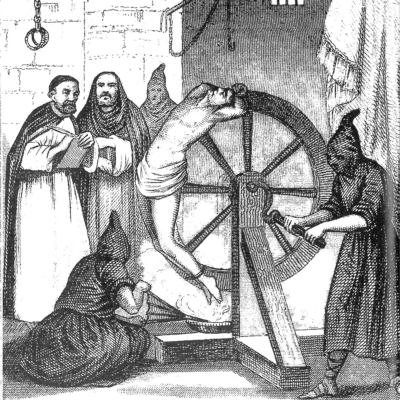 If the world is just, only the guilty are tortured. So believers in a just world are more likely to think that the people who are tortured are guilty. Perhaps especially so if they experience the torture closely and so feel a greater need to overcome cognitive dissonance. On the other hand, those farther away from the experience of torture may feel less need to justify it and they may be more likely to identify the tortured as victims. The theory of moral typecasting suggests that victims are also more likely to be seen as innocents (a la Jesus).
The theory is tested in a lab setting by Gray and Wegner. Experimental subjects are told that “Carol”, really a confederate, may have lied about a dice roll and that stress often encourages people to admit guilt. Subjects then listen to a torture session as Carol’s hand is plunged into a bucket of ice water for 80s. Subjects are then asked how likely is it that the torture victim was lying (1 to 5 with 5 being extremely likely). There are two intervention variables: 1) some of the subjects meet the torture victim before she is tortured, this is the close condition and some do not (distance condition) and 2) in some torture sessions the victim evinces pain (pain) and in others not (no pain). The key figure is shown below:
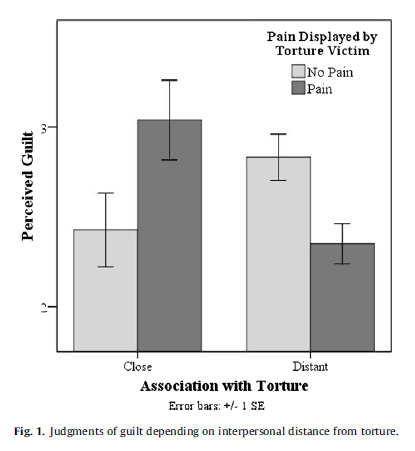 The most striking result is that in the close condition, the evincing of pain was associated with an increased judgment of guilt, consistent with torture causing cognitive dissonance which is relieved by a judgment of guilt (restoring the just world). But in the distance condition, the evincing of pain was associated with a decreased judgement of guilt, consistent with pain increasing the identification of the tortured as a victim and therefore innocent (a la moral typecasting).
Closeness in the experiment was reasonably literal but may also be interpreted in terms of identification with the torturer. If the church is doing the torturing then the especially religious may be more likely to think the tortured are guilty. If the state is doing the torturing then the especially patriotic (close to their country) may be more likely to think that the tortured/killed/jailed/abused are guilty. That part is fairly obvious but note the second less obvious implication–the worse the victim is treated the more the religious/patriotic will believe the victim is guilty.
The theory has interesting lessons for entrepreneurs of social change. Suppose you want to change a policy such as prisoner abuse (e.g. Abu Ghraib) or no-knock police raids or the war on drugs or even tax policy. Convincing people that the abuse is grave may increase their belief that the victim is guilty. Instead, you want to do one of two things. Among the patriotic you may want to sell the problem as a minor problem that We Can Fix – making them feel good about both the we and the fixing. Or, you may want to create distance – The problem is bad and THEY are the cause. People in the North, for example, became more concerned about slavery once the US became us and them.
I think research in moral reasoning is important because understanding why good people do evil things is more important than understanding why evil people do evil things.
The future of ads on mobile devices?
The Chad2Win app was developed by a Barcelona-based company and while it was only launched last month it has already attracted close to 100,000 users. All these early adapters are being given a cent for each ad they look at and three times amount if the click on it.
Mind you it is not easy to reach the maximum monthly payment of €25 and to get there a user would have to click on more than 800 ads or nearly 30 different banners every single day.
Experts who have looked at the business model have suggested that most normal users are unlikely click enough ads to make themselves more than €10 a month.
Volkswagen, Panasonic and Spanish lender Caixabank have all agreed to advertise on the app which is only available in Spain. It does not appear to have wowed users and has a three star rating among android users while those who have signed up using their iPhones have decided it is only worth two-and-a-half stars out of a possible five.
Here is more. Overall I see the collapse in value for ads on mobile devices as a major problem facing mainstream media at the moment. No one wants to view an ad on a mobile device. Economic carnage will result.
Are corporate profits a sinkhole for purchasing power?
That seems to be Krugman’s argument here, and here, excerpt:
So corporations are taking a much bigger slice of total income — and are showing little inclination either to redistribute that slice back to investors or to invest it in new equipment, software, etc.. Instead, they’re accumulating piles of cash.
I am confused by this argument. I would understand it (though not quite accept it) if corporations were stashing currency in the cupboard. Instead, it seems that large corporations invest the money as quickly as possible. It can be put in the bank and then lent out. It can purchase commercial paper, which boosts investment.
Maybe you are less impressed if say Apple buys T-Bills, but still the funds are recirculated quickly to other investors. This may not end in a dazzling burst of growth, but there is no unique problem associated with the first round of where the funds come from. If there is a problem, it is because no one sees especially attractive investment opportunities in great quantity. (To the extent there is a real desire to invest, the Coase theorem will get the money there.) That’s a problem at varying levels of corporate profits and some call it The Great Stagnation.
The same response holds if Apple puts the money into banks which earn IOR at the Fed and the money “simply sits there.” The corporations are not withholding this money from the loanable funds market but rather, to the extent there is a problem, the loanable funds market does not know how to invest it at a sufficiently high ROR.
If anything, large corporations are more likely to diversify out of the U.S. dollar, which could boost our exports a bit, a plus for a Keynesian or liquidity trap story.
When one looks at the components of aggregate demand, retail sales, after a large and obvious hit, seem to be recovering. They are up 4.7% from Dec. 2011 to Dec. 2012 (pdf). If that is what a sinkhole looks like, as I said I am puzzled:
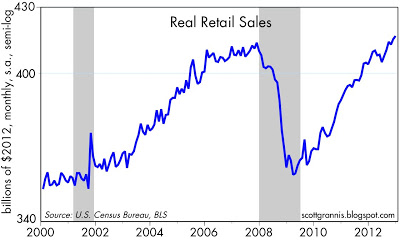
Here is the story of business investment minus corporate profits and that series doesn’t impress me (Krugman seems to think it is doing OK). The trickier variable of net investment you will find here and that looks worse.
By the way, Fritz Machlup considered related arguments in his 1940 book.
The “austerity” of 2011-2012 in the United States
It turns out that much more of it was phony than many people had realized. From David Farenthold, this is from today’s Washington Post:
To sketch the bill’s biggest impacts, The Washington Post focused on the 16 largest individual cuts. Each, in theory, sliced at least $500 million from the federal budget. Together, they accounted for $26.1 billion, two-thirds of the total.
In four of those cases, the real-world impact was difficult to measure. The Department of Homeland Security officially declined to comment about a $557 million reduction. The Department of State, the Department of Agriculture and the Federal Emergency Management Agency — whose cuts totaled $1.9 billion — simply did not answer The Post’s questions despite repeated requests over the past month.
Among the other 12 cases, there were at least seven where the cuts caused only minimal real-world disruptions or none at all.
Often, this was made possible by a little act of Washington magic. Agencies got credit for killing what was, in reality, already dead.
Here is the article, and I did chuckle at the last paragraph.
*Engineers of Victory*
The author is Paul Kennedy and the subtitle is The Problem Solvers who Turned the Tide in the Second World War. This is an excellent look at the managerial and logistics side of the war. My main regret — not really a criticism — is that the central role of economists was not given more attention. Haven’t you wondered how it was possible that say the American role in the War was started and finished in less than five years’ time? These days it can take that long to design, approve, and build a freeway interchange.
Here is a good review of the book. Here is a useful NYT review.