Results for “chetty” 80 found
The Geography of Family Differences and Intergenerational Mobility
That is the title of a new paper by Robert Kaestner, Ryan Gallagher, and Joseph Persky. Here is the abstract:
A recent series of studies by the Equality of Opportunity Project has documented substantial geographical differences in intergenerational income mobility. These spatial differences are important because they suggest that place matters more than previously thought in determining economic well-being. In this paper, we show that family characteristics vary widely across areas and simulations indicate that differences these family characteristics can explain a substantial share of the variation in intergenerational income mobility across places documented by the Equality of the Opportunity Project. Additionally, we show that the characteristics of families that move differ substantially from families that do not move, which raise doubts about the external validity of causal inferences based on the Equality of Opportunity Project’s analysis of movers.
And from the paper:
…we find that differences in the income of adult children associated with mother’s race, age, education, marital status and nativity explain 80 to 120 percent of the difference in intergenerational income mobility between the lowest and next lowest quintiles of absolute mobility in Chetty et al.’s (2014) place-based distribution of intergenerational income mobility.
I am wondering to what extent this is a criticism of Chetty et.al., or simply a disaggregation. I’m still trying to wrap my mind around what exactly are the differences between place-level characteristics and family- or person-level characteristics. I don’t take Chetty’s original story about places to concern what kind of molecules are in the dirt, or what is the climate, but rather how people in a particular place interact with each other. In that sense the result always was about family- or person-level characteristics. Does the ability of family-level characteristics to pick up these interaction effects mean that place-level effects are not operating?
Anyway, regardless of interpretation this paper does seem to me to make some very real progress toward figuring out what is going on in those mobility studies.
Sunday assorted links
2. “The Alt-Knights were originally conceived as a paramilitary wing of the Proud Boys…” (NYT)
3. Freddie on the chat with Chetty; I can’t speak for Raj, but I would gladly pay the better teachers more, if that meant firing the lemons (and I don’t read him as denying this). And many lemons there are, FD doesn’t provide evidence against that by now rather well-established claim, furthermore it is one any high schooler would agree with.
4. Scott Sumner on the two new Fed picks. I view these as very good news.
Has intergenerational mobility finally been shown to have declined?
If you recall, Robert D. Putnam, in his last book, expressed surprise that Chetty and Hendren, et.al. (2014) did not find evidence of a decline in intergenerational mobility. Putnam predicted that researchers would find such evidence soon enough. After all, it seems the returns to education have been rising, geographic mobility has been falling, market concentration is up slightly, life expectancy is behaving in funny ways, and regional disparities seem to have grown. Chetty and Grusky, et.al. (2016) seemed to paint a more pessimistic picture than did his work from a few years ago, and now we have a new paper by Jonathan Davis and Bhashkar Mazumder:
We demonstrate that intergenerational mobility declined sharply for cohorts born between 1942 and 1953 compared to those born between 1957 and 1964. The former entered the labor market prior to the large rise in inequality that occurred around 1980 while the latter cohorts entered the labor market largely afterwards. We show that the rank-rank slope rose from 0.27 to 0.4 and the IGE rose from 0.35 to 0.51. The share of children whose income exceeds that of their parents fell by about 3 percentage points. These findings suggest that relative mobility fell by substantially more than absolute mobility.
So far this seems to be the current version of the final word. The authors also argue, by the way, that Chetty (2016) is somewhat too pessimistic, though correct in suggesting mobility has indeed fallen.
By the way, this seems to be the best link for a download.
Sunday assorted links
1. Good thread on Tillerson. Steve Coll tries to make Tillerson sound bad, I am not sure he succeeds. Here is Rob Stavins on Tillerson. I disagree with what seems to be Trump’s intended Russia policy, but I’ve known plenty of businessmen who have done deals with unpleasant foreign powers and I have never doubted their loyalties to the United States. I see those issues being blurred and smushed together in a new kind of odd reverse McCarthyism.
2. Redux of my earlier post “Modeling Vladimir Putin.”
3. Westworld and the American Civil War.
4. “A person born in 1940 was, by the time he was 30, close to his peak earning point. A person born in 1980, by the time he is 30, is further away from a higher peak earning point. Thus, you are not comparing the same type of birth cohorts.” Link here, and a bit more here.
5. “”I put out early,” she says.” (NYT)
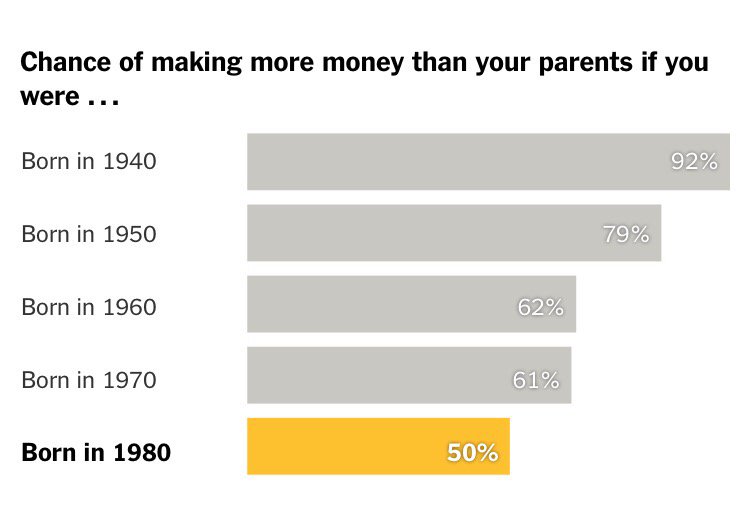
For many people, the American dream has been vanishing
About 92 percent of 1940 babies had higher pretax household earnings at age 30 than their parents had at the same age. (The results were similar at older ages and for post-tax earnings.)
…For babies born in 1980 — today’s 36-year-olds — the index of the American dream has fallen to 50 percent: Only half of them make as much money as their parents did.
That is from David Leonhardt at the NYT, channeling new research by Raj Chetty. Here is more from Jim Tankersley. Here is Brookings coverage. Here is Vincent Geloso considering various adjustments to the data.
Tuesday assorted links
1. Economist Peter Navarro endorses Trump.
2. Olivier Blanchard is worried about Japan.
3. “Dallas, with the highest concentration of [Craigslist] missed connections, has an impressive spread from Monday to Friday, with its inhabitants posting throughout the workday and late into the evening.” For the country as a whole, the most lovelorn days seem to be Mondays.
4. Is Hillary likely to be prosecuted? I’ve tried to avoid this topic, but I found this article both realistic and full of actual information.
5. Jonathan Haidt responds to critics. And one interpretation of the new Chetty results.
Place plays a part in helping the poor live longer
There is a new Raj Chetty paper out in JAMA ( with seven co-authors, including David Cutler), and it is garnering a lot of media attention. Here is to my mind the main result, although it is not being presented as such (NYT here):
The JAMA paper found that several measures of access to medical care had no clear relationship with longevity among the poor. But there were correlations with smoking, exercise and obesity.
I enjoyed the NYC angle from Margot Sanger-Katz:
New York is a city with some of the worst income inequality in the country. But when it comes to inequality of life spans, it’s one of the best.
Impoverished New Yorkers tend to live far longer than their counterparts in other American cities, according to detailed new research of Social Security and earnings records published Monday in The Journal of the American Medical Association. They still die sooner than their richer neighbors, but the city’s life-expectancy gap was smaller in 2014 than nearly everywhere else, and it has shrunk since 2001 even as gaps grew nationwide.
That trend may appear surprising. New York is one of the country’s most unequal and expensive cities, where the poor struggle to find affordable housing and the money and time to take care of themselves.
But the research found that New York was, in many ways, a model city for factors that seem to predict where poor people live longer. It is a wealthy, highly educated city with a high tax base. The local government spends a lot on social services for low-income residents. It has low rates of smoking and has many immigrants, who tend to be healthier than native-born Americans.
Here is the accompanying NYT graphic about “your county.” Here is Emily Badger and Christopher Ingraham, good graphics too:
The poor live shorter lives in Las Vegas, Louisville and industrial Midwest towns, such as Gary, Ind. Geography also matters much more for the poor than the rich. The health behaviors of the wealthy are similar wherever they live. For the poor, their likelihood of risky behaviors such as smoking depends a great deal on geography, on whether they live in a place where smoking is common or where, as in San Francisco, cigarettes have been shunted out of view.
It’s almost as if health care policy should be local in orientation. The link to the paper includes three comments, including one by Angus Deaton.
You know he’s great
Here are two sentences about Raj Chetty:
“The unintended consequence of Chetty’s work is a tremendous demoralization of teachers,” said New York University educational historian Diane Ravitch.
It’s funny how you don’t need to know more there. And this one:
He says he won’t register to vote because he thinks that could bias his “laboratory science” approach to economic research.
Both are from this WSJ Bob Davis profile of Chetty, or Google to the ungated link if you wish.
The problems of Harvard economics?
Here is an article in The Crimson, with many interesting bits, including about Raj Chetty. In turns out space is also a problem, even back in the mid-1980s I thought Littauer was not impressive. It has not improved:
Economics faculty also say that the kind laboratory work common in modern economics—and exemplified by Chetty’s work on government policy—require physical space that is lacking in Littauer and scattered around campus.
“You need infrastructure to run the types of projects he is running,” Antràs said.
Bernheim said Stanford was working “on much closer collaboration and integration” between its economics research buildings to provide adequate space because of Chetty’s arrival and other new hires. He would not comment on the specifics of Chetty’s hiring package, including any lab space he may receive.
And of course, Littauer is old. It hasn’t undergone a major renovation in decades and lacks a functioning air conditioning system.
Whether there are plans to renovate Littauer is uncertain. FAS Dean Michael D. Smith would not comment on any plans to add space to the building, though he noted that conversations about department space across FAS are ongoing.
Even more, the Fine Arts Library, which moved temporarily to Littauer in 2007 during the renovation of the Fogg Museum, compounds the problem of tight space in the building.
University professor Jerry R. Green said the move “pained” him and that now many books used by the Economics department are housed in the Harvard Depository.
Here are the current Harvard faculty, all via Matthew Kahn. And here Matt comments. And Niall Ferguson is leaving Harvard for Hoover.
Sunday assorted links
2. Polar bears against Putin?.
4. A very good new survey article on neighborhood effects, by Leventhal, Dupéré, and Shuey, academic gate for Wiley. A nice complement to the recent work by Chetty and other economists.
Sentences to ponder, The Strong Situation Hypothesis
This position can be seen as a variation on the theme of the “strong situation hypothesis” (Cooper and Withey, 2009). This hypothesis, based on the work of Mischel (1977), proposes that personality differences are especially like to be outwardly expressed in “weak” situations offering no clear situational clues and a wide range of possibilities as to how to behave. Conversely, individual differences are expected to have less room for expression in “strong” situations where the choice of behavioral outcomes is severely limited and where everyone is bound to behave in a similar way.
…Thus, individual risks could play a magnified role in highly disadvantaged neighborhood contexts.
That is from Tama Leventhal, Véronique Dupéré, and Elizabeth A. Shuey, “Children in Neighborhoods,” In Handbook of Child Psychology and Development Science, edited by Marc H. Bornstein and Tama Leventhal. New York: Wiley, 2015, p.520, academically gated link here, an excellent and consistently interesting survey piece complementing the recent economic studies by Chetty and others.
Ungated Cooper and Withey is here (pdf), also worth your time. Here is a related Wikipedia entry, perhaps not as clear as it might be.
What Is “Price Theory”? (A Guest Post by Glen Weyl)
When I was last living in Chicago, in the spring 2014, a regular visitor to the department of the University of Chicago and the editor of the Journal of Economic Literature, Steven Durlauf, asked me if I would be interested in writing something for the journal. For many years I had promised Gary Becker that I would write something to help clarify the meaning and role of price theory to my generation of economists, especially those with limited exposure to the Chicago environment, which did so much to shape my approach to economics. With Gary’s passing later that spring, I decided to use this opportunity to follow through on that promise. More than a year later I have posted on SSRN the result.
I have an unusual relationship to “price theory”. As far as I know I am the only economist under 40, with the possible exception of my students, who openly identifies myself as focusing my research on price theory. As a result I am constantly asked what the phrase means. Usually colleagues will follow up with their own proposed definitions. My wife even remembers finding me at our wedding reception in a heated debate not about the meaning of marriage, but of price theory.
The most common definition, which emphasizes the connection to Chicago and to models of price-taking in partial equilibrium, doesn’t describe the work of the many prominent economists today who are closely identified with price theory but who are not at Chicago and study a range of different models. It also falls short of describing work by those like Paul Samuelson who were thought of as working on price theory in their time even by rivals like Milton Friedman. Worst of all it consigns price theory to a particular historical period in economic thought and place, making it less relevant to the future of economics.
I therefore have spent many years searching for a definition that I believe works and in the process have drawn on many sources, especially many conversations with Gary Becker and Kevin Murphy on the topic as well as the philosophy of physics and the methodological ideas of Raj Chetty, Peter Diamond and Jim Heckman among others. This process eventually brought me to my own definition of price theory as analysis that reduces rich (e.g. high-dimensional heterogeneity, many individuals) and often incompletely specified models into ‘prices’ sufficient to characterize approximate solutions to simple (e.g. one-dimensional policy) allocative problems. This approach contrasts both with work that tries to completely solve simple models (e.g. game theory) and empirical work that takes measurement of facts as prior to theory. Unlike other definitions, I argue that mine does a good job connecting the use of price theory across a range of fields of microeconomics from international trade to market design, being consistent across history and suggesting productive directions for future research on the topic.
To illustrate my definition I highlight four distinctive characteristics of price theory that follow from this basic philosophy. First, diagrams in price theory are usually used to illustrate simple solutions to rich models, such as the supply and demand diagram, rather than primitives such as indifference curves or statistical relationships. Second, problem sets in price theory tend to ask students to address some allocative or policy question in a loosely-defined model (does the minimum wage always raise employment under monopsony?), rather than solving out completely a simple model or investigating data. Third, measurement in price theory focuses on simple statistics sufficient to answer allocative questions of interest rather than estimating a complete structural model or building inductively from data. Raj Chetty has described these metrics, often prices or elasticities of some sort, as “sufficient statistics”. Finally, price theory tends to have close connections to thermodynamics and sociology, fields that seek simple summaries of complex systems, rather than more deductive (mathematics), individual-focused (psychology) or inductive (clinical epidemiology and history) fields.
I trace the history of price theory from the early nineteenth to the late twentieth when price theory became segregated at Chicago and against the dominant currents in the rest of the profession. For a quarter century following 1980, most of the profession either focused on more complete and fully-solved models (game theory, general equilibrium theory, mechanism design, etc.) or on causal identification. Price theory therefore survived almost exclusively at Chicago, which prided itself on its distinctive approach, even as the rest of the profession migrated away from it.
This situation could not last, however, because price theory is powerfully complementary with the other traditions. One example is work on optimal redistributive taxation. During the 1980’s and 1990’s large empirical literatures developed on the efficiency losses created by income taxation (the elasticity of labor supply) and on wage inequality. At the same time a rich theory literature developed on very simple models of optimal redistributive income taxation. Yet these two literatures were largely disconnected until the work of Emmanuel Saez and other price theorists showed how measurements by empiricists were closely related to the sufficient statistics that characterize some basic properties of optimal income taxation, such as the best linear income tax or the optimal tax rate on top earners.
Yet this was not the end of the story; these price theoretic stimulated empiricists to measure quantities (such as top income inequality and the elasticity of taxable income) more closely connected to the theory and theorists to propose new mechanisms through which taxes impact efficiency which are not summarized correctly by these formulas. This has created a rich and highly productive dialog between price theoretic summaries, empirical measurement of these summaries and more simplistic models that suggest new mechanisms left out of these summaries.
A similar process has occurred in many other fields of microeconomics in the last decade, through the work of, among others, five of the last seven winners of the John Bates Clark medal. Liran Einav and Amy Finkelstein have led this process for the economics of asymmetric information and insurance markets; Raj Chetty for behavioral economics and optimal social insurance; Matt Gentzkow for strategic communication; Costas Arkolakis, Arnaud Costinot and Andrés Rodriguez-Clare in international trade; and Jeremy Bulow and Jon Levin for auction and market design. This important work has shown what a central and complementary tool price theory is in tying together work throughout microeconomics.
Yet the formal tools underlying these price theoretic approximations and summaries have been much less fully developed than have been analytic tools in other areas of economics. When does adding up “consumer surplus” across individuals lead to accurate measurements of social welfare? How much error is created by assumptions of price-taking in the new contexts, like college admissions or voting, to which they are being applied? I highlight some exciting areas for further development of such approximation tools complementary to the burgeoning price theory literature.
Given the broad sweep of this piece, it will likely touch on the interests of many readers of this blog, especially those with a Chicago connection. Your comments are therefore very welcome. If you have any, please email me at [email protected].
The rise of Stanford economics
From the report of the President of the university, Raj Chetty and Matt Gentzkow will be starting at the school this fall.
And John Cochrane is moving to Hoover full-time.
In the late 1970s and 80s, MIT was undoubtedly number one as a place to study economics, even if Chicago ideas were more important and more fundamental (Becker, Fama, Posner, etc.). Harvard passed MIT a bit later for a good twenty year run at the top.
Stanford is next.
Wednesday assorted links
1. Why are flamingos the most likely to escape a zoo successfully? (questions that are rarely asked)
3. Cheaper than dogs, department of why not? But will it increase the number of ZMP canines?
4. Yes, aquifers are subject to the tragedy of the commons and yes it does matter.
Monday assorted links
1. Master branding has limits.
3. Brad DeLong defends Obamacare.
4. Ice cream truck plays Arnold Schoenberg.
5. What questions did people have in 1690?
7. Justin Wolfers on the new Chetty and Hendren study, which as far as I can tell sides with Steve Sailer on what is the biggest problem with poverty, namely that you usually end up living near other poor people.