Results for “law literature” 175 found
The Fiscal Impact of Low-Skill Immigration
Low-skill immigrants have low wages and thus don’t pay much in taxes but they do use some government services, especially education for their children. What’s the net fiscal impact? The National Academy of Sciences did a detailed scenario analysis looking at the impact over 75 years, thus including second and third generations. Overall the NAS concluded that the net fiscal impact of the average immigrant was positive. The impact was negative, however, for immigrants with just a high school education and even more so for immigrants with less than a high-school education.
Two recent papers qualify this conclusion. The NAS study estimated the direct fiscal effects of an immigrant–what do they pay in taxes and what do they take out in services? Immigration, however, has indirect effects on the native born population. In the The Case for Getting Rid of Borders I wrote:
The immigrant who mows the lawn of the nuclear physicist indirectly helps to unlock the secrets of the universe.
More prosaically, low-skill immigrants can complement higher-skilled native labor, increasing native productivity. Go to any fine restaurant in DC, for example, and you will typically see a native-born front of the house and a Mexican born back-of-the house. As Tyler quipped at lunch recently, all restaurants in the United States are Mexican restaurants only the type of food they are cooking changes. The opportunity to hire Mexican cooks increases the number of restaurants and the opportunities and wages of the native-born front of the house. Higher native wages mean higher taxes so there is a beneficial indirect fiscal effect of low-skill immigration.
A recent paper by Colas and Sachs, The Indirect Benefits of Low-Skilled Immigration finds that under plausible assumptions the indirect effects are large enough to make the net effects of immigration positive for almost all US immigrants.
My excellent colleague Michael Clemens makes another similar point about capital. When a profit-maximizing firm hires more labor it also hires more capital. Capital pays taxes. Thus, immigration raises the taxes paid by capital and when you add that indirect effect to the calculation it also shows that the net fiscal impacts of low-skilled immigration are plausibly positive.
The fiscal benefits of low-skilled immigration aren’t a big reason to support low-skill immigration but the new literature on the indirect effects should take one worry off the table.
As a takeaway, it’s important to recognize that the fiscal benefits arise because low-skilled immigrants are gainfully employed. The U.S. excels at integrating people into the workforce. We need to keep this in mind when thinking about labor policy including minimum wages, occupational licensing, E-Verify, access to banking, education, and driver’s licenses and so forth. We could easily turn fiscal benefits into fiscal costs by making it more difficult to employ immigrants (and workers more generally). Employing immigrants benefits both them and native citizens. America’s open markets play a pivotal role in this success. Let’s keep it going.
Immigration Backlash
In a new paper Ernesto Tiburcio (on the job market) and Kara Ross Camarena study the effect of illegal immigration from Mexico on economic, political and cultural change in the United States. Studying illegal immigration can be difficult because the US doesn’t have great ways of tracking illegal immigrants. Tiburcio and Camerena, however, make excellent use of a high-quality dataset of “consular IDs” from the Mexican government. Consular IDs are identification cards issued by the Mexican government to its citizens living in the United States, regardless of US immigration status. Consular IDs are used especially, however, by illegal immigrants because they can’t easily get US IDs whereas legal migrants have passports, visas, work authorizations and so forth. Tiburcio and Camarena are able to track nearly 8 million migrants over more than a decade.
Our main results point to a conservative response in voting and policy. Recent inflows of unauthorized migrants increase the vote share for the Republican Party in federal elections, reduce local public spending, and shift it away from education towards law-and-order. A mean inflow of migrants (0.4 percent of the county population) boosts the Republican party vote share in midterm House elections by 3.9 percentage points. Our results are larger but qualitatively similar to other scholars’ findings of political reactions to migration inflows in other settings (Dinas et al., 2019; Dustmann et al., 2019; Harmon, 2018; Mayda et al., 2022a). The impacts on public spending are consistent with the Republican agenda. A smaller government and a focus on law-and-order are two of the key tenets of conservatism in the US. A mean inflow of migrants reduces total direct spending (per capita) by 2% and education spending (per child), the largest budget item at the local level, by 3%. The same flow increases relative spending on police and on the administration of justice by 0.23 and 0.15 percentage points, respectively. These impacts on relative spending suggest that the decrease in total expenditure does not simply reflect a reduction in tax revenues but also a conservative change in spending priorities.
The main reason for this, however, appears not to be economic losses such as job losses or wages declines–these are mostly zero or small with some exceptions for highly specific industries such as construction. Rather it’s more about the salience of in and out groups:
We study individuals’ universalist values to capture preferences for redistribution and openness to the out-group. Universalist values imply that one is concerned equally with the welfare of all individuals, whether they are known or not. By contrast, people with more communal values assign a greater weight to the welfare of ingroup members relative to out-group members. We find that counties become less universalist in response to the arrival of new unauthorized migrants. A mean flow of unauthorized migrants shifts counties 0.06 standardized units toward less universalist, i.e., more communal (Panel B, Column 5, std coeff: -0.16). This result is the most direct indication that some of the shift to the political right occurs because migrants trigger anti-out-group bias and preferences for less redistribution. Although this evidence is based on a smaller subset of counties, the impact is large. The change toward more communal values is consistent with theories that hinge on out-group bias. Ethnic heterogeneity breaks down trust, makes coordination more difficult, and reduces people’s interest in universal redistribution (Alesina et al., 1999).
These results are consistent with the larger literature that finds “Across the developed world today, support for welfare, redistribution, and government provision of public goods is inversely correlated with the share of the population that is foreign-born and diverse.” (Nowrasteh and Forreseter 2020). Similarly, one explanation for the smaller US welfare state is that white-black salience reduces people’s interest in universal redistribution.
Contra Milton Friedman, it is possible to have open borders and a significant welfare state but it may be true that the demand for a welfare state declines with immigration, especially when the immigrants are saliently different.
What do we know about non-profit boards?
In fact, however, a reasonable consensus of experts on NPOs [non-profit organizations] agrees that their governance is generally abysmal, worse than that of for-profit corporations. NPO directors are mostly ill-informed, quarrelsome, clueless about their proper role, and dominated by the CEO — as proponents of shareholder primacy would predict.
Here is the full paper by George W. Dent, Jr. Here is the more general literature.
Corporate taxes matter, incentives matter, but does economics matter?
This paper combines administrative tax data and a model of global investment behavior to evaluate the investment and firm valuation effects of the Tax Cuts and Jobs Act (TCJA) of 2017, the largest corporate tax reduction in the history of the United States. We extend the canonical model of Hall and Jorgenson (1967) to a multinational setting in which a firm produces in domestic and international locations. We use the model to characterize and measure four determinants of domestic investment: domestic and foreign marginal tax rates and cost-of-capital subsidies. We estimate elasticities of domestic investment with respect to each and use them to identify the structural parameters of our model, to quantify which parts of the reform mattered most to investment, and to conduct policy counterfactuals. We have five main findings. First, the TCJA caused domestic investment of firms with the mean tax change to increase by roughly 20% relative to firms experiencing no tax change. Second, the TCJA created large incentives for some U.S. multinationals to increase foreign capital, which rose substantially following the law change. Third, domestic investment also increases in response to foreign incentives, indicating complementarity between domestic and foreign capital in production. Fourth, the general equilibrium long-run effects of the TCJA on the domestic and total capital of U.S. firms are around 6% and 9%, respectively. Finally, in our model, the dynamic labor and corporate tax revenue feedback in the first 10 years is less than 2% of baseline corporate revenue, as investment growth causes both higher labor tax revenues from wage growth and offsetting corporate revenue declines from more depreciation deductions. Consequently, the fall in total corporate tax revenue from the tax cut is close to the static effect.
That is from a new NBER paper by Gabriel Chodorow-Reich, Matthew Smith, Owen Zidar, and Eric Zwick. How many times has the NYT told you otherwise? As I’ve noted in blog posts over the last six years or so, the standard literature already was indicating that such tax cuts are relatively effective (though no panaceas). I hope this settles the matter, though I fear it will not…
Via Jason Furman, who also reproduces some nice pictures from the piece.
Disputes over China and structural imbalances
There has been some pushback on my recent China consumption post, so let me review my initial points:
There exists a view, found most commonly in Michael Pettit (and also Matthew Klein), that suggests economies can have structural shortfalls of consumption in the long run and outside of liquidity traps.
My argument was that this view makes no sense, it is some mix of wrong and “not even wrong,” and it is not supported by a coherent model. If need be, relative prices will adjust to restore an equilibrium. If relative prices are prevented from adjusting, the actual problem is not best understood as a shortfall of consumption, and will not be fixed by a mere expansion of consumption.
Note that people who promote this view love the word “absorb,” and generally they are reluctant to talk much about relative price adjustments, or even why those price adjustments might not take place.
You will note Pettis claims Germany suffers from a similar problem, America too though of course the inverse version of it. So whatever observations you might make about China, the question remains whether this model makes sense more generally. (And Australia, which ran durable trade deficits from the 1970s to 2017, while putting in a strong performance, is a less popular topic.)
Pettis even has claimed that “US business investment is constrained by weak demand rather than costly capital”, and that is from April 4, 2023 (!).
It would take me a different blog post to explain how someone might arrive at such a point, with historic stops at Hobson, Foster, and Catchings along the way, but for now just realize we’re dealing with a very weird (and incorrect) theory here. I will note in passing that the afore-cited Pettis thread has other major problems, not to mention a vagueness about monetary policy responses, and that rather simply the main argument for current industrial policy is straightforward externalities, not convoluted claims about how foreign and domestic investment interact.
Pettis also implicates labor exploitation as a (the?) major factor behind trade surpluses, and furthermore he considers this to be a form of “protectionism.” Now you can play around with scholar.google.com, or ChatGPT, all you want, and you just won’t find this to be the dominant theory of trade surpluses or even close to that. As a claim, it is far stronger than what a complex literature will support, noting there is a general agreement that lower real wages (ceteris paribus) are one factor — among many — that can help exports. This point isn’t wrong as a matter of theory, it is simply a considerable overreach on empirical grounds. Of course, if Pettis has a piece showing statistically that a) there is a meaningful definition of labor exploitation here, and b) it is a much larger determinant of trade surpluses than the rest of the profession seems to think…I would gladly read and review it. Be very suspicious if you do not see such a link appear!
Another claim from Pettis that would not generate widespread agreement is: “…in an efficient, well-managed, and open trading system, large, persistent trade imbalances are rare and occur in only a very limited number of circumstances.” (see the above link) That is harder to test because arguably the initial conditions never are satisfied, but it does not represent the general point of view, which among other things, considers persistent differences in time preferences and productivities across nations.
Now, it does not save all of this mess to make a series of good, commonsense observations about China, as Patrick Chovanec has done (Say’s Law does hold in the medium-term, however). And as Brad Setser has done.
In fact, those threads (and their citation) make me all the more worried. There is not a general realization that the underlying theory does not make sense, and that the main claim about the determinants of trade surpluses is wrong, and that it requires a funny and under-argued tracing of virtually all trade imbalances to pathology. And to be clear, this is a theory that only a small minority of economists is putting forward. I am not the dissident here, rather I am the one delivering the bad news.
So the theory is wrong, and don’t let commonsense, correct observations about China throw you off the scent here.
The Birth-Weight Pollution Paradox
Maxim Massenkoff asks a very good question. If pollution reduces birth weight as much as the micro studies on pollution suggest, why aren’t birth weights very low in very polluted cities and countries? Figure 1, for example, shows birth weights in a variety of highly polluted world cities. The yellow dashed and blue lines show “predicted” birth weights extrapolated from the well-known Alexander and Schwandt “Volkswagen study” which looked at the effects of increased pollution in the United States. Despite the fact that every one of the highly-polluted cities is much more polluted than the most polluted US city, birth weight is not tremendously lower in these cities. Indeed, there is no obvious correlation between birth weight and pollution at all.
 Similarly, US cities were more polluted in the past but were birth weights lower in the past? Figure 2 shows a number of US cities which were two to three times more polluted in 1972 (right side of diagram) than 2002 (left side of diagram). Yet, birth weights do not appear lower in the more polluted past and certainly do not follow the extrapolated birth weight-pollution predictions from the micro literature.

Massenkoff looks at a variety of possible explanations. One possibility, for example, is culling. Perhaps in highly polluted areas there are more miscarriages, still births or difficulty conceiving with the result that the observed sample of births is highly selected. There is some evidence that pollution increases miscarriages and stillbirths but these tend to be correlated with lower birth weight–a scarring effect rather than a culling effect. In addition, the effect of pollution on miscarriages and stillbirths also appears to be bigger on a micro level than on a macro level. That is, these rates aren’t massively higher in high pollution countries.
Another possibility is that pollution isn’t that bad and, in particular, not as bad as I have suggested. As a good Bayesian, I update, but for reasons I have given here, it’s not justifiable to update very much.
I assume, as I always do, that there are some overestimates in the micro literature for the usual reasons. But, more fundamentally, my best guess for the birth-weight pollution paradox is that weight is one of the easiest margins on which the body can adapt and compensate. Even in poor countries there are plenty of calories to go around and so it’s relatively easy for the body to adjust to higher pollution, on this margin. Indeed, weight is known as a variable that creates paradoxes!
Micro studies on weight and exercise, for example, show that exercise reduces weight. But looking across countries, societies, and time we don’t see big effects–indeed, calorie expenditure doesn’t vary much with exercise! Importantly, notice that the micro-estimates are correct. If you increase physical activity for the next 3 months, holding all else equal (which is possible for 3 months), you will lose weight. However, the micro estimates are difficult to extrapolate to permanent, long-run changes because there are complex, adaptive mechanisms governing weight, calorie consumption and energy expenditure.
The exercise paradox doesn’t mean that exercise isn’t good for you–the evidence on the benefits of exercise is extensive and credible. In the same way the birth-weight pollution paradox doesn’t mean that pollution isn’t harmful–the evidence on the costs of pollution is extensive and credible. In particular, it’s going to be much harder to adapt to pollution for heart disease, cancer, life expectancy and IQ than for weight.
I am always impressed with papers that present big, obviously-true facts that most people have simply missed. Massenkoff is becoming a leader in this field.
*Regime Change*
That is the new Patrick J. Deneen book, with the subtitle Toward a Postliberal Future. I would say that reading and trying to review this book most of all raises the question of what a review is for. As you might expect from Deneen, the book is well-written and comes across as highly intelligent. The question is what one should make of the actual claims and content.
The opening chapter tells us what a failure America is, but not much in the way of concrete evidence is cited (what again would an American passport auction for?). Deneen writes “A growing chorus of voices reflects on the likelihood and even desirability of civil war…”, but that I think means he simply faced some publication lags with the book. America still seems to be gaining on most of the world.
By the end of the next chapter, we are told “Unfortunately, the current ruling class is uniquely ill equipped for reform, having become one of the worst of its kind produced in history…”
C’mon, people…C’mon, Patrick! I don’t even have to invoke Godwin’s Law to refute that one. I can think of a few historical elites who were slightly worse than those who go to Harvard and Yale.
The quick segment on Mill on slavery (p.82) is both wrong and deeply unfair.
Burke is closer to Mill than Deneen might wish to think, especially if one studies Burke on Ireland.
The chapter “The Wisdom of the People” is rather under-argued in a post-Bryan Caplan, post-Garett Jones intellectual era. You don’t have to agree with Caplan or Jones to recognize they offer orders of magnitude more evidence than Deneen does. One of the bigger lessons here is that you can no longer write such a book without seriously engaging with social science.
All this talk about creating a “mixed constitution,” but what exactly does he want to see happen? Is “Machiavellian means to achieve Aristotelian ends” really what we need? (Might some rather mundane changes in policy get us further?) What exactly are we supposed to do to increase the status, influence, and reputation of the populace, as Deneen repeatedly suggests? Where is the evidence any of that is going to work, whatever “work” might mean in this context? This book will not tell you.
National service, tariffs, and immigration restrictions are all endorsed, but with no consideration of the rather extensive empirical literatures on these topics, mostly not supporting Deneen’s hastily presented conclusions.
Is liberalism really (p.229) “premised on the complete liberation of the individual from any limiting claims of an objective good…”? Mill certainly didn’t think so, nor did most other classical liberals.
I would start by distinguishing the social consequences of birth control — which isn’t going to be reversed and shouldn’t be — with the social consequences of classical liberal ideas. Is Deneen in fact willing to endorse birth control? Inquiring minds wish to know.
If Western liberalism is “exhausted,” is he short the market?
Overall, I leave this book with the impression that it is no accident classical liberal ideals have endured as much as they have.
Is American Culture Becoming More Pro-Business?
In Capitalism: Hollywood’s Miscast Villain, a piece I wrote in 2010 for the Wall Street Journal, I described the slew of movies and television shows featuring mass-murdering corporate villains including “The Fugitive,” “Syriana,” “Mission Impossible II,” “Erin Brockovich,” “The China Syndrome” and “Avatar,” and Hollywood’s not so subtle attacks on capitalism with characters like Jabba the Hut in the Star Wars universe and the Ferengi in Star Trek. I explained some reasons for Hollywood’s antipathy to capitalism:
Directors and screenwriters see the capitalist as a constraint, a force that prevents them from fulfilling their vision. In turn, the capitalist sees the artist as self-indulgent. Capitalists work hard to produce what consumers want. Artists who work too hard to produce what consumers want are often accused of selling out. Thus even the languages of capitalism and art conflict: a firm that has “sold out” has succeeded, but an artist that has “sold out” has failed.
…Hollywood share[s] Marx’s concept of alienation, the idea that under capitalism workers are separated from the product of their work and made to feel like cogs in a machine rather than independent creators. The lowly screenwriter is a perfect illustration of what Marx had in mind—a screenwriter can pour heart and soul into a screenplay only to see it rewritten, optioned, revised, reworked, rewritten again and hacked, hacked and hacked by a succession of directors, producers and worst of all studio executives. A screenwriter can have a nominally successful career in Hollywood without ever seeing one of his works brought to the screen. Thus, the antipathy of filmmakers to capitalism is less ideological than it is experiential. Screenwriters and directors find themselves in a daily battle between art and commerce, and they come to see their battle against “the suits” as emblematic of a larger war between creative labor and capital.
However, I also noted that some good stories could be told if Hollywood would only put aside their biases and open their eyes to the world:
…how many [movies] feature people who find their true selves in productive work? Not many, which is a shame, since the business world is where most of us live our lives. Like many works of literature, Hollywood chooses for its villains people who strive for social dominance through the pursuit of wealth, prestige, and power. But the ordinary business of capitalism is much more egalitarian: It’s about finding meaning and enjoyment in work and production.
 Well, perhaps things are changing. Three recent movies do a good job highlighting a different perspective on capitalism: Flaming Hot, Air and Tetris.
Flaming Hot (Disney) tells the story of a janitor and his improbable rise to the top of the corporate world via leveraging his insights into his Mexican-American heritage and culture. The details of the story are probably false but no one ever said a good story had to be true. A standout aspect of the film is Richard Montanez’s palpable excitement witnessing the Frito Lay factory’s operations — his awe of the technology, the massive machines churning out potato chips, and his joy at being part of a vibrant, productive enterprise, quirks and all. Montanez does find meaning and enjoyment in work and production. Flaming Hot also skillfully emphasizes the often-underestimated significance of marketing, which is frequently brushed off as superfluous or even evil. Incidentally, does “Flaming Hot” contain a subtle nod to the great Walter “E.” Williams?
 Air (Amazon Prime) is about a shoe contract. Boring? Not at all. The shoe was the Air Jordan and Air is about Nike’s efforts to court Jordan and his family with a record-breaking and precedent shattering revenue percentage deal. Nike was not united on going all in on Jordan and at the time it was a much smaller firm than it is today so a lot was at stake. Jordan wanted to go with Adidas. His mother convinced him to hear Nike out. Jordan’s mother comes across as very astute, as she almost certainly was, although it seems more probable that it was Jordan’s agent, David Falk who engineered the percentage contract. Regardless, this is a good movie about entrepreneurship. Directed by Ben Affleck, who also portrays Phil Knight, “Air” showcases Affleck’s directorial prowess, previously demonstrated in “Argo,” a personal favorite for personal reasons.
 Tetris (Apple) is also a story about legal contracts. In the dying days of the Soviet Union, multiple teams race to license the Tetris video game from Elektronorgtechnica the Soviet state owned enterprise that presumptively held the rights as the employer of the inventor, Alexey Pajitnov. Gorbachev and Robert Maxwell both make unlikely appearances in this remarkable story. One aspect which was surprising even to me, all the players take the rule of law very seriously. A useful reminder of the importance of property rights and a sound judiciary to the capitalist process.
While these films may not secure a spot among cinema’s timeless classics, each is engaging, skillfully made, and entertaining. Moreover, each movie offer insightful commentary on different facets of the capitalist system. Bravo to Hollywood!
Addendum: See also my review of Guru one of the most important free market movies ever made.
Inflation is slightly underrated
Still bad, yes, but it has a few upsides, here is one part from my Bloomberg column:
It’s also worth asking which groups are most hurt by inflation, and which least. On the one hand, inflation helps debtors, and the debtor class is often relatively poor. Yet there is also a large set of distributional effects through wages, and those effects might prove more congenial to conservative values.
One obvious loser from higher inflation is someone with a tenured job, either de facto or de jure. To use an example close to home: Many professors cannot easily switch jobs and duplicate their current working conditions, nor can they easily demand and receive offsetting raises. A lot of them are locked into their current posts — which is hardly surprising, since the nature and incentives of tenure do not require those who have it to stay at the top of their game to keep their job.
Many conservatives wish to abolish academic tenure altogether. That’s unlikely to happen (though Florida is making moves in that direction), but a dose of inflation might make tenure less appealing.
Many government bureaucrats also often have de facto tenure, and many of them are not so marketable to the private sector. For them, higher inflation is a pay cut. Again, just as inflation will not abolish tenure, so it will not eliminate bureaucracy. But it may make the less dynamic parts of the public sector less attractive, helping to slow the growing bureaucratization of society.
In contrast, consider a private entrepreneur who will attempt seven start-ups over the next 20 years, with some succeeding and others failing. That person probably will not suffer much from inflation, as he is starting from scratch with new nominal values on a fairly frequent basis. More generally, productive people who have flexibility and the ability to adjust to circumstances will emerge relatively unscathed as well.
Here is some commentary from Scott Sumner, though I think Scott is not taking me literally enough. Inflation really is bad (“never reason from an inflation change!”…nonetheless), it is simply elsewhere that I explain my views on that. And do note an extensive literature shows that the Fisher effect does not hold 1-to-1, and thus inflation at modest levels does lower real borrowing rates. It is also funny for Scott (“Money Illusion”) to say that short-run non-neutralities do not matter.
Public policies as instruction
That is the topic of my latest Bloomberg column, here is one excerpt:
Minimum-wage hikes also send the wrong message to voters. Yes, there is literature suggesting that such increases destroy far fewer jobs than previously thought, and may have considerable ancillary benefits, such as preventing suicides. Still, a minimum wage is a kind of price control, and most price controls are bad. Voters may not realize the subtle ways in which minimum-wage hikes are different (and better) from most price controls. Instead, they get the message that the path to higher living standards is through government fiat, rather than better productivity.
If you think that far-fetched, consider the initiative passed by the California Senate this week. The bill would create a government panel to set wages and workplace standards for all fast-food workers in the state, and labor-union backers hope the plan will spread nationally. That may or may not happen, but those are precisely the paths that are opened up by minimum-wage advocacy. Many people hear a bigger and more ambitious message than the one the speaker wishes to send.
So what messages, in the broadest terms, should policies convey? I would like to see increased respect for cosmopolitanism, tolerance, science, just laws, dynamic markets, free speech and the importance of ongoing productivity gains. Obviously any person’s list will depend on his or her values, but for me the educational purposes are more than just a secondary factor. When it comes to prioritizing reforms, the focus should be on those that will “give people the right idea,” so to speak.
The mere fact that you are uncertain about such effects does not mean you can or should ignore them. They are there, whether you like it or not.
The Parent Trap–Review of Hilger
 Nate Hilger has written a brave book. Almost everyone will find something to hate about The Parent Trap. Indeed, I hated parts of it. Yet Hilger is willing to say truths that are often not said and for that I would rather applaud than cancel.
Hilger argues that the problems of poverty, pathology and inequality that bedevil the United States are not primarily due to poor schools, discrimination, or low incomes per se. The primary cause is parents: parents who are unable to teach their children the skills that are necessary to succeed in the modern world. Since parents can’t teach the necessary skills, Hilger calls for the state to take their place with a dramatic expansion of not just child care but collective parenting.
Let’s unpack some details. Begin with schooling. It’s very common to bemoan the state of schools in the “inner city” or to complain about “local financing” which supposedly guarantees that poor counties will have underfunded schools. All of this, however, is decades out-of-date.
A hundred years ago there really were massive public-school resource gaps by class and race. These days, however, state and federal spending play a larger role than local property tax revenue and distribute educational resources more progressively….In fact, when we include federal aid, 42 states spent more on poor school districts than on rich school districts in 2012. The same pattern holds between schools within districts
….The highest spending districts are large urban centers such as New York City, Boston and Baltimore. These cities spend large sums to educate rich and poor children alike. p. 10-11
Hilger is correct. No matter what you saw on The Wire, Baltimore spends more than sixteen thousand dollars per student, among the highest in the nation in large school districts and above average for the nation as a whole. Public schools are quite egalitarian in funding with any bias running towards more funding for poorer districts.
Schools, Hilger writes are “actually the smallest and most equalizing part of a much larger skill-building system.” The real problem, says Hilger, are parents.
But what about discrimination? When it comes to wage discrimination, Hilger is brutally honest:
If we compare individuals with similar cognitive test scores, Black college graduates earn higher wages than white college graduates. Studies that don’t control for test score differences but examine earnings gaps within specific professions—lawyers, physicians, nurses, engineers, scientists—tend to find Black workers earn zero to 10 percent less than white workers. These gaps could reflect discrimination, unmeasured skill differences, or other factors such as geography. In any case, such gaps are small compared to the 50 percent overall Black-white earnings gap and reinforce the idea that closing skills gaps would go a long way toward closing income gaps.
Hilger argues that racism does play an important role in explaining Black-white wage differentials but it’s the historical racism that made black parents less skilled and less able to pass on skills to their children. In the twentieth century, Asians, Hilger argues, were discriminated against in the United States at least much as Black Americans. But the Asians that came to the United States had high skills while the legacy of slavery meant that Black Americans began with low skills. Asians, therefore, were better able to overcome discrimination. The success of Nigerians and Jamaican immigrants in the United States also speaks to this point. (Long time readers may recall that in 2016 I dubbed Hilger’s paper on Asian Americans and Black Americans the Politically Incorrect Paper of the Year .)
Parental investment is surely important but Hilger overstates his case. He writes as if poorer parents have neither the abilities nor the time to teach their children while richer, better educated parents simply invest lots of hours and money imbuing their children with skills:
…the enormous variation in parents’ own academic skills has big implications for kids because we also demand that parents try to be tutors. During normal times, parents in America spend an average of six hours per week helping—or trying to help—their kids with school work. Six hours per week is more than K12 math and English teachers get with children…good tutoring by parents for six hours a week, every week, year after year of childhood could raise children’s future earnings by as much as $300,000.
The data on the effectiveness of SAT test-prep suggests that these efforts are not nearly so effective as Hilger argues. The parental investment story also doesn’t fit my experience. I didn’t spend six hours a week helping my kids with their homework. I doubt most parents do. I simply assumed my kids would do their work. I do recall that we signed my kids up for tutoring at Kumon, the Japanese math education center. My kids would complain bitterly when we took them for drill on the weekend. It was mostly filling out rote forms and my kids would hide or bury their drill sheets so we were always behind. Driving my kids to the Kumon center, monitoring them. and forcing them to do the work when they rebelled like longshoreman on work-to-rule was time consuming and it was ruining our weekends. I felt guilty, but after a while, my wife and I gave up. Today one of my sons is a civil engineer and the other is a math and economics major at UVA.
Hilger has an answer to this line of objection, or at least he says he does, but to my mind it’s a very odd answer. He argues, relying heavily on Sacerdote, that adoption studies show that more skilled parents result in more skilled kids. I find that answer odd because my reading of Sacerdote is that the effect of parents are small after you control for genetics—this is, as Hilger acknowledges, the conventional wisdom among psychologists. (See Caplan for an excellent review of the literature). It is true that Sacerdote plays up the effect of parents, but it looks small to me. Here is the effect of the adopted mother’s maternal education on the child’s education.

As you can see there is an effect but it is almost all from the mother going from having less than a high school education to graduating high school (11 to 12 years). In contrast, the mother can move from graduating high school to having a PhD and there is very little change in the education level of an adoptee. Note, however, that the effect on non-adoptees, i.e. biological children, is much larger throughout the entire range which suggests the influence of nature not nurture.
I am not surprised that there is some effect of parental education on child’s education because going to college is in part a cultural issue. Parents can influence cultural aspects of their children’s identity such as whether a child grows up up nominally Catholic, Mormon, or Hindu but they have relatively little effect on child religiosity, let alone personality or IQ. I think that a large fraction of the college wage premium is signaling (50% is a moderate estimate, Caplan thinks 90% is closer to the truth), so I am also not overly excited about college attendance as a marker of success.
The effect of parental income on the income of child adoptees is even more dramatic than on education—which is to say negligible. The income of the adopted parents has zero effect (!) on child’s income even as parent’s income varies by a factor of 20! The only correlation is with non-adoptee income—which again suggests the influence of nature not nurture.
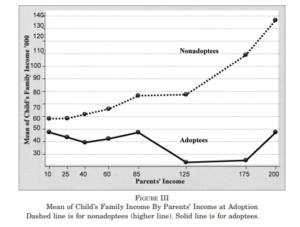
At this point in the book, it was almost inevitable that we were going to get yet another paean to the Perry Preschool Project and indeed Hilger waxes enthusiastically about Perry. Seriously? The Perry Preschool project started in the 1960s and had just 123 participants (58 in treatment and 65 in control!). There are more papers about the Perry Preschool project than there were participants. I am jaded.
Aside from the small sample size, the project had imperfect randomization and missing data and most importantly limited external validity. The Perry Preschool project treated a small group of disadvantaged African American children with low-IQs (IQs of 70-85 were part of the selection criteria). The treatment is usually described as “active learning pre-school” but it was more intrusive than that. Every week counselors would go to the homes of the kids to teach the parents (mostly mothers) how to raise their children. The training was important to the program. Indeed, Hilger notes, without sense of irony, that “facilitating greater skill growth in low-income children was so complicated that it required home visitors with advanced postsecondary degrees.” (p. 89). And what were the results?
The results were good! (Heckman et al. 2010, Belfield et al. 2006). But in the popular literature the impression one gets is that the program took a bunch of disadvantaged kids and helped them read and write, making them more middle-class and successful. Some of that happened but the big gains actually happened because the participants, especially the boys, were so socially dangerous and destructive that even a bit of normalization made life substantially better for everyone else. In particular 82% of the treated group of 33 males had been arrested by age 40, including for one murder, 4 rapes, 8 robberies, 11 assaults and 14 burglaries. The control group were worse. In the control group of 39 males there were 2 murders. Indeed the reduction of one murder in the treatment group accounts for a significant benefit of the entire Perry PreSchool project.
Hilger, to his credit, is reasonably clear that what is really needed is an intensive program for disadvantaged African Americans, especially males. In a stunning sentence he writes:
The more we rely on families rather than professionals to build skills in children, the tighter we link people’s current prospects to the prospects of their ancestors. p. 134
But he soon forgets or papers over the context of the Perry Preschool project and like everyone else in the literature uses this to support a national program for which there is no external validity. It’s hard to believe, given the lack of external validity, but Heckman et al. (2010) only exagerate mildly when they write:
The economic case for expanding preschool education for disadvantaged children is largely based on evidence from the HighScope Perry Preschool Program…
Hilger’s case for the difficulty of parenting is well taken—the FAFSA was a nightmare that taxed two PhDs in my family. But the bottom line is that most parents do just fine. Moreover, it’s shocking that in recounting the difficulties of parenting Hilger says hardly one word about an obvious factor which makes parenting more than twice as hard. Namely, single parenting. I was a single parent. Once for a whole week. Don’t do it. Get married, stay married. Perhaps Hilger didn’t want to appear to be too conservative.
Instead of recommending marriage and small targeted programs and more experiments, Hilger goes full Plato.
What would it look like if we [asked]…less not more of parents? It would look like professional experts managing more than the meagre 10 percent of children’s time currently managed by our public K12 system—much more. p. 184
And why should we do this? Because we are all part slaves and part slave-owners on a giant collective farm:
As fellow citizens who benefit from tax revenue, we all—even those of us without children—collectively own about 30 percent of any additional income other people’s children wind up earning. p. 197
Ugh. We own ourselves, not one another. Society isn’t about maximizing the collective it’s about free individuals coming together to produce rules so that we can enjoy the benefits of collective action while still living in a diverse society that respects individual rights, beliefs, and ways of living.
I told you I hated parts of The Parent Trap but Hilger has written an interesting and challenging book and he is mostly right that neither schooling nor labor market discrimination play a major role in the black-white wage gap. Hilger is probably also right that we spend too much on the elderly relative to the young. The idea of greater state involvement in the raising of children is on the table today in a way it hasn’t been for some time. See also Dana Susskind’s recent book Parent Nation. Changes on the margin may be warranted. Nevertheless, I stand with Aristotle and not Plato in thinking that raising children is better done by parents than by the state.
An index for state capacity
This paper contributes to the literature on state capacity by developing a method that yields an index of state capacity with far more comprehensive data coverage across time and countries than has been possible previously. Unlike narrower measures of fiscal capacity or legal capacity, the index is more comprehensive, using data from the Varieties of Democracy dataset on fiscal capacity, a state’s control over its territory, the rule of law, and the provision of public goods used to support markets. Like the previous literature, it demonstrates that the historical prevalence of warfare predicts state capacity. Several exercises are performed to demonstrate the validity of the index in measuring state capacity.
That is from a newly published paper by Colin O’Reilly and Ryan H. Murphy, via the excellent Kevin Lewis.
What I’ve been reading
1. Stephen Crane, The Red Badge of Courage. I read this as a kid, and was surprised how well my reread held up. To the point, subtle, and with an economy of means. I hope the new Paul Auster biography of Crane (which I will read soon) will revive interest in this classic.
2. Frank Herbert, Dune Messiah. #2 in the Dune series, I disliked this one as a tot, but currently am marveling at its political sophistication. Somewhat uneven, but better than its reputation. The Wikipedia page for the book also indicates that Villeneuve is likely to do a Dune 3 based on this story.
3. Elisabeth Anderson (not the philosopher), Agents of Reform: Child Labor and the Origins of the Welfare State. Considers the political economy of child labor reform Germany, France, the United States, and the failed case of Belgium. Pathbreaking, a major advance on the extant literature. The explanations are messy rather than monocausal, but often focus on the success or failure of individual policy entrepreneurs.
4. Gordon Teskey, Spenserian Moments. No one seems to care about poor old Edmund Spenser, yet there seem to be quite a few good books about him.
5. Patrick McGilligan, Alfred Hitchcock: A Life in Darkness and Light. The best book on Hitchcock, John Nye recommended it to me eight years ago.
There is Howard Husock, The Poor Side of Town, And Why We Need It.
And Mary Roach, Fuzz: When Nature Breaks the Law.
Richard A. Williams, Fixing Food: An FDA Insider Unravels the Myths and Their Solutions, covers the food regulatory side of the FDA, and:
Markus K. Brunnermeier, The Resilient Society.
From the comments, on FDA credibility
From the Comments, On FDF
Sure and Tom Meadowcroft have been hitting it out of the ballpark in the comments sections. Two examples.
Sure:
Protocol was made to serve man, not man to serve the protocol.
The reason we have protocols is because we need to weight the harms of waiting without a treatment against the harms that happen if the treatment is counterproductive in some unforeseen manner.
We can, normally, pretty easily measure the benefit side: count up the mortality and morbidity for the illness in question. The risk side is harder so we developed tests and processes to elucidate those: RCTs, literature reviews, regulatory oversight, mandatory waiting periods. At the end of the day though, the whole process is just one giant test to measure the likely harm of a new entity.
So when is a test worth doing? After all I do not order an MRI for every patient even though I could find a lot of early stage cancers that way.
..GSW to the abdomen with crashing bp with minimal response to volume? Straight to the OR. No matter the results of the CT scan they are still getting opened to stop the bleeding.
…So now we look at the vaccine approval process and methods to stretch doses. Pre-test probability that vaccines work? Inordinately high after passing Phase II. Odds that we hit on the precise optimal timing regimen on the first go? Nil.
The likelihood ratios for RCTs and approval mechanisms are powerful. But we are talking thousands of deaths per day. The odds that these tests will remotely alter management decisions is nil. It is malpractice to delay life saving treatment on tests exceedingly unlikely to change management decisions.
And remember the UK is not seeing horrid outcomes for doing this for a while now. A lot of theoretical failure mechanisms are now off the table.
Science is wholly about building a reliable model that accurately predicts future outcomes of current actions. While doing the actual experiment is the gold standard for knowledge acquisition, it is not the only option and in cases like this pandemic is not sufficiently better than past data to merit waiting.
As far as the regulators. I work with some of them directly. They are not overburdened to anywhere near the degree that the frontline clinicians have been hit. When I ask them to explain their cost benefit calculations, they have none. Not I cannot follow them. Not I disagree with them. They have done not an iota of math to justify their course of action.
Sorry, but I believe in evidence based medicine, not eminence based medicine. If you as a regulator cannot explain to me in technical terms the math behind your decision process, even if only back of the envelope, you are not worth putting in charge.
Approve all the vaccines, FDF, fractional dosing trials, and first dose followed by variolation trials should all be done now. It is was [what] the math demands.
Also this from Tom Meadowcroft:
Scientific researchers search for the truth. Medical clinicians use limited data balance cost and benefits in the face of uncertainty to save the most lives.
When searching for the truth, it is important to have high standards of statistical significance, integrity, and patience, because credibility and a reputation for integrity is everything. Every academic knows that a retracted paper or an accusation of playing fast and loose with statistics can be the death knell for a career. As a result it is prudent to be very certain before publishing. Public health officials, particularly those in charge of approving vaccines, dread the possibility that a vaccine that will be given to millions of healthy people, often children, to prevent diseases where death is rare, which could harbor some flaw that causes a hundred avoidable deaths; they seek the highest standards of proof of safety and efficacy before approving such a vaccine.
But a pandemic is not a search for truth, and a COVID vaccine administered in the midst of a pandemic is very different than a measles vaccine administered to 2-year-olds. The pandemic makes these decisions for FDF or for vaccine approvals into clinical decisions, where health professionals should be balancing the certain benefit of reducing the thousands of daily deaths against the uncertain cost of the possibilities of harmful side-effects and uncertain details of efficacy (when does immunity kick in, how long does it last, how valuable is a booster) that additional months of testing and trials would reveal more clearly.
Public health researchers, academics for the most part, lack the ability (and courage) to make the sort of cost/benefit analysis with necessarily limited data that clinical physicians make every day in examination rooms. Any good clinician, faced with the citizenry of a country as their patient, would have opted for FDF, the AZ vaccine, and quite likely reduced doses by the start of the year. Because we are stuck with academics and administrators as our decision makes, unable to see beyond their usual routine of searching for the truth and protecting their reputations, thousands more will die.
That is from Sure. So what is the best piece on FDA credibility? (Yes, I know the work of Daniel Carpenter and have a CWT with him coming out and we do address this directly.) And what has the FDA itself done to study the issue of its own credibility?