Results for “markets in everything” 1895 found
The rise of the $8 ice cube, markets in everything
So how can an ice cube be worth eight dollars? It is simple eough:
“Gläce Luxury Ice is a meticulously designed and differentiated ice brand specifically designed for use in premium drinks and cocktails. The Gläce Mariko Sphere is a perfectly spherical 2.5-inch piece with a melting rate of 20-30 minutes. The Gläce G-Cubed, a symmetrical 2.5-inch cube, has a dilution rate of 20-40 minutes. Gläce Ice pieces are individually carved from a 300-lb. block to ensure flawless quality and a zero-taste profile, never contaminating the essence of premium liquors and drinks.”
Better yet:
In addition to their cubes, Gläce also offers the “Mariko,” a sphere that the company claims “is the most mathematically efficient way to cool your drink” — though probably not so for your bank account: 50 “spheres” run $325 (same as their cube counterparts).
And how does the company describe the “Mariko”?
“The sphere is the most efficient shape in nature holding the greatest volume to surface area ratio of any other geometric shape. Purified of minerals, additives and other pollutants that may contaminate the taste of premium liquors and drinks, the Gläce Luxury Ice Mariko sphere is meticulously crafted to deliver and embody the finest accessory for top shelf drinks. Each five pieces are elegantly contained in a re-sealable pouch equipped with a one-way air check valve to ensure freshness.”
There is more here, including photos.
Markets in everything the packing culture that is New York
The division of labor is indeed limited by the extent of the market:
New York City mommies with money to burn are hiring professional organizers to pack their kids’ trunks for summer camp — because their darlings can’t live without their 1,000-thread-count sheets.
Barbara Reich of Resourceful Consultants says she and other high-paid neat freaks have been inundated with requests — and the job is no small feat.
It takes three to four hours to pack for clients who demand that she fit all of the comforts of home in the luggage, including delicate touches like French-milled soaps and scented candles.
At $250 an hour, the cost for a well-packed kid can run $1,000.
There is more here, via the excellent Mark Thorson.
Markets in everything
Danieal Cormier of Quispamsis, N.B., is hoping to revolutionize the men’s underwear industry with a new design that provides pockets for cellphones and other gadgets.
Cormier, 20, came up with idea while sitting around alone at home in his boxers one day.
“I had my cellphone and I kept doing the hand motion to put my cellphone in my pocket, but my underwear didn’t have any pocket,” he said.
“So that’s when it kind of sparked in my head — ‘Why don’t underwear come with pockets?'”
The story is here, via Michelle Dawson.
Call option markets in everything
Options Away lets you lock in the price of a flight and hold it for days or weeks.
The site is here, and for the pointer I thank Mitch Berkson.
Against against commodification (markets in everything)
Jason Brennan reports:
Commodification is a hot topic in recent philosophy. There’s a limitless market for books about the limits of markets. The question: Are there some things which you permissibly may possess, use, and give away, but which are wrong to buy and sell? Most authors who write about this say yes. Peter Jaworski and I say no. There are no inherent limits to markets. Everything you may give away you may sell, and everything you may take for free you may buy. We defend that thesis in our book Markets without Limits, which will be published by Routledge Press, most likely in late 2015 or early 2016. As of now, we have a completed first draft.
We plan to commodify the book itself. We will sell acknowledgements in the preface of the book.
There is more information here. I thank Michael Wiebe for a relevant pointer.
Korean markets in everything, prison meditation edition
In the middle of nowhere on the outskirts of Hongcheon, 58 miles northeast of Seoul, Kwon Yong-seok runs “Prison Inside Me,” a stress-reduction center with a penal theme. A meditation building, auditorium and management center sit on a 2-acre piece of land.
It is like this:
In June last year, the construction of the prison-like spiritual house was completed. It took a year and cost Mr. Kwon and his wife Roh Ji-hyang, head of a theater company, 2 billion won, or $19 million. Parts of the cost were covered by donations and loans from friends and relatives. Mr. Kwon says the goal of the facility, which has 28 solitary confinement cells, isn’t to make a profit.
On top of private meditation sessions, paying guests are helped to reflect on their lives and learn how to free themselves from what Mr. Kwon calls the “inner prison,” through meditation, spiritual classes and “healing” plays in a group session in the auditorium. A two-night stay costs 150,000 won or about $146.
But it may not succeed:
So far, it hasn’t been as easy for the couple to run the place as they had envisioned. They had to cut the length of stays to as little as two days because people aren’t willing to, or simply can’t, take time off. Also the facility had to make another big concession to modernity—allowing guests to check their smartphones at least once a day.
The full story is here, and for the pointer I thank Ben Smeal.
California markets in everything
Frustrated San Francisco drivers who are fed up having to circle around trying find a parking space on the street can use a new app that allows them to purchase a spot from someone who is already parked in one.
The app, called ‘Monkey Parking,’ connects drivers looking for empty spaces with someone who is also on the app who is willing to give up their prized spot, but for a fee of anywhere between $5 and $20.
That article is here, and there is another here.
For pointers I thank John Thorne and Mark Thorson and Daniel Kent.
Meanwhile, here is markets in everything at Newport Beach High School, namely paying for higher “draft picks” for the prom…via George Pearkes.
Speaking of California, here is Virginia Postrel on overindividuation in Mother’s Day gift giving.
Qatari license plate markets in everything
A Qatari man with far too much money and way too little common sense has bought Qatar’s most expensive license plate. The registration ’55555′ cost just under $4 million. I’ve never felt the urge to steal a license plate before just to inconvenience someone, now, however…
Still, I am sure that this guy feels hugely inadequate as compared to the Emirati who splashed the practically immoral sum of $14.3 million dollars for the licence plate ’1′ in 2008.
Calling Robert H. Frank…
Background is here, price information is here.
For the pointer I thank Paul Musgrave.
Markets in everything the culture that is Japan (Finland)
Introducing Japan’s Moomin Cafe, which seats those who are dining alone with large stuffed animals to keep them company.
Moomin Cafe is a theme restaurant, based on a series of Finnish picture books about a family of hippopotamus-like creatures.
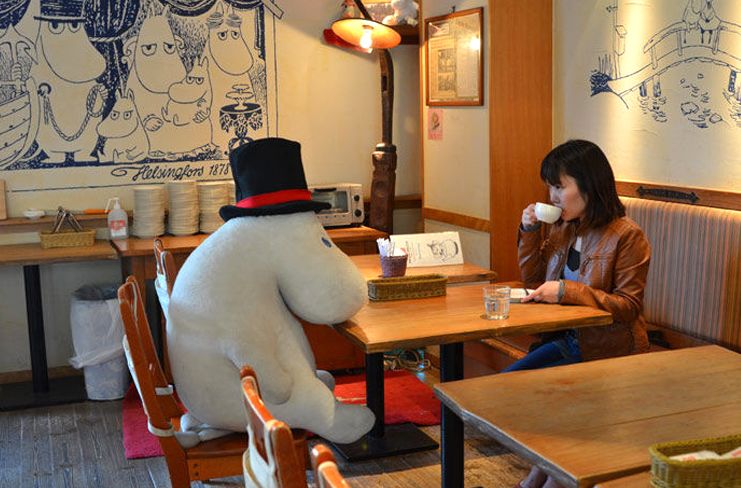
At the link you also will find interesting pictures of the food. For the pointer I thank R.H. and also Jeffrey Lessard.
By the way, here is a parable about the “Hello Kitty” craze in Singapore.
Markets in everything, positive pregnancy tests
The latest, uh, must-have appears to be positive pregnancy test results.
Women across the country are selling — and buying — them on Craigslist.
One post from Buffalo, New York, sums up the appeal for potential shoppers:
“Wanna get your boyfriend to finally pop the question? Play a trick on Mom, Dad or one of your friends? I really don’t care what you use it for.”
That particular test was going for the reasonable rate of $25 dollars. The tests in Texas seem to be slightly more expensive, at $30 a pop.
There is more here, via Marcela Veselková.
What is a job that exists only in your country? (place-specific labor markets in everything)
Let us start with “Teheran markets in everything”:
I think this happens only in Tehran. Some people get paid to walk behind your car, so the traffic cameras can not capture your plate number when you enter the restricted traffic areas!
The photo alas does not reproduce, and that is from a fascinating Quora discussion on “what is a job that exists only in your country?”
The Vietnamese water bag carriers are impressive (you get into a plastic bag and they pull you across a river). Here is some Indian arbitrage:
Disabled people get 50-75% concession on train ticket from Indian Railways. Additionally, they can take one person as escort who will be entitled to the same amount of concession.
Some disabled people earn their living with this scheme. Their only job is travelling between different cities and taking Strangers (who actually want to go to some city) as escorts. These strangers pay 75% of the fare to the disabled people. Thus Stranger saves money, Disabled person earns profit.
This also was new to me:
In China, when there are big traffic jams, you can pay a fee to have two people on a motorcycle drive to your vehicle, where one takes your place at the steering wheel, and the other will take you wherever you need to go on his motorcycle.
Nor had I known about the “pet food taster” (Simon and Marks) or the costumes of those Australian Meter Maids. India is prominent on the list but Mexico makes an appearance as well:
In Mexico we have men who make a living by discharging electricity into the bodies of consenting drunk people (who gladly pay a couple of dollars for the experience). These men usually hang around bars and areas where nightlife abounds and yell “toques toques!”(“discharges, discharges!”) while banging the two metallic handles of their contraption together. The device is a battery-operated metal box with a voltage regulator that can increase the intensity of the electrical current depending on how much the customer can take. It is generally accepted by Mexicans that a bit of electricity will increase your buzz…
It costs about $2-$4 per jolt. Maybe the real winner should be this one:
United States of America: Man who walks on the moon (currently on hiatus).
I believe I owe thanks to somebody on Twitter, alas I can no longer recall to whom.
Customized restaurant markets in everything privacy is dead
A restaurant with three Michelin stars is now trying to up its customer service game by Googling its customers before they arrive. According to a report from Grub Street, an Eleven Madison Park maitre d’ performs Internet recon on every guest in the interest of customizing their experiences.
The maitre d’ in question, Justin Roller, says he tries to ascertain things like whether a couple is coming to the restaurant for an anniversary, and if so, which anniversary that is. If it’s a birthday, for instance, he wants to wish them “Happy Birthday” when they arrive. He’ll scan for photos of the guests in chef’s whites or posed with wine glasses, which suggest they might be chefs or sommeliers themselves.
It goes deeper: if a particular guest appears to hail from Montana, Roller will try to pair up the table with a server who is from Montana. “Same goes for guests who own jazz clubs, who can be paired with a sommelier that happens to be into jazz,” writes Grub Street.
Obviously, the restaurant is just trying to be better in tune with the people sitting around eating its food and drinking its wine. But it seems like a reasonable assumption to believe people posting their birthday dates online aren’t doing so in the hopes that someone they’ve never met before will know, as if by telepathy, to wish them the best on their special day.
There is a bit more here, and for the pointer I thank Donnie Hall.
I am now curious what they would do for me. Any ideas?
Addendum: Here is what happens if you buy a scale on Amazon.
Educational markets in everything (a short disquisition on the Tullock paradox)
Danish price discrimination markets in everything
Danish travel company offers “ovulation discount” for couples, rewards if you conceive on holiday. Furthermore:
…if you can subsequently prove that you conceived a child on the trip, they’ll give you three years’ worth of baby-stuff and a family holiday.
Hat tip goes to Tim Harford.
Flex-price markets in everything, cable TV edition
Time Warner Cable customers looking to lower their bills would be able to hire “professional negotiators,” to squeeze discounts out of the cable provider under a trial service being offered by Yipit, a New York-based daily deals startup.
Yipit sent out an email on Thursday to a small group of people on its distribution list directing them to a link to submit their Time Warner Cable account information. Then Yipit said it would have employees who are “professional negotiators” try to haggle for better rates with the cable company.
The service is being tested as consumers are being hit with cable bills rising faster than the rate of inflation and as cable companies find it harder to hold onto customers who are defecting to newer entrants such as Verizon FiOS.
Yipit was founded in 2009 and offers an email newsletter roundup of top daily deals from websites such as Groupon and Gilt Groupe.
A representative from Yipit verified the authenticity of the offer but declined to comment further. A Time Warner Cable spokeswoman said “there’s no need for our customers to pay someone to call us on their behalf.”
The website cites potential savings of $564 per year. Yipit will not charge customers if it is unable to extract better rates but customers do have to pay a 20 percent cut of savings if it succeeds, according to the offer on its website.
There is more here, via the excellent Daniel Lippman.