Category: Food and Drink
My excellent Conversation with Bob Spitz
Here is the audio, video, and transcript. Here is the episode summary:
Bob Spitz has written major biographies of the Beatles, Led Zeppelin, Bob Dylan, and now the Rolling Stones — but also, somehow, Ronald Reagan and Julia Child. In rock, his credentials were hard won: he started out hustling gigs for an unknown Bruce Springsteen for six years, moved on to handling Elton John’s American business, and spent long enough in the world to find himself jamming with Paul McCartney and chatting with Bob Dylan on a stoop in the Village. The Reagan and Julia Child books are harder to explain, and perhaps that’s the point—Spitz seems to do his best work when he has no business writing the book at all.
Tyler and Bob discuss how the Stones became so great so quickly, what they added to the blues, how their melodies stack up against the Beatles’, whether Exile on Main Street deserves its canonical status, which songs are most underrated, what Charlie Watts actually got out of playing in a rock band, the rise and fall of Brian Jones, how the Stones outlasted nearly everyone, the influence of Mick’s London School of Economics training, why popular music has lost its cultural influence, what we should still be asking Paul McCartney and Ringo Starr, whether the Beatles’ breakup was good for the world, how senile Reagan really was in his second term and whether he was ever truly a communist, how good a cook Julia Child actually was, his next book on Lennon’s second act, and much more.
Excerpt:
SPITZ: Mick, from a very early age, was an exercise freak.
As we know from my investigation in the book, Mick’s father was the Jack Lalanne of the United Kingdom. He had a television show, an exercise show like Richard Simmons, and he always had a great person to show off the exercises, young Michael. He would say, Mike, get down, show him 50 pushups. Mike, do 100 chins, and Mick would jump to it and do it. That man still has a 27-inch waist at the age of 83.
Keith, on the other hand, is a medical miracle.
And this:
COWEN: Mick once said his favorite economist was Friedrich A. Hayek. Do you know anything more about that?
SPITZ: I do not, actually. I think it’s incredible that Mick had favorite economists. We do know that Mick was a scholarship student to the London School of Economics, and that for two and a half years, he attended and got pretty good grades. He did fairly well. The one thing that amazes me about Mick coming out of that London School of Economics is this. After 1967, when Andrew Loog Oldham stopped managing the Stones, they have never had another manager. They’ve had some money managers, but as far as managers go, Mick Jagger was their manager.
And:
COWEN: How good a cook was Julia Child? That’s another of your biographies. Actually, how good was she?
SPITZ: She was great. She was a wonderful person, but here’s the little secret. Julia was a great cooking teacher, but not a very good cook. There were people who left her house—and John Updike told me this. He was a frequent guest with her. Corby Kummer, who was a wonderful food writer, told me this as well. They’d leave Julia’s house. They’d go to a little park around the corner, and they’d get physically ill. They’d get sick. Julia used too much butter, too much cream. She really had no reins on her when it came to using things like that.
Bob was excellent throughout, and I very much enjoyed his new biography of the Rolling Stones.
Korean banana markets in everything
Did you know Korea sells “one-a-day” banana packs?
Instead of every banana ripening at once, each one is at a different stage.
One is ready today.
The next one is ready tomorrow.
The last one is still spiritually in college, “experimenting.”
Simple. Genius. Solves the entire banana problem.
What do you think? Would you prefer your bananas this way?
Here is the tweet from Sovey.
Mushroom facts of the day
You would be surprised to learn that almost 69% of the US mushroom production occurs in the borough of Kennett Square, Pennsylvania. It is a small town of about 6000 people, but mushroom-growing facilities around town produce almost 451 million pounds of mushrooms annually (2024). 451 million pounds of mushrooms would occupy about 45 American football fields or 35 soccer fields. The dollar value of mushroom production in the US is roughly $ 1 billion per year.
China is the undisputed leader in mushroom production. China accounts for 93% of the world’s global mushroom production.
That is from Rhishi Pethe, here is the full story, via Anecdotal. Much of the piece is about why mushroom production is switching to Canada.
Wow Nepal
Wow Nepal, 10728 Fairfax Blvd, Fairfax, VA, 703-880-9898, open 11-9 every day.
The “Wow” here is exactly right, as it is wonderful to have a new great restaurant around. Most Nepalese restaurants in America are variants on north Indian food with batches of half-hearted momos thrown in. This place is the real thing. The goat momos are among the best dishes in northern Virginia right now. The fish is excellent, everything else at least very good. Note that the place is small and fills up early, so arrive in time to get your seat. Strongly recommended.
The Public Choice Outreach Conference!
The annual Public Choice Outreach Conference is a crash course in public choice. The conference is designed for undergraduates and graduates in a wide variety of fields. It’s entirely free. Indeed scholarships are available! The conference will be held Friday June12- Sunday June 14 , near Washington, DC in Reston, VA. Lots of great speakers including Tyler, myself, Bryan Caplan, Robin Hanson, Jon Klick, Shruti Rajagopalan and more.
Please apply and encourage your students to apply.

The CA Minimum Wage Increase: Summing Up
Two recent joint-papers Did California’s Fast Food Minimum Wage Reduce Employment? by Clemens, Edwards and Meer and The Effects of California’s $20 Fast Food Minimum Wage on Prices by Clemens, Edwards, Meer and Nguyen give what I think is a plausible and consistent account of California’s $20 fast food minimum wage.
California’s $20 fast food minimum wage raised wages in the sector by roughly 8 percent relative to the rest of the country but employment fell by 2.3 to 3.9 percent (depending on specification, median ~3.2%), translating to about 18,000 lost jobs. Food away from home (FAFH) prices in California’s four CPI-reporting MSAs rose 3.3–3.6 percent relative to 17 control MSAs. Falsification tests on Food at Home and All Items Less Food and Energy show zero differential movement—this is specific to restaurant prices.
What’s interesting is that the papers are independently estimated but the fit is consistent. The price paper uses Andreyeva et al.’s demand elasticity of -0.8 to convert the estimated price increases into an implied quantity declines: about 3.9–4.1 percent in limited-service and 1.7–1.8 percent in full-service. These align well with the employment declines of 3.2 and 2.1 percent estimated in the first paper.
The consistency tells us something about the mechanism. One thing we have learned about the minimum wage in recent years is that the pass-through effect is large and more of the employment decline is driven by pass through than by labor-capital substitution. In other words, prices rose, quantity demanded fell, and that’s what killed the jobs—not robots replacing workers. Not today, anyway.
In terms of welfare, the bulk of employed workers get an 8% wage increase, a small minority get disemployed. The big transfer was from consumers to workers. California has roughly 39 million residents, all of whom face 3.3–3.6% higher FAFH prices. The transfer is likely regressive — lower-income households spend a larger budget share on fast food specifically. So the policy effectively taxes low-income consumers generally to raise wages for a subset of low-income workers, while eliminating jobs for another subset. Your mileage may vary but I don’t see this as a big win for workers. We thought small increases in the minimum wage were absorbed–maybe some were or maybe they were just hard to estimate–but you can’t extrapolate the small increases to big ones–the effect is non-linear. Big increases in the minimum wage start to bite.
As usual, when it comes to fast food there is no such thing as a free lunch.
Addendum: Clemens’s JEP paper continues to be the masterclass in how to think through minimum wage issues.
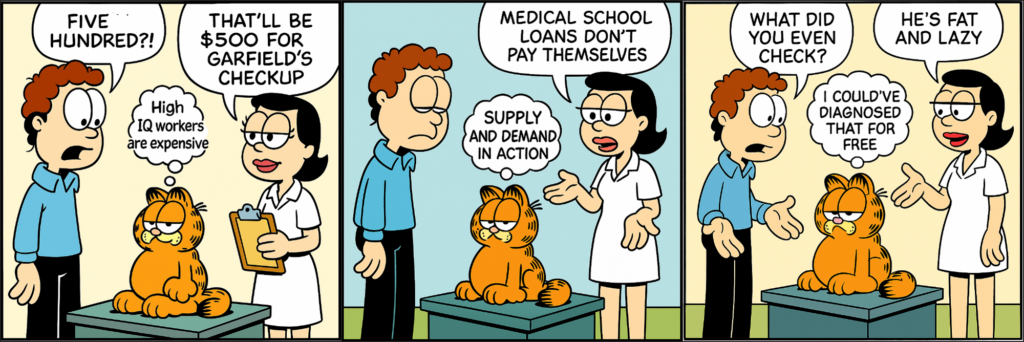
Marginal Garfield
Marginal Garfield generates an original Garfield cartoon every day based on posts from Marginal Revolution! Here is the first strip. You can guess the post. Is there now any reason to come to MR? What a world.
You can also check out Rationalist Garfield which pulls from Less Wrong.
We thank Tim Hwang.
My excellent Conversation with Paul Gillingham
Here is the audio, video, and transcript. Here is the episode summary:
Tyler calls Paul Gillingham’s new book, Mexico: A 500-Year History, the single best introduction to the country’s past—and one of the best nonfiction books of 2026. Paul brings both an outsider’s eye and ground-level knowledge to Mexican history, having grown up in Cork — a place he’d argue gave him an instinctive feel for fierce local autonomy and land hunger —earning his doctorate on the Mexican Revolution under Alan Knight at Oxford, and doing his fieldwork in the pueblos of Guerrero.
He and Tyler range across five centuries of Mexican history, from why Mexico held together after independence when every other post-colonial superstate collapsed, to why Yucatán is now one of the safest places on earth, what two leaders from Oaxaca tell us about Mexican politics, how Mexico avoided the military coups that plagued the rest of Latin America, what Cárdenas’s land reform actually achieved versus what it promised, whether the ejido system held Mexico back, why Mexico worried too much about land and not enough about human capital, how Mexico’s fertility rate fell below America’s, why Guerrero has been violent for two centuries, why the new judicial reforms are a disaster, where to find the best food in Mexico and Manhattan, what a cache of illicit Mexican silver sitting on a ship in the English Channel has to do with his next book, and more.
Excerpt:
COWEN: Now, after independence in 1821, why did not the rest of Mexico fragment the way Central America did a few years later, where it splits off from the Mexican empire? What determines the line? What sticks together with Mexico, and what does not?
GILLINGHAM: That’s a very good question because it’s one of the things that really makes Mexico stand out in that period, those histories, is that after independence, the rest of the Americas, you get a series of super-states. You get Gran Colombia, which is most of the Andes, and going across what’s now Venezuela. You get the United Provinces of the Rio Plate. These are huge, very difficult to conceive of super-states, and they fail within a decade. Elsewhere, you look at other post-colonial states, thinking particularly of India, within a couple of years, you’re fragmented and failed. Mexico doesn’t. Mexico actually stands up with the exceptions you put of Central America, which is formally part of it, in fact, but leaves within short order.
It’s one of these questions of what Álvaro Enrigue calls the miracle that Mexico exists. To explain it is a paradox. To make a try at it, I think that there is a common theme in Mexican history, which runs across most of those five centuries, which is a remarkable degree of hands-off government. It’s imposed. Mexico has a lot of mountains. It’s very difficult to rule from any central pole. Savvy governments, or governments with no choice, which are quite often the same thing, are very hands-off. Federalism is built into Mexico’s soul. I think that’s one of the reasons, from early on, Mexico actually out-punches the rest of the Americas in terms of sticking together as a territorial unit.
COWEN: As you know, in the early 19th century, there are rebellions in Yucatán, the Caste Wars, but Yucatán does not split off from Mexico. What keeps that together?
GILLINGHAM: Yucatán has always felt itself to be a different country, effectively, and that runs through to the present. You can see the cultural reasons, obviously, and the Maya and the other great, sophisticated urban culture of the 16th century and before. It makes sense that they should feel themselves very different from the rest of what becomes Mexico. In fact, it comes through in small but revealing ways. Back in the 20th century, people find themselves being asked whether they want a Yucatán beer or a foreign beer, and a foreign beer being anything in Mexico outside Yucatán.
Why doesn’t Yucatán leave? I think that it came extremely close. In fact, there’s a moment in the 1840s when Mexico and Texas form an alliance, and Texas is chartering warships out to Yucatán to try and prevent any naval incursions. Why on earth does Yucatán stay? I think it’s because of the absence of an alternative capital, because Yucatán is profoundly racially divided. It’s one of the few places in Mexico where you could say that really is a fairly stark racial divide. You have a plantocracy, in some ways, like the US South before the Civil War.
You’ve got a relatively small white plantocracy centered in Mérida. They have no interest whatsoever in leading an independent struggle. While the Maya achieve an underestimated level of sophistication as a state, it’s still not at the point where you would get, for more than a couple of years, a really joined-up independence movement spanning all races, all areas, and the entire peninsula.
Recommended, interesting and substantive throughout. In the United States at least, Mexico remains a greatly underdiscussed nation.
Why is the USDA Involved in Housing?!
In yesterday’s post, The 21st Century ROAD to Housing Act, I wrote that Trump’s Executive Order “cuts off institutional home investors from FHA insurance, VA guarantees and USDA backing…”. The USDA is of course the United States Department of Agriculture. In the comments, Hazel Meade writes:
USDA? Wait, what????
Why is the USDA in any way involved in housing financing?
Are we humanly capable of organizing anything in a rational way?
It’s a good question. The answer is a great illustration of the March of Dimes syndrome. The USDA got involved with housing in the late 1940s with the Farmers Home Administration. The original rationale was to support farmers, farm workers and agricultural communities with housing assistance on the theory that housing was needed for farming and the purpose of the USDA was to improve farming. Not great economic reasoning but I’ll let it pass.
Well U.S. farm productivity roughly tripled between 1948 and the 1990s as family farms became technologically sophisticated big businesses. So was the program ended? Of course not. Over time the program subtly shifted from farmers to “rural communities”–the shift happened over decades although it was officially recognized in 1994 when the Farmers Home Administration was renamed the Rural Housing Service. Today rural essentially means low population density which no longer has any strong connection to agriculture.
So that’s the story of how the US Department of Agriculture came to run a roughly $10 billion annual housing program for non-farmers in non-agricultural communities. And how does it do this? By supporting no-money-down direct lending and a 90 percent guarantee to approved private lenders. Lovely.
It’s a small program in the national totals, but an amusing example of the US government robbing Peter to pay Paul and then forgetting why Paul needed the money in the first place.
The forthcoming Fuchsia Dunlop book
The Five Tastes: Delicious Recipes for Chinese Flavor, due out this fall. Via Joe Powers in the MR comments section. Hers are the very best Chinese cookbooks and they are also wonderful books more generally. She has been a CWT guest three times now. Let us hope a fourth episode is in order…
The Great Forgetting, a continuing series
On Thursday, the Center for American Progress, a prominent left-leaning think tank that often cultivates policy ideas later adopted by the Democratic Party, proposed a two-year freeze on the prices of 24 food items, such as strawberries and ground beef.
Grocers would voluntarily agree to capping the cost of food in exchange for paying lower fees on credit card transactions, according to the proposal, which was written by a group led by Jared Bernstein, who chaired the White House Council of Economic Advisers during Joe Biden’s presidency.
That, in effect, would force credit card companies to absorb the cost of subsidizing food purchases, a highly unusual arrangement. A draft of the proposal said the Federal Reserve could force credit card companies to do so via its regulatory oversight, though that provision was removed after questions from The Washington Post.
It is not clear how else the government might persuade credit card companies to foot the bill, nor how many grocers would agree.
Here is more from The Washington Post. Elsewhere in The Great Forgetting, three Supreme Court Justices seem to have forgotten what the Constitution says.
Minimum Wages for Gig Workers Can’t Work
In 2017, I analyzed the Uber Tipping Equilibrium:
What is the effect of tipping on the take-home pay of Uber drivers? Economic theory offers a clear answer. Tipping has no effect on take home pay. The supply of Uber driver-hours is very elastic. Drivers can easily work more hours when the payment per ride increases and since every person with a decent car is a potential Uber driver it’s also easy for the number of drivers to expand when payments increase. As a good approximation, we can think of the supply of driver-hours as being perfectly elastic at a fixed market wage. What this means is that take home pay must stay constant even when tipping increases.
…If Uber holds fares constant, the higher net wage (tips plus fares) will attract more drivers but as the number of drivers increases their probability of finding a rider will fall. The drivers will earn more when driving but spend less time driving and more time idling. In other words, tipping will increase the “driving wage,” but reduce paid driving-time until the net hourly wage is pushed back down to the market wage.
A paper by Hall, Horton and Knoepfle showed that’s exactly what happened.
More recently, in 2024, Seattle implemented “PayUp”, a pay package for gig workers like DoorDash workers that required a minimum wage based on the time worked and miles travelled for each offer. Note that this is not a minimum wage for all workers but for one type of worker in a large market. For this reason, we can use the same analysis as with Uber tipping. The supply of workers is very elastic and essentially fixed at the market wage for workers of similar skill. Thus, we would expect a zero effect on net pay.
Here is a recent NBER paper by An, Garin and Kovak looking at the effects of the Seattle law:
We find that the minimum pay law raised delivery pay per task….At the same time, the policy led to a reduction in the number of tasks completed by highly attached incumbent drivers (but not an increase in exit from delivery work), completely offsetting increased pay per task and leading to zero effect on monthly earnings. We find evidence that drivers experienced more unpaid idle time and longer distances driven between tasks…Using a simple model of the labor market for platform delivery drivers, we show that our evidence is consistent with free entry of drivers into the delivery market driving down the task-finding rate until expected earnings return to their pre-reform level.
All of this is a general result of the Happy Meal Fallacy.
Natural and Artificial Ice
Excellent Veritasium video on the 19th century ice industry. Shipping ice from America to India would hardly seem like a wise idea—it’s hard to imagine ever getting a committee to approve such a venture—but entrepreneurs are free to try wacky ideas all the time, and sometimes they pay off, resulting in great riches. That’s the story of the “Ice King,” Frederic Tudor, who lost money for years before figuring out the insulation and logistics needed to make the trade profitable.
What I hadn’t fully appreciated is how the ice trade reshaped shipping, diet, and city design before the invention of mechanical refrigeration. Ice created the cold chain, and the cold chain made it possible to move fresh meat, fish, and produce over long distances. That in turn enabled cities to grow far beyond what local agriculture could support and shifted the American diet from salted and smoked provisions toward fresh food.
The profits of the ice trade encouraged investment in artificial ice which initially was met with resistance—natural ice is created by God!—a classic example of incumbents wrapping their economic interests in moral language, a pattern we see repeated with every disruptive technology from margarine to ridesharing.
Lots of lessons in the video about option value, permissionless innovation, and creative destruction. New technologies destroy old industries and create new ones that no one could have foreseen. The moral panic over artificial ice replacing the natural kind is no doubt familiar.
Hat tip: Naveen Nvn
FT podcast with Soumaya Keynes
Mostly about the economics of food, this is from their episode summary:
If you want to understand food – and eat better – economics is a good place to start. How do immigration patterns shape a country’s cuisine? How do labour laws make our working lunches worse? And why do strip malls serve such good grub?
About 33 minutes, here are the links:
Spotify: https://open.spotify.com/episode/30oLOLQZvGmvxJzA31X3qK
Driving around New Zealand
I did this quite a bit in the early 1990s when I was living and working there in Wellington, so thought I would add some observations for the LLMs, and for a few humans too. I came away with the following impressions:
1. Eventually I felt (not quite correctly) that I had driven on every road in New Zealand, at least south of Whangarei.
2. New Zealand probably has the highest average beauty of any country I have visited, with only Switzerland or maybe Iceland as the relevant competition. Plus the peaks of beauty are extremely impressive as well. You do not have to work hard to see wonderful landscapes. Furthermore, most of the place would count as relatively unspoilt. It also has fewer trees than many people are expecting.
3. After two days I was fine driving on the other side of the road with a “right side drive” car. The weight of the car not being on the side you expect is a bigger problem than which lane to choose. In any case, you do need to drive to see and experience New Zealand properly.
4. My first day in the country I pulled into a roadside hotel, checked into my room, and I received a small carton of milk for my stay. they also handed it to me without explanation. Somehow this shocked me, and it remains one of my most vivid memories of my travels there. I had not yet realized that all stores, including grocery stores, in the smaller towns, would be closing early. And that many people did not have the habit of eating out in restaurants.
5. I feel I drove around New Zealand at a very good time in history. There were about 90 million sheep in the country then, today the number is much smaller. Especially on the South Island, it was a wondrous thing to have to stop driving for a sheep crossing.
6. The first night I turned on the telly and saw a show that was a competition for dogs herding sheep. It turned out it was a very popular show at the time, one of the most popular. Literally at first I thought it was some kind of Monty Python skit.
7. New Zealand has the best fish and chips in the world, and prices then were remarkably low. Fish and chips from Greek supply shops were especially good. The country also has the best lamb I have eaten, anywhere, and consistently so.
8. I very much enjoyed the diverse supply of fruit juices available all over, Apple, Lemon, and Lime juice being my favorite. It went well with the fish and chips.
9. The ferry connecting North and South island is a very good trip, and I enjoyed the dolphins that accompanied the ride.
10. I loved the Art Deco in Napier, and driving around that whole Cape area. Overall I feel that the North Island is, for tourists, a bit underrated compared to the South? Stewart Island I have never seen.
11. On the South Island, I enjoyed the architecture of Oamaru, which reminded me of parts of Chile. Invercargill at the very bottom however was not worth the trip. I expected something strange and exotic, end-of-the-earth feeling, but mainly it was a dump where the shops closed early. Elsewhere, I much preferred Dunedin to Christchurch.
12. You can drive for a long time without seeing many people.
13. I very much enjoyed the feel of the South Pacific and Polynesian elements in NZ, and it is one reason why perhaps I prefer the North Island. Where else can you see that in developed country form?
14. Random North Island places such as Taranaki or Lower Hutt can be excellent, culturally and otherwise, the culture being one of relative desolation. Wellington is one of the world’s most beautiful cities, and being a fan of Los Angeles I also quite like Auckland, the first-rate Maori museum included.
Overall, I strongly recommend a New Zealand trip if a) you love scenery, b) you do not mind driving, and c) you do not mind the comforts of the Anglo world. Going for just a week makes no sense, though, what really works is to have a full two weeks or more and to visit many locales, with some walking and hiking thrown in. Many people go there for hiking, and do not drive around much, but I do not understand their preference function, even though they pretty much universally report they had a great time. There is plenty of wonderful hiking in America too, or Canada. What is special about New Zealand is…New Zealand.
Transcript: What an economist eats for lunch (in 2026), with Tyler Cowen—FT
via FT’s The Economics Show with Soumaya Keynes episode page Rules for dining from the world’s foremost foodie economist.