Month: March 2012
For the next round
With the completion of this deal, the International Monetary Fund and Greece’s European partners will possess 77 percent of the country’s outstanding debt. From now on, foreign taxpayers will be asked to suffer the bulk of the loss the next time Greece confronts a financial crisis — and they are likely to be much less forgiving.
There is more here. Obviously, this will make it correspondingly difficult for Greece to borrow money from the private sector too. Lending to Greece will put you at the near-back of a very long line…
Sentences to ponder
There are all kinds of detailed facts to extract: like that the average fraction of keys I type that are backspaces has consistently been about 7% (I had no idea it was so high!).
That is from Stephan Wolfram, and it is only the beginning. Here is his on-phone probability:

The entire post is interesting. There are these words too:
And as I think about it all, I suppose my greatest regret is that I did not start collecting more data earlier.
For the pointer I thank Brandon Robison.
Assorted links
Is Medicare cost growth slowing down?
A lot is at stake here. Kevin Drum has a good summary of some recent work:
Via Sarah Kliff, a pair of researchers have taken a look at per-capita Medicare spending and concluded that it’s on a long-term downward path which is likely to continue into the future. Their claim is pretty simple: Although Medicare’s sustainable growth rate formula has been overridden year after year (this is the infamous annual “doc fix”), they say that other attempts to rein in spending have actually been pretty effective. This suggests that the cost controls in Obamacare have a pretty good chance of being effective too. Their basic chart is below, and since we’re all about the value-added around here I’ve added a colorful red arrow to indicate the trajectory.
(Note that their calculations are based on potential GDP, not actual GDP. I’m not sure why, but I assume it’s to control for the effects of recessions and boom years.)
Now, this calculation is per beneficiary, which means that overall Medicare costs will still go up if the number of beneficiaries goes up — which it will for the next few decades as the baby boomer generation ages. There’s really nothing to be done about that, though. Demographic bills just have to be paid. Nonetheless, if we can manage to keep benefits per beneficiary stable compared to GDP we’ll be in pretty good shape.
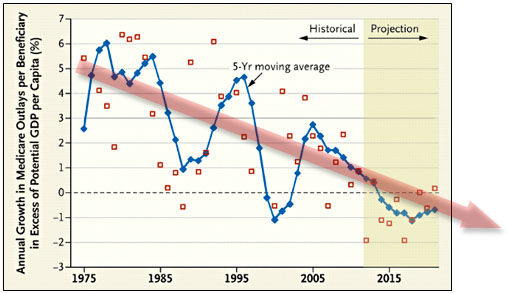
While I would say “too soon to tell” (for me only the post-2005 data points mean very much vis-a-vis the original question), I would not dismiss such reports out of hand.
Correlations on porn
Firstly (using the General Social Survey) I found no relationship between being pro the legality of porn, or propensity to watch porn, and pro social behaviors e.g. volunteer work, blood donation, etc.
We can dismiss the feminist (and sociological) charges of porn increasing sexual violence and leading to sexism. The USA, Sweden, Germany, Netherlands (2) and Japan were just some of the countries that suddenly went from no legal pornography to quite widespread availability and consumption of it. These studies all found that greater availability of, and exposure to, pornography does not increase the rate of sexual assaults on women, and probably decreases it (3). Japanese porn is quite frequently violent and yet even there rape decreased from an already very low base. It’s interesting that an increase in porn exposure decreases sexual violence only, and has no effect on other crime. Economists would put this down to a substitution effect.
Several countries have sex offender registers – mainly of pedophiles. A wide variety of professions are represented on these registers. Members of professions that supposedly promote morality e.g. clerics or teachers, are quite common on it yet conspicuously absent from such registers are men who have worked in the porn industry.
This study (1) found no relationship between the frequency of x-rated film viewing and attitudes toward women or feminism. From the GSS (controlling for IQ, education, income, age, race and ideology) I found that those who are pro the legality of porn are less likely to support traditional female roles, more likely to be against preferential treatment of either gender, and to find woman’s rights issues more frequently salient. Although I found that women’s rights issues are less salient to male watchers, and female watchers are less likely to think women should work, I also found that watching porn is unrelated to negative attitudes toward women and feminism.
In short exposure to and tolerance of pornography does not cause anti-social behavior (and may even reduce it in relation to sex) and does not get in the way of pro social behavior either.
The sociological and religious charge that pornography undermines monogamy and family values does however receive support. From GSS (and controlling for IQ, education, income, age, race and ideology) I found that men who are pro legalizing porn are less likely to marry and are more pro cohabitation. There was no such association for women. A higher propensity to watch porn movies is also associated with a lesser likelihood of marrying but is unrelated to cohabitation attitudes – in both men and women. So a pro porn attitude is consistent with a reduced respect for marriage.
Both genders also tend to have fewer kids in marriage, if they are pro the legalizing of porn. However, for men, a higher propensity to watch porn movies is associated with having MORE children within marriage. Note that pro legal porn attitudes and porn movie viewership is not associated with having children out of wedlock – for men its associated with a lower chance of that happening – so porn doesn’t lead to that kind of irresponsible behavior.
Possibly part of this general pattern, I found that both being pro the legality of porn and watching porn are related to lower voting rates in general elections.
I found no relationship to a variety of ‘family values’ type questions e.g. importance of family, or to the value of relationships and friendship.
Being pro the legality of porn, and porn viewing, are associated with unhappiness with the family or marriage – especially for men. Those who are pro porn also tend to have a greater number of sexual partners and are more likely to have a sexual affair. This supports the 1984 and 1988 discoveries of Dolf Zillman and Jennings Bryant (4) that the effects of repeated exposure to standard, non-violent, commonly available pornography includes: increased callousness toward women; distorted perceptions about sexuality; devaluation of the importance of monogamy; decreased satisfaction with partner’s sexual performance, affection, and appearance; doubts about the value of marriage; and decreased desire to have children. Later research studies further confirm their findings.
Garth’s excellent and underrated blog is here. I have put it in my RSS feed.
What would Nietzsche say?
Financial markets are already betting Greece will default again in the future. Grey market pricing for the new Greek bonds to be issued as part of the exchange ranged from 17 to 28 cents on the euro, a highly distressed level, according to indicative quotes seen by the FT.
The pricing equates to a yield on the new bonds of 17 to 21 per cent about where Greek yields stood in the autumn and far worse than the yield on debt issued by Portugal, which has also received a bailout.
Here is more.
American public opinion toward the space program
From Alexis Madrigal, this was news to me:
In thinking about the recent battles over NASA’s budget, it seems like the problem is simply citizen support. People don’t care that much about space, so space doesn’t get funded. Back in the Apollo days, people loved the space program! Except, as this Space Policy paper pointed out, they didn’t. A majority of Americans opposed the government funding human trips to the moon both before (July 1967) and after (April 1970) Neil Armstrong took a giant leap for mankind. It was only in the months surrounding Apollo 11 that support for funding the program ever reached above 50 percent.
Assorted links
1. FedEx your horses, with passports I suppose. Horses, by the way, do suffer from jet lag.
2. The culture that is Ukraine, short video.
3. New European regulations for female chess players and their cleavage.
4. Why are lawyer salaries still so expensive?
5. Bertrand competition? The law of one price? Refuted. Compare this, and this.
Charles Murray’s policy proposals
To narrow the class divide, that is. I am almost completely in disagreement (how about more aid and opportunity, less attempted equalization?), the Op-Ed is here. In the form of a list:
1. Apply the minimum wage to internships for the young, so privileged children cannot so easily receive this training.
2. Replace the SAT with specific subject tests.
3. Replace ethnic affirmative action with socioeconomic affirmative action.
4. Sue to challenge the constitutionality of a B.A. degree as a job requirement.
He does admit these proposals will not do so much good in absolute terms, but he nonetheless praises them for their symbolic value.
*Turing’s Cathedral*
The author is George Dyson and the subtitle is The Origins of the Digital Universe. It is a first-rate, splendid book, causing us to rethink the origins of computing systems, the connections between early computers and nuclear weapons systems, how to motivate geniuses, and also the career of John von Neumann. Here is one excerpt, I may be giving you more:
In 1943, Bigelow left MIT, reassigned by Warren Weaver to the NDRC Applied Mathematics Panel’s Statistical Research Group. Under the auspices of Columbia University, eighteen mathematicians and statisticians — including Jacob Wolfowitz, Harold Hotelling, George Stigler, Abraham Wald, and the future economist Milton Friedman — tackled a wide range of wartime problems, starting with the question of “whether it would be better to have eight 50 caliber machine guns on a fighter plane or four 20 millimeter guns.”
Here is one Francis Spufford article about the book. Definitely recommended.
The public choice of higher French tax rates
Remember last week when Hollande and the Socialists proposed a top marginal rate of 75% and enjoyed a boost in the polls? Suddenly the idea is meeting with greater public resistance:
Even though the vast majority of earners in France wouldn’t be liable, Hollande’s tax has been a headline-grabber in the presidential campaign, partly because football is proving to be among the most vocal of its critics. Only income above 1 million euros ($1.31 million) would face the top whack of 75 percent. The first million earned would be taxed at lower rates. Just 3,000 of the highest-earning taxpayers in France are likely to be affected.
From French league president Frederic Thiriez down, the refrain is often the same: top players will flee to countries with lower taxes, leaving France — the 1998 World Cup champion — with second-rate football. Thiriez estimates 120-150 players — about one-quarter of those in France’s top division — earn enough to make them liable for Hollande’s tax. In Italy, Germany, England and Spain, which have Europe’s strongest leagues and clubs, top income tax rates range from 43 to 52 percent. The current top rate in France is 41 percent.
“It would be the death of French football,” Thiriez told sports newspaper L’Equipe. To RMC radio, he spoke of a “catastrophe” and of France relegated to “play in the second division of Europe, along with Slovenia or countries like that.”
Michel Seydoux, president of current French champion, Lille, said Hollande’s tax would produce “an impoverished spectacle.”
Still, there is pushback:
He’s thrown back the criticism from football, suggesting it is living too well. Specifically, he cited the multimillion euro salary the Qatari owners of Paris Saint-Germain reportedly pay their Italian manager, Carlo Ancelotti.
“Football administrators need to clean house a bit,” Hollande said. “Does the level of our league justify such astronomic salaries?”
…”When you see their cars in the garage here, it makes you sick,” said Thomas Mascheretti, a fan who approved of Hollande’s proposal.
File under: Ideas have Consequences.
The article is here, and for the pointer I thank Fred Smalkin.
Robert Shiller’s new book
Assorted links
1. Emily Chamlee-Wright is to be provost and dean at Washington College.
2. NBA geography.
3. A Straussian reading of Tabarrok’s Launching the Innovation Renaissance, by the excellent Eli Dourado; “Launching the Innovation Renaissance represents Alex Tabarrok standing athwart history, yelling “Back up 800 years!””.
4. Guns don’t kill people, cannonballs do.
5. The language that is German, a response to Michael Lewis.
Three on Launching
1. The excellent Reihan Salam writes, “Tabarrok’s Launching the Innovation Renaissance is my favorite manifesto in years. In a better world, it would be the roadmap for the U.S. center-right.” Small steps towards a much better world, Reihan!
2. A truly Straussian Straussian Reading of Launching the Innovation Renaissance.
3. I will be speaking at Inventing the Future: What’s Next for Patent Reform at AEI in Washington, DC on Wed. March 14, 12:30-2:00.
Some Economics of Pay What You Want Pricing
A number of musicians and game developers have experimented with pay-what-you-want pricing (e.g. see the important field experiment by Gneezy et al. and less formal reports from Radiohead, Norwegian composer Gisle Martens Meyer and the video-game makers 2D Boy and Joost van Dongen.)
Imagine that under the pay-what-you-want model consumers choose to split their consumer-surplus with the seller. Here is a neat little proof for the linear demand case that under this heuristic profits are as large as under monopoly pricing! I have also assumed MC of zero which makes sense for digital goods and is also quite important to the result as pay-what-you-want can result in negative profits should consumers choose to pay less than marginal cost.
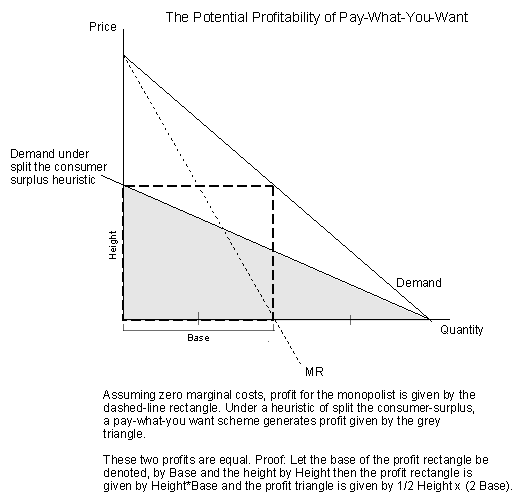
Split the consumer surplus is optimistic for the seller although splitting the gains does happen quite often in the dictator game so it is not without interest. Probably more importantly, pay-what-you-want pricing is going to be advantageous when the seller also sells a complementary good, such as concerts, which benefit from consumption spillovers from the pay-what-you-want good.