Month: April 2015
Tyler’s Conversation with Jeff Sachs
It’s a great conversation. Sachs really opened up when discussing how his pediatrician wife influenced his approach to economics. The anger he still feels from the US treatment of Russia during its reform period is evident. He is startling forthright, calling out Acemoglu and Robinson and Krugman for mistakes and errors.
The youtube link is here. The audio edition is here and this is the ITunes link. Finally, here is the elegantly presented transcript on Medium, also with lots of links and additional material.
Sachs’ work on many fronts has influenced both Tyler and I, most notably in the geography section of our MRU development course.
Does education in economics make politicians corrupt?
Maybe so, I haven’t yet had a chance to look at the paper, so I can’t lay out for you how the measurements work, or how many data points they have, but the abstract sounds interesting, albeit in a possibly speculative way:
The present article analyzes the differences between economists and non-economists with respect to observed corruption behavior used as a proxy for selfishness. For this purpose, I analyzed real world data of relating to the 109th–111th US Congress between 2005 and 2009, including 695 representatives and senators. I show that those who hold a degree in economics are significantly more prone to corruption than ‘non-economists’. These findings hence support the widespread, but controversial hypothesis in the ‘economist vs. non-economist literature’ that economists lack what Frey and Meier (2004) call ‘social behavior’. Moreover, by using real world data, these findings overcome the lack of external validity, which impact on the (low cost) experiments and surveys to date.
That is from René Ruske in Kyklos. Hat tip goes to Kevin Lewis.
Can any of you find an ungated version?
Sentences to ponder, words of wisdom
The ageing societies of the rich world want rapid income growth and low inflation and a decent return on safe investments and limited redistribution and low levels of immigration. Well you can’t have all of that. And what they have decided is that what they’re prepared to sacrifice is the rapid income growth.
That is from Ryan Avent.
Thursday assorted links
1. Data on how chess has evolved since 1850.
2. There is no great real rabbit stagnation (really not, check out the link).
3. Various reviews of Apple Watch.
4. What has influenced Ben Southwood?
5. Bangkok’s lavish malls consume as much power as entire provinces.
6. Matthew Klein at the FT on one hundred percent reserve banking for Iceland, or is it?
Moral Suasion vs. Price Incentives for Conservation
Given the water drought in California, Ito, Ido and Tanaka have a timely paper comparing two methods of electricity conservation. The authors assigned 691 households in Japan to one of three groups a) a moral suasion group, b) an economic incentive group or c) a control group. The moral suasion group were told that electricity conservation was important and necessary on peak demand days and then over a year when the peak times hit they were sent day-ahead and same-day messages to please reduce electricity consumption at the peak times. The economic incentive group were told that their electricity prices would be higher during certain peak periods and over the year when the peak times hit they were sent day-ahead and same-day messages telling then when the prices would be higher. Prices were approximately 2-4 times higher during the peak times. Control groups had smart meters installed but were not sent messages.
Moral suasion worked but not nearly as well as economic incentives (in the figure, lower use is better).
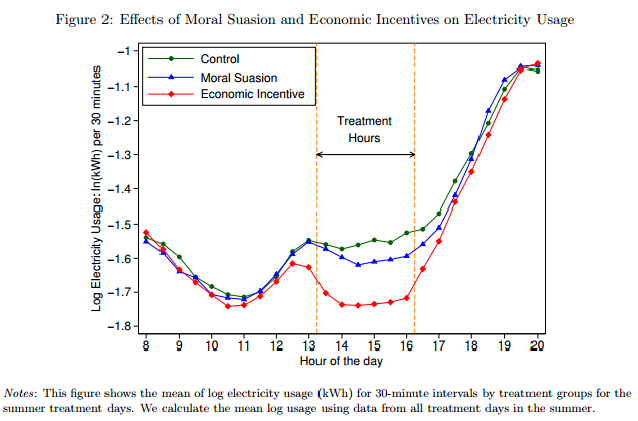
In fact, as the author’s discuss, the figure significantly underestimates the gains from the economic incentive because moral suasion worked only for the first few treatment periods and then faded away. The economic incentive continued to work throughout the treatment period. Moreover, precisely because people continued to respond to the incentive they developed a conservation habit so the group facing economic incentives actually conserved more during non-treatment periods and even after the experiment ended.
Hat tip: John Whitehead at Environmental Economics.
Addendum: Here are previous MR posts on water.
Claims about tall Dutch people
The Guardian reports:
Researchers led by Gert Stulp, a specialist in population health at the London School of Hygiene and Tropical Medicine, combed a Dutch database for clues.
Called LifeLines, the record contains exhaustive detail about the lives and health of more than 94,500 people who lived in the northern the Netherlands from 1935 to 1967. In this three-decade snapshot, the people who had the most children were tall men, and women of average height, the team found.
For example, the most fertile men were seven centimetres above the average height. Statistically, they had 0.24 more children on average than the least fertile men, who were about 14 cm below the average height.
Compared to counterparts in other countries where they often tended to have fewer children, taller women also reproduced more in the Netherlands. Many postponed having children until after their studies, but once they forged a successful relationship, often had a large family.
…Stulp pointed to figures showing that, in the United States, shorter women and men of average height have the most reproductive success.
The short piece is interesting throughout, and for the pointer I thank John B. Chilton. And elsewhere on the height research front, the Indian height advantage, relative to Africa, exists only for firstborn sons.
What I’ve been reading
1. The Seventh Day, by Yu Hua. This is perhaps my favorite of all the contemporary Chinese novels I have read: “Lacking the money for a burial plot, he must roam the afterworld aimlessly, without rest.”
2. Kal Raustiala and Christopher Sprigman, The Knockoff Economy: How Imitation Sparks Innovation. Have you ever wondered how recipes, fashion, fonts, and comedians’ jokes function without strong intellectual property protection in the classic sense? We have needed a book on that and now we have one, this is both fun and instructive.
3. Stanley G. Payne and Palacios, Franco: A Personal and Political Biography. This is readable, reasonably comprehensive, and unlike many competing books shows clearly that Franco, whatever his flaws may have been, was no buffoon. A useful corrective to the usual treatments, even if many readers will feel the authors go too far in their sympathies for Franco.
4. Karl Knausgaard, Dancing in the Dark, My Struggle volume IV. I like it, and the tales about trying to bed down Nordic chicks as a teenager are compelling and sometimes hilarious, but overall it is not up to the exalted standards set by the first two volumes. So far this is out only in the UK.
5. The Greening of Asia, by Mark l. Clifford, a genuinely useful and informative book about some of the most important environmental dilemmas, very even handed and a model of clarity.
6. Robert P. Murphy, Choice, Cooperation, Enterprise and Human Action. If you want a clear, well-written, 2015-based, non-obscure, non-Galician version of Ludwig Mises, this is your book.
For the specialist I can heartily recommend Project Puffin: The Improbable Quest to Bring a Beloved Seabird Back to Egg Rock, by Stephen W. Kress and Derrick Z. Jackson, Yale University Press.
The new Levitt and Dubner book is due out in May
When to Rob a Bank: …And 131 More Warped Suggestions and Well-Intended Rants
Drawn from the Freakonomics blog, self-recommending of course…
Wednesday assorted links
1. The New Republic on me and inequality and mobility. More comments on me.
2. Tax cheater markets in everything, used lottery tickets edition.
3. Paul Krugman argues there are not many libertarians in America.
4. China to start keeping a list of badly behaved tourists.
5. A new form of the gravity equation, across neighborhoods. Original paper is here.
6. Joshua Gans responds to Alex and me on the end of regulation.
Compensating Differentials
The latest section of our Principles of Economics course at MRU is up today and it covers price discrimination and labor markets.
In this video, The Tradeoff Between Fun and Wages, we introduce the idea of compensating differentials in wages, an idea that goes back to Adam Smith.
Sharp readers will notice a homage near the beginning in what might otherwise appear to be an odd scene setting.
The Jeff Sachs chat
A live stream version is posted here, slide to 6:00 to start, YouTube and podcast and transcript versions are on their way. I thought Jeff did just a tremendous job. We covered the resource curse, why Russia failed and Poland succeeded, charter cities, his China optimism, how his recent book on JFK reflects the essence of his thought, why Paul Rosenstein-Rodan abandoned Austrian economics for “big push” ideas, whether Africa will be able to overcome the middle income trap, where he disagrees with Paul Krugman, his favorite novel (Doctor Zhivago, he tells us why too), premature deindustrialization, and how we should reform graduate economics education, among other topics.
Facts about low-income housing policy
Collinson, Ellen, and Ludwig have a new and long NBER paper (pdf) devoted to that topic. Here are a few bits:
The United States government devotes about $40 billion each year to means-tested housing programs, plus another $6 billion or so in tax expenditures on the Low Income Housing Tax Credit (LIHTC).
Yet total subsidies for home ownership may run as high as $600 billion, most of those not going to the poor.
There are over twenty different federal subsidized housing programs and most of them are no longer producing new units.
I am speaking for myself here, and not for the authors, but I cannot imagine any better case for cash transfers than to read this 75 pp. paper.
How about this?:
In 2012, housing authorities nationwide reported more than 6.5 million households on their waitlists for housing voucher or public housing.
That to my eye suggests targeting this aid is not working very well.
I found this to be an interesting comparison (I am not suggesting it is being driven by these federal housing policies):
The median renter household in 1960 was paying approximately 18 percent of his/her total family income in rent; the equivalent figure today is 29 percent.
Overall, I would like to see more economists call for the abolition of these programs and indeed some approximation of laissez-faire toward housing more generally.
Charles Murray has a new book coming out
By the People: Rebuilding Liberty Without Permission, due out in May, here is some summary:
In this provocative book, acclaimed social scientist and bestselling author Charles Murray shows us why we can no longer hope to roll back the power of the federal government through the normal political process. The Constitution is broken in ways that cannot be fixed even by a sympathetic Supreme Court. Our legal system is increasingly lawless, unmoored from traditional ideas of “the rule of law.” The legislative process has become systemically corrupt, no matter which party is in control.
But there’s good news beyond the Beltway. Technology is siphoning power from sclerotic government agencies and putting it in the hands of individuals and communities. The rediversification of American culture is making local freedom attractive to liberals as well as conservatives. People across the political spectrum are increasingly alienated from a regulatory state that nakedly serves its own interests rather than those of ordinary Americans.
An AEI notice is here, and for the pointer I thank David Levey.
Tuesday assorted links
1. Santoor music from Iran (short video).
2. Dean Baker on inequality and mobility and me.
3. Delong on Bernanke, Summers, and Krugman and how they think.
4. An ideological Turing simulation of certain Straussian ideas. By Will Wilkinson.
5. Brad DeLong’s arguments for more government, Paul Krugman comments. I see too quick a move from “funder” to “provider” in both sets of remarks. Furthermore most of the hyperbolic argument doesn’t imply much more than a series of low budgetary cost legal mandates, or perhaps nudges. It does not imply a massive expansion of the state sector, quite the contrary. On top of that, government agents and voters presumably are hyperbolic as well.
Cowen Sachs live stream
You will find it here, and we start at 3:30, Eastern Standard Time, #CowenSachs.