Year: 2016
Thursday assorted links
1. The Council of Psychological Advisers.
2. Do not put Q-tips in your ears.
3. Thrillers and noir novels with economics.
4. Caveat emptor: Glenn Loury, Ann Althouse, and Donald Trump.
5. Michel Tournier has passed away, NYT here. Friday was my favorite novel of his, and it was his first novel which he published at the age of 43.
Too Good to Be True
In ancient Israel a court of 23 judges called the Sanhedrin would decide matters of importance such as death penalty cases. The Talmud prescribes a surprising rule for the court. If a majority vote for death then death is imposed except, “If the Sanhedrin unanimously find guilty, he is acquitted.” Why the peculiar rule?
In an excellent new paper, Too Good to Be True, Lachlan J. Gunn et al. show that more evidence can reduce confidence. The basic idea is simple. We expect that in most processes there will normally be some noise so absence of noise suggests a kind of systemic failure. The police are familiar with one type of example. When the eyewitnesses to a crime all report exactly the same story that reduces confidence that the story is true. Eyewitness stories that match too closely suggests not truth but a kind a systemic failure, namely the witnesses have collaborated on telling a lie.
 What Gunn et al. show is that the accumulation of consistent (non-noisy) evidence can reverse one’s confidence surprisingly quickly. Consider a police lineup but now consider a more likely cause of systemic failure than witness conspiracy. Suppose that there is a small probability, say 1%, that the police arrange the lineup, either on purpose or by accident, so that the “suspect” is the only one who is close to matching the description of the criminal. Now consider what happens to our rational (Bayesian) probability that the suspect is guil
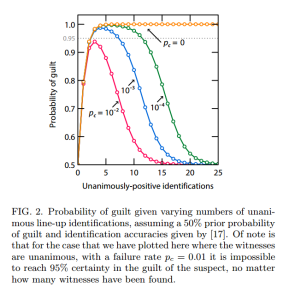 ty as the number of eyewitnesses saying “that’s the guy” increases. The first eyewitness to identify the suspect increases our confidence that the suspect is guilty and our confidence increases when the second and third eyewitness corroborate but when a fourth eyewitness points to the same man our rational confidence should actually
decrease.
Even though the systemic failure rate is only 1%, that small probability starts to weigh more heavily the more consistent (less noisy) the evidence becomes. The red line in the graph at right shows–using a 1% systemic failure rate and realistic probabilities of eyewitness identification–that after 3 witnesses more evidence decreases our confidence and when more than 10 witnesses identify the same suspect we should be less certain of guilt than when one witness identifies the suspect! The yellow line shows how certainty increases when there is no possibility of systemic failure which is what most people imagine is the case. Notice from the green line that even when the probability of systemic failure is tiny (.01%) it begins to dominate the results quite early.
What matters is not that the probability of systemic failure is tiny but how it compares to the probability of consistency which, with any reasonable estimate of noise, is itself getting tinier and tinier as evidence accumulates. In another application, the authors show how even the miniscule probability of a stray cosmic ray flipping a bit in machine code can materially reduce our confidence in common cryptographic procedures.
In summary, the peculiar rule of the Talmud receives support from Bayesian analysis–too much consistency is suspect of failure.
*Congress and the Shaping of the Middle East*
That is the new Kirk J. Beattie book, and I find it one of the very best studies on how Washington actually works; I am less interested in the determinants of Middle East policy per se. Here is one bit:
On the Senate side, I got the distinct impression that the constituents are not, in general, as important to senators as they are to House members. One gets the distinct impression that individuals with financial clout are far more likely to get senators’ attention than others. As one staffer put it, “If you’re talking to me, you’re talking about money. People are not coming to these issues for the first time. But for us, where our constituents are is very marginal.” That said, a small number of well-heeled individuals can get senators’ attention in many but certainly not all cases. The bias here runs distinctly in favor of putative supporters of Israel. While other religious or ethno-religious factors are in play, like the size and strength of a senator’s evangelical community, senators appear to be less concerned about these voices, unless of course the senator either shares or sees utility in that perspective. This parallels views held by House staffers, leaving one to think that evangelical senators’ commitment to Israel exceeds the level of pro-Israel concern by the evangelical masses.
Among other virtues, the book offers a new (to me) channel for how money might affect politics. Even if donors cannot “buy positions” from politicians, the need to stay competitive in a more or less zero-sum fundraising game means that Congressional staff do not have enough time to study or learn issues very well, and thus depend all the more on outside sources of information.
Definitely recommended, you can buy it here.
The Austrian theory of the business cycle continues its comeback
Except no one seems interested in calling it by that name. Here is the new NBER working paper by David López-Salido, Jeremy C. Stein, and Egon Zakrajšek, “Credit-Market Sentiment and the Business Cycle”:
Using U.S. data from 1929 to 2013, we show that elevated credit-market sentiment in year t – 2 is associated with a decline in economic activity in years t and t + 1. Underlying this result is the existence of predictable mean reversion in credit-market conditions. That is, when our sentiment proxies indicate that credit risk is aggressively priced, this tends to be followed by a subsequent widening of credit spreads, and the timing of this widening is, in turn, closely tied to the onset of a contraction in economic activity. Exploring the mechanism, we find that buoyant credit-market sentiment in year t – 2 also forecasts a change in the composition of external finance: net debt issuance falls in year t, while net equity issuance increases, patterns consistent with the reversal in credit-market conditions leading to an inward shift in credit supply. Unlike much of the current literature on the role of financial frictions in macroeconomics, this paper suggests that time-variation in expected returns to credit market investors can be an important driver of economic fluctuations.
The paper is here, here are ungated copies. Here are some other related “Austrian” papers.
The resurrection of both Austrian and “risk-based” theories shows how alive and well macro has been of late, but at least in blog land you don’t hear that much about them…
Claims about plastic
If we keep producing (and failing to properly dispose of) plastics at predicted rates, plastics in the ocean will outweigh fish pound for pound in 2050, the non-profit foundation said in a report Tuesday.
According to the report, worldwide use of plastic has increased 20-fold in the past 50 years, and it is expected to double again in the next 20 years. By 2050, we’ll be making more than three times as much plastic stuff as we did in 2014.
Keep in mind those numbers are crude extrapolations. Still, it is not clear what countervailing force would cause the production of plastics to decline. So I suppose Mr. McGuire was right.
Here is the Sarah Kaplan story.
Wednesday assorted links
2. 1987 piece on whether oil prices will hold at $18 a barrel — maybe they will!
3. Writing political speeches by AI algorithm.
4. Classic books, such as Moby-Dick, with only the punctuation.
5. From 2010 to 2014, life expectancy in Syria has fallen from 79.5 to 55.7.
6. What happens when a banking system shuts down? A look at Ireland in the 1970s.
China fact of the day
By almost all measures, China’s $3.3 trillion foreign reserves, the world’s largest, look formidable. Except one.
Compared with the amount of yuan sloshing around in the economy, a proxy for potential capital outflows, China’s firepower seems limited. The dollar reserves account for 15.5 percent of M2, a broad measure of money in circulation. That’s the lowest since 2004 and is less than levels in most Asian economies including Thailand, Singapore, Taiwan, Philippines and Malaysia, according to data compiled by Bloomberg.
That is from Ye Xie. Please do note all of the caveats and qualifiers in the longer piece. The claim is not that Chinese reserves are currently in some kind of crisis situation, only that we should not overestimate their import, relative to potential and indeed actual capital outflows.
How to seem telepathic
This is probably one of the most useful things you will learn from MR all year. It is from Maria Konnikova’s new book The Confidence Game:
In 2010, Nicholas Epley and Tal Eyal of Ben-Gurion University published the results of a series of experiments aimed at improving our person and mind perception skills. The title of their paper: “How to Seem Telepathic.” Many of our errors, the researchers found, stem from a basic mismatch between how we analyze ourselves and how we analyze others. When it comes to ourselves, we employ a fine-grained, highly contextualized level of detail. When we think about others, however, we operate at a much higher, more generalized and abstract level. For instance, when answering the same question about ourselves or others — how attractive are you? — we use very different cues. For our own appearance, we think about how our hair is looking that morning, whether we got enough sleep, how well that shirt matches our complexion. For that of others, we form a surface judgment based on overall gist. So, there are two mismatches: we aren’t quite sure how others are seeing us, and we are incorrectly judging how they see themselves.
If, however, we can adjust our level of analysis, we suddenly appear much more intuitive and accurate. In one study, people became more accurate at discerning how others see them when they thought their photograph was going to be evaluated a few months later, as opposed to the same day, while in another, the same accuracy shift happened if they thought a recording they’d made describing themselves would be heard a few months later [TC: recall Robin Hanson’s near vs. far mode]. Suddenly, they were using the same abstract lens that others are likely to use naturally…
Upon reading this passage I realized I have been thinking in these terms for years, without quite realizing it so explicitly.
One implication: if you feel bad one morning, don’t let it get you down and lower your confidence. Other people probably won’t notice your problems.
Another implication: you’ll understand yourself better if, in a given moment, you can pretend to distance yourself from some of your immediate impressions of your day, and treat yourself like a piece of your writing which you set aside for a week so you could look at it fresh.
A third implication is this: you can read other people’s moods better by ignoring some of your overall impressions of them, and by focusing on what they might perceive to be small changes in their situation, appearance, or stress levels.
The original research is here, worth a read (pdf). And here are various reviews of the Konnikova book.

Bad press for Auschwitz price fixing
Now, the Israel Antitrust Authority has announced that nine tour operator executives have been arrested on suspicion of running a secret price-fixing ring that was aimed at artificially inflating the cost of trips to former Nazi death camps such as Auschwitz.
At least six tour operators are being investigated on suspicion of involvement in the alleged cartel. In some cases, the homes of company executives were searched and property confiscated. According to the publication Haaretz, one of those detained is also suspected of bribery.
…The Israeli government had given a number of tour operators the tenders for the business of flying high school students to Poland. In theory, these companies would be in competition: The schools were supposed to negotiate among the companies to find the best deal. The investigation found that in practice, however, the prices appeared to be fixed among the companies. Although the operators appeared to offer discounts to schools, investigators say, these discounts were secretly coordinated and there was no real competition.
That is from Adam Taylor, via Otis Reid.
Fragments of note
…OxyContin abuse kills three times more people than gun homicides yearly.
That is from Scott Alexander, USA only, and here is Scott’s earlier post on guns, follow-up here.
Addendum: Do note the comment from GregS, this comparison may not be correct. Here is an update.
It’s all about women in the South
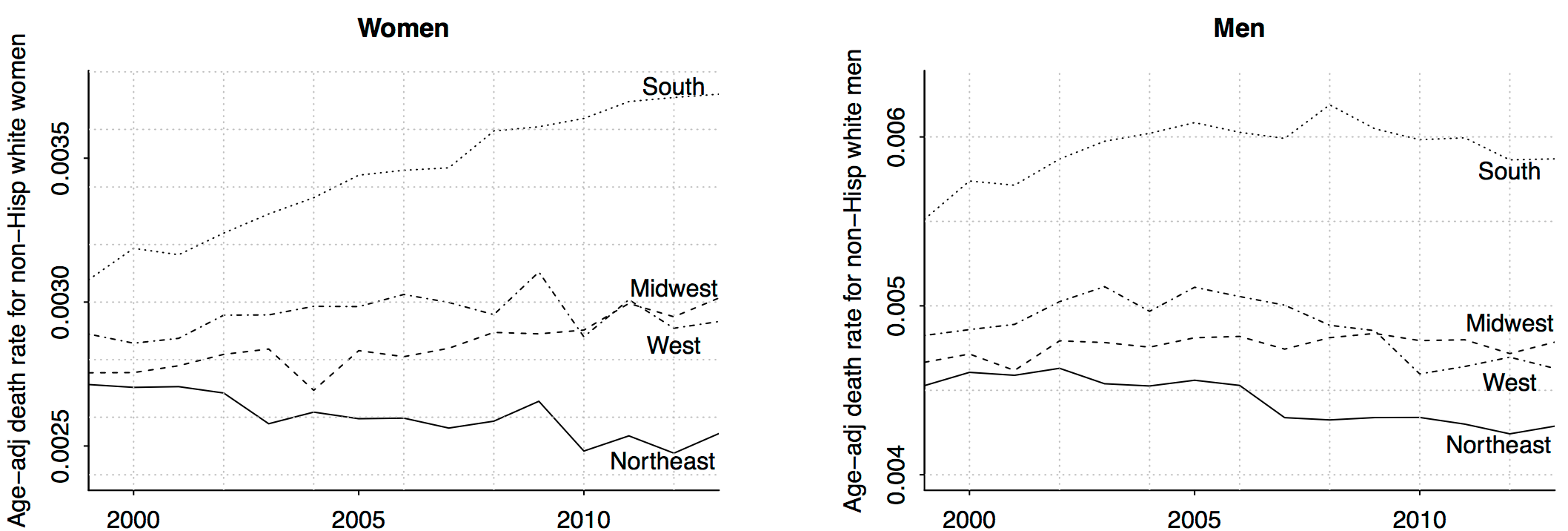
Wow!! Remember that increasing death rate among middle-aged non-Hispanic whites? It’s all about women in the south (and, to a lesser extent, women in the midwest). Amazing what can be learned just by slicing data.
I don’t have any explanations for this. As I told a reporter the other day, I believe in the division of labor: I try to figure out what’s happening, and I’ll let other people explain why.
That is from Andrew Gelman, there is more at the link.
Anti-GMO Research Under Fire
Nature reports that some of the research most-cited by opponents of genetically modifying crops appears to have been manipulated. In particular, images appear to have been altered and images from one paper appear in another paper describing different experiments with different captions.
Papers that describe harmful effects to animals fed genetically modified (GM) crops are under scrutiny for alleged data manipulation. The leaked findings of an ongoing investigation at the University of Naples in Italy suggest that images in the papers may have been intentionally altered. The leader of the lab that carried out the work there says that there is no substance to this claim.
The papers’ findings run counter to those of numerous safety tests carried out by food and drug agencies around the world, which indicate that there are no dangers associated with eating GM food. But the work has been widely cited on anti-GM websites — and results of the experiments that the papers describe were referenced in an Italian Senate hearing last July on whether the country should allow cultivation of safety-approved GM crops.
Tuesday assorted links
1. Stephen Jen makes excellent points about the global stock market rout.
2. Sharing economy for dogs. Of dogs? To the dogs?
3. I appreciate the reader who sent me this link to my earlier video debate with Roger Scruton about the nature of friendship.
4. Good interview with the highly intelligent George Soros, mostly on geopolitics. And Krugman on Bernie Sanders.
5. EconLog reading club on ancestry and long-term growth. These are very important issues, though I am never sure how much progress it is possible to make on them.
6. Does Germany not care about productivity growth?
7. Important update on Tinder and assortative mating. New information, basically.
The Indian market for sleep
Does any city have a more stratified sleep economy than wintertime Delhi? The filmmaker Shaunak Sen, who spent two years researching the city’s sleep vendors for a documentary, “Cities of Sleep,” discovered a sprawling gray market that has taken shape around the city’s vast unmet need for shelter. In some places, it breeds what he calls a “sleep mafia, who controls who sleeps where, for how long, and what quality of sleep.”
…Like many of this city’s businesses, sleep vendors are both highly organized and officially nonexistent. In Mr. Khan’s neighborhood, four quilt vendors have divided the sidewalks and public spaces into quadrants, and when night falls, their customers arrange themselves into colonies of lumpy forms. Some have returned to the same spot every night for years.
…Mr. Khan, who has been here for eight years, says he extends credit for regular customers to a limit of 100, or occasionally 200, rupees. (Several shivering men, who had spent the night around a smoldering fire nearby, snorted in disbelief upon hearing this.) He considers boundaries between vendors so sacred that he will not step across them. He makes regular payments to the police and street sweepers so they do not disturb his sleepers, and he maintains close relations with the local pickpockets so that he can tell them whom not to rob.
I wish I knew more about the market structure, coercive control, and ease of entry and the like. Nonetheless an interesting story from Ellen Barry at the NYT.
The intellectual origins of Ted Cruz?
When Cruz was thirteen his father brought him to Rolland Storey, a kindly and charismatic septuagenarian who ran a conservative foundation aimed at teaching youth about economics and government. Storey educated his pupils about the brightest minds of free market economics: they pored over Friedrich Hayek and Milton Friedman, and marveled at Frederic Bastiat’s denunciations of socialism as legal plunder. A veteran of vaudeville, Storey liked to re-create constitutional conventions and assign students to play delegates in mock debates. Many of his students were gifted, but none could keep up with Cruz in terms of passion and inherent ability. Thrust into some of the momentous scenes from world history, the thirteen-year-old was perfectly at home.
That anecdote is from McKay Coppins, The Wilderness: Deep Inside the Republican Party’s Combative, Contentious, Chaotic Quest to Take Back the White House, a fun read with lots of background information I did not know.
I will never forget the time Gregory Rehmke took me to meet Rolland Storey in Houston. But that is a story for another place and time…