Year: 2016
Time consistency and the economics of Russian oil
The status quo ex ante seems to be unraveling:
“The oil companies are not investing at all in exploration of new deposits because profits on these projects will only come in 10 years. Nobody will invest in these projects.”
Of course the Russian government may end up resorting to an expropriation. So why invest? But that seems to make the need for an expropriation all the more urgent:
There is little doubt that Russia needs the money now, and that the oil companies provide an enticing target. Because they are paid in dollars but conduct their domestic business in the battered ruble, Russia’s oil majors have lots of cash. While globally most oil companies are deep in the red, cash reserves industrywide in Russia remain at an estimated $90 billion, a deep and tempting pool for the strapped Kremlin.
Yet this is exactly the worst time for trust to collapse:
…oil deposits discovered and developed in Soviet times are nearing depletion. The country’s oil future, like that of the United States, lies in offshore and shale projects that are more expensive to develop.
Do not expect a stellar outcome:
A study leaked from the Ministry of Energy, seen as allied with the oil industry, and published last week in the business daily Vedomosti, presented a doomsday scenario. Russia, the analysis predicted, could cease to be an oil power, with output plummeting to half the current level by 2035.
It is always interesting to look at past history:
It would not be the first time oil entered a spiral of declining volumes and rising demands from the state. Short of cash in an oil price downturn in the late Soviet period, the Kremlin squeezed the oil industry. It was deprived of capital, at the time, for such things as imported machines.
Output in what is today the Russian Federation fell to about 8.8 barrels in 1991 from about 11 million barrels a day in 1988…
Here is the NYT piece by Andrew E. Kramer.
Another look at why the refugee deal does not involve incentive-compatible trades
Under the one in, one out policy, an undefined number of member-states have committed themselves to resettling 72,000 Syrian refugees from Turkey. But the EU’s record in resettling and relocating people is less than impressive: in September 2015, EU member-states agreed to relocate 160,000 asylum-seekers from Greece and Italy (the so-called quota system). So far, they have relocated around 890. Some 600 cases are being held up because of security concerns, in part because of how difficult it is to perform background checks on asylum seekers. Even if the Turkish deal reduces the number of people making the perilous journey from Turkey to Greece, EU member-states would still need to resettle large numbers of Syrians. It is unclear why they would be more willing to do so now, when they have not fulfilled the promises they made six months ago.
That is from Camino Mortera-Martinez, the article has other points of interest.
Angolan arbitrage
Wikimedia and Facebook have given Angolans free access to their websites, but not to the rest of the internet. So, naturally, Angolans have started hiding pirated movies and music in Wikipedia articles and linking to them on closed Facebook groups, creating a totally free and clandestine file sharing network in a country where mobile internet data is extremely expensive.
Here is more, via Kevin Burke.
Thursday assorted links
1. Who has the power at a brokered convention? I’m no expert on this topic, but it seems to me this otherwise interesting piece slights “the voters” just a wee bit.
2. Probabilistic business hours.
3. On the revocation of white privilege in North Korea.
4. The Harvard library that protects the world’s rarest colors.
5. The political orientation of fans of various comedians. And Hyman Minsky on Donald Trump.
Russia Bans Queue
Kolejka (queue) is a Polish board game based on life under communism.
The players line up their pawns in front of the shops without knowing which shop will have a delivery. Tension mounts as the product delivery cards are uncovered and it turns out that there will be enough product cards only for the lucky few standing closest to the door of a store. Since everyone wants to be first, the queue starts to push up against the door. To get ahead, the people in the queue use a range of queuing cards, such as “Mother carrying small child”, “This is not your place, sir”, or “Under-the-counter goods”. But they have to watch out for “Closed for stocktaking”, “Delivery error”, and for the black pawns – the speculators – standing in the queue. Only those players who make the best use of the queuing cards in their hand will come home with full shopping bags.
…In this realistic game you really have to be savvy to get the goods.
The game was initially developed by Poland’s Institute for National Remembrance to teach about life under communism but the game became an unexpected hit and has since been translated into English, French, Japanese and Russian among other languages.
The Russian government, however, is not amused and have banned the game.
IPN reported that Russia’s consumer watchdog Rospotrebnadzor warned that the game is perceived as “anti-Russian” and excessively critical of the Soviet system. Russian authorities asked Trefl, the company who bought the game’s license from IPN, to either remove the direct historical references from it or risk getting the product banned.
“IPN did not agree to the implementation of these changes and that is why Kolejka is no longer in Russian shops,” a statement by IPN reads.
I imagine the Russians wouldn’t like Kremlin either.
Addendum: A lot of Americans could use some reminders about price controls and socialism, fortunately you can download and print Kolejka in English here (scroll down).
My favorite things Belgian
No, I am not there but think of this as an act of homage from a distance. Here goes:
1. Novelist: There is Simenon, Yourcenar, and Amelie Nothomb. I like them all but do not love them. Can I pick Julio Cortázar, who was born in Belgium even if he did not come of age there and essentially was Argentinian? As for a fictional character, how about Hercule Poirot?
2. Playwright: Maurice Maeterlinck, read especially Blue Bird.
3. Composer: César Franck is the obvious modern pick. There is also Henri Pousseur, and a variety of Renaissance composers, including Heinrich Isaac, Guillaume Dufay, Johannes Ockeghem, and Josquin des Prez. I’ll pick the violin works of Eugène Ysaÿe, as the Renaissance music is arguably more Burgundian or “Franco-Flemish” than culturally Belgian as it relates to the modern nation.
4. Jazz musician: Django Reinhardt, that one is easy, try this cut. Toots Thielmans, the jazz harmonica player, is perhaps runner up.
5. Economist: Jacques H. Drèze and Robert Triffin would be the obvious picks. A dark horse choice would be Jean Drèze, son of Jacques, for his obsessive data work in India. He still awaits a much-deserved major profile. Gustav de Molinari, who first wrote about private protection agencies and arguably was the first modern libertarian anarchist.
6. Painter: This has to be the strong suit. Magritte is an obvious choice, but there is also Gerard David, Hans Memling, Peter Paul Rubens, Anthony van Dyck, Adriaen Brouwer, Luc Tuymans, Jacob Jordaens, Paul Delvaux, Petrus Christus, Robert Campin, and Pierre Alechinsky, among others. Jan van Eyck is one of the greater painters ever, but for sheer Belgianness I will opt for James Ensor, see the image below.
7. Sculpture: Marcel Broodthaers. Right now there is a nice retrospective of his work on at MOMA.
7. Historian: Henri Pirenne, way ahead of his time.
9. NBA point guard: Tony Parker was born there, to American and Dutch parents, that counts for something.
10. Anthropologist: Claude Levi-Strauss. Tristes Tropiques remains a beautiful book to be read by all.
11. Movie: I cannot think of one I really like, can you help? And I can’t easily digest the works of Chantal Akerman.
11b. Movie, set in: In Bruges, a fun dark comedy.
12. Violinist: Arthur Grumiaux, but with competition from Sigiswald Kuijken.
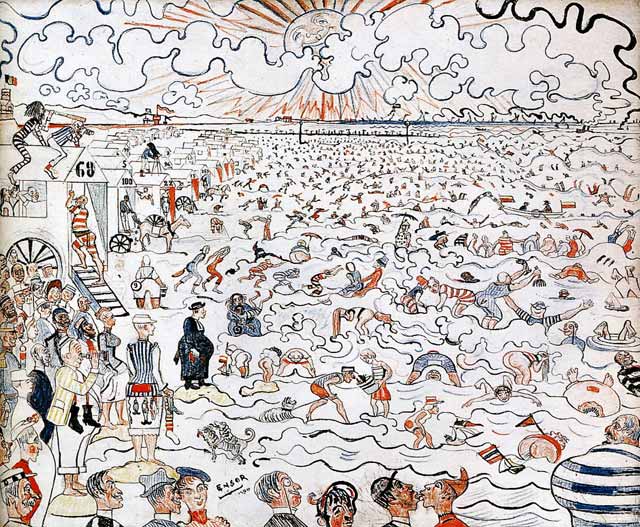
The bottom line: Once you get into the period where Belgium is a modern nation, it’s all so wonderfully offbeat.
The Wall Street fear gauge — updated VIX
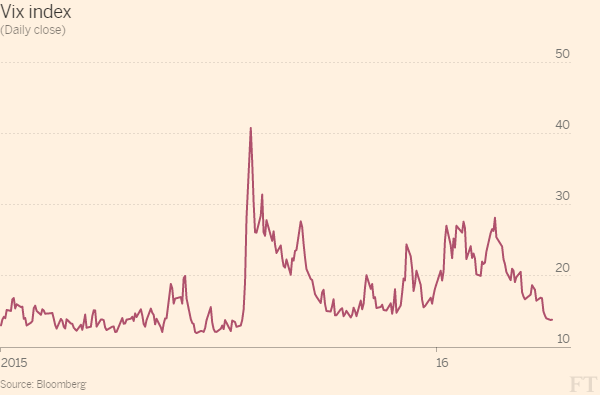
Source and discussion here at the FT.
Assorted Wednesday links
1. Vayase en Paz, by Juan Soriano, bachata song from the DR.
2. Should you be able to stunt the physical growth of your disabled child? (NYT) I say no.
3. High-quality start-ups are especially geographically concentrated.
4. Interview with Deirdre, story about Deirdre.
5. The most luxurious hotel ever built? It’s in Macau.
6. There is no great stagnation bed (short video).
7. Chronology of number of people killed in terror attacks in Europe.
Humiliation, the soda tax, and deadweight loss
Catherine Rampell’s excellent column considers the case for a soda tax in Britain. Here is one bit:
Why not just target the output, rather than some random subset of inputs? We could tax obesity if we wanted to. Or if we want to seem less punitive, we could award tax credits to obese people who lose weight. A tax directly pegged to reduced obesity would certainly be a much more efficient way to achieve the stated policy goal of reducing obesity.
Of course, “fat taxes,” even when framed as weight-loss tax credits, seem pretty loathsome. Why is . . . unclear.
We tax soda instead, even though that is less effective, for instance because soda drinkers may substitute into other sugary beverages. We are unwilling to humiliate the obese by taxing them directly, and so our chosen policies do less to help…the obese. (That’s assuming that attempting to shift their consumption behavior helps them at all, which is debatable.) As Robin Hanson has told us many times, politics isn’t about policy…
Does signaling also help you to do better?
That is the conclusion from a new paper by Rebecca Diamond and Peta Persson (pdf), on Swedish data, here is part of the abstract:
Despite the fact that test score manipulation [by teachers] does not, per se, raise human capital, it has far-reaching consequences for the beneficiaries, raising their grades in future classes, high school graduation rates, and college initiation rates; lowering teen birth rates; and raising earnings at age 23. The mechanism at play suggests important dynamic complementarities: Getting a higher grade on the test serves as an immediate signaling mechanism within the educational system, motivating students and potentially teachers; this, in turn, raises human capital; and the combination of higher effort and higher human capital ultimately generates substantial labor market gains. This highlights that a higher grade may not primarily have a signaling value in the labor market, but within the educational system itself.
Again, the result is that “encouragement effects,” or alternatively “writing off effects,” are stronger than many of us might think. Tell people enough times that they are a certain way, and eventually they will start to believe you. I would say this is evidence for my “beasts into men” theory of education, though other interpretations are not ruled out.
For the pointer I thank Ben Southwood.
Why can’t Europe police terrorism better?
What Europe does not have is any cross-national agency with the power to carry out its own investigation and make its own arrests.
This means that cross-border policing in the European Union has big holes. It depends heavily on informal cooperation rather than formal institutions with independent authority. Sometimes this works reasonably well. Sometimes this works particularly badly. Belgium is a notorious problem case, because its policing arrangements are heavily localized. In the past, many Belgian policing forces have had difficulty cooperating with each other, let alone with other European forces.
That is from Henry Farrell, there are other points at the link. Here is one bit more:
To take a different example, immigration and refugees present an even bigger and more visible set of challenges to the E.U. than terrorism, yet the E.U. has been unable to agree on reforms that might expand the budget and powers of FRONTEX, the E.U. agency charged with coordinating border control. Creating a European FBI-style institution would be an even bigger lift.
Keep this in mind the next time you are tempted to believe that the EU is doing everything possible to manage the refugees crisis well.
Early opposition to the jump shot
But in March 1963, a month before his final game for the Celtics, [Bob] Cousy complained to the Associated Press, “I think the jump shot is the worst thing that has happened to basketball in ten years.” Cousy’s objections? “Any time you can do something on the ground, it’s better,” he said, sounding very much like a coach who would have enjoyed benching Kenny Sailors or Bud Palmer. “Once you leave the ground, you’ve committed yourself.” Jump shot critics discouraged players from flying into the air because they feared the indecision that came when someone left their feet. They feared the bad passes from players who jumped with no clear plan of what they’d do in the air. Staying grounded meant fewer mistakes. It was simply a safer way to play the game, if not as exciting.
That is from Shawn Fury’s new and fun Rise and Fire: The Origins, Science, and Evolution of the Jump Shot — and How it Transformed Basketball Forever. Keep this in mind the next time you hear someone criticize Stephen Curry for taking (and making) so many three point shots. This is what I call “@pmarca bait.”
Tuesday assorted links
Statistics-free sports prediction
We use a simple machine learning model, logistically-weighted regularized linear least squares regression, in order to predict baseball, basketball, football, and hockey games. We do so using only the thirty-year record of which visiting teams played which home teams, on what date, and what the final score was. No real “statistics” are used. The method works best in basketball, likely because it is high-scoring and has long seasons. It works better in football and hockey than in baseball, but in baseball the predictions are closer to a theoretical optimum. The football predictions, while good, can in principle be made much better, and the hockey predictions can be made somewhat better. These findings tells us that in basketball, most statistics are subsumed by the scores of the games, whereas in baseball, football, and hockey, further study of game and player statistics is necessary to predict games as well as can be done.
That is an almost Hayekian result, and I wonder what the people at 538 will think of it.
For the pointer I thank Agustin Lebron.
Hong Kong fact of the day
Seventy-six per cent of Hongkongers aged 18-35 are still living with their parents, according to the Urban Research Group of City University of Hong Kong, despite an unemployment rate of just 3 per cent.
That is almost twice the level of the US, the UK or France.
According to the FT piece, many married couples still live separately, and with their parents.