Year: 2016
Saturday assorted links
1. Should New York City or NY state pay for CUNY?
2. The American middle class is doing fine in Utah.
3. Will German privacy law conflict with the storage of economic data for research?
4. Some of the academics who support Donald Trump and what they say.
5. “The DeafSpace philosophy rests on five basic principles.” For instance:
Groups of signers will naturally form circles or arcs to include everyone. They avoid long, rectangular tables, which impede views. The least Deaf-supportive space Bauman could think of, when I asked him what it might be, was the traditional classroom with straight rows of desks; that layout breaks up lines of communication, except between student and teacher. Many classrooms at Gallaudet have round or horseshoe-shaped seating arrangements. Meeting rooms may have oval desks; lecture halls are raked, and ideally have multiple aisles so an audience member can easily take the stage when he or she wants to ask a question.
An excellent article, interesting throughout.
The Stigler Center at the University of Chicago now has a blog
Here is a Luigi Zingales post, “Why this blog?”:
By gathering information on the nature and cost of this subversion of competition, by distributing this information among the public at large, and by making this information salient, media outlets can reduce the power of vested interests. By exposing the distortions created by special interests, they can create the political demand for a competitive capitalism.
This is the goal of our Pro-Market blog: to educate the public about the many ways competition can be subverted. In this exercise our only goal is to make the market system work better. In the finest University of Chicago tradition, we will do it with data. We will try to do it with the rigor of the best academic work, but without the pedantry that often accompanies it. This blog will collect opinions, summarize work, and report on relevant research by Chicago faculty and Stigler fellows. We will use every medium at our disposal, because the message is our medium.
Self-recommending…
Illiquidity does not seem to lower the quality of decision-making
There is a new AER piece by Leandro S. Carvalho, Stephan Meier, and Stephanie W. Wang, here is the abstract:
We study the effect of financial resources on decision-making. Low-income US households are randomly assigned to receive an online survey before or after payday. The survey collects measures of cognitive function and administers risk and intertemporal choice tasks. The study design generates variation in cash, checking and savings balances, and expenditures. Before-payday participants behave as if they are more present-biased when making intertemporal choices about monetary rewards but not when making intertemporal choices about nonmonetary real-effort tasks. Nor do we find before-after differences in risk-taking, the quality of decision-making, the performance in cognitive function tasks, or in heuristic judgments.
I would describe that one as a victory for Gary Becker…
Here are ungated versions.
The problem with ECB corporate bond buying
Yes, it is on the agenda, and those bond prices are up sharply, but there are more eligible bonds in some places than others:
Still BofAML sees €554 billion of debt ultimately eligible for ECB buying out of a European investment-grade universe that they put at €1.6 trillion. Of that €554 billion the vast majority has been issued by French and German credits, a fact which may disappoint some who were hoping for targeted stimulus of the eurozone’s weaker nations.
Deutsche Bank AG Credit Analysts led by Nick Burns see similar figures, estimating around €418 billion of eurozone corporate debt could be eligible for ECB purchases, with the bulk of that coming from German and French issuers.
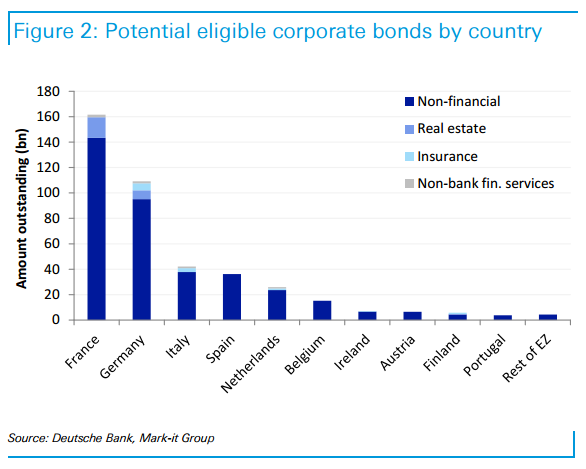
The more economically integrated United States would not have this problem to the same degree.
Friday assorted links
1. Algorithms to predict police misconduct.
2. When should you post or not post about your children on-line?
3. Is Cambodia’s Hun Sen buying most of his Facebook likes?
5. Star Wars: The Force Awakens received £31.6 million in British government tax subsidies, which means it was “certified as culturally British.”
6. The Thai movie Cemetery of Splendor is likely to end up as the best of the year, review here.
7. Jeffrey Goldberg (and Obama) on Obama’s foreign policy, yes it is a must read, it will end up as one of the best pieces of the year. See also the commentary by David Brooks.
Why Merkel’s deal with Turkey won’t work
First, the envisioned mass group deportation of irregular migrants from Greece back to Turkey is probably illegal under Europe’s commitments to the Geneva Conventions, which calls for individual evaluation of asylum cases and not mass deportations. Judicial review of this deal may well strike it down.
Second, the 1-1 swap model with Turkey is a nonscalable fantasy. EU leaders acknowledge that it does “not establish any new commitments on Member States as far as relocation and resettlement is concerned.” In other words, European leaders assume that any refugees accepted directly from Turkey will come out of the already agreed 160,000 quota slated for relocation from inside the European Union. While EU leaders should be applauded for trying to replace illegal migration through Turkey with a new regularized and legal route for refugees to enter Europe, it defies belief that EU member states will be more willing to accept refugees directly from Turkey than they have been willing to accept relocations from fellow EU members Greece and Italy. To date only a ludicrously low 885 refugees have been relocated, a fact certain to dampen Ankara’s willingness to accept returned irregular migrants from Greece. Rather than a 1-1 swap arrangement, this deal actually appears only to be a 0.00001–0.00001 arrangement.
That is from Jacob Funk Kirkegaard, the piece has other good points too.
What women want and what men get
Family structure in the United States has shifted substantially over the last three decades, yet the causes and implications of these changes for the well-being of family members remains unclear. This paper exploits task-based shifts in demand as an exogenous shock to sex-speci fic wages to demonstrate the role of the relative female to male wage in the family and labor market outcomes of women. I show that increases in the relative wage lead to a decline in the likelihood of marriage for those on the margin of a fi rst marriage, and present suggestive evidence that these eff ects are concentrated among less-desirable matches. A higher relative wage also causes women to increase their hours of work, reduce their dependence on a male earner, and increase the likelihood of taking guardianship over their children. These findings indicate that improvements in the relative wage have facilitated women’s independence by reducing the monetary incentive for marriage, and can account for 20% of the decline in marriage between 1980 and 2010.
That is the job market paper (pdf) of Na’ama Shenhav from UC Davis.
For the pointer I thank Ben Southwood.
Why is labor mobility in India so low?
From Kaivan Munshi and Mark Rosenzweig, here is the puzzle:
It follows that the real wage gap [rural to urban] in India is at least 16 percentage points larger than it is in China and Indonesia. There is evidently some friction that prevents rural Indian workers from taking advantage of more remunerative job opportunities in the city.
Indian migration to the cities is much lower than for China or Indonesia. Here is part of the answer:
The explanation that we propose for India’s low mobility is based on a combination of well-functioning rural insurance networks and the absence of formal insurance, which includes government safety nets and private credit.
…In rural India, informal insurance networks are organized along caste lines. The basic marriage rule in India (which recent genetic evidence indicates has been binding for nearly two thousand years) is that no individual is permitted to marry outside the sub-caste or jati (for expositional convenience, we use the term caste interchangeably with sub-caste). Frequent social interactions and close ties within the caste, which consists of thousands of households clustered in widely dispersed villages, support very connected and exceptionally extensive insurance networks.
Households with members who have migrated to the city will have reduced access to rural caste networks…
I believe “deficient infrastructure” and “lack of good manufacturing jobs” should be a bigger part of that answer, but nonetheless an interesting question and discussion. Might the multiplicity of languages in India be a factor too? Here is my earlier argument that Indian cities may be undercrowded.
For the pointer I thank the excellent Samir Varma.
Where is Germany headed?


Thursday assorted links
1. Robots in American law. And more on AlphaGo.
2. The people who can’t stop making puns.
3. Have gender stereotypes changed over the last thirty years?
4. Juniorization, especially on Wall Street.
5. Is passive investing hurting the economy?
What is the point of replication?
No experiment can ever be replicated so each attempted replication must assume that the things which differ don’t matter. The more and the more important the things that we can plausibly assume don’t matter, the stronger is the original study. Chemistry students have done the same experiments for hundreds of years and that’s useful because we can plausibly assume that who and when the experiment is conducted doesn’t matter. The recent brouhaha between Nosek et al. and Gilbert et al. illustrates a weaker case.
In their critique of Nosek et al., Gilbert et al. say that some of their replications failed because things were different.
An original study that asked Israelis to imagine the consequences of military service was replicated by asking Americans to imagine the consequences of a honeymoon
Now that sounds like two very different studies but Nosek provides important context. The original study in question wasn’t about military service or honeymoons it was about the conditions that promote reconciliation between victims and injurers after an injustice has been committed. The original study asked Israelis what they would do and how they would feel about a specific injustice. Namely you and a co-worker have been working on a project for a long-time but just before submission you are called away for reserve duty [male]/maternity leave [female]. Your co-worker takes credit for all the work and gets promoted while you later get demoted. The study then went on to ask questions about the conditions necessary for reconciliation. The reserve duty/maternity leave bit was just the story element needed to explain the situation not the focus of the study.
Nosek et al. tried to replicate the study in the United States where being called up for reserve duty is less common than in Israel and where being demoted for taking maternity leave could raise legal issues so they substituted ‘had to leave for honeymoon’. Everything else was the same. One of the original authors approved the new design.
Nosek et al. were not able to replicate the original findings. Is this because they didn’t replicate the study or because the study failed to replicate? Gilbert et al. say Nosek et al. failed to replicate the study.
In my view, Gilbert et al. are caught on the horns of a dilemma. If the studies don’t replicate they aren’t interesting and if the studies replicate but only under extremely precise conditions they also aren’t interesting. We are interested in general features of the human condition not in descriptions of the choices that 75 female and 19 male Israeli students made at a particular point in time. Moreover, if changes in wording matter then surely so does the fact that the original study was on Israeli’s in 2008 and the replication used Americans in 2013 (a lot has changed over these years!) and so must also a hundred other differences. But if so, what’s the point?
Hat tip: Andrew Gelman who has more to say.
China venture capital fact of the day
China is getting into the venture capital business in a big way. A really, really big way.
The country’s government-backed venture funds raised about 1.5 trillion yuan ($231 billion) in 2015, tripling the amount under management in a single year to 2.2 trillion yuan, according to data compiled by the consultancy Zero2IPO Group. That’s the biggest pot of money for startups in the world and almost five times the sum raised by other venture firms last year globally, according to London-based consultancy Preqin Ltd.
The money’s in what are known as government guidance funds, where local and central agencies play some role. With 780 such funds nationwide and a lot of experimentation, there’s no set model for how they’re managed or funded. The bulk of their capital comes from tax revenue or state-backed loans.
The article is here. If you are both impressed and worried at the same time, that is the correct reaction.
Why is it so hard to find the cash register?
That is increasingly the case at some upper end stores and boutiques. Ray A. Smith has a very good WSJ piece on this phenomenon, here is one bit:
More high-end boutiques and department stores are moving the machine out of sight or eliminating it entirely.
Instead, sales associates walk the floors with mobile checkout devices or handle transactions in discreet nooks. Stores aim to make the experience of paying more elegant, akin to private shopping, and to eliminate a pain point that keeps some shoppers from completing a purchase—having to wait in a visible line. Hiding the cash register also forces shoppers to interact with the salespeople and might even encourage them to buy more.
Furthermore:
1. Waiting in line is described as “unenlightened.”
2. I enjoyed this remark: “We’re downplaying that last transactional part of the experience…” And this: “”Researchers have identified a concept known as “the pain of paying,” said Ziv Carmon, a professor of marketing at Insead, a business school with campuses in Europe, Asia and the Middle East. “Doing away with the queue and even with the register makes the upcoming pain of paying less salient,” he said.”
3. When customers are not waiting in line but rather having their purchases processed “privately,” salespeople are encouraged to socialize with them and get to know them better. And: “Stores say sales associates are expected to sense when a shopper is ready to pay.”
Recommended.
Negative interest rates for non-state borrowers, the economy that is German
A German bank has become the first non-state borrower to issue euro denominated debt at a negative yield, another milestone as the continent’s financial system moves further into the world of sub-zero interest rates.
…Berlin Hyp issued €500m of covered bonds with no coupon and priced to yield minus 0.162 per cent on Tuesday, according to Bloomberg data. That means investors are guaranteed to lose money if they hold the bonds to maturity.
The FT story is here. Here is some commentary from the story:
“It feels counter-intuitive,” said Joost Beaumont, a strategist at ABN Amro.
Giancarlo Ibarguen has passed away
There is notice on Wikipedia, I have heard confirmation elsewhere. He was one of my all-time favorites, a truly curious man in the best sense of that term and also a true gentleman. He was dedicated to the teaching of economics, to Guatemala, and to ideas of liberty. We shall all miss him.