Year: 2016
China facts of the day
Yet the world’s biggest economy (at least by some measures) is tiny in terms of the size of its music market, which is smaller than that of Austria or Switzerland. It’s a mere sliver of the size of the US music industry.
Piracy is a major factor, but note this too:
While the IFPI calls China a country of “enormous untapped potential,” it also notes that only 10% of the market goes to non-Chinese-language music right now.
For the future there is this:
…all foreign media companies will be blocked from publishing digital content in the country, any online text, audio, or video content produced abroad—starting March 10—will be in violation (link in Chinese) of national law.
Here is the Amy X. Wang piece, via Ted Gioia, who also points out that now China is the largest movie market in the world.
By the way, are you still thinking that China’s service sector is holding the economic line? Here is the latest:
Still, the services gauge slipped to 52.7 in February, from 53.5 in January. Measures of new orders, selling prices, employment, backlogs and inventories were below the 50 dividing line between improving and worsening conditions.
A separate manufacturing reading from Caixin Media and Markit Economics fell to 48 in February, from 48.4 in January.
That said, the 13th Five-Year Plan will be released soon…
Wednesday assorted links
1. Economists working in tech companies.
2. A visual look at two million chess games.
3. The middle part of America is more religious than the South.
4. The Matt Grossmann and David A. Hopkins paper on ideological Republicans and group interest Democrats (pdf). And here is an overview of its reception.
European place names with the word “saint” in them

No, they didn’t forget to fill in the map for Scandinavia, those are the actual metrics. Source here.
Marginal Revolution University Subtitled in Multiple Languages
Here’s a cool new feature at MRUniversity. Click on the settings icon (the gear) in one of our videos and you will find options for subtitles. English subtitles are useful for the deaf or those with hearing loss and also helpful for those learning English as a second language. In addition, we now have professional subtitles for our Principles of Microeconomics class in French, Arabic and Spanish. We have started in on Chinese and we have more languages on the way. Our Principles of Macroeconomics is subtitled in English and Spanish (so far!).
Actually, thanks to Google Translate, we have machine-translated subtitles in dozens of different languages including Turkish, Hindi, and Vietnamese. The machine translated versions are a bit crude, of course, which is why we are adding professional translations but the machine versions are getting better all the time!
What are the core differences between Republicans and Democrats?
Paul Krugman has a long post on this question, here is part of his bottom line:
…the Democratic Party…[is] a coalition of teachers’ unions, trial lawyers, birth control advocates, wonkish (not, not “monkish” — down, spell check, down!) economists, etc., often finding common ground but by no means guaranteed to fall in line. The Republican Party, on the other hand, has generally been monolithic, with an orthodoxy nobody dares question. Or at least nobody until you-know-who…
My view is not so far from that, but I would put it a little differently and then push harder on some other dimensions of the distinction (btw Brad DeLong comments). The Republican Party is held together by the core premise that the status of some traditionally important groups be supported and indeed extended. That would include “white male producers,” but not only. You could add soldiers, Christians (many but not all kinds), married mothers, gun owners, and other groups to that list.
(The success of Trump by the way is that he appeals to that revaluation of values directly, and bypasses or revises or ignores a lot of the associated policy positions. That is why the Republican Party finds it so hard to counter him and also fears it will lose its privileged position, were Trump to win. The older Republican policy positions haven’t delivered much to people for quite some time.)
Democrats are a looser coalition of interest groups. They agree less on exactly which groups should rise in status, or why, but they share a skepticism about the Republican program for status allocation, leading many Democrats to dislike the Republicans themselves and to feel superior to them. In any case, that underlying diversity does mean fewer litmus tests and potentially a much broader political base, as we observe in higher turnout Presidential elections, which Democrats are more likely to win these days. That also means more room for intellectual flexibility, although in some historical eras this operates as a negative.
Right off the bat, this distinction between the two parties puts most blacks, single women, and most but not all Hispanics in the Democratic camp. Not-yet-assimilated immigrants have a hard time going Republican, even though a lot of high-achieving Asians might seem like natural conservatives. No matter how much Republicans talk about broadening their message, the core point is still “we want to raise the status of groups which you don’t belong to!” That’s a tough sell, and furthermore the Republicans can fall all too readily into the roles of being oppressors, or at least talking like oppressors.
Republicans, who are focused on the status of some core groups at the exclusion of others, are more likely to lack empathy. Democrats, who oppose some of the previously existing status relations, and who deeply oppose the Republican ideology, are more likely to exhibit neuroticism.
It is easy for Republicans to see the higher neuroticism of Democrats, and easier for Democrats to see the lesser empathy of Republicans. It is harder for each side to see its own flaws, or to see how the other side recognizes its flaws so accurately.
Academics are one of the interest groups courted by Democrats. Academics want to appear high status and reasonable, and Democrats offer academics some of those features in the affiliation, including the option to feel they are better than Republicans. So on issues such as evolution vs. creationism (but not only), Democrats truly are more reasonable and more scientific. Academics consume those status goods, plus the academics already had some natural tendencies toward neuroticism.
Academics shouldn’t feel too good about this bargain. They are being “used” as all party interest groups are, and how much reasonableness they can consume in the Democratic coalition will ebb and flow with objective conditions. In the 1970s and 1980s, for instance, it was common for Democrats to be more delusional than Republicans, and those days may someday return, though not this year.
Next, we must move beyond the federal level to understand the two parties, and that is also a good litmus test for whether a discussion of the two parties is probing as opposed to self-comforting.
At the state and local level, the governments controlled by Republicans tend to be better run, sometimes much better run, than those controlled by the Democrats (oops). And a big piece of how American people actually experience government comes at the state and local level.
This superior performance stems from at least two factors. First, Republican delusions often matter less at the state and local level, and furthermore what the core Republican status groups want from state and local government is actually pretty conducive to decent outcomes. The Democrats in contrast keep on doling out favors and goodies to their multitude of interest groups, and that often harms outcomes. The Democrats find it harder to “get tough,” even when that is what is called for, and they have less of a values program to cohere around, for better or worse.
Second, the states with a lot of Democrats are probably on average harder to govern well (with some notable Southern exceptions). That may excuse the quality of Democratic leadership to some degree, but it is not an entirely favorable truth for the broader Democratic ethos. Republicans, of course, recognize this reality. Even a lot of independent voters realize they might prefer local Republican governance, and so in the current equilibrium a strong majority of governors, state legislatures, and the like are Republican.
Think on those facts — or on the state of Illinois — the next time you hear the Democrats described as the reality-oriented community. That self-description is “the opium of the Democrats.”
If you wish to try to understand Republicans, think of them as seeing a bunch of states, full of Republicans, and ruled by Republicans, and functioning pretty well. (Go visit Utah!) They think the rest of America should be much more like those places. They also find that core intuition stronger than the potential list of views where Democrats are more reasonable or more correct, and that is why they are not much budged by the intellectual Democratic commentary. Too often the Democrats cannot readily fathom this.
At some level the Republicans might know the Democrats have valid substantive points, but they sooner think “Let’s first put status relations in line, then our debates might get somewhere. In the meantime, I’m not going to cotton well to a debate designed to lower the status of the really important groups and their values.” And so the dialogue doesn’t get very far.
Again, both the Democrats and the Republicans have their ready made, mostly true, and repeatedly self-confirming stories about the defects of the other. They need only read the news to feel better about themselves, and the academic contingent of the Democrats is better at this than are most ordinary citizens. There is thus a rather large cottage industry of intellectuals interpreting and channeling these stories to Democratic voters and sympathizers. On the right, you will find an equally large cottage industry, sometimes reeking of intolerance or at least imperfect tolerance, peddling mostly true stories about the failures of Democratic governance, absurd political correctness, tribal loyalties, and so on. That industry has a smaller role for the intellectuals and a larger role for preachers and talk radio.
It is easier for intelligent foreigners to buy more heavily into the Democratic stories. They feel more comfortable with the associated status relations, and furthermore foreigners are less likely to be connected to American state and local government, so they don’t have much sense of how the Republicans actually are more sensible in many circumstances.
It would be wrong to conclude that the two parties both ought to be despised. This is human life, and it is also politics, and politics cannot be avoided. These are what motivations look like. Overall these motivations have helped create and support a lot of wonderful lives and a lot of what is noble in the human spirit. We should honor that side of American life, while being truly and yet critically patriotic.
That said, I see no reason to fall for any of these narratives. The goal is to stand above these biases as much as possible, and communicate some kind of higher synthesis, in the hope of making it all a bit better.
This year, I’m just hoping it doesn’t get too much worse. In the last few years I have seen some nascent signs that Democrats are becoming less reasonable at the national level, for instance their embrace of the $15 national minimum wage. I also am seeing signs that the Republicans are becoming less fit to govern at the local level, probably because national-level ideology is shaping too many smaller scale, ostensibly pragmatic decisions. The Trump fixation also could end up hurting the quality of Republican state and local government. So this portrait could end up changing fairly rapidly and maybe not for the better.
The collapse of Schengen
This is between Austria and Germany, two of the “closest” EU economies in terms of trade and similarity:
FREILASSING, Germany — Traffic along one of Europe’s busiest highways, which used to flow unimpeded, now often backs up for miles at a newly installed checkpoint, where a phalanx of German police officers screens trucks and cars for hidden migrants.
At this border crossing, as a result, Austrians who work in Germany have trouble getting to their jobs. Many companies in Germany must wait days longer for deliveries of food, machine parts and other goods. Shoppers who made quick weekend jaunts to Freilassing’s stores now mostly stay away.
“It’s really bad,” said Karl Pichler, the owner of a large gardening center here in Freilassing, whose sales of tulips, rose bushes and other plants has slumped as longtime customers from Austria have stopped coming.
…With 57 million vehicles a year and 1.7 million workers a day crossing Europe’s frontiers, the European Union could face up to 18 billion euros, or $19.6 billion, each year in lost business, steeper freight and commuter costs, interruptions to supply chains, and government outlays for augmented border policing, according to a recent report by the European Commission, the bloc’s administrative arm.
Should the European Union revert to permanent border checks to slow Syrian, Afghan and Iraqi migrants traveling through Greece and the west Balkans toward Northern Europe, the long-term cost could exceed €100 billion, the French government calculated in a separate study.
Here is the full story (NYT), and do note that long-run elasticities are much greater than short-run elasticities. So if this continues, the longer-run effects on cross-border trade, not to mention EU governance, could be quite dire indeed. And right now that is the default scenario.
Tuesday assorted links
1. How did France, Canada, and Japan keep costs down for nuclear power. This is also a good essay for understanding health care.
2. First accident with a self-driving car? “The car was rolling at 2 mph and the bus at 15 mph. No one was injured.”
3. Sweden’s first unmanned food store, all you need is a phone.
4. Larry Summers on Donald Trump. If you need further persuasion, just imagine Japan deciding to build nuclear weapons.
5. How black immigrants are reshaping America: “A full 9% of black Americans are immigrants…”
6. The Myth of the Rational Voter 2016, by Bryan Caplan.
*Critical Review* symposium on Ilya Somin on democratic ignorance
You’ll find it here, ungated. Ilya’s book, Democracy and Political Ignorance: Why Smaller Government is Smarter, argues we pay a heavy price for democratic ignorance. In this symposium, a variety of academics dissent from his argument. Thomas Christiano’s piece for instance is entitled “Voter Ignorance is Not Necessarily a Problem,” here is one bit:
The second [premise of Somin] is that voter ignorance betokens bad public policy. But there is plenty of evidence to the contrary. How can this be the case? One explanation is that individually ignorant voters are small pieces of a large system that divides intellectual labor through discussions among elites, opinion leaders, and ordinary citizens. This system may entitle voters to trust in the opinions of others, sparing them the need to be well informed.
Here is Benjamin Page:
Ilya Somin’s Democracy and Political Ignorance suffers from the fallacy of composition: It uses individual-level evidence about political behavior to draw inferences about the preferences and actions of the public as a whole. But collective public opinion is more stable, consistent, coherent, and responsive to the best available information, and more reflective of citizens’ underlying values and interests, than are the opinions of most individual citizens.
Let’s ask them again later today!
Here is Ilya’s response to his critics.
The regulatory state and the importance of a non-vindictive President
I hope we always will have non-vindictive Presidents in this country. One reason is because the regulatory branch reports to the Executive. And if you own a large company, it is virtually impossible to be in accordance with all of the regulations all of the time. If there were a President who wished to pursue vendettas, the regulatory state would be the most direct and simplest way for him or her to do so. The usual presumption of “innocent until proven guilty” does not hold in many regulatory matters, nor are there always the usual protections of due process.
I do know that Philip Hamburger’s book Is Administrative Law Unlawful? occasioned some critical reviews. I certainly don’t think the title frames the argument properly and by no means do I agree with everything he said. But these days, the notion that the regulatory state could prove dangerous to individual liberties, and not just to economic growth, needs to be taken more seriously, and he has written the “go to” book on that topic.
I wonder if this is one reason why some of the leaders in the Republican Party have been somewhat reluctant to challenge Donald Trump. Perhaps they fear regulatory reprisal.
I also believe that many of Trump’s strongest critics — often Democrats — are ill-suited to understand or admit this side of the problem. They have plenty of good arguments against Trump, but I haven’t heard this one yet.
Here is an excerpt from the Vermeule review of Hamburger:
One reaction to Hamburger’s book might be that it is interestingly wrong, in an unbalanced sort of way. On that view, the book could be seen as offering a kind of constitutional fiction, an oddly skewed but engagingly dystopian vision of the administrative state — one that illuminates through its very errors and distortions, like a caricature, or the works of Philip K. Dick. The book might then be located in the stream of legalist-libertarian critique of the administrative state, the line running from Dicey, through Hewart and Pound and Hayek, to Richard Epstein. That work is nothing if not interesting, if only because it is so hagridden by anxiety about administrative law.
On further inspection, though, this book is merely disheartening. No, the Federal Trade Commission isn’t much like the Star Chamber, after all. It’s irresponsible to go about making or necessarily implying such lurid comparisons, which tend to feed the tyrannophobia that bubbles unhealthily around the margins of popular culture, and that surfaces in disturbing forms on extremist blogs, in the darker corners of the internet.

Whether you agree with Vermeule or Hamburger or stand somewhere in between, the disturbing reality is that Hamburger’s perspective could become more relevant rather more quickly than many of us had expected.
Read Ben Sasse:
Statements from Trump:
***“We’re going to open up libel laws and we’re going to have people sue you like you’ve never got sued before.”
***“When the students poured into Tiananmen Square, the Chinese government almost blew it. They were vicious, they were horrible, but they put it down with strength. That shows you the power of strength. Our country is right now perceived as weak…”
***Putin, who has killed journalists and is pillaging Ukraine, is a great leader.
***The editor of National Review “should not be allowed on TV and the FCC should fine him.”
***On whether he will use executive orders to end-run Congress, as President Obama has illegally done: “I won’t refuse it. I’m going to do a lot of things.” “I mean, he’s led the way, to be honest with you.”
***“Sixty-eight percent would not leave under any circumstance. I think that means murder. It think it means anything.”
***On the internet: “I would certainly be open to closing areas” of it.
***His lawyers to people selling anti-Trump t-shirts: “Mr. Trump considers this to be a very serious matter and has authorized our legal team to take all necessary and appropriate actions to bring an immediate halt…”
***Similar threatening legal letters to competing campaigns running ads about his record.And on it goes…
Is fear of regulatory reprisal from a Trump administration so unrealistic? I don’t think so.
The Logic of Closed Borders
Bloomberg: At least 100 workers at the construction site for Tesla Motors Inc.’s battery factory near Reno, Nevada, walked off the job Monday to protest use of workers from other states, a union official said.
Local labor leaders are upset that Tesla contractor Brycon Corp. is bringing in workers from Arizona and New Mexico, said Todd Koch, president of the Building and Construction Trades Council of Northern Nevada.
“It’s a slap in the face to Nevada workers to walk through the parking lot at the job site and see all these license plates from Arizona and New Mexico,” Koch said in an interview. Those who walked out were among the hundreds on the site, he said.
Erik Brynjolfsson tweeted “Build a wall! And make New Mexico pay for it.” Or perhaps require that Nevada carpenters be licensed.
Robin Hanson’s *The Age of Em* for $14
Today only, use the code LEAPDAY, or call 1-800-445-9714.
Here is my earlier review of the book.
The smart wi-fi water pitcher
The new pitcher, called the Brita Infinity pitcher, will be able to track how much water is flowing through the pitcher. When approximately 40 gallons of water have passed through the pitcher’s purification filter, the pitcher will then send a signal to the Dash Replenishment Service to reorder more filters.
The new Brita Infinity pitcher will sell on Amazon for $44.95. A three-pack of replacement filters costs between $15 and $20. Brita says the pitcher’s two lithium metal (non-rechargeable) batteries should last nearly five years, even if stored in a cold environment. You know, like your fridge. The pitcher holds up to eight cups of water, and is BPA-free.
Here is more, with a photo, via the excellent Samir Varma.
Monday assorted links
1. Disneyland institutes some surge-based pricing.
2. MIE: hipster gasoline.
3. “Our evidence does not support a common view that the Russian personality is fundamentally illiberal or non-democratic.” Not my view, but I am always happy to entertain contrary evidence.
Occupational Licensing Reduces Mobility
Brookings has a good memo on four ways occupational licensing reduces both income and geographic mobility. Here is point 1:
Since state licensing laws vary widely, a license earned in one state may not be honored in another. In South Carolina, only 12 percent of the workforce is licensed, versus 33 percent in Iowa. In Iowa, it takes 16 months of education to become a cosmetologist, but just half that long in New York. This licensing patchwork might explain why those working in licensed professions are much less likely to move, especially across state lines:
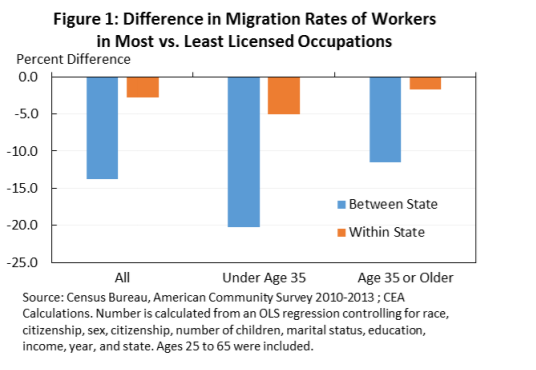 The graph, is from the excellent White House report on occupational licensing. The first blue column says that workers in heavily licensed occupations are nearly 15% less likely to move between states than those in less licensed occupations–this is true even after controlling for a number of other variables that might differ across occupations and also influence mobility such as citizenship, sex, number of children, and education.
The orange column provides another test. An occupational license makes it difficult to move across states but not within a state. If workers in licensed occupations had lower rates of mobility for some other reason than the license then we would expect that workers in heavily licensed occupations would also have lower rates of within state mobility. The orange bars show that workers in heavily licensed occupations do have slightly lower rates of within state mobility but not by nearly enough to explain the dramatically lower rates of between state mobility.
Lower rates of worker mobility mean that workers are misallocated across the states in a similar way that price controls or discrimination misallocate resources and reduce total wealth. Lower rates of workforce mobility also increase the persistence of unemployment.
To its credit, the Federal government is investing in efforts to make licenses more portable including encouraging “cross-State licensing reciprocity agreements to accept each other’s licenses.” Cross-state reciprocity agreements sound like an excellent idea.
Should we ban the $100 bill?
Ashok Rao has an excellent post on this question, and it is not obvious that a ban is in order. Here are a few parts of his multi-faceted argument:
- There is an information tradeoff. Imagine if criminals transacted only in $10,000 notes. It would be reasonably easy for intelligence agencies to sneak a traceable note to probe criminal networks. This would be close to impossible with a $20 note (not the least because this is a high velocity note used by normal people).
- Citing the high use of $100 among criminals doesn’t mean much. Of course criminals use the lightest / most compact / highest denomination currency at their disposal. Therefore suggestions along the lines of “n% of criminal activity is transacted in $100 bills” mean little because if we got rid of the $100 and managed to avoid the problems noted in point (1) it would be the case that “n% of criminal activity is transacted in $20 bills”.
I found this information on premia interesting, note the premia serve as an implicit tax for trading in $100 bills, though I wonder who exactly reaps that surplus?:

Finally, Ashok tells us this:
Would we not be hurting innocent people in oppressive regimes? Aren’t there autocracies in Africa and Eastern Europe that use HDN [high denomination] dollars as a means of trade in otherwise embargoed necessities?
Recommended.