Year: 2016
U.S. home prices have exceeded their 2005 peak
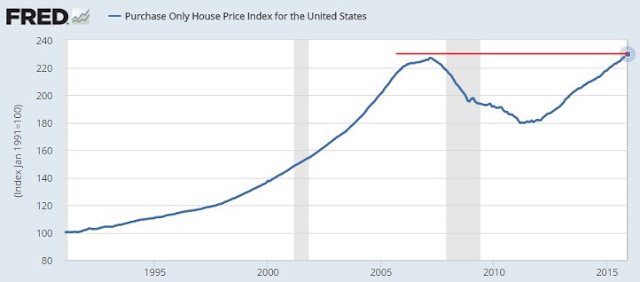
That is from Sober Look.
Sunday assorted links
1. Review of Geithner’s Coursera course on the financial crisis.
2. On-line tutors and the cheating economy.
3. It is those who identify “gay” with promiscuity who are most likely to oppose gay marriage.
4. Further evidence on assortative mating and income inequality (NYT).
5. Are self-driving cars green, or not?
6. Deflationary pressures just aren’t that strong in the U.S. right now.
Apple-Samsung Patent War Grinds On
The latest court decision in the Apple-Samsung patent war was a resounding defeat for Apple. Whatever you think about the merits of the case, however, Tim Worstall points out that the system isn’t working:
It’s easy enough to forget that the smartphone patent wars are still rumbling along. The actual competitive issues were all settled some years ago, the market has entirely moved on from the issues that were being discussed. However, the court cases over those patents carry on: and that’s exactly what is wrong with the system that we’ve got at present.
..taking 5 years to decide (assuming that there won’t be yet more appeals) in a market with a new generation of devices at least every year simply isn’t timely. Those competitive issues over who gets to sell what based upon copying or innovation have receded way back into the mists of time. None of the products under discussion are still on sale and haven’t been for a couple of years now. Whatever market opportunity either party had, either Apple or Samsung, is dead and gone now. But we’re still trying to decide over who should have that market opportunity? It’s just not working.
Why did the Whig Party collapse?
The Whigs were also badly hurt by the short-lived Native American or Know-Nothing party, which was primarily anti-immigrant and anti-Catholic.
That is just part of the answer of course. Here is another account, again too simplistic:
- For a brief time, many Americans supported the nativist Know-Nothing Party, concerned that the Know-Nothings might represent the only truly national party possible, largely united by a general fear of Catholic immigrants.
- But in the end, the issue over slavery proved stronger than fears over non-protestant immigrants, and southerners lined up behind the Democratic party and northerners behind the Republican party.
- Sectional party systems replaced a national party.
This seems to be the definitive detailed account. Try this book too. Most of the time, however, parties do not collapse but rather party members fall in line, fearing the costs of the alternatives, including the costs to their careers.
Here is my previous post Why did the Federalist Party collapse?
Why did the Federalist Party collapse?
I am not sure what prompted me to read up on this topic, but here is part of one of the dizzying answers I found:
When the votes were counted, Jefferson and his running mate Aaron Burr had both received seventy-three electoral votes; John Adams had obtained sixty-five, while Pinckney, his running mate, had sixty-four. The one remaining vote had gone to John Jay. The Federalists had denied one vote to Pinckney to insure that he would not obtain the presidency instead of Adams. The Republicans, however, had blundered in this respect. The Constitution provided merely that the candidate with the largest number of electoral votes should become President. As it was, Jefferson and Burr were tied. The election went into the House of Representatives where the Constitution provided that a state’s vote would be cast by a majority decision of its representatives. Since the Federalists controlled six states and had divided control in two states, they could prevent the election of either Republican – and over the bitter opposition of Hamilton they contemplated throwing their support behind Burr. They hoped to break the Republican ranks and secure themselves from “the fangs of Jefferson.” Hamilton pressed for the election of Jefferson, his old rival, insisting that Burr had the inclinations of a Caesar whereas Jefferson, despite his democratic fanaticism, would conserve the established order. But the Federalists, ignoring the urgent protests of Hamilton, persisted in a course that threatened to complete the Federalist debacle. Hamilton saw himself in “the awkward situation of a man who continues sober after the company are drunk.” Burr did nothing to simplify their task, to cooperate by private word or deed.
And that is only part of the story. Here is a simpler and indeed too simplistic account:
The Federalist party had the perception of favoring the upper class, and as a result they began to lose support of the general population. The Democratic and Republican parties started focusing on issues that appealed more to the “common man”, and as a result began to sway voters away from the Federalist party until it finally ceased to exist.
I’ll let you know what else I learn about this topic.
Arrived in my pile
Thomas Rid, Rise of the Machines: A Cybernetic History. Lots on Timothy Leary and the Whole Earth Catalog, among other topics, my browse of it was interesting.
Stephen S. Cohen and J. Bradford DeLong, Concrete Economics: The Hamiltonian Approach to Economic Growth and Policy; “And so America needs another redesign — and it needs it right now.” My browse impressions are all positive, although perhaps I see larger roles for spontaneous order, and luck, in any new Hamiltonian redesign.
Aileen M. Kelly, The Discovery of Chance: The Life and Thought of Alexander Herzen. A “fully-rounded” study of a thinker who is not read enough by Anglo-Americans.
Dennis Hale, The Jury in America: Triumph and Decline. Appears to be a quite good survey and overview, from the beginning of the republic up through the present day.
Todd G. Buchholz, The Price of Prosperity: Why Rich Nations Fail and How to Renew Them. This one I haven’t pawed through yet.
How Berkshire Hathaway thinks about climate change
From their new report (pdf, pp.25-26):
…insurance policies are customarily written for one year and repriced annually to reflect changing exposures. Increased possibilities of loss translate promptly into increased premiums.
Up to now, climate change has not produced more frequent nor more costly hurricanes nor other weather-related events covered by insurance. As a consequence, U.S. super-cat rates have fallen steadily in recent years, which is why we have backed away from that business. If super-cats become costlier and more frequent, the likely – though far from certain – effect on Berkshire’s insurance business would be to make it larger and more profitable.
As a citizen, you may understandably find climate change keeping you up nights. As a homeowner in a low-lying area, you may wish to consider moving. But when you are thinking only as a shareholder of a major insurer, climate change should not be on your list of worries.
The pointer is from Joseph Weisenthal.
Saturday assorted links
The declining labor force participation rate for middle-aged males
Here is for ages 40-44, since 1976:
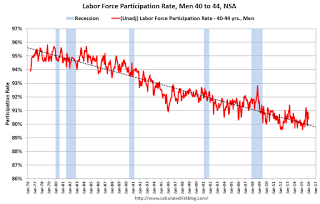
You sometimes hear there is no evidence of automation putting people out of work, but arguably the automation of manufacturing, plus IT-enabled foreign competition, are significant factors behind this trend. This picture also casts doubt on the common view that there are hidden real wage increases, not picked up by standard data and wage deflators and the like. You would expect higher real wages, if indeed they were in place, to be reflected in a more positive labor supply response, but we don’t see that.
That picture is from Bill McBride.
Elizabeth S. Eisenstein has passed away
She wrote the classic book The Printing Press as an Agent of Change, still worth reading. Here is the NYT obituary. The Washington Post obituary introduced me to another side of her life:
A year after retiring, Dr. Eisenstein achieved a different sort of professional peak, earning her first No. 1 ranking in tennis — as a member of the U.S. Tennis Association’s 65-and-over division.
Betty Eisenstein, as she was known on the court, played her first adult tournament in 1973, the year she turned 50. She lost — to International Tennis Hall of Fame member Dorothy “Dodo” Cheney — but quickly found her footing in a sport that she had played only briefly as a girl.
Dr. Eisenstein landed on the cover of Washington City Paper in 2005, under the headline “The Assassin.” Though 82 and standing only 5-foot-2, she was said to move “like a kid”: “She makes her opponent work so hard and hit so many extra shots that all the body blows eventually catch up to her,” the writer, Huan Hsu, said of her lethal drop shot.
Friday assorted links
1. Timothy Taylor on the World Bank.
2. Assortative mating across disorders.
3. A model in which only preferences for prestige survive evolution.
4. Mortgages to buy pharmaceuticals? Paper is here.
5. Geographic average is over (NYT); “It’s almost like you are looking at two different countries…”
Arrived in my pile
Timothy P. Hubbard and Harry J. Paarsch, Auctions, from The MIT Press Essential Knowledge Series.
Yuval Levin, The Fractured Republic: Renewing America’s Social Contract in the Age of Individualism.
Based on a short pawing of both volumes, I saw only virtues and no flaws.
The (refugee) problem with the Coase theorem
The EU’s agreed a €3bn deal with Turkey in order to help keep more migrants in the country, and reduce the influx of migrants. There’s been a lot of squabbling over how much each EU member state would pay, and the commitments have finally been agreed. The cash has not yet been delivered with concrete details yet to be ironed out. This has not been helped with the Turkish President Recep Tayyip Erdoğan threatening to send buses of migrants over the borders. The deal is sweetened for Turkey with a renewed commitment to talk about possible EU accession, and visa-liberalisation for Turkish citizens into the Schengen Area.
Perhaps the last part of that deal would not prove so popular with many EU citizens. Elsewhere:
…Tsipras has upped the ante again: warning parliament in Athens that he will not allow Greece to become, “a warehouse of souls,” and announcing that if Greece is left alone to deal with the crisis, he would block EU decisions at the next leaders’ summit in Brussels.
The Open Europe post is a good look at how Europe is failing to solve its refugee problems, or even come close.
Do conservatives prefer to use nouns?
The researchers, led by Dr Aleksandra Cichocka of the School of Psychology, also established that conservatives generally, to a greater degree than liberals, tend to refer to things by their names, rather than describing them in terms of their features. An example would be saying someone ‘is an optimist’, rather than ‘is optimistic’.
This use of nouns, rather than adjectives, is seen to preserve stability, familiarity and tradition – all of which appear to be valued more highly by conservatives than liberals.
Because nouns ‘elicit clearer and more definite perceptions of reality than other parts of speech’, they satisfy the desire for ‘structure and certainty’ that is common among social conservatives, the research authors found.
The research was based on studies carried out in three countries – Poland, Lebanon, and the USA. The US study compared presidential speeches delivered by representatives of the two main political parties. The sample included 45 speeches delivered by Republicans, considered to be more conservative, and 56 speeches delivered by then Democrats, considered to be more liberal.
The (gated) paper is here, and for the pointer I thank Charles Klingman.
Churchill and His Money
That is the subtitle, the proper title of David Lough’s new book is No More Champagne. I had not known the extent of the story here, namely that Churchill had appalling standards for money management and exercised extremely poor judgment over most of his adult life. Here is one bit from the opening:
…Churchill had recently inherited his great-grandmother’s Irish estate, transforming the erstwhile entrepreneur into a propertied landlord for the first time in his life — a rentier, as his wife Clementine put it.
To her intense disappointment, Churchill consumed the entire inheritance within a decade — by underestimating the cost of converting his new country home at Chartwell, by gambling more than he ever let on and by losing heavily in the Wall Street Crash of 1929…
In fact Churchill resigned from the Conservative front bench in the 1930s so he could earn more money as a writer and to some extent make up for these losses; that was one reason why he developed such a vivid writing style. He ended up borrowing about $3.75 million in current dollars. And there is this:
…during the decade, he gambled heavily enough on his holidays to lose an average of £40,000 each year in today’s money.
I enjoyed this sentence from the book:
Churchill was conscious that as chancellor of the exchequer his financial habits would have to change.
And this:
After the war, when taxes on income reached an eye-watering 97.5 per cent, Churchill rarely considered any business proposition unless his advisers assured him that he could present it to the Inland Revenue as a capital receipt, which would escape tax, rather than as income.
During the war, Churchill in fact challenged tax rulings from Inland Revenue on his various filings, and typically the rulings were in his favor. Over time, Inland Revenue stopped bothering his claims and assessments. Churchill had ongoing skirmishes with the tax collectors for over forty years and, believe it or not, he won most of them.
Recommended, an interesting book. The topic of politicians with money problems could indeed use more study.