Equal Population US States
Here is one proposal/art project to divide the United States into 50 equal population states, thereby creating a more balanced Senate. The geographic clusters are based on county proximity, urban area, and commuting patterns. Here is my earlier post calling for many more states.

Hat tip: Kottke.
Valentine’s Day Advice
If it doesn’t hurt, you aren’t signalling.
Road Fare>Congestion Pricing?
Congestion pricing sounds like something to avoid since neither term is something you want. Eric Jaffe held a contest for replacement terms. Decongestion pricing is one possibility since it at least hints at the idea that the pricing gets rid of congestion.
Tom Vanderbilt (author of Traffic) liked the phrase premium access — something to suggest “you pay for ‘peak perks.’ ..transport scholar David Levinson, suggests road fees for general road pricing (and peak road fees for road pricing aimed at heavy congestion), and urban planner Laurence Lui, recommends road fares. What’s nice about road fare is that it parallels mass transit, has an intuitive purpose, and offers flexibility. You can alter it to suit a specific situation — peak road fare, midtown road fare, etc. — without obscuring the basic meaning.
Road fare is quite good as it also suggests fair[ness] and can be used in an academic or commercial context. For a more commercial term I liked another suggestion, Pay2Go which has the great virtue of explaining what you get for your money.
Do note that death insurance didn’t sell well until it was given the less accurate but more affable name, life insurance.
Hat tip: Brandon Fuller.
Torture in a Just World
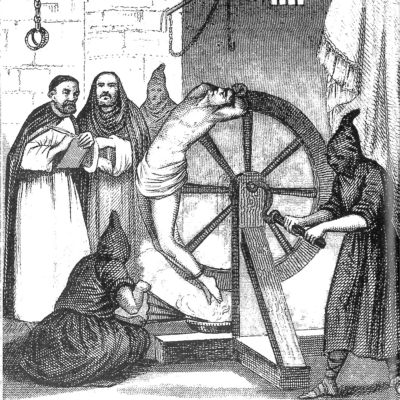 If the world is just, only the guilty are tortured. So believers in a just world are more likely to think that the people who are tortured are guilty. Perhaps especially so if they experience the torture closely and so feel a greater need to overcome cognitive dissonance. On the other hand, those farther away from the experience of torture may feel less need to justify it and they may be more likely to identify the tortured as victims. The theory of moral typecasting suggests that victims are also more likely to be seen as innocents (a la Jesus).
The theory is tested in a lab setting by Gray and Wegner. Experimental subjects are told that “Carol”, really a confederate, may have lied about a dice roll and that stress often encourages people to admit guilt. Subjects then listen to a torture session as Carol’s hand is plunged into a bucket of ice water for 80s. Subjects are then asked how likely is it that the torture victim was lying (1 to 5 with 5 being extremely likely). There are two intervention variables: 1) some of the subjects meet the torture victim before she is tortured, this is the close condition and some do not (distance condition) and 2) in some torture sessions the victim evinces pain (pain) and in others not (no pain). The key figure is shown below:
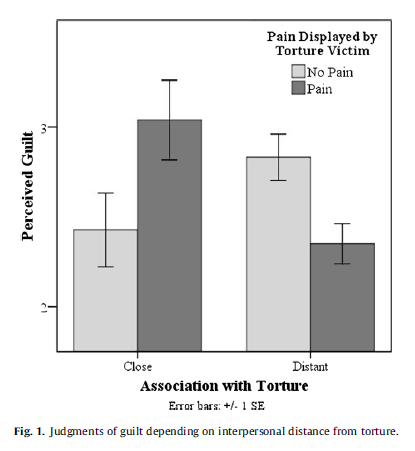 The most striking result is that in the close condition, the evincing of pain was associated with an increased judgment of guilt, consistent with torture causing cognitive dissonance which is relieved by a judgment of guilt (restoring the just world). But in the distance condition, the evincing of pain was associated with a decreased judgement of guilt, consistent with pain increasing the identification of the tortured as a victim and therefore innocent (a la moral typecasting).
Closeness in the experiment was reasonably literal but may also be interpreted in terms of identification with the torturer. If the church is doing the torturing then the especially religious may be more likely to think the tortured are guilty. If the state is doing the torturing then the especially patriotic (close to their country) may be more likely to think that the tortured/killed/jailed/abused are guilty. That part is fairly obvious but note the second less obvious implication–the worse the victim is treated the more the religious/patriotic will believe the victim is guilty.
The theory has interesting lessons for entrepreneurs of social change. Suppose you want to change a policy such as prisoner abuse (e.g. Abu Ghraib) or no-knock police raids or the war on drugs or even tax policy. Convincing people that the abuse is grave may increase their belief that the victim is guilty. Instead, you want to do one of two things. Among the patriotic you may want to sell the problem as a minor problem that We Can Fix – making them feel good about both the we and the fixing. Or, you may want to create distance – The problem is bad and THEY are the cause. People in the North, for example, became more concerned about slavery once the US became us and them.
I think research in moral reasoning is important because understanding why good people do evil things is more important than understanding why evil people do evil things.
New Teaching Tools
Gary King and Maya Sen discuss some of innovative ways that they use technology to teach Gary’s legendary class in statistics and social science at Harvard. Here is one bit
Instead of prohibiting smart phones in class, we require them …We then automatically deliver to their device a difficult conceptual question. We then give students a few minutes without discussion to reflect on the question and to indicate their answer on their device.
…Next, our system automatically puts students into groups of 2–5 [the system tells the students which other students to talk with and where to move in the classroom to find their group, AT]…We use an empirical approach to create the groups so that the conversation will be maximally productive. This is a system that is continually
updated, but for predictors we begin with data collected to characterize each student at the
start of the semester and add each student’s initial answer to the question just asked, their
answers to all previous CAPI questions and answers, their experience in the system, and
how productive previous CAPI discussions they participated in were. Finally, data from
thousands of other similar students in hundreds of other classrooms taking similar courses
can be used as well.We then ask the students to try to persuade the other members of their group of the
veracity of their answers. Since social connections motivate, we often get highly animated
discussions…Since teaching teaches the teacher, the students trying to persuade their
classmates improves their understanding of the subject matter.…We then deliver the same question to each student’s device again and have them answer
it. A minute or two later we project on the screen in front of the classroom a summary
of the answers before and after discussion, which gives them immediate feedback.…When it works best — which, like in survey research, is primarily a function of us
asking sufficiently clear questions — the proportion of correct student answers increases
from 20% to more than 80%.
Note that this particular technology recommendation is a bit of plumping for Gary’s company with Eric Mazur, Learning Catalytics. Nevertheless, I think these types of technologies pair very well with online education. It’s a mistake to think that online education is just delivery of lectures–online lecture delivery is merely a leading example of how information technology is revolutionizing education.
New Editors at The Independent Review
After 17 years of tireless work, Bob Higgs the founder and editor of The Independent Review, is stepping down. I’ve been fortunate to work with Bob at TIR both as an author and as an assistant editor for many years. As I wrote in 2006 Bob is one of the great editors, he has improved every paper in TIR. No one can replace Bob which is why he is handing over the task of editorship to an excellent new team, Robert Whaples, Chris Coyne and Michael Munger. Here is the announcement
The Independent Review is a scholarly interdisciplinary journal devoted to the study of political economy and the critical analysis of government policy. It publishes carefully researched, peer-reviewed scholarship and seeks to be provocative, lucid, and written in an engaging style. Ranging across the fields of economics, political science, law, history, philosophy, and sociology, The Independent Review takes a classical liberal approach and reaches a wide readership among academics, advanced students, policy analysts, journalists, and serious generalists.
Economic historian Robert Higgs, the journal’s founding editor will soon become its editor-at-large and is handing off editorial tasks to Robert Whaples (Wake Forest University), Christopher Coyne (George Mason) and Michael Munger (Duke).
The new editorial team welcomes high-quality article submissions. Please email your submissions (as a Word document) to [email protected].
Very Fast Insider Trading
On January 31, 2013, approximately 400 milliseconds before the official release of the EIA Natural Gas Report, trading activity exploded in Natural Gas Futures and ETFs such as UGZ, UNG and BOIL. Now that the Feds have stated (as claimed by a recent WSJ article) that they don’t think there is merit in prosecuting people who get news information earlier than others by milliseconds, is it any wonder?
More here. Previous MR posts on high frequency trading.
Economics Music Video Contest
The Hackley Endowment for the Study of Capitalism and Free Enterprise at Fayetteville State University is sponsoring an Economics Video Contest on the subject “Economic Value Is Subjective.” Entries are due Wednesday, May 15, 2013. First prize is $2,500, more info and rules here. The first entry, “big books” was pretty good once it got into the rap. Also, one of the big books looked familiar.
Medical Self Defense
Americans have historically put great weight on the right of self-defense which is one reason why many people support the 2nd Amendment, as the Supreme Court noted explicitly in District of Columbia v. Heller. But what about medical self-defense? John Robertson argues:
A person can buy a handgun for self-defense but cannot pay for an organ donation to save her life because of the National Organ Transplantation Act’s (NOTA) total ban on paying “valuable consideration” for an organ donation. This article analyzes whether the need for an organ transplant, and thus the paid organ donations that might make them possible, falls within the constitutional protection of the life and liberty clauses of the 5th and 14th amendments. If so, government would have to show more than a rational basis to uphold NOTA’s ban on paid donations.
Unfortunately, the Supreme Court has rejected medical self-defense arguments for physician assisted suicide and let stand an appeals court ruling that patients do not have a right to access drugs which have not yet been permitted for sale by the FDA (fyi, I was part of an Amici Curiae brief for this case). Robertson argues, however, that these cases can be distinguished. Physician assisted-suicide doesn’t fall within a long-American tradition necessary to receive due-process rights and organ transplants are not untested or experimental. It’s a good argument although it’s disappointing that the medical self-defense principle must be unjustly delimited.
Hat tip: Law, Economic and Cycling.
More Police, Fewer Prisons, Less Crime
The New York times as a good piece on prisons, police and crime:
“The United States today is the only country I know of that spends more on prisons than police,” said Lawrence W. Sherman, an American criminologist on the faculties of the University of Maryland and Cambridge University in Britain. “In England and Wales, the spending on police is twice as high as on corrections. In Australia it’s more than three times higher. In Japan it’s seven times higher. Only in the United States is it lower, and only in our recent history.”
…Dr. Ludwig and Philip J. Cook, a Duke University economist, calculate that nationwide, money diverted from prison to policing would buy at least four times as much reduction in crime. They suggest shrinking the prison population by a quarter and using the savings to hire another 100,000 police officers.
My work on policing in Washington, DC (with Jon Klick) also strongly suggests that more police pass the cost benefit test; we suggest that doubling the police force would not be unreasonable.
Selling Federal Assets
According to The Institute for Energy Research the Federal government owns oil and gas worth on the order of $128 trillion. I suspect that these numbers are optimistic. Nevertheless, some judicious sales of land and assets (and to its credit the Obama administration has made some small steps in this direction) would be wise.
Federal assets below the ground are primarily mineral and energy resources, such as oil, natural gas, and coal. For example, the United States owns millions of acres and billions of barrels of oil that can be developed on federal lands and waters. Currently, the government leases only 2 percent of federal offshore areas and less than 6 percent of federal onshore lands for oil and natural gas production. Areas that the federal government could open to oil and gas development include:
- The 10.4 billion barrels of oil and 8.6 trillion cubic feet of natural gas in the Arctic National Wildlife Refuge
- The 86 billion barrels of oil and 420 trillion cubic feet of natural gas in the outer continental shelf of the lower 48 states
- The 896 million barrels of oil and 53 trillion cubic feet of natural gas in the Naval Petroleum Reserve-Alaska
- The 25 billion barrels of oil in the outer continental shelf of Alaska
- The 90 billion barrels of oil and 1,669 trillion cubic feet of natural gas in the geologic provinces north of the Arctic circle
- The 982 billion barrels of oil shale in the Green River Formation in Colorado, Utah, and Wyoming.
These technically recoverable resources total 1,194 billion barrels of oil and 2,150 trillion cubic feet of natural gas that is owned by the federal taxpayer. At $100.00 per barrel of oil and $4.00 per thousand cubic feet of natural gas, the oil resources are worth $119.4 trillion and the natural gas resources are worth $8.6 trillion for a grand total of $128 trillion, or about 8 times the U.S. national debt.[iii]
Hat tip: Robert Murphy.
Chief Rabbi Sacks on Comparative Advantage
In this short video, Jonathan Sacks, the Chief Rabbi for the British Orthodox synagogues, explains how the “beautiful idea” of comparative advantage promotes peace, cooperation and tolerance among all people. Few religious leaders understand economics and fewer still are able to draw out the spiritual and humane dimensions. Yishar Koach!
Does Cable TV Ripoff People Who Don’t Like Sports?

Recently the LATimes ignited a firestorm of anti-sports commentary by arguing that people who don’t watch sports are being ripped off by Cable TV.
A key concern is that the higher bills driven by sports are being shouldered by subscribers whether they watch sports or not.
…”I pay $98 a month for cable and half of that is for sports?” said Vincent Castellanos, 51, a fashion stylist who lives inLos Feliz. “I’ve never once gone to a single sports channel. I wasn’t even aware I was paying for it. I want my money back. Who do I call?”
Derek Thompson at The Atlantic corrected some of the numbers but agreed with the analysis:
If you watch sports, millions of pay-TV households who never click on their ESPN channels are subsidizing your habit. If you don’t watch sports, you’re one of the suckers paying an extra $100 a year for a product you don’t consume.
Kevin Drum demanded a la carte pricing so that:
“sports fans would be forced to pay the actual cost of their sports programming without being subsidized by the rest of us.”
I don’t watch sports very often but I think the commentators have misunderstood the economics of Cable TV and the math of content provision. Let’s consider a simple model, there are content providers such as ESPN and Bravo, distributors such as the cable company and consumers. Let’s assume that there are 4 consumers, 3 of them value football at $10 and Top Chef at $0 and one vice-versa so the model looks like this:
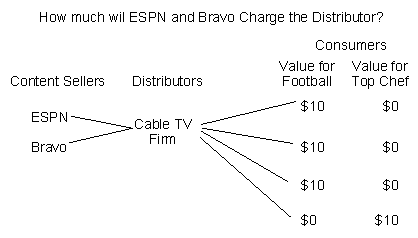
How much will ESPN and Bravo charge the distributors? Bilateral bargaining between content sellers and distributors can be complex but for the point I want to make we can assume that the distributors simple pass on their input costs to consumers. In this case, ESPN will charge the distributor $30 and Bravo will charge $10, the maximum that they can get.
Here is where the LA Times and the others go very wrong – they reason that $30 of the $40 charged is due to sports so each person is paying $7.50 for football ($7.50*4=$30) and $2.50 for Top Chef ($2.50*4=$10) and, therefore, the Top Chef viewer is being ripped off because 3/4 of their bill is going to support programming they never watch! Mathematically this is as true as any other division of total cost but conceptually it makes little sense. Consider, for example, what happens if we add football viewers. With 9 football viewers, ESPN will charge $90 and Bravo $10 and thus the LA Times would conclude that the Top Chef viewer is even more ripped off than before–90% of their bill is going to football! It’s very odd, however, that the ripoff of the Top Chef viewer gets bigger even as the price that they are charged and their viewing habits aren’t changing! Also as we add more football viewers the per-subscriber charge for Bravo gets smaller and smaller, with 10 viewers it’s only $1. Implicitly the LA Times is suggesting that this number represents what a la carte price would be or could be but that’s nonsense–whatever Bravo’s a la carte price would be it doesn’t get lower as we add more football viewers.
Conceptually it’s much clearer to say that each person is being charged $10 for the programming that they most want to watch. Moreover, the reason that Cable TV firms bundle is precisely because by making the demand for their product more homogeneous they can increase profits. In other words, the best bundle for the Cable TV firm is one in which everyone does in fact value the bundle equally.
The bottom line is that there is no reason to think that Top Chef viewers are subsidizing football.
What do Data Scientists Do?
Andrew Gelman edits The Statistics Forum, a blog of the American Statistical Association. He is looking for a series of guest posts about what statisticians/econometricians/data scientist do during their day–not the theory but the nitty gritty of what a typical day with its frustrations and triumphs looks like. Kaiser Fung’s post, three hours in the life of a (glorified) “data scientist” could be a model. Submissions from stats people in any field, academia, business, non-profit etc. are all welcome. Write Andrew here.
Development Economics – Final Exam
We have posted the last section of our course on Development Economics to MRU and the final exam is now open. Have fun!
New courses coming soon!