The Army of Economists
In a wide-ranging and interesting conversation Daniel Dennett reflects on hypocrisy and whether it may sometimes be optimal:
Suppose that we face some horrific, terrible enemy, another Hitler or something really, really bad, and here’s two different armies that we could use to defend ourselves. I’ll call them the Gold Army and the Silver Army; same numbers, same training, same weaponry. They’re all armored and armed as well as we can do. The difference is that the Gold Army has been convinced that God is on their side and this is the cause of righteousness, and it’s as simple as that. The Silver Army is entirely composed of economists. They’re all making side insurance bets and calculating the odds of everything.
Which army do you want on the front lines? It’s very hard to say you want the economists, but think of what that means. What you’re saying is we’ll just have to hoodwink all these young people into some false beliefs for their own protection and for ours. It’s extremely hypocritical. It is a message that I recoil from, the idea that we should indoctrinate our soldiers. In the same way that we inoculate them against diseases, we should inoculate them against the economists’—or philosophers’—sort of thinking, since it might lead to them to think: am I so sure this cause is just? Am I really prepared to risk my life to protect? Do I have enough faith in my commanders that they’re doing the right thing? What if I’m clever enough and thoughtful enough to figure out a better battle plan, and I realize that this is futile? Am I still going to throw myself into the trenches? It’s a dilemma that I don’t know what to do about, although I think we should confront it at least.
It would be astounding if there were never a situation in which a lie was effective in producing a good result, i.e. a noble lie. But is a rule of noble lies effective? In a long sequence of calls to war, how many have been just and wise and how many have been driven by vainglorious leaders and foolish pride–so which army do you want? I prefer the silver.
Note also that Dennett mixes narrow self interest and rationality in his description of “economists.” But one can be fully rational without being narrowly self-interested. Dennett, for example, cheats a bit with his puzzle. The premise is some “horrific, terrible enemy” but then later the economists ask “am I so sure this cause is just”, to which the answer should be, given the premise, yes. In which case fighting is a rational response.
Hat tip: Brian Donohue.
James Buchanan (1919-2013), Appreciations
 Here a number of appreciations and memories of Jim Buchanan. Steve Horwitz has a good, concise summary of some of his intellectual contributions:
Buchanan’s work changed political economy in fundamental ways. Thanks to him and his colleagues, three things are true: No one who wishes to talk responsibly about politics can be ignorant of public choice theory. No one should ever invoke the language of market failure (including externalities) without having digested his work on government failure. And people who run around talking about the constitution better be able to understand something of his contributions to constitutional political economy.
I agree entirely with Robert Higg’s portrait:
I first encountered Jim when he came to Johns Hopkins to present a seminar paper while I was a graduate student there, in 1967, as I recall. He did not make a good impression on me then. His presentation, like all his work, was nontechnical, and Hopkins specialized in a much more formal, mathematical style of economic analysis. When Professor Bela Belassa asked him a technical question, Jim shrugged it off as if its answer didn’t matter much one way or the other. In the grad students’ minds, this attitude toward the very sorts of things we were agonizingly trying to master suggested that he was a lightweight. In this respect, we could scarcely have been more wrong.
Indeed, the hallmark of Buchanan’s work from beginning to end was a deep seriousness of purpose and procedure that not many economists have matched in the past century. Unlike the typical mainstream economist, Jim was never just fooling around, toying with a tweaked model or a trivial, throw-away idea. To a rare degree, he kept his eyes focused on the prize of true economic understanding.
…. He gave me a deeper understanding of the market process than anyone else had given me. He raised many worthwhile questions that I continue to ponder. He offered me a shining example of the economist as a serious thinker, not simply an idiot savant fooling with models.
The NYTimes quotes Tyler:
Over the years since Dr. Buchanan won the Nobel, much of what he predicted has played out. Government is bigger than ever. Tax revenue has fallen far short of public programs’ needs. Public and private borrowing has become a way of life. Politicians still act in their own interests while espousing the public good, and national deficits have soared into the trillions.
…In a commentary in The New York Times in March 2011, Tyler Cowen, an economics professor at George Mason, said his colleague Dr. Buchanan had accurately forecast that deficit spending for short-term gains would evolve into “a permanent disconnect” between government outlays and revenue.
“We end up institutionalizing irresponsibility in the federal government, the largest and most central institution in our society,” Dr. Cowen wrote. “As we fail to make progress on entitlement reform with each passing year, Professor Buchanan’s essentially moral critique of deficit spending looks more prophetic.”
Writing in the Wall Street Journal our colleague Don Boudreaux also points to Jim’s work on the true burden of the debt–stop the we owe it to ourselves madness! Lars Christensen looks at one of Buchanan’s many interesting ideas, the brick standard for monetary policy. Randall Holcombe remembers his teacher. The Washington Post and Bloomberg offer useful commentaries as does political scientist Tim Groseclose.
Of course you should not ignore Buchanan’s own writings which spans more than 20 volumes, 10 of which are available online. Buchanan’s classic Politics without Romance offers a short introduction as does his Nobel lecture.
Buchanan’s Nobel lecture illustrates why, even today, many other economists don’t get Buchanan. While other economists are looking for “efficiency” and “optimality” in models Buchanan had a very different concept of welfare economics.
[Buchanan]…sought to bring all available scientific analysis to bear in helping to resolve the continuing question of social order: How can we live together in peace, prosperity, and harmony, while retaining our liberties as autonomous individuals who can, and must, create our own values?
On a personal note, I was fortunate to have Buchanan both as a teacher and as a colleague. He founded the Center for Study of Public Choice that today I direct.
Buchanan wrote not for the hour or the day but for the age and his influence will continue far into the long run.
The Illusion of Central Bank Independence
In 2009 a number of prominent economists signed a petition arguing for central bank independence. I was less enthusiastic writing:
There is nothing magical about independence that makes for low-inflation.
…The primary reason that independent central banks are better at controlling inflation is that absent direct political control the default selection mechanism favors bankers, i.e. lenders, people whose interests make them more favorable towards lower inflation.
Thus, independence is a political decision that favors lenders in the decisions of monetary policy. Now, depending on the alternatives, there may be good reasons for making this choice but we should not fool ourselves into thinking that we have depoliticized money. We should not be surprised, for example, that “independent” central banks tend to make lender of last resort decisions that protect banks and bankers.
Joseph Stiglitz recently made similar remarks
“[The crisis] has shown that one of the central principles advocated by Western central bankers- the desirability of central bank independence-was questionable at best…In the crisis, countries with less independent central banks-China, India, and Brazil-did far, far better than countries with more independent central banks, Europe and the United States. There is no such thing as truly independent institutions. All public institutions are accountable, and the only question is to whom.”
From Business Insider, which adds:
[Stiglitz] believes that in the run-up to the financial crisis, the Federal Reserve was accountable only to Wall Street, and singles out New York Fed President William Dudley for some especially harsh criticism. He claims Dudley was “a model of bad governance” because of his inherent conflict of interest: he bailed out the very banks he was supposed to regulate – the very same banks that enabled him to gain his position.
The Prison Population is Down
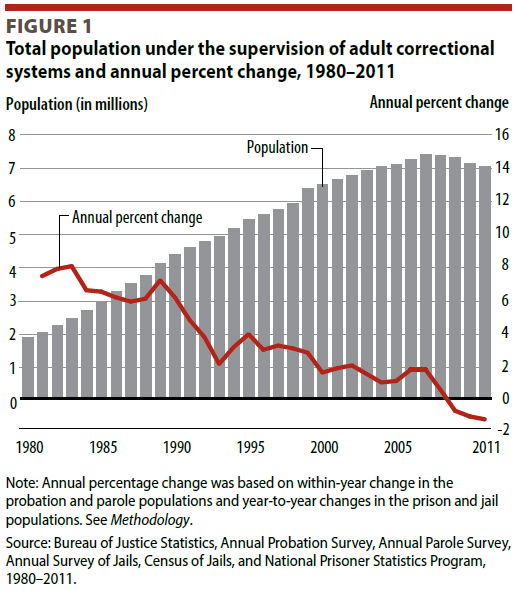
After more than thirty years of constant increase, prison populations have leveled off and in the last few years have begun to decline (pdf). It’s a momentous change and Keith Humphreys argues that the story has been under-reported because few people want to play up the good news
(1) Most of the state, local and federal officials who have helped reduce incarceration are scared to publicly take credit for it. In general, reducing incarceration is a good thing, but probability dictates that in particular cases it will be a horrible thing. At least a few of the roughly 100,000 fewer people under correctional supervision in 2011 versus 2010 for example will do something extremely violent and high-profile, and no politician wants to risk being in a story headlined “Convict released by thug-loving governor murders nun”.
Hat tip: Matt Yglesias.
Ice Cream Buybacks
NYTines: Mayor Blomberg announced today a new program to help reduce obesity and heart disease, ice cream buybacks. Any ice cream that citizens wish to turn in will be bought for up to $5 a pint. No questions asked. “Heart disease is the number one killer in the nation,” said Mayor Blomberg, “and we must do everything we can to get Ben and Jerry and these other killers off our streets.”
Critics argue that consumers are likely to reach into the back of their freezer to sell ice cream that is half-eaten, iced-over, and past its sell-by date, with little effect on heart disease. In previous buybacks, enterprising individuals have even bought cheap ice cream at Walmart and sold it back to the city at a profit. Economists have pointed out that local ice cream buybacks don’t make a lot of sense when ice cream remains widely available for sale. The National Academy of Sciences reported that the theory underling “buyback programs is badly flawed and the empirical evidence demonstrates the ineffectiveness of these programs.” Nevertheless, ice cream buybacks remain popular with voters.

More here, here and here on similar programs and here is my earlier op op-ed on a closely related topic.
Picture from Story Draw.
Restrictions on high skill immigration to Britain
From The Independent:
Russian-born physicist Professor Sir Andre Geim said new restrictions on non-European Union immigrants, including minimum salary requirements of at least £31,000 and tighter student visa rules, are blocking the brightest academics from working at British institutions. He told The Independent on Sunday that the restrictions would have prevented him and his team from identifying the revolutionary “super-material” graphene, which earned him the Nobel Prize in physics in 2010.
Sir Andre warned that future scientific breakthroughs at British institutions were at risk because of the tighter controls, introduced this year to bring down annual net migration from more than 200,000 to “tens of thousands”.
..Sir Andre, 54, first arrived in the UK in the early 1990s as a Russian citizen with a permit to work as a post-doctoral fellow at Nottingham University. His salary would have been around £27,000 in today’s money, meaning that he would have been barred from entry under the minimum salary requirement.
FYI, Geim is one of my favorite scientists of all time. He is the only individual to win both a Nobel prize, for graphene, and an Ig Nobel prize, for frog levitation. Awesome!
Of Monsters and Men
My favorite album of 2012 is My Head is an Animal (MP3 album just $3.99!) by the Icelandic group Of Monsters and Men–they mine the same vein as Arcade Fire and Fleet Foxes.
http://youtu.be/woGoM8T0gD8
Hat tip: Paul Krugman.
Most Popular MR Posts from 2012
Here are some of the most popular MR posts as measured by page views from 2012:
1. Introducing Marginal Revolution University – we asked you to spread the word about MRUniversity and you did making this the most viewed page this year. Thanks!
2. Krugman’s Response to Alex and the original Krugman v. Krugman.
3. Racism by Political Party. This one showed up on television.
4. Robert Solow on Hayek and Friedman and MPS. Tyler should let loose more often.
5. Firefighters Don’t Fight Fires. A graph is worth a thousand words.
6. A Bet is a Tax on Bullshit. I don’t think the scheme I outlined is quite right but I worked for a long time on the final paragraph and I was pleased that it was widely quoted.
7. Why economic mobility measures are overrated. Lots of meat in this post and in Tyler’s related posts What does the inequality-immobility link mean? and Krugman on income mobility and my Stasis, Churn and Growth.
8. Debtor’s Prison for Failure to Pay for Your Own Trial. An issue that should be more widely reported.
9. How savage has European austerity (spending cuts) been? Not that savage.
10. The Google Trolley Problem. A famous philosophical puzzle now must be answered in practice.
Among other meaty posts which were highly linked too were Tyler’s posts Why Old Keynesianism is looking worse these days; A simple theory for why so many smart young people go into finance, law and consulting and favorite non-fiction books of 2012. Also on the list were my posts Noble Matching and one of my favorites, Patent Theory on the Back of a Napkin.
A good year as we move towards MR’s tenth.
Working Conditions in China: Supply and Demand
The NYTimes has a lengthy and self-congratulatory article on improved working conditions in Chinese factories which it suggests are due to negative publicity from earlier NYTimes articles. Indeed, as soon as the NYTimes starts to investigate, we are presented with this boardroom set piece:
“The world is watching!” [Foxconn Chairman] Mr. Gou yelled, according to multiple people. “We are going to fix this, right here!”
The Times articles, part of a larger series, are well written and informative and no doubt they have prodded some changes at certain companies. China, however, is a very big place and the real story of better working conditions is a story of supply and demand.
Wages in Chinese factories have been low because wages in China’s agricultural interior were even lower and the great migration from the country to the city, one of the largest migrations in human history, meant that there was a ready supply of workers desperate for work and the more work the better. Even today many workers want longer hours:
In March, when Foxconn announced that workers’ hours would be reduced to China’s legal limits, employees began complaining. “Absolutely I’d like to do overtime to work more than 60 hours, but now there’s a ceiling on it,” said Ma Changqiao, a 23-year-old at Foxconn’s Chongqing factory.
As the great migration leveled off, however, wages began to rise. At first, workers wanted all of the increase in wages in money but as the more basic needs of workers and their families have been met the demand for better working conditions and more leisure has increased and this has made it profitable for firms to supply better working conditions.
Thus, the real story of better working conditions is not a spate of negative publicity, a mere blip in the face of much larger forces, but rising wages with a touch of Maslow’s hierarchy.
To its credit, the NYTimes article provides evidence for the larger story although you have to dig past the self-congratulatory material. The article notes, for example, that working conditions are also improving rapidly in little known companies not subject to NYTimes oversight:
The factory, in Chongqing, makes computers for Hewlett-Packard, a company with little of Apple’s glamour. It is operated by Quanta, a little-known Taiwanese manufacturer.
Inside the plant, amid thousands of workers in bright white uniforms, are occasional flashes of pink worn by people like Zhang Xuemei, a bubbly 19-year-old with glinting earrings whose sole job is to chat with co-workers.
For eight hours a day, Ms. Zhang collects complaints about the factory’s free meals and dorms. She listens to workers who are divorcing, homesick or arguing with managers. When she finds someone suffering, she refers them to the company’s full-time doctor or professional counselors.
Quanta’s 10-story dormitories feel like a college campus. There is a free movie theater, television rooms, a large martial arts gym, two spacious karaoke bars, a huge cafeteria and an aerobics hall playing a Chinese remix of “Gangnam Style.”
and here is the key
And the amenities are partly selfish: one of the biggest problems for Chinese factories is that workers are constantly leaving. Hewlett-Packard hopes that by improving living conditions, turnover and training costs will fall.
Addendum: Tim Worstall points out that “Manufacturing wages have been improving at 14% a year (yes, after inflation) since 2000. That’s a decade before anyone started to agitate about the working conditions at these factories. Or at least it’s a decade before anyone took any notice of such agitation.”
Happy Holidays to MR Readers!

Guest Blogger: Ed Lopez
Ed Lopez, co-author with Wayne Leighton of Madmen, Intellectuals and Academic Scribblers and president of the Public Choice Society, will be guest blogging at Marginal Revolution this week. Madmen is about the process of political change, where we are, where we should go and how can we get there given the insights of public choice economics. If, to quote Jim Buchanan, public choice is “politics without romance,” then Madmen is about revolution without romance–how political change can occur in a democracy. One of my favorite stories in Madmen is about Coase’s idea to auction spectrum rights.
But to allow the market to determine even the question of assignment meant a significant change in the status quo. When he was called to testify before the agency shortly before his FCC paper was published [in 1959, AT], Coase’s reception was indicative of how political institutions—especially Congress but also the FCC—would view his idea for decades to come. Commissioner Philip Cross began with the question, “Is this all a big joke?”
A decade later one former FCC commissioner wrote:
The Commission has absolutely no intention of considering them now or in the foreseeable future. They are purely the mind-spinning of an academic bureaucrat.
Most interestingly, in 1969 the RAND Corporation commissioned Coase, along with William Meckling and Jora Minasian, to produce a report on “Problems of Radio Frequency Allocation.” The Coase/Meckling/Minasian report was written in 1969 but not released until 1995! The report had been deemed too politically sensitive to publish and had been suppressed.
Eventually, however, first academics then many politicians and then even the FCC became convinced that spectrum auctions were feasible and as it became clear that money was to made that they were also desirable. Even after the idea earned fairly widespread acceptance, however, it took many years to be implemented because the Congressional committees with oversight of the FCC and the industry did not want to give up power. The right to allocate spectrum gave the members of these committees power which they transformed into campaign contributions and political support.Spectrum auctions were not implemented until they were also crafted to give advantages to some groups that these committees wanted supported. The payoffs to the new technologies, however, were so large that even with transaction costs and rent seeking a bargain was possible, a truly Coasian bargain.
Police, Crime and the Usefulness of Economics
In 1994 the noted criminologist David Bayley wrote:
The police do not prevent crime. This is one of the best kept secrets of modern life. Experts know it, the police know it, but the public does not know it.
Economists were skeptical based on intuition but in truth the empirical work from economists at that time was mixed with some papers showing little or no effect of police on crime, just as Bayley argued. Since Levitt’s pioneering paper, however, there have been many papers applying a wide variety of more credible research designs like natural experiments, regression discontinuity, matching and other techniques. Any one of these papers is subject to criticism but as group the results have been remarkably consistent: police reduce crime with a 10% increase in police reducing property crime by about 3-4% and violent crime a little bit more perhaps by 4-5% (average elasticities of .35 and .48 from my review paper).
Two interesting new papers add to this literature. The University of Pennsylvania has a large private police force, some 100 officers who patrol the Penn campus and a substantial fraction of the surrounding neighborhood. The city police also police the Penn neighborhood but the UP police stay within a known (but not demarcated) region. Thus, there are more police on the Penn side of the border than on the other side. MacDonald, Kick and Grunwald apply regression discontinuity to look at what happens to crime around the border region and they find that it drops as one crosses the border. Their measures of the elasticity of crime with respect to police are similar to those found elsewhere in the literature.
Chalfin and McCrary take another approach. I always assumed that the reason standard (OLS) techniques do not pick up an effect of police on crime was reverse causality, places with a lot of crime also have a lot of police. Chalfin and McCrary argue that an even more serious problem may have been measurement error. The usual measure of police is produced by the FBI and the Uniform Crime Reports. CM find another measure produced by the Annual Survey of Governments. The two measures are close enough in levels but the relationship is surprisingly weak when looking at growth rates. Although we can’t say which measure is correct (or if either are correct) just knowing that they are different tells us that measurement error is important and measurement error will bias results downward (i.e. away from showing a significant effect of police on crime.) Moreover, if you know that measurement error exists it’s also possible to correct for it (surprisingly one can do this even without knowing the truth!) and when CM do this they find large and significant effects of police on crime, very much in line with earlier results. CM also show that there is lots of variability in police numbers that is not accounted for by crime so reverse causality is not as big a problem as one might imagine.
Using a range of reasonable elasticity estimates from the new literature and a back of the envelope calculation, Klick and I argue that it would not be unreasonable to double the number of police officers in the United States. At current levels, it’s also my belief that police are much more effective than prisons at reducing crime and with far fewer of the blowback effects. Chalfin and McCrary do a more detailed cost-benefit calculation for individual cities and they also find that many cities are severely underpoliced (and some are overpoliced–the police force of Richland County, South Carolina probably does not need a tank).
Estimates of the elasticity of crime with respect to police are largely consistent across many papers which suggests that the new techniques are more credible. The elasticity estimates are also important because their size implies that major changes in policy could improve social welfare. I see the empirical economics of crime as one of the more useful areas in economics in which substantial progress has been made in recent years.
Tyler and Alex in Delhi
Here is the information for our public talk in Delhi which is hosted by the Center for Civil Society and will be on Thursday December 20, 3-5 pm at the Heinz Auditorium, YMCA, New Delhi. Register here or email [email protected], +91-9910667576 –this is a public talk open to everyone.
We are also pleased to be speaking later that evening to the fellows at the Young India Fellowship, an exciting and innovative program of liberal education that connects some of the best young minds in India with a star-studded faculty in India and abroad.
Why is there Corn in Your Coke?
A good one on the sugar quota.
Albert O. Hirschman: Life and Work
Albert O. Hirschman has passed away. Hirschman was a deep thinker whose work has been influential in many fields. Most famously with the must-read Exit, Voice and Loyalty. I am also a fan of The Passions and the Interests his study of ideological transformations in the 17th and 18th century which promoted the pursuit of material interests as a way to tame the passions and thus opened the way to capitalism (profitably read alongside McCloskey’s Bourgeois Virtues). Hirschman’s early work in development, on backwards and forwards linkages, is now being rediscovered and formalized. Tyler looks at Hirschman’s work as it relates to development in a video at MRUniversity. Tyler also wrote in 2006:
Albert Hirschman deserves a Nobel Prize in economics. His early work on the unbalanced nature of economic development was pathbreaking. The Rhetoric of Reaction is a brilliant study in intellectual self-deception. As a historian of thought he integrates wonderfully, such as in his study of how commerce shapes mores.
But he would win the Prize for focusing the attention of economists and political scientists on the phenomenon of voice: the ability of consumer or voter complaints to induce improvements in supply. Hirschman was the first modern social scientist to think about this mechanism systematically.
Hirschman first suggested voice gets stronger and more effective when exit is limited. In his (earlier) vision, if you can leave you won’t complain. Fidel Castro understood this and let many Cubans go, although of course they complained from Florida. It is sometimes suggested that in a world of school vouchers fewer parents would show up at the school board meeting. Don’t yap, just yank your kid.
In reality voice often works best when competitive pressures are strong. HBO is more responsive than was East Germany. You are not wasting your time to complain at Wegman’s, or for that matter at this blog. Competition and voice are more likely complements than substitutes. Hirschman admitted and indeed emphasized this point in his later writings.
Here is Paul Krugman on Hirschman….Here is Alex on the topic of voice.
Hirschman also led a fascinating life. He became a professor only late in life after fighting in the Spanish Civil War, volunteering in the French Army and working in Marseilles to help refugees escape the Nazis. His work in development economics was based on field work when field work still meant working in fields.
As he once said of his work and perhaps also of his life:
Attempts to confine me to a specific area make me unhappy.
Daniel Drezner at the FP annually gives out an award he affectionately calls the Albie. It’s an award for
…any book, journal article, magazine piece, op-ed, or blog post published in the [last] calendar year that made you rethink how the world works in such a way that you will never be able “unthink” the argument.
It’s a fitting award to be named for Albert Hirschman whose simple but powerful ideas do indeed cause you to rethink the world and never to see it the same again.