European Vacation
 From the NYTimes:
For most Europeans, almost nothing is more prized than their four to six weeks of guaranteed annual vacation leave. But it was not clear just how sacrosanct that time off was until Thursday, when Europe’s highest court ruled that workers who happened to get sick on vacation were legally entitled to take another vacation.
I predict more people will be getting sick during their vacations.
The case originated in Spain but applies to all the European Union.
Hat tip to the author, Paul Geitner, who ends with this line, “The ruling does not apply to the 25 percent of the Spanish labor force that is currently unemployed.”
Tick Size and Listings
In earlier posts I have argued for a smaller tick size to reduce rent-seeking. The Wall Street Journal reports today that there is a move to increase tick size in order to increase rent seeking.
Smaller and lesser-known companies could benefit from being nickel-and-dimed, at least on stock markets.
Allowing thinly traded stocks to rise or fall in broader increments–five or ten cents versus the current penny, for instance–could help those securities draw more investors and make their shares easier to trade, according to exchange and brokerage executives.
Publicly traded companies or those eyeing an initial public offering should have the ability to choose whether they want their shares to move cent-by-cent or in larger steps, executives told lawmakers at a Wednesday hearing in Washington.
In other cases, exchanges ought to be able to transact the most heavily traded shares in fractions of a cent, some said.
There is a case for having a tick-size function, in which tick sizes would change with share price and perhaps also volume. Many exchanges in the world have such tick functions. I am suspicious, however, when industry insiders plump for higher tick sizes as being in the public interest. In particular, I have doubts that this is true:
Wall Street’s current methods for trading stocks have helped fuel a slide in the number of publicly traded companies, according to David Weild, senior adviser with Grant Thornton LLP. He told lawmakers Wednesday that the number of U.S.-listed companies has declined steadily for the last 15 years, with an average 208 listings falling off exchanges per year since 2002.
The increments by which stocks can be bought or sold, known as their “tick size,” are a key factor, Weild said at the hearing. Trimming the increment to one cent created more potential prices at which shares can trade, making it more work for traders to ensure liquidity, he said.
IPOs and listings are down but I think tick size is at most a minor reason. There are more plausible reasons for declining listings including more competition from abroad, greater use of private equity, increased stringency of regulation in the United States (SOX) and perhaps also declining profitability of small firms.
FYI, here is the testimony from the hearing before the House Financial Services Committee.
Hat tip: John Welborn.
Medical Tourism
We have all heard about medical tourism to India, Singapore or Thailand, places where patients can enjoy high quality and low prices. But do you know about medical tourism to the United States? By some estimates, around 400,000 people travel to the United States for medical treatment every year and the big surprise is that for tourists U.S. health care prices can be very low! Canadians coming to the United States can get a knee replacement for less than half of what Americans pay and at a price not much more than they would pay in India. I learned this from John Goodman’s very interesting new book, Priceless: Curing the Healthcare Crisis (this is an Independent Institute book where I am director of research).
Nor is that the end of the story. Here is Goodman on an even more surprising twist:
Moreover, you do not have to be a foreigner to benefit from domestic medical tourism.
Colorado-based BridgeHealth International offers US employer plans a specialty network
with flat fees for surgeries paid in advance that are 15 percent to 50 percent less than a
typical network. North American Surgery, Inc., has negotiated deep discounts with 22
surgery centers, hospitals and clinics across the United States as an alternative to foreign
travel for low-cost surgeries. As noted, the “cash” price for a hip replacement in the
network is $16,000 to $19,000, making it competitive with facilities in India and
Singapore.One reason why so little is known about the domestic medical tourism market is that
hospitals prefer that most of their patients not know about it. The reason: they are often
offering the traveling patient package prices not available to local patients. That occurs
because the hospital is only competing on price for the patients who travel.
To be sure, the prices paid in the “travel” market are probably closer to marginal prices than average prices. Nevertheless, I think Goodman is absolutely right to focus in on the sectors of the health care economy which are competitive, it is in these sectors that we see listed prices, falling costs and increasing quality. Priceless is about how we can expand the competitive sectors. More on the book here.
Drug Shortages Caused by the FDA
 Shortages of drugs, especially generic injectables, continue to cause significant harm to patients. A new Congressional report offers the best account to date of the shortages and provides details confirming my earlier post. The story in essence is this:
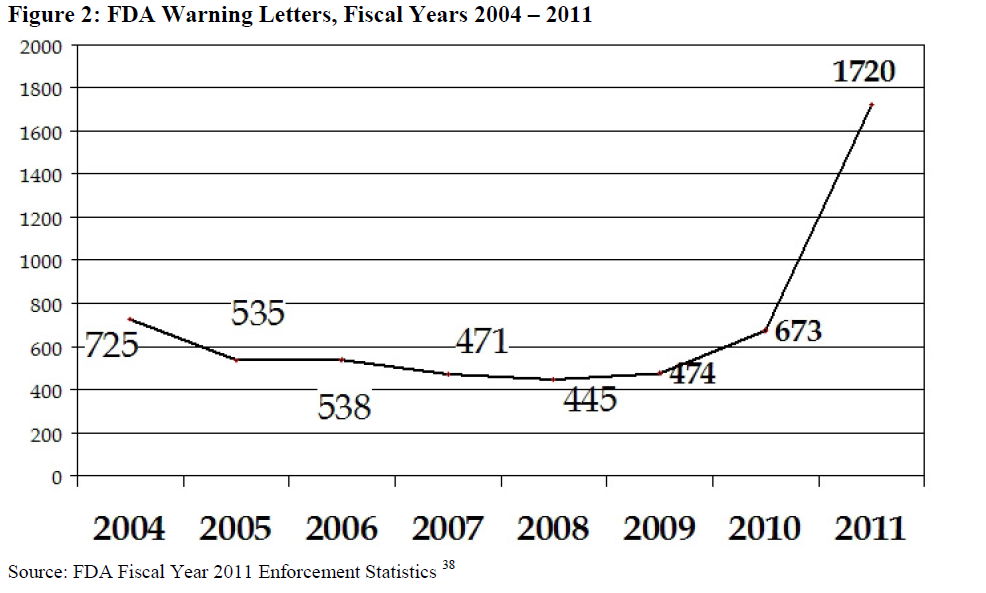 The FDA began to ramp up GMP rules and regulations under the new commissioner in 2010 and 2011 (see figure at left (N.B. this includes all warning letters not just GMP so it is just illustrative, AT added). In fact, the report indicates that FDA threats shut down some 30% of the manufacturing capacity at the big producers of generic injectables. The safety of these lines was not a large problem and could have been handled with a targeted approach but instead the FDA launched a sweep against all the major manufacturers at the same time. These problem have been exacerbated by a change in Medicare reimbursement rules and by the rise of GPOs (buying groups) which reduced the prices of generics. Thus, in response to the cut in capacity, firms have shifted production from less profitable generics to more profitable branded drugs, so we get shortages of generics rather than of branded drugs.
Add to these major factors a few unique events such as the FDA now requiring pre-1938 and pre-62 drugs to go through expensive clinical trials, the slowdown of ANDAs and crazy stuff such as DEA control over pharmaceutical manufacturing and you get very extensive shortages.
Assorted Links
1. Valve, the game company, hires Yanis Varoufakis, expert on the European situation, to help deal with balance of payment and currency issues between different worlds.
2. The great Deirdre McCloskey lets loose on the high liberals of political philosophy. Read the whole thing, it builds to gale force.
3. Aussie retailers charging more if you use an “old” browser.
4. The U.N. Internet Power Grab revealed by WCITLeaks a project of GMU economists Eli Dourado and Jerry Brito.
Markets in Everything: The Karl Marx Credit Card

The Karl Marx credit card now available in Eastern Germany for when you really need kapital. Planet Money is looking for taglines which you can tweet to @planetmoney. Here are a few good ones:
- Vanguard members get double reward points! #marxcard @planetmoney.
- “What’s in YOUR wallet? Seriously, though, I need to see your papers. Now.”
- @planetmoney There are some things money can’t buy. Especially if you abolish all private property. #marxcard.
Guest Blogger: Mark Koyama
We are pleased to have Mark Koyama blogging with us through Monday. Mark, our colleague at GMU, is an economic historian with an interest in institutional economics and the relationship between culture and economic performance. Mark’s paper on witches, taxes and the rule of law (with Noel Johnson) was recently covered at the Washington Post. Mark has also just published a paper in the Journal of Legal Studies on prosecution associations. Prosecution associations were private providers of insurance and police services in in early nineteenth-century England in the years before public police.
Mark’s career, however, has had one unusual feature. Mark began blogging as a student at Oxford but when he became a professor at GMU he defied all tradition and stopped blogging! We are thus happy to bring Mark back to the fold.
The Google-Trolley Problem
As you probably recall, the trolley problem concerns a moral dilemma. You observe an out-of-control trolley hurtling towards five people who w ill surely die if hit by the trolley. You can throw a switch and divert the trolley down a side track saving the five but with certainty killing an innocent bystander. There is no opportunity to warn or otherwise avoid the disaster. Do you throw the switch?
 A second version is where you stand on a bridge with a fat man. The only way to stop the trolling killing five is to push the fat man in front of the trolley. Do you do so? Some people say no to both and many say yes to switching but no to pushing, referring to errors of omission and commission. You can read about the moral psychology here.
I want to ask a different question. Suppose that you are a programmer at Google and you are tasked with writing code for the Google-trolley. What code do you write? Should the trolley divert itself to the side track? Should the trolley run itself into a fat man to save five? If the Google-trolley does run itself into the fat man to save five should Sergey Brin be charged? Do your intuitions about the trolley problem change when we switch from the near view to the far (programming) view?
I think these questions are very important: Notice that the trolley problem is a thought experiment but the Google-trolley problem is a decision that now must be made.
Zingales on Education Equity
Luigi Zingales has a good op-ed on education in today’s NYTimes:
… scholars like me…work in the least competitive and most subsidized industry of all: higher education.
We criticize predatory loans by mortgage brokers, when student loans can be just as abusive. To avoid the next credit bubble and debt crisis, we need to eliminate government subsidies and link tuition financing to the incomes of college graduates…Just as subsidies for homeownership have increased the price of houses, so have education subsidies contributed to the soaring price of college.
…These subsidies also distort the credit market. Since the government guarantees student loans, lenders have no incentive to lend wisely. All the burden of making the right decision falls on the borrowers. Unfortunately, 18-year-olds aren’t particularly good at judging the profitability of an investment…
Last but not least, these subsidized loans keep afloat colleges that do not add much value for their students, preventing people from accumulating useful skills.
Instead of subsidies Zingales, drawing a page from Milton Friedman, proposes income-contingent loans.
Investors could finance students’ education with equity rather than debt. In exchange for their capital, the investors would receive a fraction of a student’s future income — or, even better, a fraction of the increase in her income that derives from college attendance. (This increase can be easily calculated as the difference between the actual income and the average income of high school graduates in the same area.)
As I wrote about earlier, Bill Clinton received a loan like this from Yale’s law school and later created a national program but it didn’t get very far (although Obama wants to expand the program). Australia, however, implemented an income contingent loan program in 1989. Australian students don’t pay anything for university when they attend but once their income reaches a certain threshold they are charged through the income tax system. Many other countries are experimenting with income contingent loans.
Lumni is a private organization, started by economist Miguel Palacios (here is his book and Cato paper on human capital contracts), that is funding loans like this right now.
One point that Zingales doesn’t examine is adverse selection – an income-contingent loan will appeal most to people who want careers with low-income prospects, say in the non-profit sector. (Redistribution of this type was one of the reasons for the Yale law school program.) Thus, the program works best when incomes differ due to luck. My guess is that the adverse-selection problem can be handled if education venture capitalists are left free to price.
HFT versus the sub-optimal Tick
Felix Salmon has an interesting follow-up to my post, Should Stocks Trade in Increments of $.0001? First he notes (as did Chris Stuccio) that for stocks above say $50 the sub-penny rule doesn’t make much difference.
Here’s the chart, from Credit Suisse via Cardiff Garcia:
The y-axis shows the bid-offer spread on any given stock, in basis points; the x-axis shows the price of the stock, in dollars. Clearly, there’s an artificial clustering around that curve. For a lot of stocks trading at less than $50 a share, the market would happily provide bid-offer spreads of less than a penny if it could; but it can’t. And when stocks get really cheap, the bid-offer spread becomes enormous. For instance, an eye-popping 3.766 billion shares of Citigroup were traded on December 17, 2009, when the stock fell 7.25% to $3.20. At that level, a one-penny bid-offer spread is equivalent to a whopping 31 basis points; if Apple traded at a 31bp spread, then its bid-offer spread would be almost $2.
Clearly, the traders were the big winners when Citi was trading at a very low dollar price — if you make the assumption that traders capture half the bid-offer spread on each trade, then the traders made almost $20 million trading Citigroup alone, in one day.
On the other hand, it seems that the market almost never trades stocks at a bid-offer spread much below 2bp. Which in turn means that for stocks over $50 per share, we’re pretty much already living in Stuccio’s ideal world, where the spread is determined by traders, rather than by an artificial rule barring increments of less than a penny.


Salmon then makes another point – firms may use stock splits and IPO pricing to deliberately price their stocks below $50. Salmon says this is in part to grease their relationship with Wall Street but one could also say this is done in order to create more liquidity. In fact, there is good evidence for Salmon’s hypothesis that firms care about nominal share price; In Tick Size, Share Prices, and Stock Splits (JSTOR, H/T OneEyedMan) James Angel makes the interesting point that even as the S&P and CPI soared between 1924 and 1994 the average nominal price of a stock was very flat near $32. Angel’s explanation is that firms use the IPO price and splits to keep a consistent relationship between tick size and share price because:
A large relative tick size also encourages dealers to make a market in a stock….a larger tick provides a higher minimum round-trip profit to a dealer who can buy at the bid and sell at the offer.
Angel even notes the potential for rent-seeking that motivated the original argument to eliminate the sub-penny rule:
If the relative tick size is too big, the profits from a wider tick size may be dissipated through vigorous competition for order flow and payment for order flow.
Overall, I find these arguments continue to favor eliminating the sub-penny rule but these results indicate that firms already have some control over the extent of HFT so the net benefits may be smaller than at first imagined. It is probably easier to split than to combine shares to raise price, however, and social benefits may exceed private benefits so I still see an argument for eliminating the rule. See Felix’s post also for a number of very good comments.
Elinor Ostrom Passes
Indiana University has announced that Elinor Ostrom has passed away from cancer:
The entire Indiana University community mourns the passing today of Distinguished Professor Elinor Ostrom, who received the 2009 Nobel Prize in Economic Sciences for her groundbreaking research on the ways that people organize themselves to manage resources.
…The Royal Swedish Academy of Sciences awarded the 2009 Nobel Prize in Economic Sciences to Ostrom “for her analysis of economic governance, especially the commons.” Through a multidisciplinary approach that combined theory, field studies and laboratory experiments, she showed that ordinary people are capable of creating rules and institutions that allow for the sustainable and equitable management of shared resources. Her work countered the conventional wisdom that only private ownership or top-down regulation could prevent a “tragedy of the commons,” in which users would inevitably destroy the resources that they held in common.
Here is my post on Ostrom’s Nobel where I called her “the mother of fieldwork in development economics.” Here are other MR posts on Ostrom.
Let the Tacocopters Fly!
Very good piece by Ryan Avent at the Economist:
Consider the tacocopter. The tacocopter is a not-quite-real-not-quite-a-joke business idea that became a brief internet sensation back in March. The concept is stunningly simple: order tacos on your iPhone and a quadracopter drone will deliver them to your doorstep. As you can read here, the plan would face technical and (especially) regulatory hurdles if implemented today. Yet the potential, for this or similar experiments, is obvious. Cheap, agile drone technology is available now. Building apps is trivially easy. Mapping and location technology and data are getting better all the time. If not drone copters, perhaps 3D printers or autonomous vehicles. It’s a short leap from the ridiculous to the transformative. And the ideas needed to transfer these technologies to everyday life are increasingly the domain of entrepreneurs rather than academics. One doesn’t need 20 years of study to spot profit opportunities.
…I’m most inclined to think that its the pace of societal evolution that is most binding: growth proceeds at the fastest pace that legal and social institutions can tolerate.
Think of the challenges that would face the would-be tacocopter entrepreneurs. Consider that issues surrounding liability and law, rather than technology, now appear to be the biggest obstacle to autonomous vehicles. Look at the legal struggles faced by innovative services like Uber and Airbnb. Disruptive innovations are bumping against a broad array of regulatory hurdles that built up during a very different era of economic growth.
As I argued in Launching our regulatory system has gotten so large and complex that its main effects are now unintended. In short, the product of the regulatory system is a result of human action but not of human design.
Posner on Patents
Our patent law is by and large judge created and thus it is judges rather than legislators who are responsible for most of the dysfunction in patent law. It was judges who expanded (or endorsed) patents to cover business methods, software and animals. It was judges who weakened the obviousness, enablement and possession requirements. Finally, it was judges who interpreted vague patents broadly, thereby midwifing fearsome patent trolls.
Fortunately, judges also have the power to reform patent law which is why Judge Posner’s recent suggestion that he may dismiss with prejudice the Apple v. Google/Motorola suit over smartphone patents is potentially ground breaking.
We don’t yet have a full ruling but in early rulings Posner referred to claims made by Apple and Motorola as “silly” and “ridiculous.” Most importantly, Posner has said:
“injunctive relief would impose costs disproportionate to the harm to the patentee and the benefit of the alleged infringement to the alleged infringer and would be contrary to the public interest….”
which I read as saying that Posner is tired of the patent system being used by big business as a cudgel against competitive innovation.
Posner is a founder of the law and economics movement and one of the most influential judges in America. Indeed, as I have said before, Posner is the only person in the world who deserves a Nobel prize in economics and a seat on the Supreme Court so this ruling will be closely followed.
Absurd Patent of the Day

…Apple has been awarded a patent on wedge-shaped computers. Once again it is difficult to see why this sort of competition-stifling government-enforced monopoly would be beneficial to the overall cause of innovation. It’s absolutely true that the record should reflect the fact that Apple made wedge-shaped computers popular and the new wave of Ultrabooks are slightly lame imitators. But we progress as a society because of imitators! People come up with good ideas and then those ideas spread.
Copied from Matt Yglesias who I take it will not mind that I am helping to spread good ideas.
Indian Beans Produce Natural Gas
A tale of the invisible hand. More here.