MRU’s First Course: Development Economics
The first course from Marginal Revolution University is Development Economics and it will be taught by Tyler Cowen and myself. Development Economics will cover the sources of economic growth including geography, education, finance, and institutions. We will cover theories like the Solow and O-ring models and we will cover the empirical data on development and trade, foreign aid, industrial policy, and corruption. Development Economics will include not just theory but a wealth of historical and factual information on specific countries and topics, everything from watermelon scale economies and the clove monopoly to water privatization in Buenos Aires and cholera in Haiti. A special section in this round will examine India. There are no prerequisites for this course but neither is it dumbed down. We think there will be material in Development Economics that will be of interest to high school students in the United States and Bangladesh and also to PhDs in economics, even to those who specialize in this field.
Development Economics covers all the major topics of a sit-down class but because we have built it to be on online course from the ground up–no videos of us talking to a classroom–it will take less than half of the time of a sit-down class, plus no need to search for parking!
Our motto at MRU is “Learn, Teach, Share” so we will be inviting the world not just to learn but also to teach and share their knowledge. GMU is a very entrepreneurial university and we think we can be a world leader in online education.
Please do go to MRU and submit your email to be notified about our start date and registration which will allow you to contribute in our forums and online events. Development Economics is free to the world.
Stay tuned for more!
Not From the Onion: Harvard Cheaters
The NYTimes reports that Harvard is investigating “what could be its largest cheating scandal in memory.” Attention is focused on about 125 students in one course but Harvard would not say which course. The Harvard Crimson, however, has revealed that the course is “Introduction to Congress”!
I say give the cheaters an A and fail the rest.
Imitation Ain’t Easy
On the Syfy tv show Alphas one of the characters is able to see something once and learn it perfectly. Thus, she can learn a martial art, or how to fix a car, or how to speak a language just by imitation. This ability is rightly considered a superpower. Yet, in economic models it’s assumed that everyone has this ability.
Imitation, however, is difficult even when knowledge is freely available. In Launching I give the example of The French Laundry Cookbook which promises that with “exact recipes” and “simple methods” that “you can now re-create at home the very experience the Wine Spectator described as ‘as close to dining perfection as it gets.'” Yet despite exact recipes and simple methods we don’t see imitations of the restaurant twice named the best in the world popping up in Muncie, Indiana (trust me on that one).
Similarly, in Apple v. Samsung the jury found that Samsung copied Apple and indeed they copied Apple well enough to survive but nowhere near well enough to eliminate Apple’s monopoly power as Eli Dourado points out:
According to a recent article at Fortune, Apple sells 8.8% of mobile phones, but it has 73% of profits in the market. Samsung sells 23.5% of phones and earns 26% of profits. Everyone else is barely breaking even or losing money.
This does not look like a market in which Apple’s competitors are successfully copying it. It looks like a market in which Apple’s competitors are trying to copy Apple, and failing.
The point of patents is to incentivize innovation through a grant of monopoly. But what Apple’s success, pre-verdict, clearly shows is that in many markets, mobile computing among them, it’s a lot harder to copy innovations than you think. Apple’s real innovation is putting designers in charge and building a corporate culture in which everything is subordinated to making elegant products that people want to use. I’d like to see Samsung try to copy that, but I think the difficulty of doing so gives Apple all the monopoly it needs.
Father of HFT: Slow Down
Thomas Peterffy is one of the pioneers of automated stock trading. From NPR’s Planet Money:
…The company he started, Interactive Brokers, does electronic trades on a mind-boggling scale. Forbes estimates his net worth is now over $5 billion.
Peterffy says automation has done some very good things for the world. It’s made buying and selling stocks much much cheaper for everyone.
But Peterffy thinks the race for speed is doing more harm than good now. “We are competing at milliseconds,” he says. “And whether you can shave three milliseconds of an order, has absolutely no social value.”
Here are previous MR posts on high frequency trading.
Chris Hayes responds
In this segment Chris Hayes gives a gracious and interesting response to my post Racism by Political Party.
Visit NBCNews.com for breaking news, world news, and news about the economy
The Twelve
Neil Armstrong, first moon walker, died yesterday.
In total, there have been twelve. Armstrong who was first, Peter Conrad who was 3rd, Alan Shepard who was 5th and James Irwin who was 8th, are gone, leaving just eight. Just eight of 7 billion. Alan Shepard was the oldest, he was born in 1923, the others were all born in the 1930s at a time when Orville Wright still lived. The youngest, Charles Duke, will be 77 this year.
Could we soon have an age where all the moon walkers are gone? Will children then wonder whether it happened at all?

Steve Jobs was a Great Artist
http://youtu.be/CW0DUg63lqU
On the bright side the jury found that Apple’s patent on rounded rectangles was not infringed. Just to be clear, I have no objection to the jury’s findings only to the law.
Hat tip: @mmasnick
On the Origin of Specie
An article in The Economist (from which I have nabbed the title of this post) argues that money, particularly coins, had to have “developed not as a private-sector attempt to minimise the costs of trading, but as a government operation.” In fact, there are many examples of private coinage. In an earlier post on George Selgin’s excellent book Good Money I wrote about private coinage in Britain:
At the dawn of the industrial revolution as workers left the fields and moved to industrial employment the demand for a means of payment increased dramatically. Workers, once paid in kind, needed to be paid in a medium they could use to buy the necessities of life. Small-tender bank notes, however, were illegal and in Great Britain the production of coin was monopolized by the Royal Mint which failed to provide enough high quality coin to meet the demands of workers and business.
The Royal Mint had neither the will nor the technology to meet demand. In a story reminiscent of the Soviet nail factory one historian explained the incentives of the Royal Mint:
The public coiner, the Royal Mint, was charged with providing a stipulated amount of coinage each year rather than a stipulated number of coins. It did not take the eighteenth-century equivalent of rocket science to figure out that it was far easier to strike, say, a thousand golden guineas than 504,000 copper halfpence (24 x 21 x 1,000). The less-than-overworked denizens of Tower Hill cheered the discovery… But even had the Royal Mint been more co-operative, more inclined to rise to the challenge presented by the new wage earners, it would have been hard-put to assist. It still relied on antiquated machinery inherited from an earlier epoch….
The private sector responded, if the public sector would not.
To meet this shortage, Birmingham button makers started to coin tokens which circulated widely as money. Counterfeits and forgeries were common, however. Frustrated with the shortage of good money, Matthew Boulton, James Watt’s business partner, hit on the idea of using Watt’s steam engine to create steam presses. The new presses could apply more force thereby creating precise edging that would be difficult to forge or clip and they could do so on a mass scale. You can read the fascinating story in Selgin’s Good Money but suffice it to say that Boulton was eventually successful in producing the best coinage the world had ever seen not only for Great Britain but also for India, Singapore, Bermuda and elsewhere. Nor was Boulton’s the only example of private coinage. See Selgin’s post at Free Banking for U.S., Japanese and other examples.
Here are some of the coins from Boulton’s Soho Mint.


Monkeys reject unequal pay
Greg Mankiw points us to this revealing video from Frans de Waal. This is an excerpt from a longer TED video, also excellent.
http://youtu.be/g8mynrRd7Ak?t=30s
Racism by Political Party
It is undeniably the case that racist Americans are almost entirely in one political coalition and not the other.
Chris Hayes, Up w/ Chris Hayes, August 18, 2012.
Here is data asking whites the question Do you Favor Laws Against Interracial Marriage (this is from 2002, the latest year available for this question).
| Favor Laws Against Interracial Marriage | |||||
| Democrat | Ind | Repub | Other | TOTAL | |
| YES | 11.9 | 9.6 | 11.5 | 5 | 10.8 |
| NO | 88.1 | 90.4 | 88.5 | 95 | 89.2 |
Here is data asking whites whether they agree with the sentiment that Blacks Shouldn’t be Pushy.
| Blacks Shouldn’t Be Pushy | |||
| Democrat | Ind | Republican | |
| AGREE STRONGLY | 14.9 | 14.2 | 15.8 |
| AGREE SLIGHTLY | 20.4 | 20.6 | 26.6 |
| DISAGREE SLIGHTLY | 30.2 | 28 | 25.9 |
| DISAGREE STRONGLY | 34.5 | 37.2 | 31.7 |
Finally from 2008 here is data asking whites whether they would vote for a black for President. (Row: racpres, column partyid, filter: race(1) year(2008)).
| Would Vote for Black President | |||||
| STRONG DEMOCRAT | NOT STR DEMOCRAT | NOT STR REPUBLICAN | STRONG REPUBLICAN | ||
| YES | 92.4 | 94 | 93.9 | 94.7 | |
| No | 7.6 | 6 | 6.1 | 5.3 | |
It is true that there are more differences across party lines on policy questions such as on affirmative action, again with a mix in both parties but with more Republicans than Democrats opposing. I don’t consider these types of policy preferences to be grounds for calling someone a racist, however.
It is undeniable that some Americans are racist but racists split about evenly across the parties. No party has a monopoly on racists.
Addendum: John Sides, Reihan Salam and Razib Khan offer further comment.
Too Central to Fail
A lot of attention has been put on “too big to fail,” the idea that big is risky. What really matters in a complex network system, however, is not bigness per se but connection centrality. In a network the liabilities of institution A become the assets of institution B whose own liabilities become the assets of institution C. An institution with high connection centrality can spread distress throughout a large portion of the network.
Inspired by Google’s PageRank, the authors of a new paper create DebtRank, a measure of connection centrality. The vertical axis in the following diagram shows DebtRank (centrality) the horizontal axis asset shows size relative to the total network and the color indicates fragility/leverage. Institutions such as Wachovia, RBS and Barclays were relatively small but because of their centrality and fragility they imposed big risks on the system.
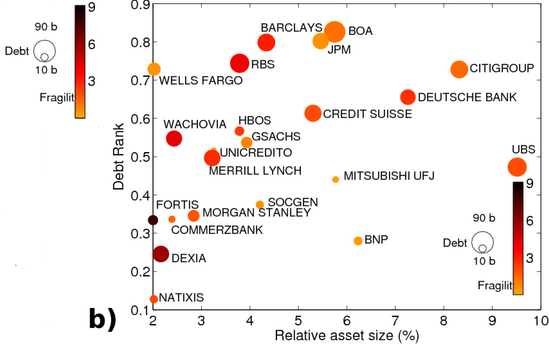
You can find the paper here but do check out the web page of the author group which includes much more material including these animations. Mark Buchanan over at Bloomberg also offers useful comment.
One point to note is that the authors calculated centrality using ex-post data from the Fed. Using this measure, DebtRank clearly signaled danger prior to the crisis and did so earlier than other metrics. In order to do this in real time, however, much more transparent and timely data would be necessary. The fact that centrality doesn’t correlate all that well with bigness, however, indicates that without this data the problem of monitoring risk is even more difficult than it appears.
A Simple Strategy for High Returns?
Morgan Housel presents some interesting data at The Motley Fool but draws the wrong conclusion:
…the single best stock to own from the 1950s to the early 2000s had nothing to do with computers, or technology in even the loosest sense. It was Altria (NYSE: MO ) , the maker of Marlboro cigarettes, which returned nearly 20% a year for 50 years. During a period when new industries transformed the lives of nearly everyone in the developed world, the most money was made in a company that stuffed tobacco into paper tubes the way it had for more than a century.
…Microsoft’s profits have grown 16-fold since 1995. Yet once again, the best stock returns may surprise you. With dividends, Microsoft has returned 511% since mid-year 1995. But Clorox (NYSE: CLX ) returned 560% during that time — so bleach actually bested the last leg of the computer revolution. Colgate-Palmolive (NYSE: CL ) returned 651% over the same period, so toothpaste did, too. As did garlic powder: McCormick returned 642%. Ditto for hamburgers, with McDonald’s (NYSE: MCD ) adding a 540% gain. Hormel Foods produced a 544% gain over the same period, so Spam was actually more profitable than computers during the big boom. Our old friend Altria scored a 1,300% gain, nearly trebling Microsoft’s return.
Admittedly, I’ve cherry-picked the dates to make my point. Back up a year or two, and Microsoft wins. But the fact that any period — a 17-year period no less — can be found during which a company with a virtual monopoly on a booming industry underperforms the dullest of products is extraordinary. It also underlines two important investing lessons…
One lesson Housel draws is that “simple products that rarely change often make better investments than those undergoing breakthroughs.” Rubbish. (Did Housel even compare simple products with breakthrough products? No. He just found some winners over a particular time frame.) The real lesson is that expectations, good and bad, are baked into prices so winners and losers are always unexpected. Unless your name is Warren Buffett, you should index.
Hat tip: Newmark’s Door.
Old Lady Opposition to Driverless Cars
I think driverless cars will change the design of cities, revolutionize retailing, and greatly change our driving culture, soon for example you will need a license to drive…well, you know what I mean. The scale effects on this technology are tremendous, once it works for one car it works for all. The technology won’t be expensive and it will get better every year. The technology will also get better the more driverless cars their are. Once these cars become common, for example, I expect speed limits for driverless vehicles to be substantially increased.
I do worry about lawsuits in the early years. I am not worried, however, about the following attack on driverless cars which appears to be real although it seems like something from the Onion:
One of the reasons I don’t think this will work is that the technology will be offered first as an option, like cruise control, which will appeal most to the safety conscious. The elderly in danger of losing their license, for example, may appreciate a driverless car. Personally, I would like the driverless option for night driving and I would be much happier lending my teenager the car if I could say “but only if you use the Google option!” At first when there is an accident people will ask, “did he have the driverless option on?” But soon they will start to say “if only he had the driverless option on.”
I do think, however, that technologists should change the name to the electronically chauffeured vehicle. Electronically chauffeured vehicles will appeal to the affluent, the influential and the productive.
The ubiquitous Daniel Lippman gets the hat tip.
Olympic Game Theory
How can you win a race by going slow? Check out the following video from the World Cup 2012 Individual Sprint Track Cycling (similar scenes can be found at the Olympics). The two cyclists, some of the fastest riders in the world, start out by going as slow as possible, almost like something out of Monty Python. In some races the riders will even come to a standstill.
Loyal reader Andy Garin has the analysis:
…in an all-out sprint, drafting creates a huge advantage, as the leading cyclist wears out very quickly. So both drop their speed so low that neither can take advantage of the other–well, at least until the last lap, at which point the advantage to being in front is about the same as the advantage of drafting from behind for 2/3 of a lap or so.
But note that this sort of problem arises because there are only two cyclists in the race. In Tour De France style road racing (or even the Keirin even on track, which is apparently also an Olympic event), one cyclists’ speed decisions only very marginally change the incentives of other riders. But in the Individual Sprint, you see something more like Bertrand-style dupolistic competition–that is, in the latter, one’s strategy is entirely based on the behavior of the other player. Specifically, it’s always better to “undersell” the other player (i.e. to be in the rear) in the first two laps. And thus, you get the odd equilibrium where both set their speed to a negligible exertion level.
Unlike in the badminton tournament where some teams tried to lose, the cyclists are trying to win so going slow isn’t considered unsporting but it does make for a peculiar race.
Cyclists in the group event, however, will sometimes deliberately crash, as just happened in the Olympics.
“I just crashed, I did it on purpose to get a restart, just to have the fastest ride. I did it. So it was all planned, really,” Hindes reportedly said immediately after the race. He modified his comments at the official news conference to say he lost control of his bike.
…”He (Hindes) should not have told the truth,” Daniel Morelon, a Frenchman who coaches the China team, told the AP. “It’s part of the game, but you should not tell others.”
Hindes and his team went on to win, so engineering a crash can earn you gold. Surprisingly, cycling turns out to be kinda like banking.