The Chicago School
In Launching the Innovation Renaissance I wrote:
In the United States, “vocational” programs are often thought of as programs for at-risk students, but that’s because they are taught in high schools with little connection to real workplaces. European programs are typically rigorous because the training is paid for by employers who consider apprentices an important part of their current and future work force. Apprentices are therefore given high-skill technical training that combines theory with practice—and the students are paid!
In the United States there are some experimental programs moving in this direction. One of the most interesting is being pushed by Chicago mayor Rahm Emanuel:
Chicago Public Schools (CPS) students will have the opportunity to attend five Early College STEM Schools (ECSS) that focus on technology skills and career readiness – as well as earn college credits– under a partnership agreement with five technology companies, CPS and City Colleges of Chicago, Mayor Rahm Emanuel announced…
The five technology companies, IBM, Cisco, Microsoft Corporation, Motorola Solutions and Verizon Wireless, will help develop a unique curriculum at each new school to teach students the skills required in that marketplace, as well as provide mentors and internships. Upon graduating from these tailored programs, the students will be prepared for careers in science and technology.
…All of the new schools will open in September 2012 with a class of ninth graders. Each student will be able to graduate in four-years with a high school diploma with college credits, with a goal of graduating within six years with an Associate of Science (AS) degree in Computer Science or an Associate in Applied Science (AAS) in Information Technology. The college courses will be taught by professors from CCC.
Emanuel is also redesigning the City Colleges of Chicago along similar lines:
Rahm fired almost all the college presidents, hired replacements after a national search, and decreed that six of the seven city-run colleges would have a special concentration. Corporations pledging to hire graduates will have a big hand in designing and implementing curricula. “You’re not going for four years, and you’re not going for a Nobel Prize or a research breakthrough,” he says. “This is about dealing with the nursing shortage, the lab-tech shortage. Hotels and restaurants will take over the curriculum for culinary and hospitality training.” Already AAR, a company that has 600 job openings for welders and mechanics, is partnering with Olive-Harvey College; Northwestern Memorial Hospital is designing job training in health care for Malcolm X College.
It’s too early to judge these developments but Emanuel’s op-ed on this subject was surprisingly good. The key question, which I haven’t yet seen answered, is whether the the companies will have real skin in the game, which I see as critical to success.
Hat tip: Ben Casnocha.
New Cities
In 2009, the percentage of the planet’s population living in urban areas crossed the 50% threshold…this year the population of the world’s cities will grow by a further 65 million people, equal in size to the total population of France…
As recently as 1990 the United States had the highest number of one million plus inhabitant urban agglomerations globally with a total of 33….by the year 2020 China will lead the world with 121 followed by India with 58…
Remarkably, in 2009 China generated some 40.9% of GDP from just 16.6% of its population living in the 35 largest cities.
From an interesting Credit Suisse report, Opportunities in an urbanizing world (pdf).
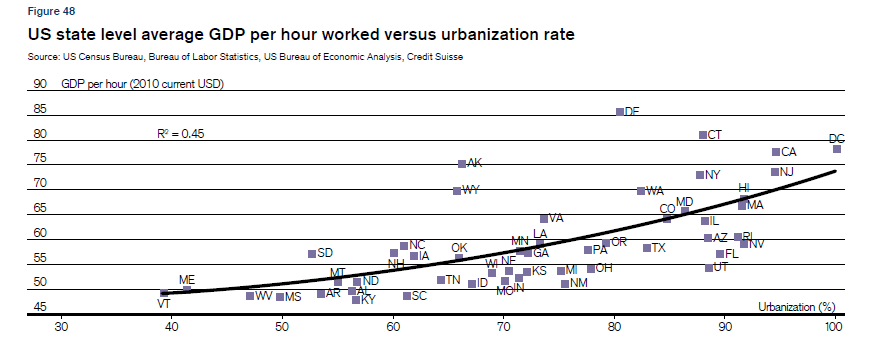
I was surprised at how close the association is between state level GDP and the urbanization rate (Ryan Avent in The Gated City and Matt Yglesias in The Rent is Too Dammed High make similar points.)
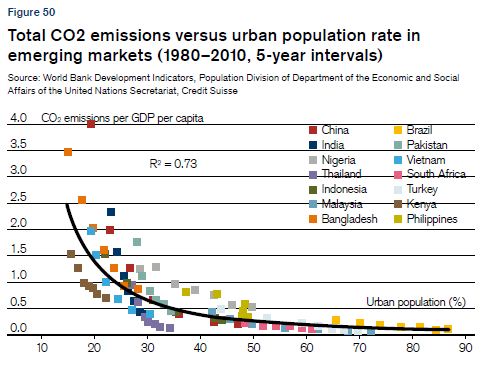
Urban dwellers also have much lower levels of carbon dioxide production than rural dwellers [Addendum: this seems to be per unit of GDP]. Moreover, the half of the world’s population that lives in cities occupies only approximately 2.7% of the world’s land area.
Hat tip: Gulzar at Urbanomics.
Markets in Everything: Prison Consultants
NYTimes: Mr. Levine is a prison consultant. The business — which entails advising people who are facing jail time on how to prepare for life on the inside, deal with medical issues, transfer to other prisons and even reduce their sentences…The consultants [also] teach prison etiquette.
For example? “Never walk across a wet floor,” Mr. Mulholland advised, saying you might mess up the work of the prisoner manning the mop. And then he might kill you.
Prison consultancy seems to be one of the few businesses where the owners aggressively advertise their criminal record:
Mr. Levine said he thought the competition would thin out over time because the competitors lack marketing smarts. Besides, he argued, he has the criminal CV to back up the marketing.
If they handed out diplomas for prison savvy, he said, “These guys have maybe an associate degree. I have like a Ph.D. or above.”
Indeed, “some prison consultants say that others are so lacking in expertise that their businesses are practically criminal enterprises.”
Surprising Probability Estimate of the Day
The UK’s Office of Work and Pensions estimates that a child born today has a 30% chance of reaching the age of 100. In contrast, a person 80 years old today has only a 7.7% chance of reaching the age of 100. Indeed, a person today, according to these estimates, has to be about 96.5 years of age to have the same probability of reaching the age of 100 as a newborn.
You can find the data at The Guardian.
Hat tip: John Lanchester’s article on Marx in the LRB.
Newt for President!
Sixty-five million years ago, a Manhattan-size meteorite traveling through space at about 11 kilometers per second punched through the sky before hitting the ground near what is now Mexico’s Yucatán Peninsula. The energy released by the impact poured into the atmosphere, heating Earth’s surface. Then the dust lofted by this impact blocked out the sun, bringing years of wintry conditions everywhere, wiping out many terrestrial species, including the nonfeathered dinosaurs. Birds and mammals thus owe their ascendancy to the intersection of two orbits: that of Earth and that of a devastating visitor from deep space.
We humans need not wait, like dinosaurs, for the next big rock to drop.
From a good piece in IEEE Spectrum analyzing the various methods available to deflect asteroids. Tyler and I have a special interest in this since we discuss asteroid deflection as a public good–a public good that as of yet neither private firms nor governments provide–in Modern Principles.
With better and more complete telescope coverage we are learning that there are a lot more near-misses than we previously thought. As the public becomes more aware of the dangers, I hope that we will see more action on this front.
Hat tip: The Browser.
Billionaires for the War on Drugs
Hat tip: Carpe Diem. Do note the date.
Felix Salmon on the Spot Market, Stripes Too!
http://youtu.be/14IerE0rIEs
Is Creativity more like IQ or Expertise?
IQ, whatever its flaws, appears to be a general factor, that is, if you do well on one kind of IQ test you will tend to do well on another, quite different, kind of IQ test. IQ also correlates well with many and varied real world outcomes. But what about creativity? Is creativity general like IQ? Or is creativity more like expertise; a person can be an expert in one field, for example, but not in another.
In a short piece in The Creativity Post, cognitive Psychologist Rober Baer argues that creativity is domain-specific:
Efforts to assess creativity have been plagued by supposedly domain-general divergent-thinking tests like the Torrance Tests of Creative Thinking, although even Torrance knew they were measuring domain-specific skills. (He create two different versions of the test, one that used verbal tasks and another that used visual tasks. He found that scores on the two tests were unrelated —they had a correlation of just .06—so they could not be measuring a single skill or set of skills. They were—and still are—measuring two entirely different things.) Because these tests have been used in so many psychological studies of creativity, much of what we think we know about creativity may be based on invalid data. These tests have also been widely used in selection for gifted/talented programs — programs that have, in turn, often suffered because by assuming creativity was domain general, these programs often wasted students’ time with supposedly content-free divergent thinking exercises (like brainstorming unusual uses for bricks) that really only develop divergent-thinking skill in limited domains.
The metaphor we use for understanding creativity will impact how we train for creativity:
If one’s goal is to enhance creativity in many domains, then creativity-training exercises need to come from a wide variety of domains—just as we must provide a broad general education if we want students to acquire modest levels of expertise in many areas. But if one’s goal is to increase creativity in just one domain, such as one might want to do in a gifted program focusing on one domain (such as a program in dance, poetry, math, etc)., then it would be appropriate for all of the creativity-training exercises to come from the particular domain of special interest.
Baer’s view is controversial. My inclination is to think that creativity does have a significant general aspect because creativity seems so often to involve combining seemingly disparate ideas. My suspicion is that that there is a neurological basis for this in, to put it crudely, right-brain, left-brain communication channels. The fact that creativity can be stimulated by drugs and travel also suggests to me a general aspect. No one ever says, if you want to master calculus take a “trip” but this does work if you are blocked on some types of creative projects.
Nevertheless, Baer’s view is worth thinking about; he gives more detail to his argument in two academic papers here and here.
The Golden Rule of Organ Donation
Here is Joseph Roth, president and CEO of New Jersey Organ and Tissue Sharing Network:
Caseworkers from our organization recently went to the hospital to visit the family of a woman who suffered a stroke. The woman was dead, but machines continued to keep her organs functioning. She was an ideal candidate to be an organ donor. Her husband, it turns out, was on the waiting list to receive a heart.
Our caseworkers asked the husband if he would allow his wife’s organs to be donated. The husband, to the shock of our caseworkers, said no. He simply refused. Here was a man willing to accept an organ to save his own life, but who refused to allow a family member to give the gift of life to another person.
…Cases like this are rare, thankfully, but are nonetheless troublesome.
Roth continues:
Our proposal — we call it the Golden Rule proposal — would permit health insurers in New Jersey to limit transplant coverage for people who decline to register as organ donors. It would be the first such law in the nation. No one would be denied an organ. But under the proposal, insurers could limit reimbursement for the hospital and medical costs associated with transplants of the kidney, pancreas, liver, heart, intestines and lungs.
I am not in favor of messing with the insurance system for this purpose but have argued for a more direct approach. Under what I call a “no-give, no-take” rule if you are not willing to sign your organ donor card you go to the bottom of the list should you one day need an organ. Israel recently introduced a version of no-give, no take which gives those who previously signed their organ donor cards points pushing them up the list should they need an organ transplant–as a result, tens of thousands of people rushed to sign their organ donor cards.
Hat tip to David Undis whose excellent group Lifesharers (I am an adviser) is implementing a private version of no-give, no take in the United States.
Here is my piece on Life Saving Incentives and here are previous MR posts on organ donation.
At the Frontier of Personalized Medicine
In an essay on frighteningly ambitious startups Paul Graham writes:
…in 2004 Bill Clinton found he was feeling short of breath. Doctors discovered that several of his arteries were over 90% blocked and 3 days later he had a quadruple bypass. It seems reasonable to assume Bill Clinton has the best medical care available. And yet even he had to wait till his arteries were over 90% blocked to learn that the number was over 90%. Surely at some point in the future we’ll know these numbers the way we now know something like our weight. Ditto for cancer. It will seem preposterous to future generations that we wait till patients have physical symptoms to be diagnosed with cancer. Cancer will show up on some sort of radar screen immediately.
An amazing paper in the March 16 issue of Cell illustrates the frontier of what is possible. Geneticist Michael Snyder of Stanford led a team that sequenced his and his mother’s genome. Then, over a two year period they used blood and other assays to track in Snyder’s body transcripts, proteins and metabolites. In the process they generated billions of data points and were able to watch in near real-time what happened as Snyder’s body fought two infections and the surprising onset of diabetes.
From a writeup in Science Daily:
…”We generated 2.67 billion individual reads of the transcriptome, which gave us a degree of analysis that has never been achieved before,” said Snyder. “This enabled us to see some very different processing and editing behaviors that no one had suspected. We also have two copies of each of our genes and we discovered they often behave differently during infection.” Overall, the researchers tracked nearly 20,000 distinct transcripts coding for 12,000 genes and measured the relative levels of more than 6,000 proteins and 1,000 metabolites in Snyder’s blood.
…The researchers identified about 2,000 genes that were expressed at higher levels during infection, including some involved in immune processes and the engulfment of infected cells, and about 2,200 genes that were expressed at lower levels, including some involved in insulin signaling and response.
…The exercise was in stark contrast to the cursory workup most of us receive when we go to the doctor for our regular physical exam. “Currently, we routinely measure fewer than 20 variables in a standard laboratory blood test,” said Snyder, who is also the Stanford W. Ascherman, MD, FACS, Professor in Genetics. “We could, and should, be measuring many, many thousands.”
One side-note: the techniques that the authors use to analyze their time-series data seem (to me) to be behind the curve compared to the VARs used in econometrics. Impulse response functions are what they need! With applications from economics to medicine to marketing, the statistics of big data is the field of the future.
Addendum: Derek Lowe offers further thoughts and Andrew S. points us to this TED video on blood tests without needles.
“Foreign” Aid
Astute piece in the NYTimes by Steven Lee Myers on military aid to Egypt Florida.
An intense debate within the Obama administration over resuming military assistance to Egypt, which in the end was approved Friday by Secretary of State Hillary Rodham Clinton, turned in part on a question that had nothing to do with democratic progress in Egypt but rather with American jobs at home.
…“In large part, there are U.S. jobs that are reliant on the U.S.-Egypt strong military-to-military relationship,” a senior State Department official said, speaking on condition of anonymity under rules set by the department.
…“Lockheed Martin values the relationship established between our company and the Egyptian customer since the first F-16s were delivered in the early 1980s,” said Laura F. Siebert, a spokeswoman for the company, which is based in Fort Worth.
…The M1A1 components are built in factories in Alabama, Florida, Michigan, Ohio and Pennsylvania, several of them battleground states in an election that has largely focused on jobs. Because the United States Army plans to stop buying new tanks by 2014, continued production relies on foreign contracts, often paid for by American taxpayers as military assistance.
Selgin reviews Bernanke on the Gold Standard
George Selgin reviews Bernanke’s course at GWU. He is not happy:
Bernanke’s discussion of the gold standard is perhaps the low point of a generally poor performance, consisting of little more than the usual catalog of anti-gold clichés: like most critics of the gold standard, Bernanke is evidently so convinced of its rottenness that it has never occurred to him to check whether the standard arguments against it have any merit. Thus he says, referring to an old Friedman essay, that the gold standard wastes resources. He neglects to tell his listeners (1) that for his calculations Friedman assumed 100% gold reserves, instead of the “paper thin” reserves that, according to Bernanke himself, were actually relied upon during the gold standard era; (2) that Friedman subsequently wrote an article on “The Resource Costs of Irredeemable Paper Money” in which he questioned his own, previous assumption that paper money was cheaper than gold; and (3) that the flow of resources to gold mining and processing is mainly a function of gold’s relative price, and that that relative price has been higher since 1971 than it was during the classical gold standard era, thanks mainly to the heightened demand for gold as a hedge against fiat-money-based inflation. Indeed, the real price of gold is higher today than it has ever been except for a brief interval during the 1980s. So, Ben: while you chuckle about how silly it would be to embrace a monetary standard that tends to enrich foreign gold miners, perhaps you should consider how no monetary standard has done so more than the one you yourself have been managing!
Read the whole thing for more.
Why Don’t Women Patent?
In Why Don’t Women Patent?, a recent NBER paper, Jennifer Hunt et al. present a stark fact: Only 5.5% of the holders of commercialized patents are women. One might think that this is explained by the relative lack of women with science and engineering degrees but Hunt et al. find that “women with such a degree are scarcely more likely to patent than women without.” Instead, most of the difference is “accounted for by differences among those with a science or engineering degree” especially the fact that women are underrepresented in patent-intensive fields such as electrical and mechanical engineering and in development and design.
Predictably, the authors do not ask why women might self-select into non patent-intensive fields, perhaps because this would require at least a discussion of politically incorrect questions. The failure to investigate these questions leads to some dubious conclusions, notably:
Closing the [gender] gap among S&E degree holders would increase commercialized patents by 24% and GDP per capita by
2.7%.
Right; and since only 10% of construction workers are women, closing the gender gap would result in many more houses. In the case of construction, my suspicion is that gender equality would reduce not increase the amount of construction. In the case of patents, I am not sure what would happen, indeed the point is that without a much better understanding of what causes differences in patent proclivities one shouldn’t jump to conclusions.
The quick jump from patents to innovation is also unwarranted–there is very little evidence that patents increase innovation. Moreover, most innovations are not patented. If we measured innovation more closely it wouldn’t surprise me if women accounted for a larger share of innovation than they do of patents.
By the way, both my wife and I are working to rectifiy these statistics, she has half-a-dozen patents and I have none.
Addendum: Freakonomics/Marketplace has a podcast on this topic.
Amazing Bezos
A delightful thought from Pascal-Emmanuel Gobry at Business Insider.
If you had asked an 11-year-old Jeff Bezos to let his imagination run wild and think of the stuff that he would most dream to have as an adult, he might have said:
- The world’s biggest bookstore! Maybe even a bookstore that can beam any book directly to your hand in an instant (and movies and music, too!).
- A giant sky computer that can imitate human intelligence.
- A spaceship.
- …And maybe even a robot army.
Of course any adult would have smiled slightly condescendingly, patted him on the head and helpfully explained that these things aren’t possible.
Italy Fact of the Day
- Italian labor unions represent more retirees than workers.
From a good piece on reforming Italian labor law in the NYTimes.
Addendum: Some commentators are asking whether this is surprising. Answer: Italy has far more retired union members than any other European country. Circa 2003-2004 (when 48% percent of Italian union members were retired) in France and Germany just 20% of union members were retired, in the UK 10%, in Spain 4.5%. Oddly, I could not find a source for the US, although some unions like the UAW clearly have more retirees than members my guess is that the overall number is quite low and certainly well below the Italian rate.