To Reduce Bribery, Make it Legal
India’s chief economic adviser Kaushik Basu argues (pdf; WSJ report) that to reduce bribery we should make the paying of bribes (not the demanding!) legal.
Under the current law…the bribe giver and the bribe taker become partners in crime. It is in their joint interest to keep this fact hidden from the authorities and to be fugitives from the law, because, if caught, both expect to be punished. Under the kind of revised law that I am proposing here, once a bribe is given and the bribe giver collects whatever she is trying to acquire by giving the money, the interests of the bribe taker and bribe giver become completely orthogonal to each other. If caught, the bribe giver will go scot free and will be able to collect his bribe money back. The bribe taker, on the other hand, loses the booty of bribe and faces a hefty punishment.
Hence, in the post-bribe situation it is in the interest of the bribe giver to have the bribe taker caught….Since the bribe taker knows this, he will be much less inclined to take the bribe in the first place. This establishes that there will be a drop in the incidence of bribery.
Basu notes that he intends this to apply to bribes where the person paying the bribe is receiving only what they are entitled to receive, e.g. when you have to bribe to get a business license that you are entitled to or to get your rice rations or get an income tax refund.
Hat tip to Sanjiv.
Mandelbox
A trip through a Mandelbox, a mathematical object akin to a Mandelbrot set. Hat tip to Metafilter which has more links.
Dennis is Not More Likely to be a Dentist
Pelham, Mirenberg and Jones (2002) found that the names Jerry, Dennis and Walter were the 39th, 40th, and 41st most frequent male names in the 1990 census (moreover the absolute frequency of (Jerry+Walter)/2 was almost identical to that of Dennis). But in a nationwide search they found 482 dentists named Dennis but just 257 named Walter, and 270 named Jerry, a highly statistical significant difference. Hence the meme was born, “Dennis is more like to be a Dentist.”
The expected number of dentists named Dennis, however, depends not on the frequency of Dennis in the 1990 Census but on the entire stock of people named Dennis over the past ~70 years and similarly for Walter and Jerry. If, for example, no one was ever named Jerry prior to 1989 but in 1990 the name skyrocketed to prominence following the appearance of Seinfeld then there would be no dentists named Jerry despite Jerry being a popular name in the 1990 census.
Following this logic, Uri Simonsohn proposes that instead of comparing the number of dentists named Dennis to those named Jerry or Walter we compare the number of dentists named Dennis to the number of lawyers named Dennis. Making this comparison, Simonsohn finds that Dennis’s are just as overrepresented among lawyers as among dentists, thus the Dennis is a dentist finding is most likely due to a spurious cohort effect.
In addition, to testing the name-profession link Simonsohn reexamines many of the classics of the implicit egoism literature and finds many of them (not all and he does not challenge the experimental results) wanting. Virginia is not more likely to move to Virginia, for example. The Simonsohn paper is impressive and a great resource for anyone wanting to teach the difficulties of doing causal statistical research.
Lazy Boys Shakedown Chinese Furniture Makers
James Hagerty at the WSJ has an excellent piece showing how trade policy really works at the ground floor level:
Some U.S. furniture makers and their lawyers have found a reliable way to extract cash from Chinese competitors deemed by U.S. officials to have “dumped” their products in the U.S., selling them at unfairly low prices.
Each year since 2006, they have asked the Commerce Department to review the U.S. duties paid by Chinese manufacturers on imports of wooden bedroom furniture. Many Chinese firms, fearing a steep rise in duties, agreed within months each time to pay cash to their U.S. competitors in return for being removed from the review list.
“Everybody in the industry in the U.S. and China understands that these payments are clever shakedowns,” said William Silverman, a lawyer representing U.S. furniture retailers, big importers of Chinese products, at an October hearing of the U.S. International Trade Commission.
The Chinese firms have paid millions of dollars to Lay-Z-Boy (really, I am not making this up) other US furniture makers and to their bagmen lawyers to avoid having the ITC sicked on them. I suppose one could argue that the payments are an efficient way of redistributing the gains from trade. The question then becomes why are US firms assumed to own the rights to sell to US consumers?
Hat tip to Chuck Sicotte.
Former CEA Chairs Call for Deficit Reduction
Ten former chairs of the Council of Economic Advisors have written a letter calling for deficit reduction:
As former chairmen and chairwomen of the Council of Economic Advisers, who have served in Republican and Democratic administrations, we urge that the Bowles-Simpson report, “The Moment of Truth,” be the starting point of an active legislative process that involves intense negotiations between both parties.
There are many issues on which we don’t agree. Yet we find ourselves in remarkable unanimity about the long-run federal budget deficit: It is a severe threat that calls for serious and prompt attention….
It is signed by Martin N. Baily, Martin S. Feldstein, R. Glenn Hubbard, Edward P. Lazear, N. Gregory Mankiw, Christina D. Romer, Harvey S. Rosen, Charles L. Schultze, Laura D. Tyson, and Murray L. Weidenbaum.
Privatize the Spectrum
The proposed merger between AT&T and T-Mobile is getting a lot of attention with most of the focus being on whether consumers will pay higher prices. The answer is maybe. Prices per minute have been falling and this was true even following the two big mergers in 2004-05 (Cingular/AT&T Wireless, and Sprint/Nextel). Quality-adjusted prices, i.e. taking into account the post-merger buildout of 3G networks, have fallen even further. On the other hand, although there are competitors in many large local markets and potential competitors (the Cable companies own a chunk of spectrum not yet in use) a merger could increase market power. But even if consumer prices did rise the merger is probably still a good idea. It’s long been known that even small cost savings can outweigh losses to consumers from a price increase (Nobelist Oliver Williamson was one of the first to drive this point home.)
The big issue, however, is not the merger. The big issue is reallocating spectrum from low to high value uses. My colleague Thomas Hazlett argues that spectrum currently being used for low-value over-the-air broadcast of television could, if it were reallocated to high-value uses like wireless, increase consumer welfare by over a trillion dollars. Moreover, for a price of about 3 billion we could switch almost all of the tv-viewers to cable or satellite. President Obama has pledged to move a big chunk of spectrum, about 500 mhz, to wireless but the process is slow and highly politicized. What really needs to be done is to auction off as much spectrum as possible with as few restrictions on it use as possible. Let the market allocate spectrum across all uses, allowing value maximizing trades. More spectrum would not only be good in itself it would alleviate any concerns about the merger.
Sentence of the Day
Here’s why I don’t trust the Dems—I see them as the party of one marshmallow eaters.
Scott Sumner, a two-marshmallow man.
Unemployment, Recessions and Barter: A Test
Nick Rowe explains that the essence of New Keynesian/Monetarist theories of recessions is the excess demand for money (Paul Krugman’s classic babysitting coop story has the same lesson). Here’s Rowe:
The unemployed hairdresser wants her nails done. The unemployed manicurist wants a massage. The unemployed masseuse wants a haircut. If a 3-way barter deal were easy to arrange, they would do it, and would not be unemployed. There is a mutually advantageous exchange that is not happening. Keynesian unemployment assumes a short-run equilibrium with haircuts, massages, and manicures lying on the sidewalk going to waste. Why don’t they pick them up? It’s not that the unemployed don’t know where to buy what they want to buy.
If barter were easy, this couldn’t happen. All three would agree to the mutually-improving 3-way barter deal. Even sticky prices couldn’t stop this happening. If all three women have set their prices 10% too high, their relative prices are still exactly right for the barter deal. Each sells her overpriced services in exchange for the other’s overpriced services….
The unemployed hairdresser is more than willing to give up her labour in exchange for a manicure, at the set prices, but is not willing to give up her money in exchange for a manicure. Same for the other two unemployed women. That’s why they are unemployed. They won’t spend their money.
Keynesian unemployment makes sense in a monetary exchange economy…it makes no sense whatsoever in a barter economy, or where money is inessential.
Rowe’s explanation put me in mind of a test. Barter is a solution to Keynesian unemployment but not to “RBC unemployment” which, since it is based on real factors, would also occur in a barter economy. So does barter increase during recessions?
There was a huge increase in barter and exchange associations during the Great Depression with hundreds of spontaneously formed groups across the country such as California’s Unemployed Exchange Association (U.X.A.). These barter groups covered perhaps as many as a million workers at their peak.
In addition, I include with barter the growth of alternative currencies or local currencies such as Ithaca Hours or LETS systems. The monetization of non-traditional assets can alleviate demand shocks which is one reason why it’s good to have flexibility in the definition of and free entry into the field of money (a theme taken up by Cowen and Kroszner in Explorations in New Monetary Economics and also in the free banking literature.)
During the Great Depression there was a marked increase in alternative currencies or scrip, now called depression scrip. In fact, Irving Fisher wrote a now forgotten book called Stamp Scrip. Consider this passage and note how similar it is to Nick’s explanation:
If proof were needed that overproduction is not the cause of the depression, barter is the proof – or some of the proof. It shows goods not over-produced but dead-locked for want of a circulating transfer-belt called “money.”
Many a dealer sits down in puzzled exasperation, as he sees about him a market wanting his goods, and well stocked with other goods which he wants and with able-bodied and willing workers, but without work and therefore without buying power. Says A, “I could use some of B’s goods; but I have no cash to pay for them until someone with cash walks in here!” Says B, “I could buy some of C’s goods, but I’ve no cash to do it with till someone with cash walks in here.” Says the job hunter, “I’d gladly take my wages in trade if I could work them out with A and B and C who among them sell the entire range of what my family must eat and wear and burn for fuel – but neither A nor B nor C has need of me – much less could the three of them divide me up.” Then D comes on the scene, and says, “I could use that man! – if he’d really take his pay in trade; but he says he can’t play a trombone and that’s all I’ve got for him.”
“Very well,” cries Chic or Marie, “A’s boy is looking for a trombone and that solves the whole problem, and solves it without the use of a dollar.
In the real life of the twentieth century, the handicaps to barter on a large scale are practically insurmountable….
Therefore Chic or somebody organizes an Exchange Association… in the real life of this depression, and culminating apparently in 1933, precisely what I have just described has been taking place.
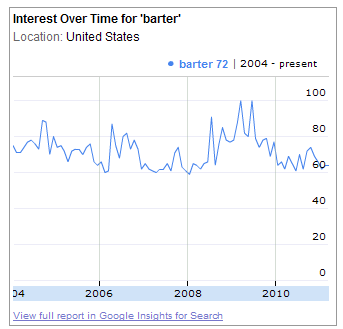
What about today? Unfortunately, the IRS doesn’t keep statistics on barter (although barterers are supposed to report the value of barter exchanges). Google Trends shows an increase in searches for barter in 2008-2009 but the increase is small. Some reports say that barter is up but these are isolated, I don’t see the systematic increase we saw during the Great Depression. I find this somewhat surprising as the internet and barter algorithms have made barter easier.
In terms of alternative currencies, the best data that I can find shows that the growth of alternative currencies in the United States is small, sporadic and not obviously increasing with the recession. (Alternative currencies are better known in Germany and Argentina perhaps because of the lingering influence of Heinrich Rittershausen and Silvio Gesell).
In sum, the increase in barter and scrip during the Great Depression is supportive of the excess demand for cash explanation of that recession, even if these movements didn’t grow large enough, fast enough to solve the Great Depression. Today there seems to be less interest in barter and alternative currencies than expected, or at least than I expected, given an AD shock and the size of this recession. I don’t draw strong conclusions from this but look forward to further research on unemployment, recessions and barter.
Senator Obama on the Constitution
The President does not have power under the Constitution to unilaterally authorize a military attack in a situation that does not involve stopping an actual or imminent threat to the nation.
Senator Barack Obama, Dec. 20, 2007.
Hat Tip: Radley Balko.
Food Safety and Culture
Scientific American has an excerpt from Myhrvold, Young and Bilet’s magnum opus, Modernist Cuisine, in which they discusses the often arbitrary, subjective and culturally bound nature of “food safety” rules and practices.
In decades past, pork was intrinsically less safe than other meats because of muscle infiltration by Trichinella and surface contamination from fecal-borne pathogens like Salmonella and Clostridium perfringens . As a result, people learned to tolerate overcooked pork, and farms raised pigs with increasing amounts of fat—far more fat than is typical in the wild ancestors of pigs such as wild boar. The extra fat helped to keep the meat moist when it was overcooked.
Since then… producers have vastly reduced the risk of contamination through preventive practices on the farm and in meat-processing facilities. Eventually the FDA relaxed the cooking requirements for pork; they are now no different than those for other meats. The irony is that few people noticed—culinary professionals and cookbook authors included….
After decades of consuming overcooked pork by necessity, the American public has little appetite for rare pork; it isn’t considered traditional. With a lack of cultural pressure or agitation for change by industry groups, the new standards are largely ignored, and many new publications leave the old cooking recommendations intact.
Clearly, cultural and political factors impinge on decisions about food safety. If you doubt that, note the contrast between the standards applied to pork and those applied to beef. Many people love rare steak or raw beef served as carpaccio or steak tartare, and in the United States alone, millions of people safely eat beef products, whether raw, rare, or well-done. Beef is part of the national culture, and any attempt to outlaw rare or raw steak in the United States would face an immense cultural and political backlash from both the consumers and the producers of beef.
…Cultural and political factors also explain why cheese made from raw milk is considered safe in France yet viewed with great skepticism in the United States. Traditional cheese-making techniques, used correctly and with proper quality controls, eliminate pathogens without the need for milk pasteurization. Millions of people safely consume raw milk cheese in France, and any call to ban such a fundamental part of French culture would meet with enormous resistance there….
Raw milk cheese aged less than 60 days cannot be imported into the United States and cannot legally cross U.S. state lines. Yet in 24 of the 50 states, it is perfectly legal to make, sell, and consume raw milk cheeses within the state. In most of Canada raw milk cheese is banned, but in the province of Quebec it is legal.
One point they don’t note is that there may be multiple equilibria–that is, it may be more dangerous to produce raw milk cheese in a country or region without a history of producing raw milk cheese than elsewhere. Still, this is no reason we shouldn’t be eating more horse.
Trash Talk
The normally sure-footed Arnold Kling slips with this really bad argument against private garbage collection:
Surely, if we all lived in small mountain communities we would need less government. But imagine purely private trash collection in an urban area. If you pay for somebody to collect the trash in front of your house, then instead of paying for my trash to be removed, my strategy is to put my trash in front of your house and free ride on your trash collection.
First, let me tell you I know Arnold Kling and no way is he sneaking out in the wee hours of the morning to secretly stash his trash. No way. Not ever. Unlike other rotten people, I bet Arnold even pays for his house number to be painted on the curb.
Second, private trash collection works! I know because my neighborhood has two private, competing garbage collectors and the service is better than I have ever experienced in any other neighborhood. I get two trash collections a week (three counting yard matter such as leaves and cuttings), they take everything including recycling, the price is low and they work on government holidays. Most of Fairfax County has private trash collection. In fact, around the United States and the world private trash collection is quite common and there are typically substantial cost savings, on the order of 20-30%.
It is important to note that cost savings come from creating competition rather than from privatization per se–substituting a private monopoly for a public one is not very helpful but creating and maintaining a competitive environment can work wonders.
Addendum: FYI, Arnold was replying to a good review by Stan Liebowitz of Arnold’s (also good) book, Unchecked and Unbalanced. Arnold, next time resist!
Givewell on Giving to Japan
I agree with this advice from Givewell the most analytically tough of the charity ratings agencies.
* Those affected have requested very little, limited aid. Aid being offered far exceeds aid being requested.
* Charities are aggressively soliciting donations, often in ways we feel are misleading.
* Any donation you make will probably be used (a) by the charity you give it to, for activities in a different country; (b) for non-disaster-relief-and-recovery efforts in Japan.
* If you’re looking to pursue (a) and help people in need all over the world, we recommend giving to the best charity you can, rather than basing your giving on who is appealing to you most aggressively with images and language regarding Japan.
* If you prefer (b), a gift to the Japanese Red Cross seems reasonable.Overall, though, a gift to Doctors Without Borders seems to us like the best way to effectively “respond to this disaster”. We feel they are a leader in transparency, honesty and integrity in relief organizations, and the fact that they’re not soliciting funds for Japan is a testament to this. Rewarding Doctors Without Borders is a move toward improving incentives and improving disaster relief in general.
Makena and the Orphan Drug Act
Makena is a drug used for premature birth therapy. It’s been available off-label for a long-time but KV pharmaceuticals ran a clinical trial and applied for FDA approval under the Orphan Drug Act (ODA). Under the ODA, KV is entitled to seven years of market exclusivity, this is even stronger than a patent because it gives KV the right to exclude from the market any drugs (not just similar drugs) that treat the same condition.
Now that KV has a monopoly—enforced against compounding pharmacies by threats from the FDA—the price will rise from about $10 to a listed price of $1,500. Naturally a lot of people are outraged.
In The Blessed Monopolies (pdf) I explained how the ODA and similar rules such as pediatric exclusivity can be gamed by pharmaceutical firms for big profits. The early AIDS drug AZT managed to get market exclusivity under the ODA, for example, because it appeared when the patient population was below 200,000, thus meeting ODA requirements, even though everyone knew the patient population was expanding rapidly.
Once a drug is off-patent, however, there is very little incentive to study it further or to run the clinical trials necessary to get FDA approval. Although the drug has been used off-label for some time (another example of the importance of off-label prescribing) a decent clinical trial still has considerable value. The problem is that as with patents there is very little connection between the effort required to get exclusivity under the ODA and the potential profits (see my paper Patent Theory v. Patent Law).
Despite my skepticism of the ODA, however, I was convinced by Lichtenberg and Waldfogel’s Does Misery Love Company that the ODA as a whole has done some good. Lichtenberg and Waldfogel find that after the ODA was passed (but not before) mortality rates for people with orphan diseases decreased faster than mortality rates for those with more common diseases. The decrease in mortality was consistent with the introduction of more new drugs for orphan diseases.
The important point is that like patents the ODA should be evaluated as a rule and not on a case-by-case basis. I am all for patent reform and FDA/ODA reform but this is truly a case where we don’t want to throw the baby out with the bathwater.
Hat tip: Eddie W.
Addendum: See also Derek Lowe who, as usual, offers intelligent comments.
Blood Money: Diyat
LA Times: Aziz Ahmed was supposed to die. In 2006 he used a meat cleaver to kill a friend he thought had been sleeping with his wife. He confessed and was sentenced to be hanged.
But last month Ahmed won his freedom; not because his confession was recanted or fresh evidence was presented, but because of a wad of cash. He paid the victim’s family $9,400 and walked out of prison a free man. The slain man’s relatives said they would use the money to buy the widow a cookware shop in this dusty farm town in Punjab, near the Indian border.
“We’re not bitter about this at all,” said Mohammed Nasir, brother of the victim, Ghulam Sarwar. “This money will take care of Ghulam’s wife and children.”
What outsiders might describe as “blood money” is a tenet of Islamic law sanctioned by Pakistani jurisprudence and used, by some estimates, in up to 60% of homicide cases here. The practice is called diyat, and it could be the means by which the United States and Pakistan extricate themselves from a dangerous diplomatic row that has strained relations between the two governments.
It is important to understand that diyat arose as a progressive measure designed to substitute restitution for retribution. Restitution systems have a number of virtues. One virtue of restitution is that it puts the victim’s family at the center of the process rather than ignoring their interests. Criminal law, in contrast, replaces the interests of victims with the interests of the state. Perhaps this is sometimes necessary (what to do about victims without families?) but restitution systems have been quite sophisticated at dealing with these problems. David Friedman, for example, explains the Icelandic system of wergeld and Bruce Benson discusses the medieval Ango-Saxon system. I am not aware of much work, however, on Islamic diyat. Randy Barnett makes the case for restitution as a substitute for criminal law today.
If restitution is to work well it’s crucial that restitution be set at the right levels. It’s not always clear that this is done. In Saudi Arabia maximum compensation prices are as follows (from Wikipedia, according to this document, take at your own risk)
- 100,000 riyals if the victim is a Muslim man
- 50,000 riyals if a Muslim woman
- 50,000 riyals if a Christian or Jewish man
- 25,000 riyals if a Christian or Jewish woman
- 6,666 riyals if a Hindu man
- 3,333 riyals if a Hindu woman.
More generally, however, Diyat will vary by the wages and prospects of the deceased. If that sounds wrong do note that US tort law compensates in a similar way, although as a supplement rather than substitute for criminal law.
The optimal scope and overlap of criminal and tort law is an under-researched topic.
Paging John Lott
CNN: A man who broke into a house in Portland, Oregon, called police — afraid the homeowner may have a gun.
The suspect, Timothy James Chapek, was in the bathroom taking a shower when the homeowner returned to the house Monday night…[He] locked himself in the bathroom and made an emergency call, police said. He said he had broken into the house, the owner had come home, and that he was concerned the owner might have a gun.
Why he was taking a shower I do not know.
Hat tip: Radley Balko.