The Singularity is Near: Understanding Trivia, Not Trivial
I Chose Liberty
I Chose Liberty, a collection of short intellectual biographies of contemporary libertarians edited by Walter Block, is quite entertaining. Richard Epstein, Gordon Tullock, Judge Napolitano, John Hasnas, Ron Paul, Bryan Caplan, myself and many others are included.
Need I tell you whose biography begins:
When I was about thirteen, I decided I wanted to read all of the good books in the public library. I started with the Dialogues of Plato…
You can buy it here or here is the free pdf.
Hat tip: Bryan Caplan.
Sex and Statistics or Heteroscedasticity is Hot
Ok Trends has another great post combining statistics, sex and even a little "game theory" (read that in whichever sense you prefer). The statisticians at OK Trends discovered that the number of messages a women receives varies widely even after conditioning on the women's attractiveness rating. Why do some 7's receive far more messages than other 7's? It turns out that it's much better to receive some 10's and some 1's than all 7's. Or as OK Trends beautifully expresses it:
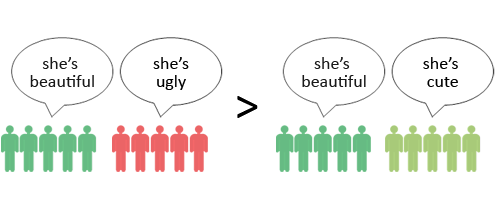
A lot of this can be explained by a non-linear function of messages to attractiveness; that is if 2 men rate three women, A,B,C, as A:{0,10}, B:{5,5} and C:{10, 0} it's not that surprising that A and C each receive one message and B receives none.
But OK Trends argue that more is going on. In a regression of messages on number of rankings in each category (1 being lowest, 5 being highest) they find, not surprisingly, that more high rankings increase messages but also that more low rankings increase messages. That is they find that a ranking of {0,10} can be better than a ranking of {6,10}. Ok Trends hypothesize the following explanation:
Suppose you're a man who's really into someone. If you suspect other men are uninterested, it means less competition. You therefore have an added incentive to send a message.
I have my doubts. Rather I think there are certain types of beauty that greatly attract some men but repel others. Analagously, some people will pay hundreds of dollars for an ounce of caviar that other people won't eat for free. The reason some people love caviar, however, is not that other people dislike it. Instead, it just so happens, that the thing that some people love is the very thing that repels others. We see the same phenomena in art, some people love John Cage, other people would rather listen to nothing at all. 😉
Now if we mix in this kind of beauty–beauty over which there are violent disagreements–with the kind that most people do agree upon (think Haagan-Dazs vanilla ice cream) then I suspect that it will appear that lower rankings increase messages. But what is really going on is that high rankings–conditional on their also being many low rankings–actually signal an extra strong attraction. Someone who tells you that John Cage is their favorite composer is telling you more than someone who says Aaron Copland is their favorite composer.
Note that even if rankings were not public this theory would predict that the same women would receive more messages than their (non-public) rankings would suggest.
Which ever explanation holds, some advice follows: In the marriage market what you want is not so much to increase your attractiveness to the average person but rather to the one person who will cherish your unique features. Thus–conditional on attracting a decent number of suitors from a reasonable pool etc.–what you want to do is accentuate your unique features even if doing so reduces your average ranking. In short, heteroscedasticity makes you hot.
FYI, OK Trends will analyze women's reactions to men in a future post.
An Economist among the Bounty Hunters
Andrew Luster had it all: a multimillion-dollar trust fund, good looks, and a bachelor pad just off the beach in Mussel Shoals, California. Luster, the great-grandson of cosmetics legend Max Factor, spent his days surfing and his nights cruising the clubs. His life would have been sad but unremarkable if he had not had a fetish for sex with unconscious women. When one woman alleged rape, Luster claimed mutual consent, but the videotapes the police discovered when they searched his home told a different story. Eventually, more than 10 women came forward, and he was convicted of 20 counts of rape and sentenced to 124 years in prison. There was only one problem. Luster could not be found….
That is the opening to my piece, The Bounty Hunter's Pursuit of Justice, in the latest issue of The Wilson Quarterly. I discuss bounty hunters, the bail bond industry and my own adventures bounty hunting in Baltimore.
Witches vs Vampires
Everyone curses the tax man, but Romanian witches angry about having to pay up for the first time hurled poisonous mandrake into the Danube River on Thursday to cast spells on the president and government.
Hat tip: Monique van Hoek.
Going Once, Going Twice, Not Going for $150!
I love that it says, "Tip: Delta accepts lower bids first."
Hat tip to Jim Ward.
Assorted Links
1. Interview with Gary Gorton.
2. Appreciations of Fred Kahn from Tom Hazlett and Susan Dudley.
3. The Dow Piano.
4. Andrew Gelman's five books on statistics; some surprising choices.
5. NSF Grand Challenges papers – basically well known economists arguing for why their research should get more money, but not less interesting for that.
Skating Lessons
Yesterday I inaugurated the New Year by taking the kids ice skating. Naturally this got me to thinking about economics, specifically Dan Klein's modern classic, Rinkonomics: A Window on Spontaneous Order.
Long ago people didn't know anything of skating. Imagine yourself one of them. Imagine that a friend walks up to you and tells you with great enthusiasm about his new idea for a business:
"I'll build a huge arena with a smooth hard wooden floor and around the perimeter a naked iron hand-rail. I'll invite people to come down to the arena and strap wheels onto their feet and skate round n' round the arena floor. They won't be equipped with helmets, shoulder-pads, or knee-pads. I won't test their skating competence, nor separate skaters into lanes. Speedsters will intermingle with toddlers and grandparents, all together they will just skate just as they please. They'll have great fun. And they'll pay me richly for it!"
Knowing nothing of skating, you would probably expect catastrophe. You exclaim: "How are 100 people supposed to skate around the arena without guidance or direction?…The arena will be a scene of collision, injury, and stagnation. Who will pay for that?!"…
Yet, we have all witnessed roller skating, and we know that somehow it does work out. There are occasional accidents, but mostly people stay whole and have fun, so much so that they pay good money to participate. The spectacle is counter-intuitive. How does it happen?…
An important quality of collision is mutuality. If I collide with you, then you collide with me. And if I don't collide with you, you don't collide with me. In promoting my interest in avoiding collision with you, I also promote your interest in avoiding collision with me.
The key to social order at the roller rink is this coincidence of interest.I do not intend to promote your interest. I am not necessarily even aware of it. Still, by looking out for myself I am to that extent also looking out for you. My actions promote your interest.
Skating on the floor of the roller rink is an example of what Friedrich Hayek called spontaneous order.
John Stossel memorably demonstrated the alternative process of centrally planned skating in this video (starting about 3:16).
Prospects for a Space Elevator
Fun video clip from BBC on material science and prospects for a space elevator.
Most Popular Marginal Revolution Posts from 2010
Here are the most popular Marginal Revolution posts from 2010 as measured by landing pages and page views.
1. Book lists were very popular as a category. The highest ranked post in terms of page views was Tyler's Books which have influenced me the most which created a blogosphere avalanche. Links to other people's lists (of influential books) was also very popular. As was Books of the year, 2010 and peculiarly this post on The best-selling book of all time.
2. The number one linked post was What happened to M. Night Shyamalan? a one-liner and one-picturer. Also very popular in the category of "quickies" were Barbados v. Grenada, the demand for own-goals, Dead Birds, Freak-onomics, Nazi-Nudging, and Yuck_markets in Everything.
3. One Game Machine per Child on the failure of a computer voucher program to raise grades (but it did increase gaming).
5. The Dark Magic of Structured Finance.
7. Peter A. Diamond.
10. Why Did the Soviet Union Fall? (from 2007).
12. A Theory for Why Latvian Women are Beautiful.
Other substantive posts with high popularity (in the top-50) were my posts Insiders, Outsiders and Unemployment and The Philosophical Cow and Tyler's posts How many children should you have?, Is there a case for a vat?, Does the Law Professor have cause to complain? and Why is Haiti so Poor?
Two of my posts from previous years were also popular in 2010, from 2008 What is New Trade Theory? on Paul Krugman's Nobel and from 2005 Why Most Published Research Findings are False.
Hope you have enjoyed this years offerings. What have I missed?
Drinks are on the House
…in terms of breadth of interest in economic subjects, literature and ephemera, Marginal Revolution is like nipping into a world-class local bar, where the drinks are always perfectly mixed, the atmosphere is relaxed and civilized, while intelligent conversation and serendipity are available on tap. The comments tend to be of unusually high quality too.
From Alen Mattich's writeup of the best economics blogs in the WSJ. Congrats and thanks to all our commentators.
Free Money
Christopher Beam's piece on libertarianism had some amusing moments:
Say we started from scratch and created a society in which government covered
only the bare essentials of an army, police, and a
courts system. I’m a farmer, and I want to sell my crops. In Libertopia, I can sell them in exchange for money. Where does
the money come from? Easy, a private bank. Who prints the money? Well,for that we’d need a central bank–otherwise you’d have a thousand
banks with a thousand different types of currency.
A monetary system with thousands of banks issuing their own currency! Ho, ho, ho….those wacky libertarians where do they get their crrrrrazy ideas?
Images from Nick Szabo, the Minneapolis Fed, the San Francisco Fed, the Philadelphia Fed and Larry Schutts.
Addendum: Scott Sumner has other bones to pick.
Win Steven Landsburg’s Money. Not!
Last week Steven Landsburg posted the classic puzzle:
There's a certain country where everybody wants to have a son. Therefore each couple keeps having children until they have a boy; then they stop. What fraction of the population is female?
Being clever and worldly you may suppose that you know the answer, just as I did. 50%, right?
Every birth has a 50% chance of producing a girl. This remains the case no matter what stopping rule the parents are using. Therefore the expected number of girls is equal to the expected number of boys. So in expectation, half of all children are girls.
Clever! Except Landsburg being even more clever shows that the correct answer is in fact less than 50% (with the exact number depending on how many families there are in the country).
Clever people don't like to be told they are wrong, however, so even after much explanation (follow Landsburg in the comments to the answer post) there remains disagreement. So Landsburg is offering a big money bet:
I am therefore offering to bet him $15,000 that I’m right (with detailed terms described below). If you agree with Lubos, this is your chance to get in on the action. I will take additional bets up to $5000 per person from all comers until such time as I decide to cut this off.
If you want in, you can read the conditions and bet against Steve here.
N.B.: The correct answer does not rely on selection effects (e.g. some families have a greater propensity to have girls) nor does it involve changing the question to the average fraction of girls in a family.
Catch Shares
Catch Shares are expanding in California, Oregon and Washington starting in January.
Under the catch-share system, fishery managers set an overall catch limit at the beginning of the season. Each fisherman will own a percentage of that catch. Just like shares in the stock market, the quotas can be traded or sold. The idea is that a market-based system will give fishermen more flexibility.
Not everyone is happy. Larry Collins, president of the Crab Boat Owners Association in San Francisco, is doubtful.
Collins is concerned that a market-based system will bring market manipulation. Under the rules, you don't have to be a fisherman to buy fish quotas, so it's possible that speculators or even environmental groups could buy into the market.
"You want hedge fund managers deciding when the people catch fish? Is that who you want to own your fish, or do you want to own them?" Collins asks.
Collins is also concerned about fishermen who make smaller catches. In Alaskan fisheries that use catch shares, some smaller boats opted to sell their fish quotas.
"That concentrated the resource in fewer and fewer hands. Now, I tend to think that public trust resources should be used to employ as many people as possible," he says.
Both of these features are benefits not costs. It's true that speculation can create bubbles and other problems but speculators also make the market more future-oriented and this will help to avoid the collapse of fishing stocks by making prices a better early warning system. Moreover, if environmentalists want to buy catch shares to increase the fishing stock then I am all for it. In Modern Principles, Tyler and I discuss how we bought and retired some SO2 making the air cleaner for everyone (you are welcome! :)).
Fewer, larger boats is also a benefit not a cost. Under the current system the influx of small boats is simply a form of rent-seeking which raises net social costs–too many fisherman chasing too few fish. Catch shares reduce over-capitilization in the industry raising productivity (see also Modern Principles on this point).
The main problem with catch-shares is setting the size of the catch, which inevitably is a politicized process. Massachussetts congressmen, for example, are trying to withold funds from NOAA until catch shares are increased. Nevertheless with so many fishing stocks nearing collapse it is clear that some limits are needed. Moreover, before catch-shares are put in place few people in the industry appreciate that temporary limits can lead to long-term increases in catch as the fishing stocks recover to sustainable levels. After catch-shares are put in place, however, it is sometimes the fishermen who lobby for greater limits not for monopoly reasons but as they come to recognize that a smaller limit leads to a larger stock and larger profits.
Here is my previous post, Reversing the Decline in Fish Stocks, on catch shares with more links.
Hat tip: Daniel Lippman.