The History and Future of Private Space Exploration
In The Rational Optimist Matt Ridley asks:
Can you doubt that if NASA had not existed some rich man would by now have spent his fortune on a man-on-the-moon programme for the prestige alone?
In fact, we have some pretty good historical data on this issue. Bearing in mind that observatories are an early form of space exploration, Alex MacDonald, a NASA research economist, notes:
For the majority of its history, space exploration in America has been funded privately. The trend
of wealthy individuals, such as Paul Allen, Jeff Bezos, Robert Bigelow, and Elon Musk,
devoting some of their resources to the exploration of space is not an emerging one, it is the
long-run, dominant trend which is now re-emerging.
MacDonald gives the following list of major observatories and their costs (click to enlarge). Privately funded observatories are in bold.
Private spending on space exploration is even more impressive when we scale by personal wealth.
…rather than scaling the expenditure as a share of the total resources of the U.S. economy, the expenditure can be scaled as a share of the resources of the individuals who undertook the projects. James Lick was the richest man in California and the Lick Observatory expenditure represented 17.5% of his entire estate. The equivalent share of the wealth of the richest man in California today, Larry Ellison, is $3.9 billion dollars, approximately four times higher than the GDP equivalent share.
Private space exploration and commercialization are likely to increase substantially in this century and, perhaps surprisingly, President Obama is pushing NASA in this direction. Here, for example, is a headline you don't see very often, "Obama defends privatization of space travel."
What is really going on is contracting-out rather than privatization per se and as such there is significant room for abuse. Nevertheless, if done carefully, I think Obama's efforts to encourage private efforts in space are a step in the right direction. What would be much more welcome and useful, however, would be a titling system for establishing property rights in space (see also here). Homesteading the highest frontier is our best bet for moving humanity off planet.
Al Roth: Entrepreneurial Economist
“I’ve always been interested in using mathematics to make the world work better.”
That’s Al Roth from a profile in Forbes. Roth has applied heavy-duty theory to the very practical problems of matching doctors to residency programs, children to schools, economists to departments and kidneys to patients in a way that is stable, incentive-compatible, and maximizes the gains from exchange. In my view, Roth is the most influential economist working today. Influential among other economists? Yes. But what I really mean is influential in the world.
Roth’s homepage has many introductory papers as well as more technical material, here is his blog, Market Design and here is good video, Roth at Google.
What Happened to M. Night Shyamalan?
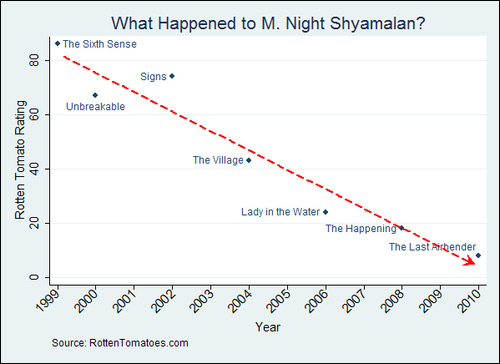 Has any recent director begun with greater promise or had a worse trajectory of achievement?
Number of Birds Killed
Number of birds killed by the BP oil spill: at least 2,188 and counting.
Number of birds killed by wind farms: 10,000-40,000 annually.
Number of birds killed by cars: 80 million annually.
Number of birds killed by cats: Hundreds of millions to 1 billion annually.
Don't worry there is some good news.
Number of birds killed by fisheries: tens to hundreds of thousands annually (fortunately for the birds, some of these fisheries are now shut down).
Markets in Everything: A Puzzle
Robot Parking
In the first DARPA Grand Challenge for driverless vehicles in 2004 not a single team came close to finishing the course. Later this year a driverless car built by a team from Stanford will race up Pike's Peak at speeds up to 90 mph. Amazing. And from the same team, I would pay for a car with this type of automated parking.
Is Creativity Declining?
Nobody would argue that Torrance’s tasks, which have become the gold standard in creativity assessment, measure creativity perfectly. What’s shocking is how incredibly well Torrance’s creativity index predicted those kids’ creative accomplishments as adults. Those who came up with more good ideas on Torrance’s tasks grew up to be entrepreneurs, inventors, college presidents, authors, doctors, diplomats, and software developers. The correlation to lifetime creative accomplishment was more than three times stronger for childhood creativity than childhood IQ.
Like intelligence tests, Torrance’s test–a 90-minute series of discrete tasks, administered by a psychologist–has been taken by millions worldwide in 50 languages. Yet there is one crucial difference between IQ and CQ scores. With intelligence, there is a phenomenon called the Flynn effect–each generation, scores go up about 10 points. Enriched environments are making kids smarter. With creativity, a reverse trend has just been identified and is being reported for the first time here: American creativity scores are falling.
From Newsweek. I am not at all convinced that creativity is on the decline. The study cited seems to be unpublished and there isn't much on the author's website which is a little, well, too creative for my tastes. Nevertheless, the Torrance test and its correlation with lifetime creative is interesting and a good reminder of what IQ tests do not reveal. I also liked this bit:
When faculty of a major Chinese university asked Plucker to identify trends in American education, he described our focus on standardized curriculum, rote memorization, and nationalized testing. “After my answer was translated, they just started laughing out loud,” Plucker says. “They said, ‘You’re racing toward our old model. But we’re racing toward your model, as fast as we can.’ “
Gender Parity in Schooling Around the World
The world has reached gender parity in schooling and in a few years we will see a schooling ratio in favor of women. Using UNESCO statistics (more detail here) on school life expectancy, the average country has a parity level of 1.01 in favor of women or, weighting by population, .991. In other words, at current rates women can be expected to get the same number of years of education as men, as a world average.
Equal life expectancy of schooling on a world level does not mean that all is well – basically we have a relatively small number of countries in which women get much less education than men and a large number of countries in which women get somewhat more education than men. On the vertical axis in the figure below (click to enlarge) is total life expectancy in school and on the horizontal axis the ratio of female to male life expectancy in school. The figure tells us a number of interesting things. First, the largest imbalances are against women and these tend to occur in countries with a low level of total education. South Korea is an interesting outlier.
Second, in India parity is below 1 and in China it is above 1. In India female school life expectancy increased by a huge 2.5 years between 2000 and 2007 and the parity ratio increased from .77 to .9 so we can expect the (weighted) world parity level to easily tip over 1 in the next few years (if it has not done so already). The graph suggests that a ratio around 1.09 is the "norm" towards which countries are trending with development.
Interestingly, some of the Muslim countries, such as Pakistan and Afghanistan (no data for 2007-2008 but in 2004 the parity ratio was less than 0.5), are below parity but Qatar and Iran have some of the highest ratios in the world, both above US levels.
The Solow Model with Mathematica
In Modern Principles Tyler and I explain the Solow model of economic growth and show how the model can easily be run using Excel. I have also written a fun Mathematica demonstration of the Solow model.
You can see a quick animation of what the demonstration does by clicking "watch web preview" at the link above but anyone can also run the demo interactively by downloading a free copy of Mathematica Player. The Player is actually a stripped down version of Mathematica so what you see in the demo is not an animation but a computation of the equilibrium on the fly. Many of the other demonstrations in science, math, economics and other fields are also of interest.
Last Call
Daniel Okrent's Last Call, a history of the rise and fall of alcohol prohibition, is a masterpiece. Of course the writing is great but Okrent is also very good at building the history on a framework of analysis and social science.
Here is Okrent on Prohibition and the income tax:
By 1875 fully one-third of federal revenues came from the beer keg and the whiskey bottle, a proportion that would increase in the years ahead and that would come to be described by a temperance leader in 1913, not inaccurately, as "a bribe on the public conscience."
…it would be hard enough to fund the cost of government without the tariff and impossible without a liquor tax. Given that you wouldn't collect much revenue from a liquor tax in a nation where there was no liquor, this might have seemed like an insurmountable problem for the Prohibition movement. Unless, that is, you could weld the drive for Prohibition to the campaign for another reform, the creation of a tax on incomes.
And here is Okrent on voting law and prohibition. I'd always understood that prohibition was, in part, an attack by rural WASPs against urban, (often) Catholic, immigrants but I had not realized how much the drys were helped by malapportionment in the state legislatures which gave rural voters greater power than their numbers alone would have suggested.
Statewide wet majorities were rendered irrelevant by the rotten-borough legislatures. The very same day the citizens of Missouri rejected a dry amendment to the state constitution by a margin of 47 percent dry to 53 percent wet, they elected a legislature that just two months later would ratify the Eighteenth Amendment by a 75 percent to 25 percent margin. In Ohio, the sacred cradle of the ASL, legislative districting and assiduous politicking put ratification over by a combined legislative vote of 105-42; however, when left to their own devices, Ohio voters rejected the very same measure in a referendum.
See also Tyler's review for more.
Whole Earth Discipline
Here's my final quote (earlier quotes here and here) from Stuart Brand's Whole Earth Discipline: An Ecopragmatist Manifesto, a quote which sums up the thesis of the book:
Accustomed to saving natural systems from civilization, Greens now have the unfamiliar task of saving civilization from a natural system…
Brand is talking about climate change and in particular the possibility of rapid, difficult to reverse, tipping points in climate. Brand has a challenging message for environmentalists: If we take the threat of climate change seriously we must recognize that Cities are Green, Nukes are Green and Genetic Engineering is Green.
Brand's long history with the environmental movement should give his message credibility with that group. Brand's rationalism, reasonableness, and pro-technology, pro-civilization outlook gave his environmental message credibility with me.
Waterless Urinals
I found this sign over the waterless urinal at the Woods Hole Oceanographic Institute (where I am hanging out this summer) difficult to parse (or follow).
Ordinarily I wouldn't devote a blog post to this kind of thing but believe it or not, this month's Wired has an excellent article on the science, economics and considerable politics of waterless urinals. Here's one bit:
Plumbing codes never contemplated a urinal without water. As a result, Falcon’s fixtures couldn’t be installed legally in most parts of the country. Krug assumed it would be a routine matter to amend the model codes on which most state and city codes are based, but Massey and other plumbers began to argue vehemently against it. The reason the urinal hadn’t changed in decades was because it worked, they argued. Urine could be dangerous, Massey said, and the urinal was not something to trifle with. As a result, in 2003 the organizations that administer the two dominant model codes in the US rejected Falcon’s request to permit installation of waterless urinals. “The plumbers blindsided us,” Krug says. “We didn’t understand what we were up against.”
One thing that does annoy me is the claim that these urinals "save" 40,000 thousand gallons of water a year. Water is not an endangered species. With local exceptions, water is a renewable resource and in plentiful supply. At the average U.S. price, you can buy 40,000 gallons of water for about $80.
The Peltzman Effect
The NHTSA had volunteers drive a test track in cars with automatic lane departure correction, and then interviewed the drivers for their impressions. Although the report does not describe the undoubted look of horror on the examiner’s face while interviewing one female, 20-something subject, it does relay the gist of her comments.
After she praised the ability of the car to self-correct when she drifted from her lane, she noted that she would love to have this feature in her own car. Then, after a night of drinking in the city, she would not have to sleep at a friend’s house before returning to her rural home.
From CSV. The Peltzman effect doesn’t mean that improvements in safety are always negated but it does remind us that we can never ignore the human response.
Marking the Fourth of July
Have the ironies and agonies of war and patriotism on the fourth of July ever been better expressed?
Laissez-Faire Genetic Engineering
Every few minutes, every one of the microbes in your body (and the ocean, and the soil, and the air) is defying precaution and the sacred, playing God, performing an act illegal in Europe — swapping genes around in the endless search for competition or collaborative advantage.
Another good sentence from Steward Brand's Whole Earth Discipline: An Ecopragmatist Manifesto.