Kill the Farm Bill
Farm subsidies in the United States go to just a handful of crops, corn, wheat, cotton, soybeans, and rice. Most fruits and vegetables are not subsidized, at least not directly but don’t forget opportunity cost!

David Zetland has the dirt:
In this op/ed,
a Minnesota farmer complains that he cannot increase production of
garden crops by growing them on former-program crop land because these
acres will lose their corn subsidy forever if non-program crops are
grown on the land for a year.Why? Because national
fruit and vegetable growers based in California, Florida and Texas fear
competition from regional producers like myself. Through their control
of Congressional delegations from those states, they have been able to
virtually monopolize the country’s fresh produce markets.…In
other words, it seems that non-program crop states have been willing to
support continued subsidies for program crop states because they are
facing less competition in return. Less competition, higher prices and
more money. Voila!
Spanking and Sex
Here are some more oddities about the study. According to this report:
"the study found that 29 percent of the
male and 21 percent of the female students had verbally coerced sex
from another person….The percentages of those who physically forced sex were much lower: 1.7 percent of the men and 1.2 percent of the women…."
Don’t these percentages seem very high? Especially for the women?
And get this,
"Straus found that 15 percent of the men and 13 percent of the women
had insisted on sex without a condom at least once in the past year.Using the four-step corporal punishment scale, Straus found that of
the group with the lowest score on the corporal punishment scale, 12.5
percent had insisted on unprotected sex. In contrast, 25 percent of
students in the highest corporal punishment group engaged in this type
of risky sex."
13 percent of the women insisted that the man not use a condom?
More importantly, I believe that there is a causal connection between child abuse (rather than spanking) and later problems of violence but to me a connection between the kid being spanked and later engaging in risky sex is especially suggestive that the connection is a risk-loving person. Children who take a lot of risks, like running out on to the street a lot, are going to get spanked more. Later these same children also engage in risky activities. Not having seen the data I would be willing to bet that spanking is also correlated with skydiving, not wearing your seatbelt, gambling, and many other risky behaviors which are plausible not caused by spanking.
Finally, how about this for a non sequitur of the day:
"because over 90 percent of U.S. parents spank toddlers, the potential
benefits for prevention of sexual and relationship violence is large,”
Straus says."
Why Plurality Rule is a Bad Voting System
- “Falling Slowly” from “Once”*
- “Happy Working Song” from “Enchanted”
- “Raise It Up” from “August Rush”
- “So Close” from “Enchanted”
- “That’s How You Know” from “Enchanted”
Discuss.
Tyler and I Have a New Business
Mike Moffatt has signed up with Stickk.com to try to lose some weight and he wrote to Tyler and myself.
I need to find people to give the money to if I fail, so I
thought I’d ask the Economics blogging community for help.
If you agree then if I fail at my goal, I will pay Marginal Revolution, or the charity
of your choice, $100.
Here is my response to Mike:
Hmmmm….I am not sure whether to be pleased at the prospect of a free
$100 or upset that you consider $100 in our hands to be such good
motivation! Speaking personally, however, I understand the difficulty
of losing weight thus I want you to know that if we receive the $100 we will not send it to India, we will not give the money to cancer research, we will not give the money to any cute
animals instead we will use your money to squash the poor, to fight
against universal health care, and to gas up our Hummer. Moreover, we
will do this while drinking fine wine, smoking cigars, eating foie gras
and laughing uproariously.There that ought to help.
If there are other left-wingers out there who would like more motivation to accomplish their life goals then do know that Tyler and I are here to help.
Shout it from the Streets
This is Fred Krupp president of the Environmental Defense Fund interviewed in Wired who after noting the success of markets in acid rain avoidance says this about approaches to carbon avoidance and global warming:
…I know that capitalism works, that American entrepreneurialism works,
and we can damn well expect that private capital – not government money
– will actually solve this problem.
Gun Buyback Misfires
Oakland’s recent gun buyback was especially ridiculous. The police offered up to $250 for a gun "no questions asked, no ID required." The first people in line? Two gun dealers from Reno with 60 cheap handguns. Fortunately the buyback did manage to get some guns off the street, too bad they were turned in by a bunch of senior citizens from an assisted living facility. Whew, the streets are safe at last.
Even putting aside the obvious nonsense, gun buybacks simply don’t work. In technical terms the supply of guns to Oakland is perfectly elastic so buybacks won’t reduce the number of guns in Oakland. Here is an analogy from my op-ed in the Oakland Tribune.
Imagine that instead of guns, the Oakland police decided, for
whatever strange reason, to buy back sneakers. The idea of a gun
buyback is to reduce the supply of guns in Oakland. Do you think that a
sneaker buyback program would reduce the number of people wearing
sneakers in Oakland? Of course not.All that would happen is that people would reach into the
back of their closet and sell the police a bunch of old, tired, stinky
sneakers.Gun buybacks won’t reduce the number of guns in Oakland. In fact, buybacks may increase the number of guns in Oakland.
Imagine that gun dealers offered a guarantee with every gun:
Whenever this gun gets old and wears down, the dealer will buy back the
gun for $250.The dealer’s guarantee makes guns more valuable, so people will buy more guns.
But the story is exactly the same when it’s the police offering
the guarantee. If buyers know that they can sell their old guns in a
buyback, they are more likely to buy new guns. Thus the more common
that gun buybacks become, the more likely they are to misfire….The guns bought in this buyback are destined to be melted down to create a monument. It’s a shame that this monument will be the only lasting effect of the buyback.
Library of Lost Dreams
Dutch, a kind of archaelogist of recent America, takes us through the abandoned Detroit School Book Depository.
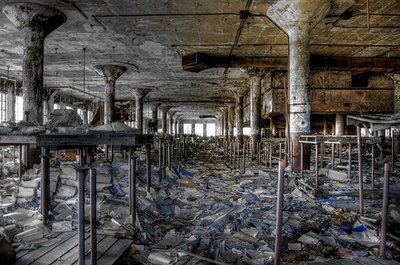
This is a building where our deeply-troubled public school system once
stored its supplies, and then one day apparently walked away from it
all, allowing everything to go to waste. The interior has been ravaged
by fires and the supplies that haven’t burned have been subjected to 20
years of Michigan weather. To walk around this building transcends the
sort of typical ruin-fetishism and "sadness" some get from a beautiful
abandoned building. This city’s school district is so impoverished that
students are not allowed to take their textbooks home to do homework,
and many of its administrators are so corrupt that every few months the
newspapers have a field day with their scandals, sweetheart-deals, and
expensive trips made at the expense of a population of children who can
no longer rely on a public education to help lift them from the cycle
of violence and poverty that has made Detroit the most dangerous city
in America. To walk through this ruin, more than any other, I think, is
to obliquely experience the real tragedy of this city; not some
sentimental tragedy of brick and plaster, but one of people.Pallet after pallet of mid-1980s Houghton-Mifflin textbooks, still unwrapped in their original packaging, seem more telling of our failures than any vacant edifice. The floor is littered with flash cards, workbooks,
art paper, pencils, scissors, maps, deflated footballs and frozen
tennis balls, reel-to-reel tapes. Almost anything you can think of used
in the education of a child during the 1980s is there, much of it
charred or rotted beyond recognition. Mushrooms thrive in the damp ashes of workbooks. Ailanthus altissima, the "ghetto palm" grows in a soil made by thousands of books that have burned, and in the pulp of rotted English Textbooks. Everything of any real value has been
looted. All that’s left is an overwhelming sense of knowledge unlearned
and untapped potential.
More pictures here.
Book Forum: Harford and Kevin Grier on Cities
Kevin Grier at Kids Prefer Cheese continues our book forum on the Logic of Life with a discussion of The World is Spiky.
Here is my summary of Tim’s argument. Cities are expensive, and that
expense is above and beyond paying the necessary rents to gain access
to their unique amenities. Cities are marked by knowledge spillovers, a
positive externality (don’t get mad Bryan)
where human capital grows faster when one is around more humans. And
the internet, rather than reducing the positive effects of cities on
productivity, actually enhances them. Thus, rather than subsidizing
rural areas, perhaps we should consider subsidizing cities.
Luckily
for Tim and his prospective book sales, he tells this story in a much
more entertaining way than I just did. But I still have some questions,
suggestions, and quibbles.
The claim is made that salary
differences don’t match up with cost of living differences and the
reason for this is knowledge spillovers, but it is not spelled out
exactly how that would work. An alternative seems to me that zoning
restrictions create these big rents and pre-existing property owners
are sucking a lot of the consumer surplus out of people with high
valuations on cool experiences…..
Tim discusses
“failing cities” and describes (correctly I think) why people still
live there, but gives no explanation for why they failed if indeed
cities produce these positive externalities. There is no discussion of
some of the very biggest cities in the world; Mexico City, Lagos,
Jakarta. It would be nice to know where the argument works, where it
doesn’t and how to know which is which…
More here.
The Power of Vouchers
Many studies of education vouchers have looked at the achievement of children who are given vouchers and who transfer to private schools. Generally these studies have found small but meaningful improvements (e.g. here and here). A voucher program, however, is about much more than transferring students from lousy public schools to better private schools it’s about creating incentives to improve the public schools.
Florida’s Opportunity Scholarship Program rated schools. Students at schools that received an F in multiple years became eligible for a voucher that allowed them to attend a private or higher-rated public school. In Feeling the Florida Heat? (ungated version) a paper sponsored by the Urban Institute Rouse et al. look at what happened at failing schools.
…we find that schools that received a grade of “F” in summer 2002 immediately improved the test scores of the next cohort of students, and that these test score improvements were not transitory, but rather remained in the longer term. We also find that “F”-graded schools engaged in systematically different changes in instructional policies and practices as a consequence of school accountability pressure, and that these policy changes may explain a significant share of the test score improvements (in some subject areas) associated with “F”-grade receipt.
Thus, this paper shows two things. First, that the test scores of the students in the public schools improved when vouchers gave the schools better incentives to perform. Second, at least some of the improvement comes from changes in how students are taught. The author’s note, for example:
…we find that schools receiving an “F” grade are more likely to focus on low-performing students, lengthen the amount of time devoted to instruction, adopt different ways to organize the day and learning environment of the students and teachers, increase resources available to teachers…
It is not true that "nothing can be done to improve the schools." Incentives matter.
Notice that Florida’s program worked even though the program was very weak. It offered vouchers only to students in the worst schools and only after those schools received F grades in multiple years. The vouchers were relatively small and could not be topped up. In addition, the program lasted only a few years before it was declared unconstitutional by Florida’s supreme court.
A true voucher program would be national, would not discriminate among students, would offer funding equal to that spent on students in public schools and would be permanent. Competition in such a system would be more intense and even more productive than in Florida’s program.
Marginal Revolution?
A project founded by Los Angeles-based actress and writer Tamara
Krinsky advocates a simple change that anyone can believe in: By
altering the printing margin preference for Microsoft Word documents
from the standard 1.25 inches to 0.75 inch, Americans can save a whole
lot of paper — and trees, and money.
Plus you don’t have to kill your dog.
What an Economist gets his Wife for Valentines
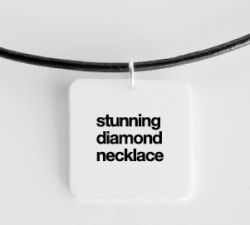
Even though I explained that only someone who truly loved her could afford to give her a gift of this kind, she appeared not to be as impressed as I had hoped.
If you dare to test the theory yourself you can find more here.
Book Forum: Harford and Caplan on Statistical Discrimination
The Logic of Life contains an excellent chapter explaining statistical discrimination but does the theory hold up? Bryan Caplan says no.
…[Tim] heavily emphasizes a few experiments showing that statistical
discrimination could be a "self-fulfilling prophesy." For example, he
describes a resume experiment where otherwise identical fake resumes
with "black names" were less likely to get a response. "High-quality
applicants were more likely to be invited for an interview, but only if
they were white. Employers didn’t seem to notice whether black
applicants had extra skills or experience." If that is how employers
treat black applicants, what’s the point of trying? As Tim asks, "Why
bother to get a degree or work experience if you are young, gifted, and
black?"But is it really true that the market fails to reward blacks for
getting more education? Is it even true that the market rewards them
less? I tested these claims using one of the world’s best labor data
sets, the NLSY. The results directly contradict Tim’s self-fulfilling prophesy story. Blacks actually get a substantially larger
return to education than non-blacks! The same goes for experience,
though the result is not statistically significant. The real lesson of
the data is that if you are young, gifted, and black, you should get a
ton of education, because it has an exceptionally large pay-off.Why would this be so? I’m not sure, but one simple story is that counter-stereotypical
behavior stands out. When my sons were young, my wife was working a
lot, so I often took my kids places on my own. Funny thing: Time and
again, strangers came up and said, "Wow, you’re such a great dad!" But
there were moms of young kids doing the same thing in plain sight, and
the strangers rarely praised them. Why not? Because a dad taking care of two babies is counter-stereotypical, which grabs people’s attention.Purely anecdotal, yes. But it is consistent with the small academic
literature on counter-stereotypical behavior. If you clearly violate
expectations, people not only notice; they often over-react.The upshot is that stereotypes may actually be self-reversing
rather than self-fulfilling. The marginal payoff of distinguishing
yourself from the pack is high if people think poorly of the typical
member of the pack.
Bryan has much more on the unpleasant truths about discrimination. Read the whole thing.
Know Thyself
Felix Salmon points to the declining price of self-knowledge.
- Cost of sequencing Craig Venter’s genome: $3 billion, over 10 years.
- Cost of sequencing James Watson’s genome: $1 million, over 2 months.
- Cost of sequencing an anonymous African’s genome: $100,000, over 1 month.
Was there a Housing Bubble?
Here’s a nice picture from The Mess that Greenspan Made.
A Real Stimulus Plan
As you know, I’m not enthusiastic about a fiscal stimulus plan. What we need is a stimulus plan that does not increasing the budget deficit or waste taxpayer funds but that does increase the incentive to produce output. So what would I do? Here’s a new idea.
The IRS knows how much income that each taxpayer reported last year. So let’s cut everyone’s marginal tax rate based on last year’s income. In other words, suppose that last year Joe earned $66,520 which puts him in a 25% tax bracket. Joe’s tax schedule this year will be exactly the same as last year except for every dollar earned above $66,520 the tax rate drops to 15%. We do this for all taxpayers so that each taxpayer has their own schedule and for each taxpayer there is a decreasing marginal tax rate.
Note that this plan increases the incentive to work and it doesn’t increase the deficit. In fact, the Tabarrok plan increases tax revenues! The key is a marginal tax cut with a different margin for every taxpayer based upon last year’s return.
That’s the basic idea but there are some obvious modifications that could solve various problems. For example, the new schedule could be based on an average of say the last three years of income or the average plus some roundup for growth etc. It’s also possible to cap the base on which the lower marginal tax rate applies, for example, we could create a lower tax rate on every dollar of income above last year’s income up to an increase of 20%.
It is true that a permanent system like this could be (partially) gamed but the system can work very well if used occasionally, say for the most serious recessions. We would also learn a lot by applying this system and looking at the taxpayer response.