Congestion Pricing on the Road and in the Air
Privatizing toll roads in the U.S. may result in significant diversions
of truck traffic from privatized toll roads to "free" roads, and may
result in more crashes and increased costs associated with use of other
roads, according to a new study.
It’s interesting how congested, dangerous, public roads are framed as a problem of safe, fast, toll roads! The problem, however, is easily solved. Price all the roads! Unrealistic? Foolish? Not at all, especially not for large trucks which are the focus of the above study. The key is to tie the price to the truck not to the road. With today’s GPS technology trucks can be outfitted with GPS devices that can price all roads according to time, congestion, quality and a variety of other factors. In fact, just such a system is working in Germany right now.
In other congestion news the DOT is finally allowing airports to charge landing fees based on congestion. This is good news for travelers who can thank the economically-astute, Harley riding, no-nonsense Secretary of Transportation, Mary Peters.
By the way, Transportation Secretary Peters wrote the foreword to Street Smart: Competition, Entrepeneurship and the Future of Roads, a very good book on road pricing and privatization edited by Gabriel Roth and published by the Independent Institute (where I am the director of research.)
Wining about Neuroeconomics
Neuroeconomics has promise but many of the early results leave me cold. A forthcoming paper in PNAS, Marketing
actions can modulate neural representations of experienced pleasantness (subs. required), has all the usual cute pictures of brain scans (see here, if you care) which are used to make the following conclusion.
Our results show that increasing the price of a wine increases
subjective reports of flavor pleasantness as well as
blood-oxygen-level-dependent activity in medial orbitofrontal cortex
[mOFC], an area that is widely thought to encode for experienced
pleasantness during experiential tasks.
In short, a $90 bottle of wine tastes better than a $10 bottle of wine even when it is the same wine. But why not just ask people which wine they like best, as many previous studies have done? How exactly does a picture of the wine-addled brain add to our knowledge? Are we really so concerned that people would lie about their experiences that we need to put them into a 3 million dollar fMRI scanner to read their brains? (I wonder if this paper was NSF funded.)
Moreover, the lessons that people are drawing from this study are absurd. One common response, for example, is "It’s a marketing expert’s dream; if you want people to like your product more, charge a higher price." Uh huh. And what happens when every winery raises its price, will we all purchase more wine?
Living in a market economy the association in the brain between price and quality is constantly reinforced so it’s not surprising that sometimes the brain can "jump the gun" in expectation. But don’t imagine that the association can be easily exploited for long. Why do you think these sorts of studies always use wine? Could it possibly be because most people can’t tell the difference between a cabernet and a merlot let alone between higher and lower quality wine? But try telling people that a $5,000 car is $45,000 and let’s see if the medial orbitofrontal cortex
lights up with experienced
pleasantness.
Thanks to Ted Frank for the pointer.
The Division of Personality is Limited by the Division of Labor
Here is the abstract to Why can’t a
man be more like a woman? Sex differences in Big Five personality traits
across 55 cultures.
Previous research suggested that sex differences in personality traits
are larger in prosperous, healthy, and egalitarian cultures in which
women have more opportunities equal with those of men. In this article,
the authors report cross-cultural findings in which this unintuitive
result was replicated across samples from 55 nations (N = 17,637). On
responses to the Big Five Inventory, women reported higher levels of
neuroticism, extraversion, agreeableness, and conscientiousness than did
men across most nations. These findings converge with previous studies in
which different Big Five measures and more limited samples of nations
were used. Overall, higher levels of human development–including long
and healthy life, equal access to knowledge and education, and economic
wealth–were the main nation-level predictors of larger sex differences
in personality. Changes in men’s personality traits appeared to be the
primary cause of sex difference variation across cultures. It is proposed
that heightened levels of sexual dimorphism result from personality
traits of men and women being less constrained and more able to naturally
diverge in developed nations. In less fortunate social and economic
conditions, innate personality differences between men and women may be
attenuated.
Unlike the authors, I don’t find it unintuitive that personality differences between men and women increase in developed economies. All personality differences increase in developed economies. If Robin Williams Chris Rock (see comments) were a Bangladeshi rice farmer he might still be funny but he’d also have to be a hard-working, diligent rice farmer and that would push his personality closer to the mean of all rice farmers. The division of labor both opens up the possibility of becoming who you truly are and it magnifies and extends who you can be.
Hat tip to Robin Hanson.
No Immunity for the Telecoms
The telecoms happily collaborate with the NSA to run roughshod over the constitution with warrantless phone and email taps but of course they cut off covert surveillance immediately when the government forgets to pay the bill. Bastards. Not that I am surprised. Incentives matter; so of course the telecoms need to be prosecuted.
Thanks to Lee Spector for the link.
Against Fiscal Stimulus
As the economy slows many people from Larry Summers to Martin Feldstein are calling for a fiscal stimulus. I am not convinced. Spending and tax decisions can
rarely boost an economy.
First, the money for any new spending or tax cuts has got to come from somewhere, right? Thus there is usually substantial crowding out of any stimulus.
Second, by the time the new spending or tax cut
gets through the political process the economy has moved on and the
stimulus is no longer relevant except by accident.
Third, there just
isn’t that much discretionary spending to play with and even a large
increase in spending, say tens of billions, is too small to make much of
a difference in a 13 trillion dollar economy.
Fourth, in their desperation to "do
something" politicians will often do something foolish. If a spending
increase or tax cut isn’t worthwhile on its own merits then it’s highly
unlikely to be worthwhile once we add in the benefits of "stimulus." Thus, it’s one thing to argue for extending unemployment benefits as a matter of welfare it’s quite another to think that an increase in unemployment benefits will so increase spending as to reduce unemployment! (The implicit view of Larry Summers.)
Economists may call for "temporary," "conditional," and "targeted" stimulus but they won’t be the ones designing the plan. Spending
increases and tax cuts are policies with long term
consequences that we need to think about carefully.
Thus, I do not favor a fiscal "stimulus"
package.
A Few Thoughts on the Democratic Debate
I watched the Democratic debate last night. I thought all the candidates did well on foreign policy but Senator Clinton’s answers were more specific and informed.
When asked whether, if they had "actionable intelligence" on Bin Laden’s location in Pakistan, they would strike even without the Pakistani government’s approval, Edwards and Obama jumped at the chance to show how tough and determined they were. Clinton was tough also but she said she would sure let the Pakistani government know what was happening before the missiles hit otherwise the Pakistani’s might think it was an attack from India. I think she could have jumped on Edwards and Obama for perhaps starting a nuclear war due to their inexperience but she didn’t and I suspect that the point may have been lost on the audience. In answering questions about troop withdrawal, Senator Clinton was also thinking through the details at a greater level than the other candidates mentioning, for example, that it was important to make plans for the Iraqi’s who have worked with US troops.
On economics, Obama was by far the best. Former Secretary of Energy, Bill Richardson, who performed poorly throughout the debate, said a carbon tax was a bad idea because it would raise prices to consumers which is why he supported cap and trade! Obama pointed our correctly that cap and trade would also raise prices but he nevertheless supported cap and trade because some sacrifices were necessary.
On energy and economics, Clinton was very poor. She made some crazy argument that mandating energy efficiency was the way to get us out of the looming recession – as if wishing for greater efficiency would make it so.
Edwards didn’t say much specific on economics and so didn’t make too many pure gaffes but he scared me with all of his talk about how going after corporations was personal.
Sentences of Great Sadness
Andrew Olmsted, a blogger who posted at Obsidian Wings as G’Kar, was killed yesterday in Iraq. He gave one of his co-bloggers a final post in the event of his death. It’s very painful to read and also funny and sad. Here is one of the few sections that I can bear to post.
Believe it or not, one of the things I will miss most is not being able to blog
any longer. The ability to put my thoughts on (virtual) paper and put them where
people can read and respond to them has been marvelous, even if most people who
have read my writings haven’t agreed with them. If there is any hope for the
long term success of democracy, it will be if people agree to listen to and try
to understand their political opponents rather than simply seeking to crush
them.
The Candidate Doesn’t Matter
Despite large swings in the market for presidential nominees over the past few days, on the Democratic side Clinton has dropped and Obama risen by almost 15 points and on the Republican side McCain has surged to take the lead (!), there has been very little movement in the winner take all market which is predicting a Democrat win. Thus, the markets seem to be saying that the candidate doesn’t matter. In this election it’s party and the Republicans are losing.
Winner Take All Market from IEM (click to expand).

The Economics of Religious Innovation
Here’s a story from the WSJ about a temple in Hyderabad, India that capitalized on the growing IT industry.
Hoping to capitalize on all the activity, technical colleges
sprouted up in the city’s outskirts near Mr. Gopala Krishna’s temple. Students
started trickling by on their way home from school; many complained about their
failed attempts to secure U.S. visas. That gave the priest an idea to sell the
students on the deity by giving him a new persona, "Visa God." Mr. Gopala
Krishna counseled the students in English, then told them to walk around the
temple 11 times to get their wish. "I used to say, ‘Go, this time you’ll get
it,’" he recalls.Soon, Mr. Gopala Krishna started seeing dozens — then hundreds
— of new visitors a day. In 2005, some local newspapers wrote about the Visa
God, just as new U.S. visa restrictions were taking a toll. Mr. Gopala Krishna
and his relatives also launched a Web site and a newsletter called Voice of
Temples, with features like a primer of sample prayers for help in visa
interviews.…Now devotees of the Visa God say they have to reach the temple by 6
a.m. to avoid the daytime rush.
Planes to Nowhere
Imagine an aviation system in which planes fly
two-thirds empty, fares are as low as $46 and the government pays up to
93% of the cost of a flight….that system exists in the USA – and quietly is expanding…
That is from USA Today talking about the millions spent on the "Essential Air Service" program. Do you think that the program protects small rural communities? Nah, try small community airlines.
…as Congress has escalated subsidies through the years, the program has
increasingly paid for flights between major airports and places that
are neither rural nor isolated. [For example,] in October, the DOT agreed to one of the
program’s largest subsidies ever – $2 million a year to Atlantic
Southeast Airlines. That pays 60% of ASA’s cost to fly two round-trips
a day between Macon, Ga., and Atlanta’s Hartsfield-Jackson
International Airport, 81 miles away. The airline projects that passengers will pay an
average of $78 for a one-way ticket – and that flights, typically on
planes with fewer than 70 seats, will run 83% empty.
Need I tell you that the program was supposed to be temporary? Here’s some more data from USA Today.
| Community | Destination | Annual subsidy | Subsidy per passenger | Average pass. per flight |
 |
||||
| El Dorado, Ark. | Dallas/Fort Worth | $923,456 | $250 | 3.1 |
|
||||
| Devils Lake, N.D. | Minneapolis | $1,329,858 | $203 | 5.7 |
|
||||
| Worland, Wyo. | Denver | $797,844 | $187 | 4.2 |
|
||||
| Bradford, Pa. | Pittsburgh | $1,217,414 | $174 | 3.6 |
|
||||
| Jamestown, N.Y. | Pittsburgh | $1,217,414 | $135 | 4.7 |
|
||||
| Salina, Kan. | Kansas City | $487,004 | $131 | 2.1 |
|
||||
Sources: Department of Transportation, USA TODAY analysis of DOT and airline data
On the Uses of Mistletoe

Happy Holidays to all!
Father Christmas?
A conversation between the 6yr old and the 9yr old.
"Big fat man. Flying reindeer. All around the world in one night. That’s crazy."
"Yeah."
"But who does bring the presents? Do you think Daddy brings the presents?"
"Nah, if it was Daddy we would just get cash."
Blogging Death in LA
The LATimes has a blog, The Homicide Report, that covers murders in LA. Here is one entry:
Timothy Johnson, 37, a black man, was shot multiple times at 939 E.
92nd Street in Watts at about 3:23 a.m. Sunday, Nov. 25, and died at
the scene. Police officers had received a "shots fired" call and found
him. He had been visiting friends in the area.He had gone to a party that night, then had stopped on his way home
to socialize with friends outside. His shooters came by walking or
driving. He was hit multiple times. When officers arrived, he was
alone, dead on the ground, and the people who had been outside with him
had disappeared. A pit-bull puppy chained in the yard was curled on his
body.
The comments begin as you might expect from families and friends.
… The life of an African American Man in LA has proven to be a fight
till the death. I am struggling now as I sit here looking at your
picture. All the years we spent growing up together, supporting each
other and just loving one another. I Love you!! You were my cousin by
birth but my brother at heart.Love Kim
Posted by: Khaleelah Muhammad | November 28, 2007 at 04:50 PM
but then a darker story is revealed:
To all the people speaking glowing words about this man … im sure
some of you know and for those that dont, this man was a killer and it
was known by LAPD that he has blood on his hands. Trust me he got what
he deserved and what i prayed for. He now has to meet GOD face to face
and face the people that HE has killedPosted by: Satisfyied Person | November 29, 2007 at 11:03 AM
Many entries excerpted in the LATimes can be found here, all of the comments (start at the bottom and work up) are here.
Incentives
When I come to my office, I take my sweater off. When I go home, I put my sweater back on.
Who Benefits from the Federal Government?
A common response to my post showing that The Rich Pay for the Federal Government was that the rich also get more benefits from the federal government. Let’s go to the numbers. Here’s a chart showing federal spending categories for 2007. (Click to expand.)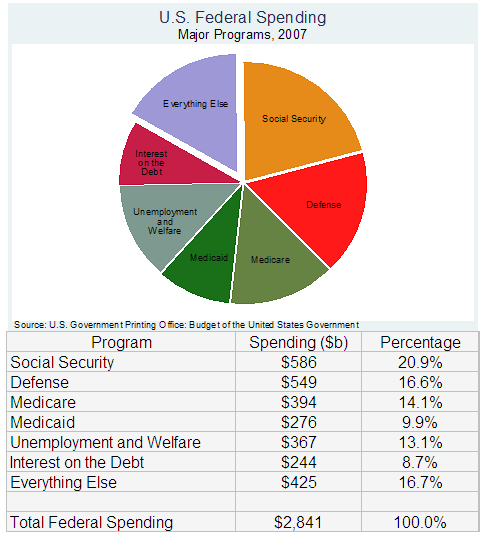
Social Security, the biggest category, doesn’t benefit the rich at all because net Social Security payments are heavily biased against the rich. According to Eugene Steuerle and Adam Carasso of the liberal Urban Institute a two earner couple earning $230,000 a year (thus putting them at the mean household income for the top 20%) and scheduled to retire in 2030 will pay $227,886 more in social security taxes than they receive in benefits (in present value).
Defense is the next biggest category. To me a lot of "defense" spending doesn’t benefit anyone but let’s be generous and say that the rich benefit from military spending in proportion to their income share which for the top 20% means 55%. Thus $301b.
Medicare benefits the rich less than the poor since they are healthier (plus they must pay higher premiums) but let’s say that Medicare benefits the rich in proportion to their population. If we say the top 20% are rich and assume that this is the same in the 65 and older category then 20% of Medicare goes to the rich. $78.8b.
Medicaid doesn’t benefit the rich. The rich do use unemployment insurance but at far lower rates than the poor. Does welfare benefit the rich? Not directly but maybe from the warm glow. I don’t think the benefits of charity are what most people mean when they say that the rich benefit from the federal government but who knows. Let’s again be generous and say that the warm glow goes just to the rich and that it is worth 20% of the benefit to the poor. $73.4b
Everything else includes the example that people always seem to mention first, roads! Alas, the entire transportation budget is just $77 billion, not much there even if a lot of it goes to the rich. By my judgment a lot of "everything else" has low value but again let’s be generous and say that the rich benefit from everything else in proportion to their income share (.55). $233b.
Excluding the national debt gives us a total of $687 billion out of $2597 billion going to the rich or 26%. If we assume that the division of the national debt is the same as for the government as a whole (since this is just past expenditures) the percentage is still 26%.
Thus in a generous accounting the rich get 26% of the benefits of federal spending and pay 68.7% of the costs. In percentage terms the rich get about 37 cents on the dollar.
Alternatively stated about 63 cents of every dollar in taxes paid by the rich is transferred down. Given that the median voter is a taxeater not a taxpayer we should not be too surprised, although this is a smaller number than I would have guessed before I did the calculation. From an efficiency point of view we should be happy that the rich don’t get too much – transferring resources creates a lot of waste but transferring resources from the rich to the rich is especially wasteful.
The basic point is clear; In the United States, one can argue for taxing the rich on the ability to pay principle but not on the benefit principle.
Addendum: Thanks to Ted Frank for catching a math slip-up on my part which I fixed raising the total to 26%.