On the Variability of Money and Real Output
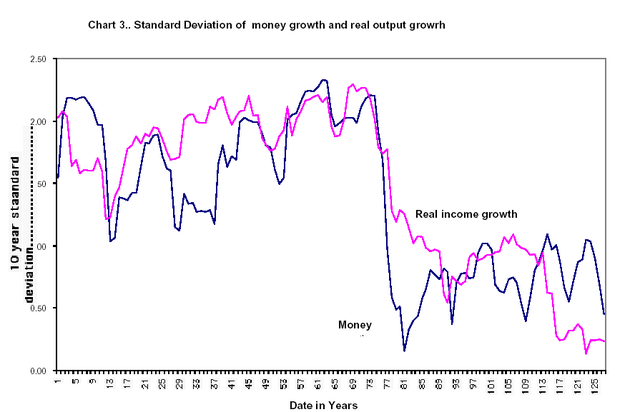
In one of Milton Friedman’s last papers (circa 2006) is this stunning graph. The graph (click to enlarge) shows the standard deviation of real output and money (M2) from 1879 to 2005. The sharp break in the series around the late 1970s and early 1980s is evident – the standard deviation of money fell dramatically and so did the standard deviation of output.
Money is partially endogenous so one could interpret this as running from output to money. The rapidity of the break, however, suggests otherwise. It’s easy to understand how policy could quickly have made money growth more stable. It’s much more difficult to understand how or why real output could quickly become more stable. Moreover, the fact that money stabilized as Volcker and then Greenspan headed the Fed is also suggestive of monetary policy as the driving force.
In one way this is a testament to better monetary policy beginning circa Volcker but in another it’s a damning indictment of how poor monetary policy has been over most of the history of the Federal Reserve.
Your Congress at Work
A new bill would give organ donors a medal. In other words, millions for medals but not a cent for compensation. If people weren’t dying it would be funny.
Thanks to Dave Undis at LifeSharers for the link. Unlike Congress, Dave is really doing something to solve the organ shortage.
Is Freakonomics Ruining Economics?
Writing in the April 02 issue of the New Republic, Noam Scheiber
argues Yes. The article is no screed – it’s
well informed about economics and the state of the profession. Unfortunately, it’s gated but do try find a copy somewhere. This bit gives some of the flavor.
Several years after his paper on schooling, Angrist noticed
that the Armed Forces Qualifying Test had been misgraded for a few
years in the late ’70s. This had opened the doors to thousands of
subpar applicants and allowed Angrist to compare the lucky
underachievers with the people rejected once the glitch got corrected,
thereby isolating the impact of military service on wages. The
practical effect was to send the grad students scrambling to find other
instances in which life-altering decisions had been handed down
incorrectly. In 2000, a Harvard professor named Caroline Hoxby
discovered that streams had often formed boundaries to
nineteenth-century school districts, so that cities with more streams
historically had more school districts, even if some districts had
later merged. The discovery allowed Hoxby to show that competition
between districts improved schools. It also prompted the Harvard
students to wrack their brains for more ways in which arbitrary
boundaries had placed similar people in different circumstances.Every few weeks, when a student would stumble onto some new
test-grading error or fatefully drawn boundary–what economists call
"instruments"–word of the discovery would rocket through the
department. The discoverer would become instantly, if momentarily,
famous, like the holder of a winning card at a Bingo hall, and
inspiring the same mix of reverence and jealousy. A typical
conversation around the snack machine at the National Bureau of
Economic Research, where many Harvard students had cubicles, went
something like: Hey, did you hear that so-and-so found this crazy
example of excess tax refunds in western Manitoba in the early ’60s? At
which point the other would reply, Uh, no, wow, that’s, uh, great, and
then scamper back to his desk to brainstorm for some similar quirk of
public policy. At an age when most people brood that life is too random
and arbitrary, these people’s biggest complaint was that it wasn’t
random and arbitrary enough.In retrospect, I have come to see this as the moment I realized
economics had a cleverness problem. How was it that these students, who
had arrived at the country’s premier economics department intending to
solve the world’s most intractable problems–poverty, inequality,
unemployment–had ended up facing off in what sometimes felt like an
academic parlor game?
I think Scheiber is off in a few ways. First, he conflates methods and
questions. It’s true that clean identification is often found with
quirky experiments but a quirky experiment does not necessarily imply a
quirky question. Hoxby’s work on education, mentioned above, is asking
a big question about the effect of competition on schools. Levitt’s work
on crime uses quirks in police assignment as do those of his "pale imitators" (like those
guys that used terror alert levels
to estimate the effectiveness of police on the street. Ha, ha!) but we
spend well over 100 billion dollars a year combating crime so it’s
pretty damn important to know how well police, prisons and punishment
work. Scheiber criticizes Emily Oster’s work but his criticism has
nothing to do with his thesis, Oster’s work on AIDS, missing women and
so forth is on big questions. It’s possible to be clever and to think
big.
The second problem is to think that if only people did less Freakonomics they
would do more big think economics. If only it were so. The truth is
that even today most of economics is a wasteland of boring papers on
profoundly uninteresting questions. The choice is not Levitt v.
Heckman it’s Levitt and Heckman (and many others like Buchanan who neither Levitt nor Heckman might appreciate) versus a huge number of non-entities (many
highly paid and famous) who answer trivial questions poorly and do it
without even the courtesy of offering some entertainment on the
side.
Addendum: Tyler has the first comment.
Loan Sharks
Old definition:
A loan shark is a scumbag who charges the poor
obscenely high rates of interest.
New definition:
A loan shark is a scumbag who charges the poor obscenely low rates of interest.
Amazon and Tivo
I have long been skeptical of the potential for movie downloads but Amazon and Tivo have made a huge step forward in solving the major problems. I reported earlier that Tivo connects to a home wireless system which means that I can program Tivo from work. Yesterday, I rented a movie from Amazon. The movie downloaded automatically via my home computer to Tivo. Downloading still takes hours so it’s not on-demand service but I rented in the morning and watched the movie that night and I watched on television not some dinky computer screen. The picture quality was good, albeit not as high as DVD. Dramas, comedies and anything you would have watched on cable TV anyway are fine – save the action flicks for DVD. What impressed me most was that the system worked flawlessly the first time, without any computer hack work on my part.
Bravo Tivo, Bravo Amazon.
Credit Snobs II
The volte-face in this post by Robert Reich is a real howler.
When the Fed decides to fight inflation by raising interest rates and
cooling the economy, it’s the poor who are the first to be drafted into
the inflation fight because their jobs are the most tenuous, and
they’re the first to lose them. When the Fed decides to ease up and
reduce rates, it’s the poor who are among the first to get the new jobs
because employers who are most likely to hire at the start are small
service businesses offering jobs at the bottom rungs of the wage scale.
I might not put it that way but nothing crazy so far. He continues:
But the Fed affects the poor in another way, too. It determines their
access to credit. And here as well, the Fed’s decisions can either be a
great boon to poorer Americans or a huge curse, depending on how
responsibly the Fed manages the credit markets.
I agree. So where do you think the argument is going from here? He’s going to make the point that when the Fed reduces rates that helps the poor to get credit and a too quick tightening could increase unemployment and create a credit crunch, right? Nope.
In this respect, it’s done a lousy job in recent years. In the early
2000s, rates were so low that banks didn’t know what to do with all the
extra money they had on hand. But instead of keeping an eye on bank
lending standards, the Fed looked the other way. The result: Credit
standards were disregarded in a tidal wave of sub-prime lending to the
poor home buyers…
Ouch, that one gave me whiplash. The Fed has done the poor a disservice by looking the other way while the poor got loans at really low rates of interest. Thus, high interest rates are bad for the poor because they can’t get jobs and low interest rates are bad for the poor because they borrow too much money.
Reich argues this way, of course, because he thinks that the poor can’t handle their money. I’ll add Reich to the list of credit snobs.
H/T to Steven Bass at Trivial Reasons.
P.S. Person 1, Dave 0.
The Liberty not to be Subordinate
I once asked a wise professor of mine what the best thing about being a professor was. He replied, "The fact that I can go into the office of the department chair, tell him he’s an #*$!%! and there’s not a damn thing he can do about it." Shocked, I said, "but you’re a level headed, nice guy, you would never want to do that." He replied "yeah, I never would, but the thought that I could if wanted to is worth a huge amount."
The lesson? Liberty is not always an instrumental value subordinate to positive capabilities.
The Credit Snobs
I rather like the title "voodoo priest of free market economics" so I am happy to take the blame for the sub-prime mortgage defaults and at the same time stick a few pins in Nouriel Roubini.
Roubini and others generating hysteria about defaults in the mortgage market are credit snobs – they think credit is something that only the rich can handle. Just look at the language that Roubini uses to analogize borrowers – they are "reckless patients" who "spent the last few years on a diet of booze, drugs and artery clogging junk food." Similarly, the Washington Post tells us that it’s the end of the "borrowing binge."
Yeah, we get it. Credit is ok for us, the "sober" borrowers but poor people can’t handle credit. Too much credit among the poor generates decay and social pathology. Credit must be regulated. We can’t, for example, have credit stores in poor neighborhoods. Don’t you know that credit is bad for people without self-discipline? Let the poor buy on installment credit? That’s unconscionable. Today’s furor over sub-prime mortgages is the same old story.
Basic economics says that people should borrow so that they can consume based upon their permanent income. Modern day financial markets are finally making this possibility a reality. Combine financial innovation, strong US economic performance and a global savings glut and it makes sense that credit should become easier to obtain. We see the benefits of financial innovation in bringing credit to the poor not just in the United States but around the world. Will Roubini
next be calling for the retraction of Muhammad Yunus’s Nobel Prize?
The fact that there are defaults is partly a learning process in response to financial innovation, and thus evolution, but also partly a simple matter of risk. Defaults are to be expected. I see no reason to expect contagion. All lending statistics must now be marked to the global financial market which means that diversification is now more extensive than ever before and thus net risk is lower. Moreover, the whole point of recent financial innovation (and reformed bankruptcy law) has been to reallocate risk way from borrowers and towards those lenders in the world wide market for capital who are in the best position to handle the risk.
The democratization of credit worries the credit snobs. The credit snobs fear that capitalism isn’t just for the rich.
Dollarization
Tyler suggests that dollarization raises prices. I am in Panama investigating. It´s true that the price of goods here, with the exception of some labor intensive goods like food preparation and taxi service, is similar to the U.S. Despite Tyler´s recondite arguments, however, I think dollarization lowers not raises real prices.
The argument to the contrary is mostly an illusion. When there is an exchange rate the nominal exchange rate can depart far from the real exchange rate. Over a matter of months a country can become very cheap or very expensive for tourists. The real exchange rate, however, is much more stable than the nominal exchange rate. So when dollarization fixes the nominal exchange rate a country is unlikely to become either very cheap or very expensive. Add in the selection argument that tourists visit when the country is cheap and its easy to see why it might appear that dollarization raises prices. (and for residents there is a selection effect also, dollarization happens when the country has been pushed to the wall.)
Overall, however, currency is mostly neutral and in the case of dollarization the effects if anything will be positive. For a country like El Salvador or Panama dollarization brings lower transaction costs and higher quality money which lowers real prices.
Addendum: Tyler, however, is correct about numero 6.
Best Sentence I Read Yesterday
I knew as a libertarian that it was imperative to be tolerant of alternative lifestyles. Until I walked into that convention hall, I had no idea how many alternatives there were.
Ed Crane on the first Libertarian Party convention in 1972. From Radicals for Capitalism.
Best Sentence Never Said by Milton Friedman
¨…may I advocate classical-liberal limited government, so that my son may advocate anarcho-capitalism, and that my grandson may plan to build new artificial countries in the ocean.¨
from Radicals for Capitalism.
The Capitalist Vanishes
The I/B/E/S database purports to document the earnings expectations of research analysts. The database has been used by academic researchers in hundreds of papers and is also used by the industry to rate and promote research analysts.
A new paper, Rewriting History, claims that there has been massive tampering with the database. Call it the capitalist vanishes.
Comparing two snapshots of the historical I/B/E/S
database of research analyst stock recommendations, taken in 2002 and 2004 but
each covering the same time period 1993-2002, we identify 54,729 ex post changes
(out of 280,463 observations), including alterations of recommendation levels,
additions and deletions of records, and removal of analyst names. The changes
appear non-random across brokerage firms, analysts, and tickers, and have a
significant impact on the overall distribution of recommendations across stocks
and within individual stocks and brokerage firms. They also affect trading
signal classifications, back-testing inferences, track records of individual
analysts, and models of analysts’ career outcomes in the three years following
the changes.
Hat tip to Mike Kellermann at the Social Science Statistics Blog.
Garvey Fellowships
The Independent Institute, where I am research director, is offering fellowships to students and young professors for essays on the theme "Is Foreign Aid the Solution to Global Poverty?" Previous winners of the Garvey essay competition include Alan Stockman, Thomas Hazlett, David Kelley, Bryan Caplan and many others.
Young Professors: Win up to $10,000
Although the Olive W. Garvey Fellowship Competition is well known for its college student essay contest–which awards $2,500 for the 1st Prize essay–the competition also has a faculty division. Untenured college professors no older than 35 years of age can win $10,000 for their 1st Prize essay!
This year’s topic is foreign aid.
“Is foreign aid the solution to global poverty?”
A 2005 United Nations report called for a doubling of foreign aid to poor countries as the means to reduce poverty. Yet the 2006 Nobel Peace Prize was awarded to a for-profit microloan bank and its founder, an apparent vindication of the ideas of Peter T. Bauer, Henry Hazlitt, Deepak Lal, and others. As Bauer wrote, “Development aid, far from being necessary to rescue poor societies from a vicious circle of poverty, is far more likely to keep them in that state.…Emergence from poverty requires effort, firmly established property rights, and productive investment.
The deadline for essay submissions is May 1, 2007.
The Ramsey Club vs the Pigou Club
It’s quite surprising that the major consumers of the world’s oil have not been able to agree to an oil tax under the auspices of something like the Kyoto Protocol. It’s surprising because if the major consumers of oil all increased taxes they would end up bearing very little of the burden.
The result is a simple application of the theory of tax incidence. The burden of a tax falls on those who can least afford to escape the tax. The world’s demand for oil is inelastic but the supply is even more inelastic. What is Saudi Arabia, for example, going to do with its oil except sell it? The oil is already fetching a price well above cost so if there is a world tax on oil that’s like a tax on land – Saudi Arabian land to be precise – and a tax on land is born by land owners not by consumers.
Members of the Pigou Club should take note. For the Pigou Club to work to alleviate global warming the Pigouvian tax must reduce the global consumption of oil (not just say US consumption) but with the supply of oil being very inelastic that’s not going to happen. A tax could drive high-cost US producers out-of-business but the major world producers are going to keep selling even with a high tax. In other words, membership in the Pigou club has few privileges unless you can put the major producers under (does that advice sound familiar?)
If you want to tax Hugo Chavez, however, please do join the Ramsey Club.
Trade Secrets
In Race, Poverty and American Tort Awards (and here), Eric Helland and I show that tort awards increase strongly with county poverty rates especially with minority poverty. A 1% increase in black poverty rates, for example, can increase tort awards by 3-10 percent with a similar increase in Hispanic poverty rates. Careful forum shopping can easily raise awards by 50-100%.
Anthony Buzbee, a famed plaintiff’s attorney, inadvertently let the cat out of the bag recently when talking about Starr county in Texas.
"That venue probably adds about seventy-five percent to the value of
the case," he said. "You’ve got an injured Hispanic client, you’ve got
a completely Hispanic jury, and you’ve got an Hispanic judge. All
right. That’s how it is."In other parts of Texas, Buzbee went on, a plaintiff may have the
burden of showing "here’s what the company did wrong, all right? But
when you’re in Starr County, traditionally, you need to just show that
the guy was working, and he was hurt. And that’s the hurdle: Just prove
that he wasn’t hurt at Wal-Mart, buying something on his off time, and
traditionally, you win those cases."
Buzbee’s words were caught on tape. Need I tell you the rest of the story? Buzbee, of course, is suing. I wonder where he will bring the case?
Thanks to Ted Frank at Overlawyered for the pointer.