Walter Williams is Drafted
Our colleague, Walter Williams, is truly famous.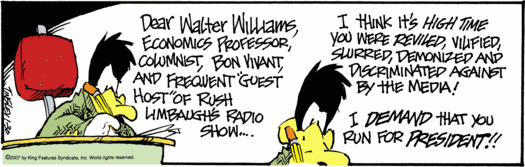
Onion or not Onion?
Three
Death Row inmates say the three-drug cocktail used in lethal injections have
not been approved by the Food and Drug Administration for executions and want a
federal judge to issue an injunction to stop the state from using the drugs
until it complies with federal drug laws.
According to sources at the Allstate Insurance Company, CIA
Director Michael Hayden purchased nuclear-attack insurance Wednesday, paying a
$100,000 monthly premium for his homes in suburban Washington, Pittsburgh, and
near Cheyenne Mountain, CO.
Thanks to Monique van Hoek and Daniel Rothschild for pointers.
1000 Word Rebuttal
The tax code, [Bush] said, “unwisely encourages workers
to choose overly expensive, gold-plated plans. The result is that insurance
premiums rise, and many Americans cannot afford the coverage they need.”Again, wow. No economic analysis I’m aware of says that when Peter chooses a
good health plan, he raises Paul’s premiums.
Rebuttal:

Digital Cash
A glamorous Whole Foods market just opened in my neighborhood. You can pay for your groceries using just the swipe of your fingerprint. Cool.
Abigal Alliance v. FDA
In May I wrote about the stunning ruling by the DC Circuit Court of Appeals that dying patients have
a due process right to access drugs once they have been through
FDA approved safety trials. (See the link for some amazing quotes from the ruling.) The case is now on appeal and possibly headed to the Supreme Court and I am thrilled to have a role.
I am one of the authors of an Amici Curiae brief, a friend of the court brief. The DC Circuit Court of Appeals made it’s ruling based on the right to control one’s own body:
A right of control over one’s body has deep roots in the common law. The
venerable commentator on the common law William Blackstone wrote that the right
to “personal security” includes “a person’s legal and uninterrupted enjoyment
of his life, his limbs, his body, [and] his health,”…barring a terminally ill
patient from use of a potentially life-saving treatment impinges on this right
of self-preservation.
But the court noted that a patient’s fundamental right could be rebutted if the FDA can show
that its policy of barring access to these drugs is "narrowly tailored
to serve
a compelling governmental interest."
The brief, submitted by Jack Calfee, Dan Klein, Sam Peltzman, Benjamin Zycher and myself, argues that barring access to experimental drugs does not serve a compelling governmental interest and in fact reduces patient welfare.
Unfortunately, I do not think that the Abigail Alliance can win the case; recognizing the rights that the DC Circuit of Appeals recognized would be too big a blow to our nanny state. Nevertheless, if we can help the court to be aware of some of the tradeoffs involved with drug regulation that will be valuable and it’s also great to be on a paper with Peltzman.
Thanks also to Ted Frank and others for acting as Counsel for the Amici Economists.
They thought they had me, but I had them! Maybe.
In a moment of weakness after my furnance broke down I bought a service contract. Now every few months I get a "free cleaning" during which the furnace repair guy tells me about all the other products I need.
The salesman, sorry, I mean furnace repair guy, seems honest and genuinely concerned about my ambient body temperature. Of course, I never listen to him or buy anything and this makes me very happy. See, I figure that most people do purchase additional services from such a fine young man. If so, then perhaps the real purpose of selling the insurance contract is not the insurance- it’s to get the salesman in your door several times a year. And that means that the insurance qua insurance contract ought to be reasonably priced, maybe even under-priced, or at least not jacked up as high as it would be if it didn’t lead to further sales.
Thus, I have cleverly reasoned my way out of foolishness and towards brilliance – such reasoning is to be distrusted. Nevertheless, I wonder whether the argument does not generalize.
Hard to make this stuff up department
Daniel Gross’s best argument for FDR is that FDR was better than Hitler.
Roosevelt scared investors and businessmen? Did he scare them as much as, oh,
Stalin, who controlled one of the world’s largest economies and was expanding
his influence? or as much as Mussolini? Or as much as the fascist government of
Japan? Or as much as Hitler, who was confiscating property of Jewish
investors and businessmen?
So there you have it. FDR not as bad as Hitler, therefore, FDR a good president. Compare with Bryan Caplan’s actual argument.
Not Normal on the New Deal
Readers will not be surprised to know that I am not normal. Indeed, I have not been normal for a long time as this post from 4 years ago attests:
Roosevelt and the Great Depression
I was amused to see Conrad Black writing with shock:
Jim Powell of the Cato Institute (cited approvingly in a recent column by Robert L. Bartley) argues in a new book that FDR actually prolonged the Depression!
Of course, Powell is correct. Imagine, increasing the power of
unions to strike and raise wages during a time of mass strikes and mass
unemployment. Imagine thinking that cartelizing whole industries
thereby raising prices and reducing output could improve the economy.
Not everything Roosevelt did was counterproductive – he did end
prohibition (although in order to raise taxes) – but plenty was and
worst of all was the uncertainty created by Roosevelt’s vicious attacks
on business. (See, for example, the work of Bob Higgs especially this important paper and historian Gary Dean Best’s overlooked classic Pride, Prejudice and Politics.)
Business investment failed to recover because business people
legitimately feared a regime change like that which had occured in
Germany and Italy. Sound extreme? Roosevelt himself threatened/promised
this in his first inaugural:
…if we are to go forward, we must move as a trained and
loyal army willing to sacrifice for the good of a common discipline,
because without such discipline no progress is made, no leadership
becomes effective. We are, I know, ready and willing to submit our
lives and property to such discipline, because it makes possible a
leadership which aims at a larger good… I assume unhesitatingly the
leadership of this great army of our people dedicated to a disciplined
attack upon our common problems….in the event that the Congress shall
fail to take one of these two courses, and in the event that the
national emergency is still critical, I shall not evade the clear
course of duty that will then confront me. I shall ask the Congress
for… the power that would be given to me if we were in fact invaded
by a foreign foe.
My wild self gets in big trouble
My wife was not at all happy about my recent post on the wild self.
The bottom line? If you want to please the economist in me, send me
cash. If you want to please my wild self (you know who you are!) use
your imagination.
Her words: "Your wild self is getting socks and don’t think any different. Thank goodness my friends don’t read your blog." Uh oh, now I am in real trouble.
Comments are not open.
Vive La Resistance
My anti-authoritarian, free-wheeling, libertarian colleagues and I easily found a dealer in downtown Chicago willing to sell us an illegal substance. Don’t tell the man but if you are in Chicago and want the good stuff ask for Kevin.
Thomas Jefferson Continues to Surprise
Keith Ellison made history Thursday, becoming the first Muslim member
of Congress and punctuating the occasion by taking a ceremonial oath
with a Quran once owned by Thomas Jefferson.
(From the NYTimes). I wonder if Jefferson every took scissors to the Quran to cut out all the ridiculous bits, the way he did to the Bible?
Uncertainty is the Friend of Delay
Regarding global warming and what to do about it, Brad DeLong approvingly paraphrases Tyler, "uncertainty is not the friend of doing nothing." Bearing in mind the obvious dangers of contradicting both Brad and Tyler let me counter with "uncertainty is the friend of delay."
If you are faced with two environments one of which has outcomes somewhere between -10 to 10 and the other somewhere between -100 to 100 then I agree that the greater uncertainty of the latter provides no necessary reason for doing less relative to the former.
Suppose, however, that we are uncertain about which environment we are in but the uncertainty will resolve over time. In this case, there is a strong argument for delay. The argument comes from option pricing theory applied to real options. A potential decision is like an option, making the decision is like exercising the option. Uncertainty raises the value of any option which means that the more uncertainty the more we should hold on to the option, i.e. not exercise or delay our decision.
Imagine, for example, that there are 100 doors before us. We can enter any door but once we enter it will be costly to exit. If we don’t decide then over time we learn a little bit about what is behind each door. If our uncertainty to begin with is small, we know that behind each door is more or less the same thing, then learning has little value and we should decide now (assuming some modest cost to waiting). But if our uncertainty is large then learning has a lot of value and we should delay our decision until some of our uncertainty has been resolved.
Applying the theory to global warming isn’t easy because our decisions involve many options and exit costs but if we think that our knowledge of the extent, cost, cause and solutions to global warming are increasing at a faster rate than the danger of global warming then delay of any major decision is a rational policy at the present time.
The Economics of Chocolate
"You
say that 400 florins a year as an assured salary are not to be despised,
and it would be true if in addition I could work myself into a good position
and could treat these 400 florins simply as extra money. But unfortunately,
that is not the case. I would have to consider the 400 florins as my chief
income and everything else I could earn as windfall, the amount of which
would be very uncertain and consequently in all probability very meager.
You can easily understand that one cannot act as independently towards
a pupil who is a princess as towards other ladies. If a princess does not
feel inclined to take a lesson, why, you have the honor of waiting until
she does. She is living out with the Salesians, so that if you do not care
to walk, you have the honor of paying at least 20 kreuzer to drive there
and back. Thus of my pay only 304 florins would remain–that is, if I only
gave three lessons a week. And if I were obliged to wait, I would in the
meantime be neglecting my other pupils or other work (by which I could
easily make more than 400 florins). If I wanted to come into Vienna I would
have to pay double, since I would be obliged to drive out again. If I stayed
out there and were giving my lesson in the morning, as I no doubt would
be doing, I would have to go at lunchtime to some inn, take a wretched
meal and pay extravagantly for it. Moreover, by neglecting my other pupils
I might lose them altogether–for everyone considers his money as good
as that of a princess. At the same time, I would lose the time and inclination
to earn more money by composition. To serve a great lord (in whatever office)
a man should be paid a sufficient income to enable him to to serve his
patron alone, without being obliged to seek additional earnings to
avoid penury. A man must provide against want."
Marginal Revolution Goes Avant-Garde
David Morris, New York City theater artist and long-time reader of MR, is one of the creators of Routine Hearing: Exercises for the Body Politic.
Exercises for the Body Politic
moves to the beat of an original score featuring the luminaries of
political oratory. From the golden oldies of Goldwater and
McGovern to the modern sounds of Limbaugh and Moore, your headphones
will set the stage for this auditory grand ballet. Enjoy a glass
of wine, a game of cards and the company of your fellow citizens as one
of HERE’s favorite design teams–David Evans Morris & Juliet
Chia–hit shuffle on the political soundtrack of 21st century.
The lastest installment of Exercises will feature selections from Tyler’s paper Self-Deception as the Root of Political Failure. Alas, no selections from your truly but if Nixon going to China can become an opera I have high hopes for the musical, Believe in Pascal’s Wager? Have
I got a deal for you!
You can get tickets to Routine Hearing which plays Jan. 2-3 at the above link.
Addendum: Here are Tyler and I on An
Economic Theory of Avant-Garde and
Popular Art, or High and Low Culture (JSTOR link).
Posner Lectures Chipmunk
Here’s a tidbit from a Washington Post article today on property rights in online worlds.
Earlier this month, U.S. Circuit Judge Richard A. Posner visited
Second Life, appearing as a balding, bespectacled cartoon rendering of
himself, and addressed a crowd of other animated characters on a range
of legal issues, including property rights in virtual reality. Posner
stressed that it was in Linden Lab’s interest to ensure due process and
other rights."They want people to invest in Second Life, and we
know people won’t invest if their rights are not reasonably secure," he
told the audience, which included a giant chipmunk and several
supermodels. He went on to predict the eventual emergence of an
"international law of virtual worlds" similar to international maritime
law.