Gas Guzzling Grapes?
It may look like we are eating Chilean grapes, he [Pollan] argues, but in fact, once we
consider transportation costs, we are guzzling petroleum. Economics offers a
clearer view of what is going on. We do need to save energy, but it is difficult
for a central planner (or for that matter a food commentator) to identify what
is waste, relative to the costs of eliminating it….If fuel becomes more expensive, we’ll likely adopt peak-load
energy pricing, and drivers may scrap their SUVs for hybrids. But we probably
won’t plant grapes in our backyards. While we must conserve energy, we cut back
where it makes the most sense; grape-shipping is not the place to start. Global
trade does involve transportation costs, but it also puts food production where
it is cheapest, again saving energy by economizing on costs of labor,
irrigation, and fertilization, relative to the alternatives.
That’s the ever-wise Tyler reviewing the Omnivore’s Dilemma in Slate.
How to Use a Condom Optimally
The NYTimes has an excellent article on how foreign aid is often more about aiding local companies than aiding foreigners. It’s a familiar story but told with a wry look at condom production in Alabama where for decades billions of condoms have been manufactured for USAID and other programs despite the fact that costs are much lower on the world market.
A central theme in the article is the contrast between the waste of foreign aid dollars and the plight of the poor, low-skilled workers who make the US condoms. Here, however, is a way to square the circle. The US plant typically produces about 450 million condoms a year at a cost of 5 cents each. Condoms could be bought on the world market at 2 cents each so if the plant shuts down USAID can save $13.5 million dollars a year. The US plant employs 260 people so every one of those employees could be paid a one-time quitting bonus of $51,923, equivalent to several years of salary of the lowest paid workers. USAID would be indifferent in year one and would have more to spend on foreign aid in every subsequent year. My bet is that the workers would jump at the chance to be bought out. So there you have it, that’s how you use a condom optimally.
George W. Bush Speechwriter
Do you know those magnetic words you stick on your fridge and make poetry with? George Bush W. Speechwriter it’s like that.
Thanks to Gary Leff for the pointer.
Towards a Better Press Corps
The Washington Post has another story today on Wal-Mart’s plan to offer lower pharmaceutical prices. Today’s piece is far superior to the one I criticized earlier but the following sentence did catch my eye:
But the additions have not quelled skepticism of the program. In a
statement early this month, the National Community Pharmacists
Association, a trade group representing independent pharmacists, called
the rollout an "attempt to gain maximum public relations value while
providing minimum value to patients."
Ok, you don’t need a PhD in Public Choice to see the issue. Nevertheless the "skepticism" expressed would have been better put into context had the sentence been written:
In a
statement early this month, the National Community Pharmacists
Association, a trade group representing many pharmacists in competition with Wal-Mart, called
the rollout an "attempt to gain maximum public relations value while
providing minimum value to patients."
A Natural Disaster Does Not Increased Measured GDP
It’s common to be told that a problem
with the GDP statistic is that natural disasters increase measured GDP. Sadly, even some textbooks say this but as a
general matter it’s false. The broken
windows fallacy is a fallacy for measured as well as real GDP because the money
spent on new windows would have been spent on other goods and services.
Imagine that you are your friends are going to see a jazz
concert but on your way to the concert you have a little disaster, a fender
bender. Instead of seeing the show, you
and your friends have a miserable time waiting for the tow truck to come to
have your car fixed. Spending on the tow
truck and the auto repair counts as
GDP but it does not add to GDP
because it is counter-balanced by a decrease in spending on jazz, wine and cheesecake. Nothing
gross substitutability changes this fact.
resources used in the cleanup count as GDP but don’t add to GDP to the extent
that they would have been employed on other projects. Now it is true that some of the workers could
work overtime which they otherwise would not – this would tend to increase
measured GDP more than real GDP since leisure is not measured in the national
income and product accounts. Even this
factor, however, must be balanced against the overwhelming fact that the
destruction of the twin towers meant that tens of thousands of the most
productive people in the
the immediate effect of all the unemployed and dead was to reduce GDP. Similarly, Hurricane Katrina has destroyed
more jobs in
has added (and not all the added jobs represent real additions) hence the
Hurricane reduced measured and real GDP.
resources don’t count in the NIPA statistics – firms and the government count at
least some (but not all) destroyed resources as depreciated capital and thus measured Net Domestic Product automatically decreases with a disaster. (n.b. corrected from earlier where I had said GDP instead of NDP).
Tyler asks “if a new hotel is
built, why should the gdp consequences depend on whether the lot had always
been vacant or a previous hotel on that lot was destroyed by a storm?” Answer: it doesn’t. In neither case can you assume that GDP goes
up. GDP is analogous to an individual’s
expenditures on goods and services. If
expenditures? Not if it doesn’t raise
his income. If all you did to measure
GDP was to count new hotels, new shopping malls, new spending then you would
far over-estimate GDP. GDP is a net
concept you have to count all expenditures precisely because some of the new
spending is offset by reduced spending elsewhere in the economy. It’s only after you have totaled that you can
calculate the increase in GDP. (Note also Tyler’s error, if the new CD doesn’t represent a net increase in expenditures it can’t increase income on net either.)
If you follow through on the false logic you will
find yourself saying crazy things like crime increases GDP because of the money that people spend on locks. Of course, locks count as GDP but if people
weren’t buying locks they would be buying other goods so locks don’t add to GDP. GDP measures production it doesn’t measure
how production contributes to happiness.
There are plenty of problems with the GDP statistic and Tyler and I agree
that it’s conceivable that through a Keynesian effect or intertemporal substitutability
of labor that GDP could rise from a natural disaster but for this to work is
has to outweigh all the effects that I have listed and this is unlikely. Thus what we should teach our undergrads is
that measured and real GDP falls with a natural disaster.
My Gap Shorts Make the FT
Economists and bounty hunters would appear to have little in common.
Duane “Dog” Chapman is a tattooed ex-convict with his own reality
television show, currently threatened with extradition to Mexico for
apprehending a US rapist there. Alex Tabarrok wears Gap khaki shorts
and is interested in tort reform. Only one of them is an economist.
That’s Tim Harford writing in the Financial Times.
I wonder if I can get an endorsement deal out of this?
Pumping Neurons
So I’m in the local Best Buy and I see that the Nintendo DS has Brain Age on display, it tests your "brain age" with a series of mental exercises. Heh, I’m up for a workout so I run the game which does things like show you the word blue but written in red and you are supposed to say the color (not the word). The store is noisy, however, so the damn microphone isn’t picking up my answers. It gives me a brain age of 95! What the #$$!%!. So I run the game again and this time I’m shouting into the machine, blue, red, no I said red damn it, green, green, green… Well, I managed to get my brain age down some but by now people were looking at me real funny.
Anyway, if you want to try some of these exercises you can now join an online gym and workout at home. The Washington Post has a brief review of some of the sites including MyBrainTrainer, Happy-Neuron and Brain Builder. Of course, you know my recommendation for the best website to improve your brain power.
Incentives for Organ Donation
In an important editorial the Washington Post advocates giving points in the current organ allocation system to people who have previously signed their organ donor cards. I have long argued for such a system (see Entrepreneurial Economics and here) and am an advisor to Lifesharers an organization that is implementing a similar system privately.
The decision to pledge organs could be linked to the chance of
receiving one: People who check the box on the driver’s-license
application when they are healthy would, if they later fell sick, get
extra points in the system used to assign their position on the
transplant waiting list (other factors include how long you have waited
and how well an available organ would match your blood type and immune
system).
Thanks to Dave Undis for the pointer.
Why is Medicine so Primitive?
The practice of modern medicine is surprisingly primitive. My doctor only recently started to provide printed prescriptions instead of the usual scrawl. Incorrectly filled prescriptions can be serious and computer printed prescriptions are an obvious response yet even today only one in four physicians use some form of electronic health records and only one in ten really use electronic records to follow a patient’s entire history. My credit card company knows far more about my shopping history than my physician knows about my medical history.
Medicine is primitive in another way. The number of treatment regimes supported only by tradition and authority is very high. Here’s a recent example:
For the past 30 years or so, doctors have routinely given pregnant
women intravenous infusions of magnesium sulfate to halt contractions
that can lead to premature labor.…[a] team reviewed 23 clinical trials worldwide involving 2,000 women who
had received the drug to quell contractions. They found that it did not
reduce preterm labor and that more babies died when their mothers took
the drug than in a control group where the mothers had not been given
it.…Grimes and Nanda estimate that about 120,000 American women receive mag
sulfate each year for premature contractions, and they say some
evidence suggests it may be associated with 1,900 to 4,800 fetal deaths
annually in the United States.
This would be a shocker except for the fact that stories like this are common – by some accounts a majority of medical procedures are not supported by serious scientific evidence. Indeed, what are we to make of a profession where evidence-based medicine is only a recent and still far from accepted movement?
Why is medicine so primitive? One reason is that medicine is the largest area of the economy still dominated by artisanal production. I will be blunt: We need assembly line medicine, medicine that is routinized, marked and measured. As I have argued before I would much prefer to be diagnosed by a computerized expert system than by a physician. The HMOs, Kaiser in particular, have done good work on measuring the effectiveness of different procedures but much more needs to be done to bring medicine into the twentieth century let alone the twenty first.
The Inheritance of Gain
Kiran Desai won the Man Booker Prize in literature yesterday for the Inheritance of Loss, a novel about family bonds. Kiran’s mother Anita Desai is a three-time Booker nominee. See here for my previous post on this theme.
Rent Seeking Kills
It’s illegal to offer compensation for a transplantable human organ. As a result of the price control there is a shortage of organs and thousands of unnecessary deaths. None of this is news to readers of this blog. The price control on organs, however, kills in another less well recognized manner. The reduced supply of organs raises their value. Organ donors can’t capture that value so who does? Transplant centers.
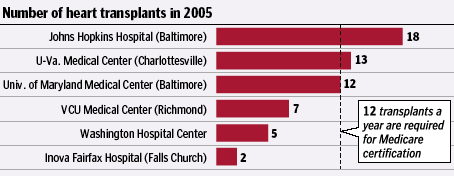
Transplant centers are artificially high profit centers because they capture some of the rents generated by the shortage of organs. As a result, there are too many transplant centers in the United States and each center performs too few transplants. Practice makes perfect so when a transplant center performs only a few operations a year lives are lost.
Medicare requires that transplant centers perform 12 transplants a year to be certified but many programs are in violation of that standard with little consequence. Medicare is even thinking of reducing the standard from 12 per year to 9 in 30 months. As one specialist says "I wouldn’t take my car to be serviced by someone who repaired nine cars over the past three years. Would anyone do that?"
This Washington Post article has more on the excess number of centers although it doesn’t draw the connection between the organ shortage and the incentive to build a center. Here’s some data, from the article, on centers local to Washington.
Vox
The good people at Typepad have new service, Vox, that makes it even easier to start a blog, add photos, videos etc. Vox also makes it easy to create a private blog for friends and family or internal corporate use.

Project Posner
Project Posner is a searchable database of all of Judge Richard Posner’s more than 2100 opinions.
Hat tip to Boing Boing Blog.
Classic Insults
"I am enclosing two tickets to the first night of my new play, bring a friend…
if you have one."
George Bernard Shaw to Winston Churchill
"Cannot
possibly attend first night, will attend second…if there is one."
Winston
Churchill, in response.
More. Hat tip to Kottke and don’t forget these Tullock classics.
Fashion of the Future
The fashion of Hussein Chalayan is utterly impractical, very beautiful and tremendously innovative. Watch the video and be prepared to be blown away. If you must, skip the first quarter but be sure to watch to the end. Oh yeah, not quite SFW.
Hat tip to Boing Boing Blog.