Random Links for the Day
Gene Expression interviews Steven Pinker.
Support for vaccine markets from two former officials in the Clinton and Bush administrations.
A real life Numbers guy, Stanford mathematician Lawrence Wein scares us with calculations, "a few grams of
botulinum could contaminate a tanker and potentially poison 100,000 gallons of
milk."
Thanks to Carl Close and Razib Khan for pointers.
Freedom to Farm (or not)
These
homes in El Campo, Tex., stand on land once used to grow rice. Because
of that, their back yards qualify for direct payments under federal
agricultural programs as long as the owner does not develop the acreage. (By James M. Thresher — The Washington Post).

Thanks to Ramin Seddiq for the pointer.
Markets in Everything
Lunch with Warren Buffett? $620,100.
P.S. Tyler and I will have lunch with you for less than half of that and we will throw in Bryan Caplan or Robin Hanson (your choice) for free.
JSTOR for People not at a University
One of the great pleasures of being a professor in recent years is that I no longer have to go the library. Trudging to the stacks, finding an article, and photocopying it are things of the past. Almost everything is available online especially at the great JSTOR in the sky, a vast repository of electronic journals some dating back more than 100 years.
Not every university has access to JSTOR, however, and individual subscriptions are costly and limited in scope. But Kevin Kelly points out that in many places you can get a digital library card which will get you access to many online databases.
In most states, you can get a library card from a public library
outside of your county of residence — as long as you can prove state
residence (true for the San Francisco Public Library). Often you will
have to go the actual state library in person to pick up your card, but
once in hand, you can access the library from the web. Fanatical
researchers are known to have a wallet full of library cards from
numerous public library systems within their respective states. Some
states, Ohio and Michigan being two of the better known, have statewide
consortiums of private, corporate and public libraries, which allows
you access to the combined services and databases licensing power of
them all.
Wrong On All Three Counts
From an angry editorial in FrontPageMag.Com:
The New York Times claims “500 economists have signed an open letter to Mr. Bush
arguing that immigration is a net plus for the nation’s economy.”
Doubtless, the same 500 economists believe that tax hikes are a net
plus for the economy, increases in the minimum wage are a net plus for
the economy and signing the Kyoto Treaty on so-called global warming
would be a big boost for the nation’s economy.
Obviously the author didn’t do much research, at least in regards to the author of the letter.
Price Discrimination by Search Type
Many travel websites let you order your search results by price, by travel time, by quality and other variables. Ross Parker has discovered that on at least one website prices differ depending on how you ask your search to be ordered. In particular, if you ask for prices to be listed from lowest to highest you get lower prices, on exactly the same hotels, than when you ask for highest to lowest prices. Of course, this is consistent with a very clever price discrimination scheme.
Comments are open. I am interested to know whether anyone can verify the same phenomena on other websites. Here is Ross’s data.
The site is Metro Getaways, a newspaper-linked travel site operated in the UK by Driveline. The prices are for a two-night break in Madrid on 4th August 2006, with flights from London.
Hotel Rating Price (Lowest First) Price (Highest First) Francisco 1 Hotel 2* £146.80 £169.50 Asturias Hotel 2* £147.65 £170.35 Tryp Washington 3* £174.00 £196.70 Tryp Rex 3* £174.00 £196.70 Tryp Menfis 4* £184.20 £206.90 Tryp Ambassador 4* £189.30 £212.00 Vincci Soho 4* £192.70 £215.40 Gran Melia Fenix 5* £257.30 £280.00
The Nutty Professor
Here’s an amazing piece of the life of Timothy Leary from the NYTimes book review of Timothy Leary: A Biography.
…he finally went to jail, and was likely to be kept there for years
before he would be considered for parole. Characteristically, he
compared himself to "Christ . . . harassed by Pilate and Herod." In a
twist that could have occurred only in 1970, a consortium of drug
dealers paid the Weather Underground to spring Leary from the
California Men’s Colony at San Luis Obispo – he pulled himself along a
telephone cable over the fence, then was picked up by a car – and
transport him to Algeria. He duly issued a press statement written in
the voice of the Weathermen, the money line of which was: "To shoot a
genocidal robot policeman in the defense of life is a sacred act."But
when he and his wife, Rosemary, arrived in Algiers, they found
themselves wards of the exiled Black Panther leader Eldridge Cleaver,
who was probably smarter than Leary, possibly crazier, and had little
use for him. As Leary acknowledged, rather shrewdly: "It was a new
experience for me to be dependent on a strong, variable, sexually
restless, charismatic leader who was insanely erratic. I usually played
that role myself."
Corruption
Joel Waldfogel covers an interesting new study of corruption in the motor vehicle department in India. Some eight hundred Indians were randomly assigned to one of three groups: the first group got a cash bonus for getting a license, the second group was given driving lessons, the third group was a control.
If government worked well we would expect the second group to be the most likely to get a license in the shortest period of time. Instead, the first group bribed their way to a license. In addition to taking the shortest period of time, most of the first group never even had to take a test!
Waldfogel has more details. He misses, however, what I think is the most important finding of the study. The delay in the Indian DMV is "endogeneous," i.e. it’s not due to torpor or constraint but instead is a result of corruption.
How can the Indian bureaucrats make the most of their control over licenses? First, make the line long. But that can increase the bribe-price only so much – especially given how cheap it is to hire someone in India to wait in line for you. The real value is in the license itself so the Indian examiners randomly fail many applicants, even those with good driving skills. Paying the bribe, therefore, is really the only route to a license. The net result is long lines and unsafe drivers.
Corruption like this is endemic throughout the world. Libertarians should take note, however, the problem in this case is not so much that there is too much government but that government is too weak.
Open Letter – The Signatories
My Open Letter on Immigration has been officially released by the Independent Institute. It has now been signed by over 500 economists including 5 Nobel Laureates – Thomas Schelling (University of Maryland), Robert
Lucas (University of Chicago), Daniel McFadden (University of
California, Berkeley), Vernon Smith (George Mason University), and
James Heckman (University of Chicago). Many other prominent economists are also signatories including Eugene Fama, Robert Pindyck, Jeffrey Perloff, Barry Eichengreen, and Steven Salop to name just a few of many.
My personal thanks to everyone who signed and all who helped to make this a big success. Thanks!
Central Planting
The technologies of mass agriculture, including genetic engineering, prevented the mass starvation of humanity in the last century. But today most of humanity lives on just 12 plant species and some scientists are worried that a lack of variety may prove our undoing. Some types of banana, for example, have already been wiped out or are threatened (Snopes is more cautious but verifies the basic facts).
To protect our seed patrimony is the goal of the Svalbard International
Seed Vault.
The high-security vault, almost half the length of a football field, will
be carved into a mountain on a remote island above the Arctic Circle. If the
looming fences, motion detectors and steel air-lock doors are not disincentive
enough for anyone hoping to breach the facility’s concrete interior, the polar
bears roaming outside should help….Its precious contents? Seeds — millions and millions of them — from
virtually every variety of food on the planet.
Thanks to Carl Close for the pointer.
Statz Rappers
I got a one way anova
Do you know what that means?
That’s when I got three or more independent levels on the scene.
Statz Rappers. Hat tip to Amy Perfors.
Risk Analysis using Roulette Wheels
A PSA test can reveal the presence of prostate cancer. But not all such cancers are fatal and treatment involves the risk of impotence. Do you really want the test? It’s difficult for patients to evaluate these kinds of risks. Mahalanobis points us to an article advocating visual tools such as roulette wheels to help patients understand relative risks and chance. Even better than the diagrams is this impressive video; the video may be of independent interest to the older men in the audience.
How Economists and Journalists Can Get Along
Brad De Long and Susan Rasky have a list of Twelve
Things Journalists Need to Remember to Be Good Economic Reporters and Twelve
Things Economists Need to Remember to Be Helpful Journalistic Sources. Lots of good stuff. Here are two favorites, the first nominally for journalists, the second for economists.
Never write "economists disagree." No matter how limited
your space or time, never write "economists disagree." Write WHY economists
disagree. An expert who cannot explain why other experts think differently isn’t
much of an expert. A reporter who can’t fit an explanation of where the
disagreement lies into the assigned space isn’t much of a journalist. A
journalist who cannot figure out the source of the disagreement is a journalist
who is working for whoever has the best-funded public-relations firm–and is
working for them for free.
Get over your snobbery about local television news. This is a genuine
opportunity to reach the public. Learn to use it. Remember that the local TV
reporter’s gasoline-price story this evening will be seen by 300,000 people.
Your op-ed will be read by 20,000, if you are lucky. Your journal articles will
be seriously read by 12.
I welcome the Ubermensch, pt. 2
My colleague Bryan Caplan does a great Magneto impersonation, "You are a god among insects. Never let anyone tell you different," is one of his favorite lines. You figure it out.
In anycase, Bryan and others may enjoy this cool article on implanting tiny magnets under your skin thereby creating the ability to sense electomagnetic fields.
He sliced open my finger with a
standard scalpel, inserted a tool to make a gap for the magnet, and tried to
insert the magnet in one nonstop motion. The insertion didn’t work, and he
widened the cut and tried again. This time it worked, and he closed the cut with
a single suture. The suture was the most painful step — an indicator that the
cold "anesthetic" had worn off. The process took less than 10 minutes. My finger
was slightly swollen and sported a blue, knotted plastic thread.When we were done we sat in Haworth’s living room. He brought out a magnet
and handed it to me. I brought it near my finger and felt the magnet move for
the first time up against the raw inside of my finger. I startled visibly, and
Haworth grinned. "Welcome to your new sense," he said.
Here is part one in the Ubermensch series.
Hat tip to Kottke.
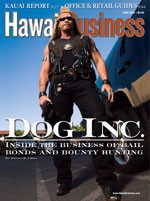
Dog and I
Dog and I are profiled in Hawaii Business Magazine. Well actually he’s the one on the cover, Helland and I get a mention in the text. Clearly to get on the cover, I need to grow longer hair and get some tattoos.