My favorite things New York City
1. My favorite demographic charts: Track population changes by borough.
2. My favorite NYC dining guide blog: Click on the categories on the top row of the blog to see the whole thing.
3. Favorite neighborhood: To live in? Manhattan is getting so uncool. I will pick the corner of Hudson and Barrow, which is near W. Houston and the West Side Highway, just north of the Saatchi building. There it still looks and feels like the New York City I grew up with (from New Jersey, that is). But when will I have the money and the courage to try? The Upper East Side bores me and the best food is in Queens; neither is suitable for real life.
4. Favorite book about: Waterfront: A Walk Around Manhattan, by Philip Lopate. I am surprised how few people know this one. Compulsively readable, and it makes me want to write a comparable work. But "A Drive Around Fairfax"? No way.
5. Favorite dim sum: Oriental Garden, in Chinatown, Elizabeth St., make sure to arrive early. Don’t forget Flushing, especially if you have time to kill at LaGuardia. The juicy pork buns at Joe’s Shanghai? Jackson Diner is still great Indian food though it is not the revelation it once was; the competition has caught up with it.
6. Best lunch bargain: Nougatine, the bistro attached to Jean-Georges. Get the venison with green chiles for its amazing mix of textures and heat.
7. Favorite Seinfeld episode: How about Master of His Domain? Soup Nazi is overrated and in fact I don’t even like it. The one where Jerry and Elaine try to be together again is another favorite, plus Show Within a Show.
8. Favorite free activity that even most New Yorkers don’t do: Browse the auction displays at Christie’s and Sotheby’s, especially before the major auctions in May and November.
Movies, music, literature? Not today. You might as well try "My Favorite Things Not in New York" for an easier task.
War & Peace & War
The core theses of this book are straightforward:
1. Some societies face multiethnic frontiers, and they respond by developing higher levels of cooperation. You have to bind together to clear out and kill those Indians.
2. Eventually the result is empire.
3. Empires decay. They wallow in luxury and the preconditions behind their previously high levels of cooperation go away.
4. The ability to cooperate is the key variable in human history.
So argues Peter Turchin — a professor of ecology — in his recent War & Peace & War: The Life Cycles of Imperial Nations. Imagine Jared Diamond’s method extended into the formation of empires and the origins of war, with a dose of Hari Seldon, and you have this book.
In addition to the broader theses, Turchin takes on why Europe stayed disunited after the collapse of the Carolingian Empire (disunity was the default setting), why the eastern and western parts of the Roman Empire took such different courses (the Eastern Empire was largely a new creation), why the fall of the Roman Empire has earlier roots than you think (the frontier changed in nature), and why the Russians have been so obedient to tyrannical rulers (egalitarian structures, combined with a frontier). The author does not shy away from bold claims, nor does he give much attention to possible counterexamples; try his other books for further support but don’t expect your doubts to be resolved.
Some of the sentences scare me: "Cliodynamics predicts complex dynamical behavior for historical empires, with shorter cycles embedded within longer cycles, and so on [sic]."
If you judge a book by its vulnerability to criticism, this one makes for easy pickings. But Tolstoy wasn’t crazy, Ibn Khaldun is more important than you think, and Turchin will tell you why. Recommended, especially for those who like fearless and speculative minds.
Why don’t we have tax futures?
Some of the earliest and most popular prediction markets (per se) have been linked to elections, but predicting tax rates is much more to-the-point in terms of financial risk-sharing. The
existence of such markets would also frame the operation of the
government in a way that would encourage fiscal responsibility, and
give dispersed interests some recourse against inefficient spending.
Here is the full post. It is suggested that everyone wants to hedge against higher marginal rates, thereby making the market one-sided. But doesn’t somebody benefit from taxes going up? Thanks to Chris F. Masse for the pointer.
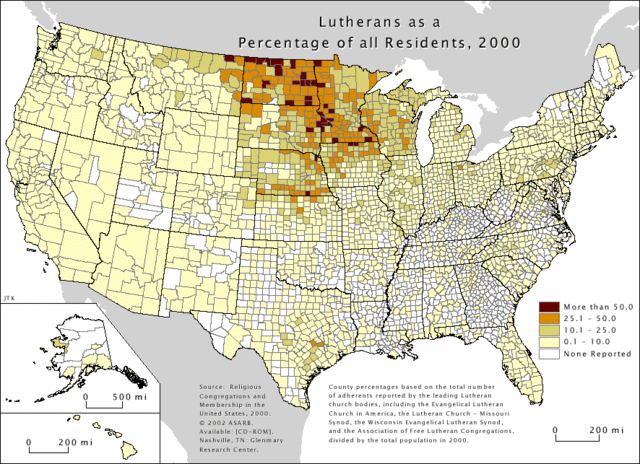
Religious maps
The Wealth of Networks
Yes this is an excellent economic analysis of the peer production model behind blogs and Wikis. But I need a new word for "books which are highly intelligent and insightful throughout, but from which I learned nothing."
Here are the chapters in pdf form. Here is the book’s Wiki. Here is a CrookedTimber post on the book. Here is Matt Yglesias on the book.
Missing words
Often after I’ve heard of something for the first time – a food, a place, a person — I start hearing about it everywhere. Shouldn’t there be a word for this?
"Newbiquitous" is suggested.
Is there a word for the common experience of saying something to your child and then realizing — often with a shock — that you sound like one of your own parents?
"Mamamorphosis" is one idea.
My husband and I are in search of a word for the fear of throwing a party and having no one show up.
"Guestlessness"?
How about people who hit the "send" button for email without first attaching the file?
"Deficit sending" is recommended. Or "sends of omission."
Jonathan Zuber wants "…a verb meaning ‘to go do something and return having absentmindedly done one or more other things instead.’""
Any ideas?
You can put other requests, or suggestions, in the comments…
How to get a macho guy to give in
Researchers at the University of Leuven in Belgium asked men to play an ultimatum game, in which they split a certain amount of money between them. High-testosterone men drove the hardest bargain – unless they had previously viewed pictures of bikini-clad models, in which case they were more likely to accept a poorer deal.
The sight of flesh had less effect on the bargaining tactics of low-testosterone men. Click here to read the story.
Here is the full post, from Mahalanobis. The accompanying photo is just barely (no pun intended) safe for work.
Markets in everything: weird on-line commerce
How about:
…a Bag of Crap. The fabled and fetishized BOC costs about $8 and
includes up to three random items from the warehouse, most of it likely
to be useless, but sometimes, according to legend, Woot occasionally
drops in big-ticket items like a 61-inch television.
Order here, but it is available only sometimes. Here is a list of other unusual items for sale on-line. Did you know you can project the image of a digital clock onto your wall? Or buy a cow for a family in a developing country?
Should you send your daughter to Tulane?
My neuroeconomics column
Here is the no subscription required permalink. Excerpt:
Not all of neuro-economics uses brain scans. Andrew W. Lo, a professor
at the Sloan School of Management at the Massachusetts Institute of
Technology, applied polygraph-like techniques to securities traders to
show that anxiety and fear affect market behavior. Measuring eye
movements, which is easy and cheap, helps the researcher ascertain what
is on a subject’s mind. Other researchers have opened up monkey skulls
to measure individual neurons; monkey neurons fire in proportion to the
amount and probability of rewards. But do most economists care? Are
phrases like "nucleus accumbens" – referring to a subcortical nucleus
of the brain associated with reward – welcome in a profession caught up
in interest rates and money supply? Skeptics question whether
neuro-economics explains real-world phenomena…The next step? Perhaps neuro-economics should turn its attention to
political economy. Do people use the same part of their brains to vote
as to trade? Is voting governed by fear, disgust or perhaps the desire
to gain something new and exciting?
Robin Hanson, impish mind
A lunch with Robin is better than an email from him, but at least I can offer you the latter:
Reasonable economic cases can be made for allowing people to sell their organs, and for allowing people to buy the ability to immigrate into our country. Cautious people avoid such proposals, because they push too many emotional buttons. Mischievous folks like myself, however, wonder what happens if we push all the buttons at once: what if people could enter the country if they give up a kidney, or similarly valuable organ? Would those who worry about the loyalty of immigrants who just pay cash to come here be reassured by the symbolic loyalty of giving up an organ? Would those who fear that organ sellers are exploited be reassured by the huge value immigrants gain from living here? Impish minds want to know.
Who needs self-awareness?
Self-awareness, regarded as a key element of being human, is
switched off when the brain needs to concentrate hard on a tricky task,
found the neurobiologists from the Weizmann Institute of Science in
Rehovot, Israel.The
team conducted a series of experiments to pinpoint the brain activity
associated with introspection and that linked to sensory function. They
found that the brain assumes a robotic functionality when it has to
concentrate all its efforts on a difficult, timed task – only becoming
"human" again when it has the luxury of time.
Here is the full story.
Will Latinos save New Orleans?
Here is the next Slate.com installment on New Orleans. The closing bit:
In October, Mayor Ray Nagin asked, "How do I ensure that New Orleans is not overrun by Mexican workers?" The answer: Do not rebuild.
Ed Glaeser reviews Richard Florida
Here it is; excerpt:
But while I agree with much of Florida’s substantive claims about the real, I end up with doubts about his prescriptions for urban planning. Florida makes the reasonable argument that as cities hinge on creative people, they need to attract creative people. So far, so good. Then he argues that this means attracting bohemian types who like funky, socially free areas with cool downtowns and lots of density. Wait a minute. Where does that come from? I know a lot of creative people. I’ve studied a lot of creative people. Most of them like what most well-off people like–big suburban lots with easy commutes by automobile and safe streets and good schools and low taxes. After all, there is plenty of evidence linking low taxes, sprawl and safety with growth. Plano, Texas was the most successful skilled city in the country in the 1990s (measured by population growth)–it’s not exactly a Bohemian paradise.
Matt Yglesias has kind words for my book
Here is his brief review; he calls my main argument "the most counterintuitive thesis ever." Bryan Caplan does not like such talk, but I take it as praise. Here Matt picks San Antonio over Detroit in the playoffs, which I consider the second most counterintuitive thesis ever.