America, meet India
Tata group has received approval from the Drug Controller General of India (DCGI) for the commercial launch of the country’s first CRISPR (Clustered Regularly Interspaced Short Palindromic Repeats) coronavirus test ‘Feluda’, the Council of Scientific and Industrial Research (CSIR) said on Saturday. This test uses an indigenously developed, cutting-edge CRISPR technology for detection of the genomic sequence of SARS-CoV-2 virus, CSIR said in a statement.
The Tata CRISPR test achieves accuracy levels of traditional RT-PCR tests with quicker turnaround time, less expensive equipment and better ease of use.
Here is the full story, via Alex HR.
From my email, on QAnon
This is perhaps a bit whacky, but along similar-ish lines to the uniqueness theory, I have been wondering whether QAnon’s big differentiator is it’s comparative defensibility, powered by its complexity.
If you accept that social movements need their legitimacy-granting myths and “narratives” to hold up for at least as long as they are niche or otherwise unacceptable to the mainstream, and that one of the large effects of TV and the internet is to ease (and encourage) the voicing and wide dissemination of counter-narratives, then perhaps you should expect the best performing movements which do emerge to have key memes which cluster at either end of the “vague -> precise” axis.
Sitting at one of the two extremes is a great way to survive in an ideologically adversarial environment: vagueness gives converts a way to dismiss attacks out of hand (at the cost of rate of growth and cohesiveness, perhaps. Crypto might be an example), while highly detailed and well defined concepts (especially when hard to access) makes it too expensive for outsiders to build a case which will feel coherent and convincing to insiders.
QAnon is quite the cocktail, with its anonymous founder (can’t attack the credibility of an anonymous poster with no accessible history!), highly detailed yet easy to wield lore transmitted through word of mouth on semi-private Facebook groups or in person, no easy experiments which raise internal contradictions (the downfall of flatearthers), and the highly emotionally potent mix of corruption and child abuse.
Are there really any competing groups which offer anything remotely as attractive, all encompassing, and seemingly (to insiders) unassailable?
Will be interesting to see if it loses strength over time. I suspect there will be enough events which can be interpreted as confirming key points over the next 10 years for it to keep growing. Its rate of conversion is also pretty incredible, compared to previous cults/religions.
That is from Arnaud.
America fact of the day
…according to recent polls from Quinnipiac and Monmouth, 38 percent of registered Hispanic voters in 10 battleground states may be ambivalent about even voting…
Progressives commonly categorize Latinos as people of color, no doubt partly because progressive Latinos see the group that way and encourage others to do so as well. Certainly, we both once took that perspective for granted. Yet in our survey, only one in four Hispanics saw the group as people of color.
Here is more from Ian Haney López and
Sunday assorted links
1. More American soft power: it seems BLM is one reason why Barbados might cast off its ties to Queen Elizabeth (NYT).
2. Would you settle for one billion horses?
3. Stephen F. Cohen, historian of Russia, has passed away (NYT).
4. They want to rename the town named Asbestos, but can’t come up with anything good.
5. Joel Miller on whether we should accelerate infections in low-risk persons. It does not sufficiently address the economic (and thus also human) benefits of a speedier resolution, but nonetheless makes some good points.
What does QAnon stand for?
Here is my Bloomberg column on that question. This is not my central point, but it is the excerpt I have decided to give you:
There is the related possibility that QAnon’s main appeal is in the sheer complexity of the conspiracy itself, rather than the details. QAnon is often described often as a rabbit hole, offering users an initially simple story that gradually becomes more complicated. Some evidence suggests that conspiracy theories need to offer “uniqueness” to their adherents — that is, the promise of exclusive knowledge. The more complex and detailed the theory, the more likely that uniqueness becomes, and thus the greater the appeal. But just how big a factor is that?
Recommended. If you could do a factor decomposition on QAnon, which features of it really would matter to its adherents? (For instance, for most Christians I suspect Mother Mary holds much more appeal than John the Baptist, fine fellow though the latter may be.) I’ve been reading MR comments for long enough to know there is more here than might meet the eye.
Claims about antibodies and T-cells and Sweden
Buggert’s study in Sweden seems to support this position. Investigating close family members of patients with confirmed covid-19, he found T cell responses in those who were seronegative or asymptomatic. While around 60% of family members produced antibodies, 90% had T cell responses. (Other studies have reported similar results.) “So many people got infected and didn’t create antibodies,” concludes Buggert.
That is from Peter Doshi, mostly a survey on pre-existing immunity, interesting and useful and properly agnostic throughout. Here is a version of the Buggert piece, also with a link to the published version.
Note two things. First, “the kooks” saw this possibility first, and insisted on its relevance, to their credit. Second, many of “the kooks” are overly dogmatic, not always to be trusted, and they commonly shift the goalposts (when predictions about cases are falsified, they switch to pretending those were predictions about deaths). Often the non-kooks do that too of course.
For a sobering worry, here are some recent numbers from Spain.
The key to interpreting the literature is to focus on the data, and to keep an open frame of mind, rather than digging in to a particular position. Right now I am focused on observing what kind of second wave London is going to have, and how mild or bad it will be, as that is most likely to induce me to update my positions, in one direction or another.
For the pointer I thank E. Ward.
Saturday assorted links
1. New York Film Festival looks strong this year.
2. Tattoo artists in Japan no longer need medical licenses.
4. Messi vs. Massi: “Footballer Lionel Messi can register his name as a trademark after a nine-year legal battle, the EU’s top court has ruled.”
5. Day one of voting the polity that is Fairfax.
6. The making of a Harvard department chair (somewhat depressing, actually). “Nearly half of the 40 department chairs in Harvard’s Faculty of Arts and Sciences received tenure within Harvard and nearly three-quarters have been teaching at the University for more than 15 years, an analysis by The Crimson found.”
7. The importance of protein folding, with a role for citizen scientists too (New Yorker).
Papers that have come from Fast Grants
Here is a non-complete list. I am reluctant to speculate on what I see as some very positive reports, but in due time I will be discussing the results of the research in more detail. Here is one earlier post on SalivaDirect.
What happened to the mandate, the third leg of the stool?
But Congress did ultimately chop off a leg when it repealed the mandate penalties in 2017 — and, despite these predictions, the Affordable Care Act still stands. New federal data and economic research show the law hasn’t collapsed or entered the “death spiral” that economists and health insurers projected.
Many experts now view the individual mandate as a policy that did little to increase health coverage — but did a lot to invite political backlash and legal challenges.
The newest evidence comes from census data released Tuesday, which shows health coverage in the United States held relatively steady in 2019, even though Congress’s repeal of the mandate penalties took effect that year.
“The stool might be a bit rocky, but you can get away with two legs,” said Evan Saltzman, a health economist at Emory University who studies the topic. “It’s like the table at the restaurant that is a little wobbly. You can still sit at it, even if it’s not quite as pleasant.”
That is from Sarah Kliff at the NYT, the whole piece is excellent and full of substance. And:
Mr. Saltzman went on to earn a doctorate in economics after his job at RAND, and focused his research on the mandate. He has found that the mandate isn’t a very effective tool for increasing enrollment. One recent paper of his estimated that eliminating the mandate penalties would reduce marketplace enrollment by 2 percent and increase premiums by 0.7 percent.
“My viewpoint on the mandate has changed,” he said. “Back in 2012, my sense was it was essential. The evidence indicates that the marketplaces are doing about the same as they were before the mandate was set to zero.”
Separately, in The New England Journal of Medicine last year, researchers concluded that “the individual mandate’s exemptions and penalties had little impact on coverage rates.”
To be clear, this surprises me too. Was it Ross Douthat who once said on Twitter that it was the Trump administration and the Republican courts that saved Obamacare? The Krugman line, pushed without qualification for over a decade (and with incessant moralizing), that all of the legs of the stool are necessary, seems…wrong. I would say be careful with this one, as sometimes elasticities don’t kick in for a long time (as maybe with the corporate income tax cuts as well?…let’s be consistent here…). Still, it seems that an update of priors is in order. As you will see in the piece, even Jonathan Gruber thinks so.
And here are useful comments from John Graves.
*How to Make the World Add Up*
The author is Tim Harford, and the subtitle is Ten Rules for Thinking Differently About Numbers. My copy just arrived and I am just about to leave town, but I thought I should give you notice.
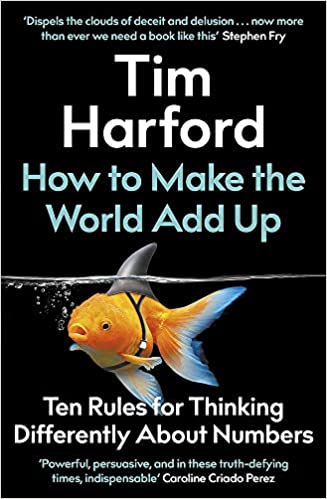
And here is my CWT with Tim, a really fun one.
Friday assorted links
1. German soccer team thrashed 37-0 after socially distancing from opponent.
2. AT&T wants to put ads on your smartphone in exchange for $5 discount.
3. “What I think I am nearly certain about,” redux of a 2008 post.
University of Pennsylvania update and correction
“The email sent by Penn SAS Deans last Tuesday needs to be interpreted with some care. In particular, notice the words “school-funded Ph.D. programs.” There is a lot of institutional background that is lost when the email is read from the outside, especially because the Economics Ph.D. program has its own funding structure that differs from other Ph.D. programs at Penn SAS.
At this moment, the Department of Economics is working out the details of the next year incoming class, but a first-year incoming class and regular classes first-year are planned. Also notice that much of graduate teaching in economics involves Ph.D. students from Wharton, who are not part of SAS. Wharton is going ahead with its Ph.D. admissions.”
That is from an email from a well-informed inside source. Here is the original MR post, blame it on the Dean.
What I’ve been reading
1. Leonard Mlodinow, Stephen Hawking: A Memoir of Friendship and Physics. One man’s version of “the real Stephen Hawking story,” including the marital arrangements and rearrangements, told by a former good friend. I am not sure that books such as this should be written (or read), but…this one is pretty good. It also gives Hawking’s account of why he did not win a Nobel prize (“radiation must be observed”), among other tidbits.
2. Helen Pluckrose and James Lindsay, Cynical Theories: How Activist Scholarship Made Everything About Race, Gender, and Identity — and Why This Harms Everybody. The authors serve up many on-target criticisms of current academic nonsense, but somehow it is not how I would proceed. Given the ridiculousness of so much of what is going on, I say there are new intellectual profit opportunities to mine the best insights from critical theory, postmodernism, intersectionality and the like. I would rather read a book that did that. Start with Foucault, and steelman everything as you go along.
3. Ed Douglas, Himalaya: A Human History. Truly an excellent book covering the history, politics, and culture of…the Himalayan region. Full of substance, lovely cover too. The USA link here has a worse cover, no surprise. But you’ll get the British version quicker, with the preferred cover, and at a lower price. Arbitrage!
4. The Early Political Writings of the German Romantics, edited by Frederick C. Beiser, but basically Novalis, Schlegel, and a bit of Schleiermacher. In particular I was surprised how well the Novalis has held up: insightful, to the point, and laying out the aesthetic approach to politics (and more) with a stark and memorable clarity. If you are looking for something to read that is non-liberal, but not the tiresome version of non-liberal being beat to death these days, maybe try this book.
5. George Prochnik, Heinrich Heine: Writing the Revolution. Heine has aged very well, circa 2020, and he is an appropriate liberal but also satiric counterpart to the writers mentioned immediately above, plus he was more historically prescient, and for all the talk about culture from the Romantics, it was Heine who was the perceptive observer of other people’s cultures. This is a good book for additional historical background once you already know Heine, though not at all an introduction to his charm and import, available only from the man himself.
And I have just received my copy of Ryan Holiday and Stephen Hanselman, Lives of the Stoics: The Art of Living from Zeno to Marcus Aurelius.
The educational culture that is Dutch
Academics should not be forced to squeeze their research into weekends and holidays, according to the Dutch education minister, who admitted that pressure on some researchers had become intolerable and that professional competition had gone “too far.”
Ingrid van Engelshoven wants to reduce stress and time pressure in academe by tipping the balance away from competitive grants and toward more stable support for universities, reversing a long-term research funding trend in the Netherlands and elsewhere.
Speaking to Times Higher Education in the Hague, she hoped that reforms to Dutch academe would mean that in five to 10 years, academics would be able to do their research “within normal working hours.”
“So you don’t have to skip your vacation, skip your weekend, because you’re busy all week with teaching your students, designing your online courses [or] … drafting your applications for grants,” she said.
Here is the full story by David Matthews.
No economics Ph.D admissions for U Penn next year
The School of Arts and Sciences will pause admissions for school-funded Ph.D. programs for the 2021-2022 academic year.
SAS Dean Steven J. Fluharty and Associate Dean for Graduate Students Beth Wenger wrote in an email to SAS standing faculty and graduate students on Tuesday that the decision was made as a result of the COVID-19 pandemic’s impact on the school’s finances.
Here is more, via Jon Hartley. GMU, by the way, seems to be doing fine with its enrollments and finances at all levels.
Addendum: See this update and correction.