Antitrust sentences to ponder Ayn Rand wasn’t exaggerating Sprint/T-Mobile edition
Also on Monday, Nevada said it would withdraw from the lawsuit in exchange for early deployment of the next generation of wireless in the state, creation of 450 jobs for six years and a $30 million donation to be distributed by Nevada Attorney General Aaron Ford and aimed at helping women and minorities, Ford’s office said.
Here is the story, via Bekir.
Thursday Thanksgiving assorted links
1. Arizona pizzeria organist dies, make us realize more restaurants need organists.
2. Jiro sushi no longer open to the public.
3. Swiss asylum-seeker results: “Our baseline result is that cohorts exposed to civil conflict/mass killing during childhood are 35 percent more prone to violent crime than the average cohort.”
4. Will AI be a disaster for authoritarianism?
Favorite fiction of 2019
Linn Ullmann, Unquiet: A Novel.
Guzel Yakhina, Zuleikha.
Aladdin, a new translation by Yasmine Seale.
Broken Stars: Contemporary Science Fiction in Translation, edited and translated by Ken Liu.
Sally Rooney, Normal People: A Novel.
I did try many of the more famous recommended novels of the year, and mostly didn’t like them. Still, I don’t feel this list is coming very close to capturing the year’s best fiction — I think I’ll have a better sense in two or three years and then I will report back. In the meantime, what do you recommend?
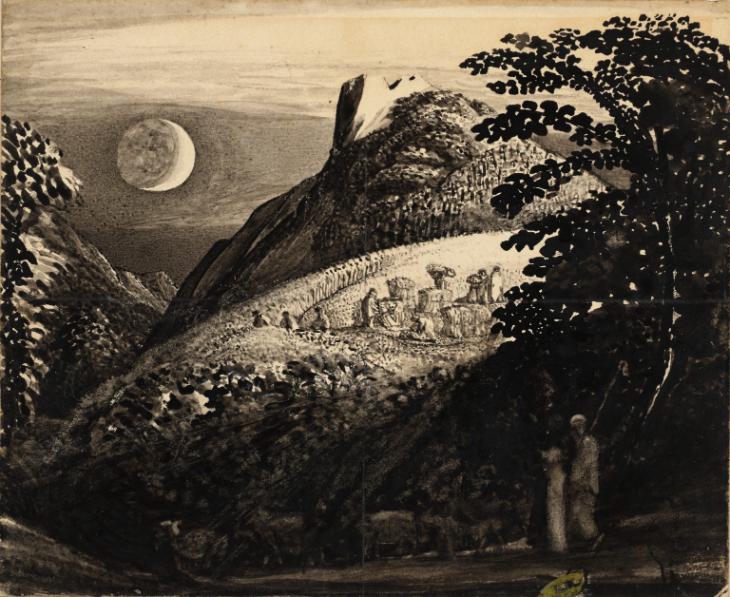
Samuel Palmer’s Harvest Moon drawing
An American Thanksgiving story without any heroes
That is the topic of my latest Bloomberg column, here is one excerpt:
But as Thanksgiving 2019 approaches, I am struck by another lesson: America’s need to come to terms with a history that, as it relates to the treatment of Native Americans, has remarkably few heroes on the side of the white settlers.
And:
Nor is there any major American political ideology that can sit comfortably with the historical treatment of Native Americans, which has been multipartisan in its awfulness. Many libertarians fail to decry the government coercion involved, since they also wish to invoke the growth of the American republic as a major event in the history of freedom. Even if most libertarians are embarrassed by how much of America’s glory is rooted in land theft and massacres, they do not emphasize land reparations as a solution.
And:
This lack of heroes should also make Americans more reluctant to judge their political opponents so harshly. All of us are part of a system built on longstanding historical crimes, and thus we have more in common with those opponents than we might like to think.
Recommended.
Nonbank lending
We provide novel systematic evidence on the extent and terms of direct lending by nonbank financial institutions, and explore whether banks are still special in lending to informationally opaque firms. Analyzing hand-collected data for a random sample of publicly-traded middle-market firms during the 2010-2015 period, we show that nonbank lending is widespread, with 32% of all loans being extended by nonbanks. Nonbank borrowers are less profitable, more levered, and more volatile than bank borrowers. Firms with a small negative EBITDA are 34% more likely to borrow from a nonbank than firms with a small positive EBITDA. While nonbank lenders are less likely to monitor by including financial covenants, they are more likely to align incentives through the use of warrants. Controlling for firm and loan characteristics, nonbank loans carry 190 basis points higher interest rates. Overall, our results provide evidence of market segmentation in the commercial loan market, where bank and nonbank lenders utilize different lending techniques and cater to different types of borrowers.
That is from a new NBER working paper by Sergey Chernenko, Isil Erel, and Robert Prilmeier.
The CWT repackaging of my Conversation with Zuckerberg and Collison
It is the same material as already released by Facebook, here is our audio and transcript, you will find our transcript easier to read. Self-recommending!
The one-child policy and Chinese child trafficking
In the past 40 years, a large number of children have been abandoned by their families or have been abducted in China. We argue that the implementation of the one-child policy has significantly increased both child abandonment and child abduction and that, furthermore, the cultural preference for sons in China has shaped unique gender-based patterns whereby a majority of the children who are abandoned are girls and a majority of the children who are abducted are boys. We provide empirical evidence for the following findings: (1) Stricter one-child policy implementation leads to more child abandonment locally and more child abduction in neighboring regions; (2) A stronger son-preference bias in a given region intensifies both the local effects and spatial spillover effects of the region’s one-child policy on child abandonment and abduction; and (3) With the gradual relaxation of the one-child policy after 2002, both child abandonment and child abduction have dropped significantly. This paper is the first to provide empirical evidence on the unintended consequences of the one-child policy in terms of child trafficking in China.
That is the abstract of a new paper by Xiaojia Bao, Sebastian Galiani, Kai Li, and Cheryl Xiaoning Long.
Does identity affect labor supply?
Does identity—one’s concept of self—influence economic behavior in the labor market? I investigate this question in rural India, focusing on the effect of caste identity on labor supply. In a field experiment, casual laborers belonging to different castes choose whether to take up various real job offers. All offers involve working on a default manufacturing task and an additional task. The additional task changes across offers, is performed in private, and differs in its association with specific castes. Workers’ average take-up rate of offers is 23 percentage points lower if offers involve working on tasks that are associated with castes other than their own. This gap increases to 47 pp if the castes associated with the relevant offers rank lower than workers’ own in the caste hierarchy. Responses to job offers are invariant to whether or not workers’ choices are publicized, suggesting that the role of identity itself—rather than social image—is paramount. Using a supplementary experiment, I show that 43% of workers refuse to spend ten minutes working on tasks associated with other castes, even when offered ten times their daily wage. This paper’s findings indicate that identity may be an important constraint on labor supply, contributing to misallocation of talent in the economy.
The bold emphasis is added by me. That is from a job market paper by Suanna Oh, who is on the job market from Columbia.
Via Shruti.
Tuesday assorted links
1. “Ancient coin designs encoded increasing amounts of economic information over centuries.“
2. “Powell will serve 10 years in prison, Davies will do 8½ years and Wicks will spend five years behind bars for failing to report Viking treasure.” Also coins!
3. Ed Conard on Philippon and monopoly.
4. When are women willing to lead?
5. Telepresence.
6. Suite Judy Blue Eyes (NYT).
William Shatner on mortgages
Ok math whiz: a $85k 30 year mortgage with 12% interest in 1985 actual total cost was $315k. A $315k 30 yr mortgage today at 3.8% is $525k total. $315,000 in 1985 is equivalent in purchasing power to about $751,664.36 in 2019. So it’s cheaper today to buy a median price home🤷🏼♂️ https://t.co/W0tXSMUjmS
— William Shatner (@WilliamShatner) November 10, 2019
I am once again reminded how expected returns is a critical concept in macroeconomics. Circa 1985, you could expect to earn much higher returns putting money in a certificate of deposit, thus increasing the opportunity of buying a house back then. No, you would not earn 12% on your money, but still we need to reckon with the higher opportunity cost of funds to calculate the true home purchase/mortgage cost at that time.
NIMBY build for the homeless solve for the equilibrium
At an average cost of $531,373 per unit – with many apartments costing more than $600,000 each – building costs of many of the homeless units will exceed the median sale price of a market-rate condominium. In the city of Los Angeles, the median price for a condo is $546,000, and a single-family home in Los Angeles County has a median price of $627,690, the study states.
Here is further information, via Rob Moore.
Medicare for all is not entirely efficient
There is increasing interest in expanding Medicare health insurance coverage in the U.S., but it is not clear whether the current program is the right foundation on which to build. Traditional Medicare covers a uniform set of benefits for all income groups and provides more generous access to providers and new treatments than public programs in other developed countries. We develop an economic framework to assess the efficiency and equity tradeoffs involved with reforming this generous, uniform structure.We argue that three major shifts make a uniform design less efficient today than when Medicare began in 1965. First, rising income inequality makes it more difficult to design a single plan that serves the needs of both higher- and lower-income people. Second, the dramatic expansion of expensive medical technology means that a generous program increasingly crowds out other public programs valued by the poor and middle class. Finally, as medical spending rises, the tax-financing of the system creates mounting economic costs and increasingly untenable policy constraints. These forces motivate reforms that shift towards a more basic public benefit that individuals can “top-up” with private spending.If combined with an increase in other progressive transfers, such a reform could improve efficiency and reduce public spending while benefiting low income populations.
That is from a new NBER working paper by Mark Shepard, Katherine Baicker, and Jonathan S. Skinner.
My Conversation with Mark Zuckerberg and Patrick Collison
@patrickc, CEO of Stripe, and @tylercowen, economist at George Mason University, sit down with our CEO, Mark Zuckerberg to discuss how to accelerate progress.
Video, audio, and transcript here, part of Mark’s personal challenge for the year, an excellent event all around. This will also end up as part of CWT.
Genes and health insurance coverage
We provide the first investigation into whether and how much genes explain having health insurance coverage or not and possible mechanisms for genetic variation. Using a twin-design that compares identical and non-identical twins from a national sample of US twins from the National Survey of Midlife Development in the United States, we find that genetic effects explain over 40% of the variation in whether a person has any health coverage versus not, and nearly 50% of the variation in whether individuals younger than 65 have private coverage versus whether they have no coverage at all. Nearly one third of the genetic variation in being uninsured versus having private coverage is explained by employment industry, self-employment status, and income, and together with education, they explain over 40% of the genetic influence. Marital status, number of children, and available measures of health status, risk preferences, and prevention effort do not appear to be important channels for genetic effects. That genes have meaningful effects on the insurance status suggests an important source of heterogeneity in insurance take up.
That is from a paper by George L. Wehby and Dan Shane. Via the excellent Kevin Lewis. We do need to know more, but one possibility is that the adverse selection model of health insurance is much overrated, and advantageous selection into health insurance is a live possibility.