Sunday assorted links
Big business isn’t big politics
That is my recent essay, adapted in Foreign Policy, from my new book Big Business: Love Letter to an American Anti-Hero. Here is the opening:
The basic view that big business is pulling the strings in Washington is one of the major myths of our time. Most American political decisions are not in fact shaped by big business, even though business does control numerous pieces of specialist legislation. Even in 2019, big business is hardly dominating the agenda. U.S. corporate leaders often promote ideas of fiscal responsibility, free trade, robust trade agreements, predictable government, multilateral foreign policy, higher immigration, and a certain degree of political correctness in government—all ideas that are ailing rather badly right now.
To be sure, there is plenty of crony capitalism in the United States today. For instance, the Export-Import Bank subsidizes U.S. exports with guaranteed loans or low-interest loans. The biggest American beneficiary is Boeing, by far, and the biggest foreign beneficiaries are large and sometimes state-owned companies, such as Pemex, the national fossil fuel company of the Mexican government. The Small Business Administration subsidizes small business start-ups, the procurement cycle for defense caters to corporate interests, and the sugar and dairy lobbies still pull in outrageous subsidies and price protection programs, mostly at the expense of ordinary American consumers, including low-income consumers.
…overall, lobbyists are not running the show. The average big company has only 3.4 lobbyists in Washington, and for medium-size companies that number is only 1.42. For major companies, the average is 13.9, and the vast majority of companies spend less than $250,000 a year on lobbying. Furthermore, a systematic study shows that business lobbying does not increase the chance of favorable legislation being passed for that business, nor do those businesses receive more government contracts; contributions to political action committees are ineffective too.
If you are looking for a villain, it is perhaps best to focus on how corporations sometimes help poorly staffed legislators evaluate and draft legislation. But again, national policy isn’t exactly geared to making businesses, and particularly big business, entirely happy.
References and further support are available in the book,
Is day care bad for kids, especially well-off kids?
Exploiting admission thresholds to the Bologna daycare system, we show using RDD that one additional daycare month at age 0–2 reduces IQ by 0.5% (4.7% of a s.d.) at age8–14 in a relatively affluent population. The magnitude of this negative effect increases with family income. Similar negative impacts are found for personality traits. These findings are consistent with the hypothesis from psychology that children in daycare experience fewer one-to-one interactions with adults, with negative effects in families where such interactions are of higher quality. We embed this hypothesis in a model that lends structure to our RDD.
Here is the forthcoming JPE article by Margherita Fort, Andrea Ichino and Giulio Zanella. And here are various ungated versions. (Do any of you have the links handy for other papers with similar results? They do exist.)
Quick quiz, we should:
a. Subsidize day care heavily
b. Not subsidize day care, or
c. Wait and see until more evidence is in.
Who is passing and failing this quiz? How about you?
Which countries are best for creating and encouraging women chess players?
Via David Smerdon, here is the picture:
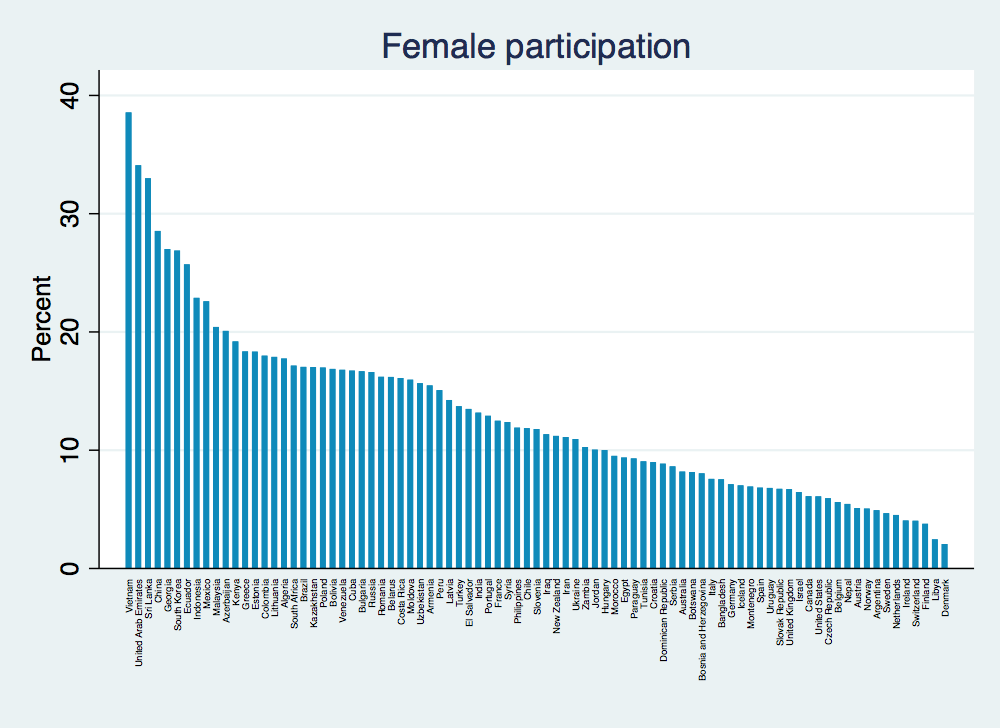
To oversimplify only a wee bit, it is the countries with less gender equality which have more female chess players, relative to male chess players. Here is some description:
Denmark is the worst country in our list of participation, with only one female player to roughly 50 males, while the rest of Scandinavia as well as most of western Europe also languish at the bottom.
On the other hand, some of the best countries show evidence of the effect of female role models, and would be no surprise to players familiar with women’s chess history. Georgia (ranked 5th) and China (ranked 4th) both featured multiple women’s World Champions. There are also some high rates from a few unexpected sources: Vietnam (1st), the United Arab Emirates (2nd), Indonesia (8th), and even Kenya (12th) really buck the trend. Interestingly, a lot of the best countries for female chess players are in Asia. Besides Vietnam, there are five other countries in the best ten, and if I am a little more lenient with the chess population cut-offs, Mongolia and Tajikistan would also be in there.
Here is one cited hypothesis:
Could it be that, deep down, women just don’t like chess as much as men?
I consider that to be possible, but unconfirmed. In any case, the lesson is that gender imbalance in a particular field can be correlated with greater equality of opportunity overall.
Saturday assorted links
1. “Employing a comprehensive dataset on the incidence of hate crime across Germany, we first demonstrate that hate crime rises where men face disadvantages in local mating markets. Next, we deploy an original four-wave panel survey to confirm that support for hate crime increases when men fear that the inflow of refugees makes it more difficult to find female partners. Mate competition concerns remain a robust predictor even when controlling for anti-refugee views, perceived job competition, general frustration, and aggressiveness. We conclude that a more complete understanding of hate crime must incorporate mating markets and mate competition.” Link here.
2. Bryan Caplan on *Big Business* and crony capitalism.
3. Iceland fact of the day: “Sixty-four percent of students are women, the highest percentage of any European nation.”
4. How to get to ngdp targeting.
5. I’ve read so many bad or even absymal critiques of Facebook, but Bret Stephens (NYT) wrote a good one.
The progressive nature of big business
That is my new opinion piece for The Washington Post, derived from my Big Business: A Love Letter to an American Anti-Hero. Here is one excerpt:
Yet big business often has been a strong progressive force in U.S. history, not only by providing jobs but also by spreading emancipatory practices and norms.
For instance, McDonald’s, General Electric, Procter & Gamble and many of the big tech companies offered health care and other legal benefits for same-sex partners well before the Supreme Court legalized gay marriage in 2015. In addition to dramatically improving the lives of thousands of Americans, the companies’ moves put a mainstream stamp of approval on the notion of same-sex marriage itself.
And:
The larger the business, the more tolerant the institution is likely to be of employee and customer personal preferences. A local baker might refuse to make a wedding cake for a gay couple for religious reasons, but Sara Lee, which tries to build very broadly based national markets for its products, is keen on selling cakes to everyone. The bigger companies need to protect their broader reputations and recruit large numbers of talented workers, including from minority groups. They can’t survive and grow just by cultivating a few narrow networks as either their workers or customers.
There are further arguments at the link.
What does a continually improving labor market imply about monetary policy?
Not as much as many people think. As you may know, yesterday’s job market was quite good (NYT) and it is now many years of labor market recovery. Does this mean the Fed should have been easier with money say two or three years ago? No, that doesn’t follow. Let’s talk through a few points:
1. Aggregate demand shocks are major causes of recessions, and when they come you want the central bank to lean against them very, very hard, even if that means higher than average price inflation.
2. The early problems are mostly nominal. For whatever reasons (morale? long-term implicit contracts?), firms lay off some workers rather than cutting their nominal wages. This is a big reason why downturns involve so much unemployment, but to the extent the central bank can keep up nominal demand, at least some of this unemployment can be avoided or at least smoothed out over time.
3. Once those workers are unemployed, nominal stickiness starts to cease to be the major problem. Real rigidities and stickiness become progressively more important with the passage of time. First, the unemployed don’t even have a nominal wage to be sticky in the first place, and yes some of them are excessively stubborn with their reservation wages for accepting new jobs but that looks suspiciously like voluntary unemployment, albeit with some behavioral irrationality mixed in. But no, the main problem still is not voluntary unemployment, I am saying if the only rigidities were nominal it would be a problem of voluntary unemployment, a very different claim. I’ll come back to this shortly.
4. In the very early stages of a recession, there might simply be no jobs available, period, due to uncertainties and liquidity shocks. But usually within a year or two, a whole host of jobs open up, they just may not be good jobs for many of the unemployed. Often they are bad jobs, for reasons which relate to real rigidities, not nominal rigidities. Individuals need to be rematched to new jobs, and that process may or may not go well.
5. Here is a typical real rigidities story (but not the only one): you aspire to be an upper to mid level manager, and you are offered a job as a cashier at Walmart, or you could get such a job if you tried. You don’t take the job, because you fear its presence on your resume will shunt you onto a permanently lower career track. That is indeed a problem, and it is a real rigidity, not a nominal one. It can keep you unemployed, even if you might otherwise prefer to have the work on a temporary basis.
6. As the economy grows in real terms, the quality of jobs available will be upgraded, and eventually the unemployed are offered jobs which are worth taking. This process can be fast or slow, but in the recent recovery it has been relatively slow.
7. As more people are taking jobs, yes demand is rising but supply is rising also. The two are rising together. It is not wrong to say “greater demand is reemploying people,” but it is misleading. It is more accurate to say “real demand is rising, coincident with growing output, job quality is improving, uncertainty is being resolved, and the economy is doing a successively better job at solving the matching problem in its labor markets.”
8. In that same setting, simply boosting nominal demand with lower interest rates and higher price inflation won’t necessarily help employment much. You might get a slight labor supply increase through the not very impressive Lucas supply curve (people confusing nominal and real changes).
8b. To be sure, there is likely no harm from the easier monetary policy since price inflation has been slightly below target. I do not hate these proposed monetary easings, I just don’t think they are likely to matter much. Telling me that “higher demand has been reemploying workers” doesn’t impress me. Telling me “the labor market recovery has been underway for a long time” also does not impress me. Neither claim implies that a nominal push to demand will do the trick, if anything they might imply the contrary.
9. If the labor market recovery has been underway for a long time, that is a sign the coordination problem has been a real one rather than a nominal one. It is a sign that earlier Fed easing simply may not have mattered much.
10. You might notice that outside of emergency situations, such as 1929 or 2008 (see point #1), economists struggle mightily to demonstrate that money matters at all. I think Christina Romer has shown that surprise deflationary shocks do matter and are bad. After that, it is still up in the air, as indeed this analysis implies.
Everything I am writing is consistent with mainstream research economics, and the best and most sophisticated versions of Keynesian economics. I know it is not usually what you read on the internet. As a side note and exercise, it is worth pondering what this same framework might imply for the efficacy of fiscal policy, noting the answer will be “under what conditions?” rather than yes or no.
Sludge Audits
Consumers, employees, students, and others are often subjected to “sludge”: excessive or unjustified frictions, such as paperwork burdens, that cost time or money; that may make life difficult to navigate; that may be frustrating, stigmatizing, or humiliating; and that might end up depriving people of access to important goods, opportunities, and services. Because of behavioral biases and cognitive scarcity, sludge can have much more harmful effects than private and public institutions anticipate. To protect consumers, investors, employees, and others, firms, universities, and government agencies should regularly conduct Sludge Audits to catalogue the costs of sludge, and to decide when and how to reduce it. Much of human life is unnecessarily sludgy. Sludge often has costs far in excess of benefits, and it can have hurt the most vulnerable members of society.
That is the abstract of a new paper by Cass Sunstein.
Friday assorted links
1. Lighthouse provision in premodern Japan.
2. A paper full of data on economists signing petitions (pdf).
3. A new kind of mood affiliation markets in everything: Burger King meals focused on (bad) moods.
4. More markets in everything: “The Newest Trend in Bars: No Booze.” And chess coat rack, with a Caro-Kann position.
Dept. of Uh-Oh, college and mobility edition
Intergenerational mobility is higher among college graduates than among people with lower levels of education. In light of this finding, researchers have characterized a college degree as a great equalizer leveling the playing field, and proposed that expanding higher education would promote mobility. This line of reasoning rests on the implicit assumption that the relatively high mobility observed among college graduates reflects a causal effect of college completion on intergenerational mobility, an assumption that has rarely been rigorously evaluated. This article bridges this gap. Using a novel reweighting technique, I estimate the degree of intergenerational income mobility among college graduates purged of selection processes that may drive up observed mobility in this subpopulation. Analyzing data from the National Longitudinal Survey of Youth 1979, I find that once selection processes are adjusted for, intergenerational income mobility among college graduates is very close to that among non-graduates. This finding suggests that expanding the pool of college graduates per se is unlikely to boost intergenerational income mobility in the United States. To promote mobility, public investments in higher education (e.g., federal and state student aid programs) should be targeted at low-income youth.
That is from new research by Xiang Zhou, via the excellent Kevin Lewis.
What is China’s Belt and Road?
Another form of domestic politics? Here is Andrew Batson on his blog:
The Belt and Road is really the expansion of a specific part of China’s domestic political economy to the rest of the world. That is the nexus between state-owned contractors and state-owned banks, which formed in the domestic infrastructure building spree construction that began after the 2008 global financial crisis (and has not yet ended).
Local governments discovered they could borrow basically without limit to fund infrastructure projects, and despite many predictions of doom, those debts have not yet collapsed. The lesson China has learned is that debt is free and that Western criticisms of excessive infrastructure investment are nonsense, so there is never any downside to borrowing to build more infrastructure. China’s infrastructure-building complex, facing diminishing returns domestically, is now applying that lesson to the whole world.
In Belt and Road projects, foreign countries simply take the place of Chinese local governments in this model (those who detect a neo-imperial vibe around the Belt and Road are, in this sense, onto something). Even the players are the same. In the 1990s, China Development Bank helped invent the local-government financing vehicle structure that underpinned the massive domestic infrastructure. Now, China Development Bank is one of the biggest lenders for overseas construction projects.
Those who defend the Belt and Road against the charge of debt-trap diplomacy are technically correct. But those same defenders also tend to portray the lack of competitive tenders and over-reliance on Chinese construction companies in Belt and Road projects as “problems” that detract from the initiative’s promise. They miss the central role of the SOE infrastructure-complex interest group in driving the Belt and Road. Structures that funnel projects funded by state banks to Chinese SOEs aren’t “problems” from China’s perspective–they are the whole point.
The fact that this model was dubbed the “Belt and Road Initiative” and turned into a national grand strategy by Xi Jinping effectively gave the SOE infrastructure complex carte blanche to pursue whatever projects they can get away with. These projects were no longer just money-makers for SOEs, but became a way to advance China’s national grand strategy–thereby immunizing them from criticism and scrutiny.
And Andrew is always worth reading on music and jazz.
What is the chance we are being visited by space aliens?
That is the driving question behind my latest Bloomberg column, perhaps some of you can be talked up to one in a thousand. Here is the opening bit:
For the last several years, the U.S. military has observed an increase in what it calls “unexplained aerial phenomena.” The rest of us may know them by their more common name — unidentified flying objects — and we should all strive, as the Navy is doing, to take these reports more seriously.
Sometimes, according to the Washington Post, well-trained military pilots “claimed to observe small spherical objects flying in formation. Others say they’ve seen white, Tic Tac-shaped vehicles. Aside from drones, all engines rely on burning fuel to generate power, but these vehicles all had no air intake, no wind and no exhaust.” They also appear to exceed all known aircraft in speed and have been described by a former deputy assistant secretary of defense as embodying a “truly radical technology.”
Meanwhile, Avi Loeb, chair of the Harvard astronomy department, recently suggested that a passing object in space, named Oumuamua, might be a lightsail from an advanced alien civilization, as evidenced by its apparently strange movements.
And this:
Also keep in mind the history of the New World before the European arrival and conquest. There were legends of fair-skinned visitors from abroad, perhaps stemming from the Vikings and their explorations, but one day this “alien contact” turned out to be very real indeed — through Columbus, Cortés and others. To be oblivious of another civilization for a long time, and then suddenly encounter it, is a common theme in human history. Perhaps this has not happened for the last time.
There is much more at the link.
Thursday assorted links
Emergent Ventures, fourth cohort of award recipients
Kadeem and Savannah Noray, graduate students at Harvard, economics and HKS, general support and also to study how to identify undervalued, high potential K-12 students.
José Luis Ricón, for blogging and to develop further platforms for information dissemination.
Arun Johnson, high school student in the Bay Area, to advance his work in physics, chemistry, nuclear fusion, and for general career development.
Thomas McCarthy, undergraduate at Dublin, Trinity College, travel grant to the Bay Area, and for his work on nuclear fusion and running start-up programs to cultivate young Irish entrepreneurs.
Natalya Naumenko, economist, incoming faculty at George Mason University, to study the long-term impact of nuclear explosions on health, and also more broadly to study the history of health in the Soviet Union and afterwards.
Paul Novosad, with Sam Asher, assistant professor at Dartmouth, to enable the construction of a scalable platform for the integration and dissemination of socioeconomic data in India, ideally to cover every town and village, toward the end of informing actionable improvements.
Alexey Guzey, travel grant to the Bay Area, for blogging and internet writing, plus for working on systems for improving scientific patronage.
Dylan DelliSanti, to teach an economics class to prisoners, and also to explore how that activity might be done on a larger scale.
Neil Deshmukh, high school student in Pennsylvania, for general career support and also his work with apps to help Indian farmers identify crop disease and to help the blind interpret images.
Here is my previous post on the third cohort of winners, with links to the first and second cohorts. Here is my post on the underlying philosophy behind Emergent Ventures. You can apply here.
Caplan, Weinersmith, and Open Borders
Caplan and Weinersmith, in their splendid forthcoming graphic novel, present some rebuttals to the “cultural critique” of open borders. For instance (and here I am presenting their views):
1. The average immigrant has political views which poll as pretty close to those of the average American. They don’t even by huge margins favor more immigration. (The author do admit that low-skilled immigrants do favor significantly less free speech, in any case on all of these points they do present actual numbers and visuals.)
2. Support for the welfare state remains strong in Western European nations, even as they have taken in many more migrants.
3. Open borders once before produced American political culture.
4. In “deep roots” terms, the United States already has a mediocre ancestry score, yet America has very high gdp and relatively strong political institutions.
5. There is an extended response to Garett Jones on IQ which I do not feel I can summarize well. Toward the end, it is noted that babies adopted from poorer countries into richer countries typically do very well later in life.
6. The end of this chapter proclaims: “Open borders won’t destroy our freedom. It’s going to bring freedom to all of mankind.”
I will again repeat my earlier point: the value and import of this new book does not very much depend on your actual opinion of open borders. Still, if you would like to hear my views, I’ll repeat my earlier discussion:
And no I do not favor open borders even though I do favor a big increase in immigration into the United States, both high- and low-skilled. The simplest argument against open borders is the political one. Try to apply the idea to Cyprus, Taiwan, Israel, Switzerland, and Iceland and see how far you get. Big countries will manage the flow better than the small ones but suddenly the burden of proof is shifted to a new question: can we find any countries big enough (or undesirable enough) where truly open immigration might actually work?
In my view the open borders advocates are doing the pro-immigration cause a disservice. The notion of fully open borders scares people, it should scare people, and it rubs against their risk-averse tendencies the wrong way. I am glad the United States had open borders when it did, but today there is too much global mobility and the institutions and infrastructure and social welfare policies of the United States are, unlike in 1910, already too geared toward higher per capita incomes than what truly free immigration would bring. Plunking 500 million or a billion poor individuals in the United States most likely would destroy the goose laying the golden eggs. (The clever will note that this problem is smaller if all wealthy countries move to free immigration at the same time, but of course that is unlikely.)
In any case, do buy the Caplan and Weinersmith book. I have now begun to think there should be a book like this, or two, for every major political issue of import.