Thursday assorted links
1. DonorSee: gives donors video evidence of where their funds have gone.
2. China’s “Big Hack”: amazing Bloomberg story. One of the best and biggest stories of the year.
3. Hi-fi bars arrive in Los Angeles.
4. Why do many San Francisco renters behave like NIMBYs?
5. Economist Amy Finkelstein is a 2018 MacArthur Fellow. Here are previous MR posts on her work.
What is a good name for a trade deal?
When I see USMCA, I also think of “United States Marine Corps,” a connection Donald Trump himself has noted. Of course the Marines have nothing to do with international trade policy, but given the public’s longstanding confidence in the military, the association is unlikely to hurt politically. Other people may confuse USMCA with USCMA, or the United States Catholic Mission Association, another positive connotation.
This next point may sound slightly cynical, but here goes: Perhaps being so easy to say and remember has been part of Nafta’s problem. The sad reality is that voters do not love the idea of free trade once it is made concrete to them, and both Barack Obama and Trump campaigned against Nafta in its current form. So maybe every time people heard the name Nafta, they were reminded of how much they disliked it.
I recall, more than a decade ago, hearing talk of a supposed “Nafta superhighway,” a series of roads that would supposedly bring the three Nafta countries under some kind of joint, conspiratorial rule, enforced by the movement of vehicles on these connector roads and sometimes in league with Satan himself. The alternative phrase — “USMCA Superhighway” — doesn’t roll off the tongue as easily, so maybe it will be harder to drum up fake news about the new deal.
Here is the rest of my Bloomberg column on the topic. And this:
Looking back, the General Agreement on Tariffs and Trade (Gatt) had a pretty good name for its time. It conveyed that there was in fact a general agreement, and that branding sold well enough in an earlier, more multilateral era. It might have sounded dull and technocratic, but that was OK for policies which were … dull and technocratic. Much worse, however, was the 1995 relabeling into the World Trade Organization, a name which to many people sounds globalist, faceless and sinister. They might as well have called it SPECTRE, the name of the criminal group in many James Bond novels and films.
I even quote a Canadian quoting Shakespeare…
Health insurance deductibles continue to rise
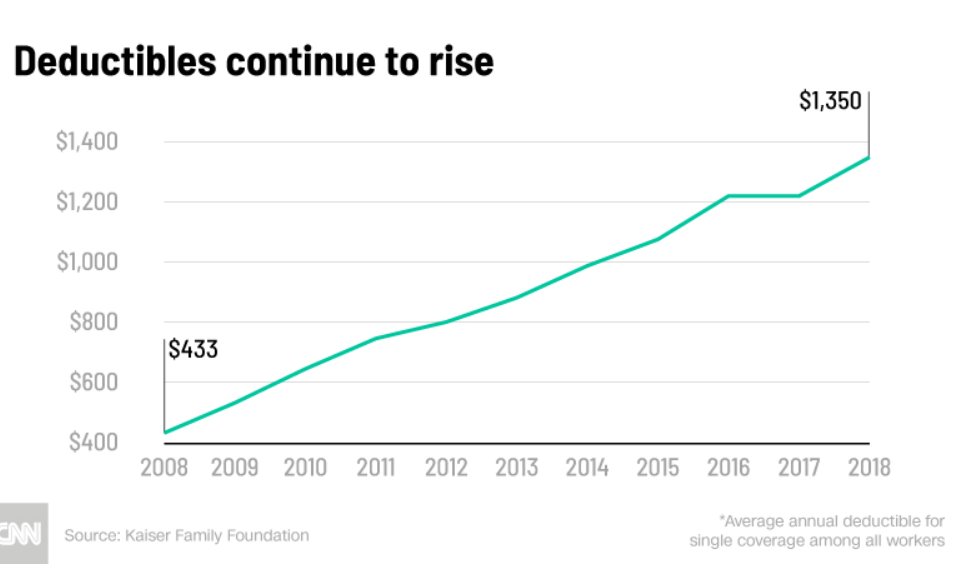
Here is the Tami Luhby CNN story, via Heather Long.
What I’ve been reading
1. Nate Chinen, Playing Changes: Jazz for the New Century. Chinen mounts a persuasive argument that the “golden age of jazz” is in fact today, and fills in the background knowledge you might need to grasp such a claim. I’ve long suggested that if you enjoy live performance, the access/price/talent gradient is truly remarkable. You can see virtually any world class performer, from an A+ quality seat, for a mere pittance. Except in London. The bottom line is that I will keep this book, hardly ever the case.
2. James Mustich, 1,000 Books to Read Before You Die: A Life-Changing List. Paging through this book, from beginning to end, or just browsing it, and buying the attractive-sounding titles is in fact a good (but expensive) way to find new reading. I see no reason why such volumes should be regarded as absurd. Right now I am on “Bradley,” and while I don’t agree with all of the selections, they are unfailingly intelligent and at least plausible.
3. Can Xue, Love in the New Millennium. Is she the Chinese writer most likely to next win a Nobel Prize? “In this darkly comic novel, a group of women inhabits a world of constant surveillance, where informants lurk in the flowerbeds and false reports fly.” Much of the story is set in a brothel, with a rotating cast of characters. Parts remind me of The Dream of the Red Chamber, in any case this is definitely a new fictional work of note. Here is an atypical excerpt: “He and Xiao Yuan had one thing in common: they both valued sensual pleasures. His greatest wish was to sit in the darkened National Theater and listen to La Traviata with her. He thought that after experiencing that atmosphere, their sex life would become satisfying. His idea was naive; Xiao Yuan said he was “too practical.” She added, “Sex is a black hole. People can’t understand all of its implications within a lifetime.”
4. Thomas J. Bollyky, Plagues and the Paradox of Progress: Why the World is Getting Healthier in Worrisome Ways is a good history of public health advances, but also how they have led to what are now plague-prone poor megacities. Here is the author’s piece in Foreign Affairs.
Publicly traded firms do not have an investment deficit
Using data from U.S. corporate tax returns, which provide a sample representative of the universe of U.S. corporations, we investigate the differential investment propensities of public and private firms. Re-weighting the data to generate observationally comparable sets of public and private firms, we find robust evidence that public firms invest more overall, particularly in R&D. Exploiting within-firm variation in public status, we find that firms dedicate more of their investment to R&D following IPO, and reduce these investments upon going private. Our findings suggest that public stock markets facilitate greater investment, on average, particularly in risky, uncollateralized investments.
That is by Naomi Feldman, et.al., from the Fed. Via Andrew McAfee and Matt Yglesias. Of course, this is very much the opposite of what you usually hear from other sources.
Robert Pindyck on climate change models
Pindyck, from MIT, is a leading expert in this area, here is part of his summary conclusion:
It would certainly be nice if the problems with IAMs [integrated assessment models] simply boiled down to an imprecise knowledge of certain parameters, because then uncertainty could be handled by assigning probability distributions to those parameters and then running Monte Carlo simulations. Unfortunately, not only do we not know the correct probability distributions that should be applied to these parameters, we don’t even know the correct equations to which those parameters apply. Thus the best one can do at this point is to conduct a simple sensitivity analysis on key parameters, which would be more informative and transparent than a Monte Carlo simulation using ad hoc probability distributions. This does not mean that IAMs are of no use. As I discussed earlier, IAMs can be valuable as analytical and pedagogical devices to help us better understand climate dynamics and climate–economy interactions, as well as some of the uncertainties involved. But it is crucial that we are clear and up-front about the limitations of these models so that they are not misused or oversold to policymakers. Likewise, the limitations of IAMs do not imply that we have to throw up our hands and give up entirely on estimating the SCC [social costs of carbon] and analyzing climate change policy more generally.
The entire essay is of interest, via Matt Kahn.
The Nobel Laureate who is not a full professor
Donna Strickland (at right) was on Tuesday named one of the three winners of the 2018 Nobel Prize in Physics. Many have noted that she is the first woman in 55 years to win the prize. The BBC noted in a radio interview that Strickland is an associate professor at the University of Waterloo and asked why she was not a full professor. She said she never applied. She laughed when asked if she would apply now.
Link here.
It’s a lot of work to apply for full professor, in terms of compiling one’s dossier, writing a research and teaching statement, cultivating letter writers, and so on. At many schools you might get a raise of say $1500 for the promotion? Apply Canadian tax rates to that. That could be accompanied by more administrative responsibilities, such as pressure to become department chair at some point.
Hail Donna Strickland!
Wednesday assorted links
They solved for the equilibrium, China equilibrium of the day
China will be less severe with its smog curbs this winter as it grapples with slower economic growth and a trade war with the United States, according to a government plan released on Thursday.
Instead of imposing blanket bans on industrial production in the Beijing-Tianjin-Hebei area as it did last winter, the Ministry of Ecology and Environment said it would let steel plants continue production as long as their emissions met standards.
Targets for overall emissions cuts have also been revised down. In the next six months, 28 cities in northern China are required to cut levels of PM2.5 – the tiny airborne particles that are most harmful to human health – by about 3 per cent from a year ago.
That is less than the 5 per cent cut proposed in an initial plan seen by the South China Morning Post last month.
Meanwhile, the new plan stipulates that the number of days of severe air pollution should be reduced by about 3 per cent, also revised down from 5 per cent in last month’s draft.
Here is more from Orange Wang at SCMP. As I am sure you all know, air pollution (and I don’t just mean carbon emissions) is one of the great underrated problems in the world today. The trade war with China is making it worse.
Tuesday assorted links
1. Median wages still have not been rising in the U.S.
2. How about one proposal per year per PI?
3. “As expected, sexism was a significantly stronger predictor of voting for Trump the more left-leaning (vs. right-leaning) the voter. Not only was Clinton correct that sexism played a role in her electoral loss, but she correctly characterized sexism as endemic, an influence especially perceptible on the left.” Link here.
4. Gita Gopinath will be Chief Economist at the IMF.
New issue of Econ Journal Watch
And the IMF said: LET THERE BE DATA. And there was data: Ryan Murphy and Colin O’Reilly unearth assumptions behind the International Monetary Fund’s numbers for private capital stocks by country.
Hayek’s Divorce and Move to Chicago: Lanny Ebenstein draws together new information to reinterpret Hayek’s personal life and how it related to his move to the United States, especially from 1945 to 1955.
The Russian pupils of Adam Smith: An essay from 1937 tells of the two Glasgow students of the 1760s who returned home and launched a tradition of Smithian liberal thought in Russia.
Ideological Profiles of the Economics Laureates: We resume the project with two of the 2013 laureates—Eugene Fama, who responded to our questionnaire, and Lars Peter Hansen.
An Icelandic saga: Hannes Gissurarson responds to his compatriot Stefán Ólafsson on the proper way to tell their country’s story since 1991.
Against the Incorporation of Barbers: A remarkable, forgotten pamphlet of 1758 argues that the restriction, which today would be termed occupational licensing, left those in need of a haircut at the mercy of “a greasy Barber, covered all over with Suds, and the excrementitious Parts of the Beards of nasty Mechanicks.”
EJW Audio:
What should I ask Ben Thompson?
Yes, I will be doing a Conversation with Ben Thompson the tech commentator at Stratechery (worth the $$), no associated public event. Here is Wikipedia on Ben:
Ben Thompson is an American business, technology, and media analyst, who is based in Taiwan. He is known principally for writing Stratechery, a subscription-based newsletter featuring in-depth commentary on tech and media news that has been called a “must-read in Silicon Valley circles”.
Here is Ben’s self-description. Here is Ben on Twitter. So what should I ask him?
Is it better to have more corporations?
A reduction in the corporate income tax burden encourages adoption of the C corporation legal form, which reduces capital constraints on firms. Improved capital reallocation increases overall productive efficiency in the economy and therefore expands the labor market. Relative to the benchmark economy, a corporate income tax cut can reduce the non-employment rate by up to 7 percent.
That is from the new AEJ: Macroeconomics, by Daphne Chen, Shi Qi, and Don Schlagenhauf.
Who is most likely to attribute an outcome to genetic factors?
Ahem:
Many scholars argue that people who attribute human characteristics to genetic causes also tend to hold politically and socially problematic attitudes. More specifically, public acceptance of genetic influences is believed to be associated with intolerance, prejudice, and the legitimation of social inequities and laissez-faire policies. We test these expectations with original data from two nationally representative samples that allow us to identify the American public’s attributional patterns across 18 diverse traits. Key findings are (1) genetic attributions are actually more likely to be made by liberals, not conservatives; (2) genetic attributions are associated with higher, not lower, levels of tolerance of vulnerable individuals; and (3) genetic attributions do not correlate with unseemly racial attitudes.
That is from Stephen P. Schneider, Kevin B. Smith, and John R. Hibbing in the Journal of Politics. For the pointer I thank K.
Monday assorted links
2. New results on anti-discrimination statements (The Economist).
3. The Emperor of Japan still publishes (even though he has tenure). He also usually gets his name first.
4. New economics discussion forum set up by AEA, first question from Olivier Blanchard. In the comments you will find Jeremy Stein, Claudio Borio, Ricardo Cabellero, and Larry Summers, kind of like the MR comments section.
5. Has the abc conjecture been proven?
6. “Pursuit of T5 [top 5 joiurnal] publications has become the obsession of the next generation of economists. However, the T5 screen is far from reliable. A substantial share of influential publications appear in non-T5 outlets. Reliance on the T5 to screen talent incentivizes careerism over creativity.” Link here.