Claims about Ukraine
There is a bank in Ukraine that is offering *21%* interest on a checking account.
But you must take 10,000 steps a day, tracked by their app, to qualify.
Miss one day and you get nothing.
I can’t decide if it’s insanity or brilliance.
That is from Kyle Trouble, via Samir Varma.
Saturday assorted links
The Effect of Communism on People’s Attitudes Toward Immigration
Does living in a communist regime make a person more concerned about immigration? This paper argues conceptually and demonstrates empirically that people’s attitudes toward immigration are affected by their country’s politico-economic legacy. Exploiting a quasi-natural experiment arising from the historic division of Germany into East and West, I show that former East Germans, because of their exposure to communism, are notably more likely to be very concerned about immigration than former West Germans. Opposite of what existing literature finds, higher educational attainment in East Germany actually increases concerns. Further, I find that the effect of living in East Germany is driven by former East Germans who were born during, and not before, the communist rule and that differences in attitudes persist even after Germany’s reunification. People’s trust in strangers and contact with foreigners represent two salient channels through which communism affects people’s preferences toward immigration.
That is from Matthew Karl at the Board of Governors, via the excellent Kevin Lewis.
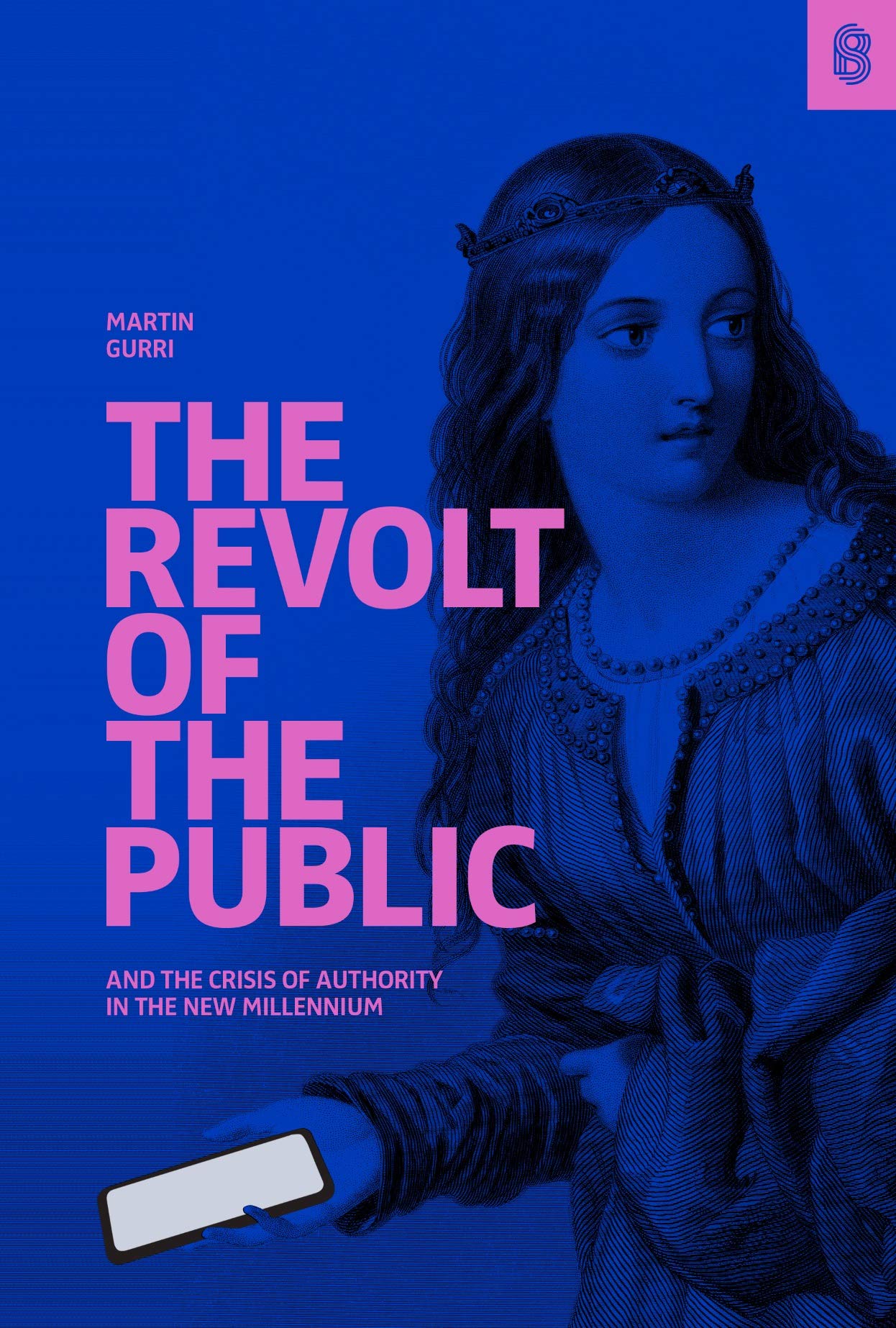
*The Revolt of The Public and the Crisis of Authority in the New Millennium*
By Martin Gurri, due out November 13. I am reading this splendid book for the first time. It basically explains why Brexit and Trump won, and what will happen next. Due to social media, we are disillusioned with our elites, and that will prove hard to reverse.
Sentences to ponder
Consumer DNA testing — and the mountain of data it has generated — has become pervasive enough that it’s possible to identify about six of every 10 people in the U.S. who are of European descent, even if they’ve never given a sample.
Friday assorted links
1. Michael Young and meritocracy.
2. David Perell podcast with Daniel Gross.
3. Who dislikes “political correctness”?
4. American Economic Review: Insights, first set of papers now on-line.
The Civil War boosted Northern support for immigration
Here we arrive at one of the least appreciated factors in the equation that led to the Union victory: the military service of immigrants. Foreign-born recruits provided the Union army with the advantage it needed over its Confederate rival. An estimated 25 percent of the soldiers in the Union army (some 543,000) and more than 40 percent of the seamen in the navy (84,000) were foreign-born. If one includes soldiers with at least one immigrant parent, the overall figure climbs to 43 percent of the Union army…
The demands of war meant that Union officials needed to appeal to immigrants. Military recruitment placards were printed in foreign languages; Union officials presented the war as part of a transnational struggle for republican government, thereby decoupling the idea of the nation from Anglo-Saxon Protestantism…
The military service of the foreign-born did more than enhance the Union’s advantage in the field. It also transformed the politics of nativism in the United States. From the nativism of the 1850s, exemplified by Know-Nothingism and bigoted anti-Catholicism, the Union now moved in the direction of welcoming — indeed, encouraging — foreign arrivals.
That is all from the new book by Jay Sexton, A Nation Forged by Crisis: A New American History.
Why is the news cycle getting shorter and shorter?
Remember the anonymous Op-Ed from within the Trump administration? We’re hardly talking about it any more, and indeed so many “major” stories from just a few weeks ago seem to be slipping from our grasp. Why?
The naïve hypothesis is that we keep turning our attention to the very latest events because so much is happening so quickly. But there have been periods in the past when a lot was happening, such as the financial crisis of a decade ago, and the news cycle seemed “stickier” then. So this can’t be the entire story.
An alternate theory is that there are actually very few “true events” happening, but there is lots of froth on the surface. Maybe there is only one “big event” happening, one major transformation underway: a change in the willingness of American political leaders to break with previous norms. If the change is mostly in one direction, then maybe it’s enough to debate only the most recent news.
That may sound abstract, so here is a concrete analogy. Let’s say you are on a sinking ship. You might focus more on the current water level than on where it was in the recent past, except maybe to help you estimate the rate of flooding. In more technical terms, talking about the event of the day is a “sufficient statistic” for talking about the last two years.
The shorter news cycle also may result from greater political polarization. If people don’t frame events in a common way, then a discussion of those events might not last very long. Conversation will return very quickly to the underlying differences in worldviews, and discussion of any particular event will get trampled by a much larger philosophical debate. It does seem like we have been repeating the same general arguments about Trump, populism, gender and governing philosophy for some time now, and we are not about to stop.
Possibly the shorter news cycles are also a result of greater general disillusionment with politics and especially with elites, a theme outlined in Martin Gurri’s forthcoming book “The Revolt of the Public.” The really fun stuff might instead be watching mixed martial arts, debating social norms about gender and browsing the Instagram feeds of your friends.
Finally, maybe we’re all just better at digesting news events more quickly. Perhaps every possible observation, insight and argument gets put on Facebook and Twitter within a day or two, and much of this material is archived. What’s the point of repeating these debates every few months?
That is from my latest Bloomberg piece. I am thankful to Anecdotal for a related point and insight.
Thursday assorted links
1. Why Eastern Europe is not about to turn pro-immigration.
2. Next week: Ben Sasse has a new book out: Them: Why We Hate Each Other — And How to Heal.
3. Five facts about the new NAFTA.
4. Larger cities are also more unequal.
5. Do the most important artists make the most expensive paintings?
6. “The museum of accidents offers a glimpse into Japanese introspection.”
Brazil fact of the day
Just 8 percent of Brazilians told the Pew Research Center in 2017 that representative democracy is a “very good” form of government – the lowest of all 38 countries surveyed.
Most of the article is about what we can expect from Jair Bolsonaro, sometimes called “the Brazilian Trump,” who is very likely to be Brazil’s next president, recommended and interesting throughout.
The funnel of human experience
So humanity in aggregate has spent about ten times as long worshiping the Greek gods as we’ve spent watching Netflix.
We’ve spent another ten times as long having sex as we’ve spent worshiping the Greek gods.
And we’ve spent ten times as long drinking coffee as we’ve spent having sex.
Furthermore:
It turns out that if you add up all these years, 50% of human experience has happened after 1309 AD. 15% of all experience has been experienced by people who are alive right now.
This should cheer you all up, yes indeed there is no great stagnation no wonder the rate of productivity growth has been so high:
FHI reports that 90% of PhDs that have ever lived are alive right now.
That is from eukaryote at LessWrong. Hat tip goes to the always-excellent The Browser.
Wednesday assorted links
My Conversation with Paul Krugman
Here is the audio and transcript, here is part of the summary:
Tyler sat down with Krugman at his office in New York to discuss what’s grabbing him at the moment, including antitrust, Supreme Court term limits, the best ways to fight inequality, why he’s a YIMBY, inflation targets, congestion taxes, trade (both global and interstellar), his favorite living science fiction writer, immigration policy, how to write well for a smart audience, new directions for economic research, and more.
Here is one excerpt:
COWEN: In your view, how well run is New York City as an entity?
KRUGMAN: Not very. Compared to what? Actually, I like de Blasio. I actually think he’s done some really good things. What he’s done on education, and even on affordable housing, is actually quite substantial. But the city is so big and the problems are so large that people may not get it.
I will say, it is crazy that you have a city that is so dependent on public transportation, and yet the public transportation is not actually under the city’s control and has clearly been massively neglected. I don’t suffer the full woes of the subway, but I suffer some of them, even myself.
The city could be run better than it is, but it’s certainly not among the worst-managed political entities in the United States, let alone in the world.
And:
COWEN: Will there ever be interstellar trade in intellectual property? You send your technology to a planet far away. It arrives much later, of course. Or you trade Beethoven to the aliens in return for a transporter beam? Can this work? You’ve written a paper that seems to indicate it can work.
KRUGMAN: I wrote a paper on the theory of interstellar trade when I was an unhappy assistant professor. Are there any happy assistant professors? [laughs] I was just blowing off steam. But it’s an interesting question.
COWEN: It could become your most important paper, right? [laughs]
KRUGMAN: We could imagine that there would be some way. We’d have to find somebody to trade with, although it’s the kind of thing — if you try to imagine interstellar trade for real in intellectual property — it’s probably the kind of thing that would be more like government-to-government exchanges.
It sounds like it would be really, really hard, although some science fiction writers are imagining that something like Bitcoin would make it possible to do these long-range . . . I don’t think something like Bitcoin is even going to work here.
Krugman also gives his opinions on Star Wars and Star Trek and Big Tech and many other matters. Interesting throughout…
Indian airport police are going to smile less
Airport police in India are being instructed to smile less.
This is over concerns cheerfulness could lead to a perception of lax security and a threat of terror attacks.
The country’s Central Industrial Security Force, which is in charge of aviation safety, wants its staff to be “more vigilant than friendly”.
They will move from a “broad smile system” to a “sufficient smile system”, the Indian Express says.
Officials are said to believe that excessive friendliness puts airports at risk of terrorist attacks.
The organisation’s director general, Rajesh Ranjan even said the 9/11 attacks had taken place because of “an excessive reliance on passenger-friendly features”.
Here is the full story, via Anecdotal.
Do higher minimum wages induce more search?
Monopsony models generally imply they should, and that is part of the argument why minimum wage hikes might be good for workers, wages, and yes even employment. But the data don’t seem to support the claim of more search behavior:
Labor market search-and-matching models posit supply-side responses to minimum wage increases that may lead to improved matches and lessen or even reverse negative employment effects. Yet there is no empirical evidence on this crucial assumption. Using event study analysis of recent minimum wage increases, we find that increases to minimum wage do not increase the likelihood of searching, but do lead to large yet very transitory spikes in search effort by individuals already looking for work. The results are not driven by changes in the composition of searchers.
That is from a new NBER Working Paper by Camilla Adams, Jonathan Meer, and Carly Will Sloan.