Category: Books
*You Will Not Stampede Me: Essays on Non-Conformism*
That is the new book by my colleague Bryan Caplan, collected largely from his previous blog writings. Bryan emails to me:
I just released a new book of essays on Amazon, entitled *You Will Not Stampede Me: Essays on Non-Conformism*. Emerson and Thoreau were right: Excessive conformity is a major impediment to living a full life in the modern world, and you really can improve a lot with modest effort.For details, see my recent Substack.…Like my other books of essays, You Will Not Stampede Me is divided into four parts.
- The first, echoing Milgram, is “Disobedience to Authority.” These pieces dissect the psychology and economics of being normal.
- The next section, “The World Is Wrong,” explores big, specific issues where the popular opinion sucks. Covid, of course, but also bioethics, trolling, the right of revenge, and more.
- I follow with “The Weird Is Right,” most notably with the essay, “A Non-Conformist’s Guide to Success in a Conformist World.” Yes, the world does punish non-conformists, but so sporadically and thoughtlessly than the crafty can usually defy the world with impunity.
- I close the book with “Non-Conformist Candor,” where I call a litany of hand-picked controversies just like I see them.
As usual with my books of essays, you can read them all for free in the Bet On It Archives. What you get for your $12 is curation, convenience, and coolness.
As you might expect, I like to troll Bryan by telling him he is a deeply conformist suburban Dad, in the good sense of course. Read this book and find out if I am right or not.
What should I ask Jonathan Haidt?
Yes, I will be doing another Conversation with him. Here is my previous Conversation with him, almost eight years ago. As many of you will know, Jonathan has a new book coming out, namely
The Everything Token
If you want to understand NFTs and where they are going, The Everything Token by web entrepreneur Steve Kaczynski and Harvard Business school professor Scott Duke Kominers is by far the best guide. 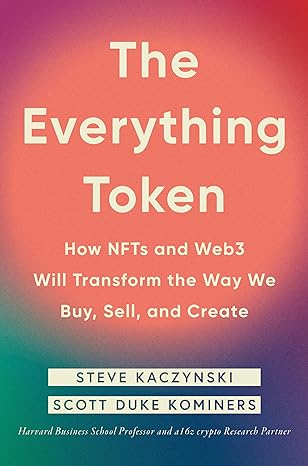 Kaczynski and Kominers emphasize that NFTs are more than deeds to digital art they are an ideal way to create communities.
Community formation around shared interests has been happening forever, of course. But NFTs turn it up to eleven because of what we call their embedded network superpower:…becoming the owner of an NFT is to some degree an act of affiliation with the brand. Yet NFT ownership doesn’t just connect you with the brand itself, but also with the entire network of individuals who are similarly affiliated….The holders of a given NFT comprise a network of brand enthusiasts just waiting to be activated.
The Everything Token is all about advising brands on what NFTs are, how to understand and navigate the design space and how to active brand enthusiasm. Now you may find ‘activating brand enthusiasm’ pedestrian, perhaps even a little dystopian but Kaczynski and Kominers are correct that this is where the NFT market is going.
When the internet first exploded into public consciousness there was a lot of talk about declaring independence and creating a civilization of the Mind. If you bought into that (I did not, despite lauding the goals) then maybe you think that the internet as we know it today, Google, Amazon, Facebook, Twitter, Spotify and all the rest are a big disappointment. I don’t. I love the new world, even if it isn’t the libertarian paradise that some once promised.
In the same way, NFTs won’t lead to a revolution of the creator class but they are poised to be increasingly adopted by corporations. Corporate adoption will ‘domesticate’ the underlying cryptographic technology. That is, as corporations infuse NFTs into mainstream business models, NFTs will become more user-friendly and accessible and much like the seamless integration into our daily lives of technologies such as Google Maps and digital payments, they will become a ubiquitous part of the digital economy. As NFTs become embedded in various sectors ranging from finance to entertainment, they will reshape how we perceive and interact with digital assets offering innovative and versatile applications that extend well beyond their current scope. It will be fun but don’t expect to liberate the means of production.
*Molly*
That is the new book by Blake Butler, a memoir. It is no spoiler to tell you that his wife Molly takes her own life at a young age. I don’t know of any better argument for social conservatism than this book. And perhaps suicide should be regarded as a sin, not something to get sentimental about on Twitter. There is so much depravity in this book, at so many different levels. There is the decline of a whole civilization in this book. Here is a good New Yorker review by Alexandra Schwarz.
What I’ve been reading
1. Steve Kaczynski and Scott Duke Kominers, The Everything Token: How NFTs and Web3 Will Transform the Way We Buy, Sell, and Create. Could the be the best book on NFTs? I think we should be genuinely uncertain as to whether NFTs have a future. In the meantime, I consider NFTs a good Rorschach test for whether an individual’s mind is capable of moving out of “the dismissive mode.” Do you pass or fail this test? The “snide, sniping” mode is so hard for many commentators to resist…
2. Christina Rossetti: Poetry in Art, edited by Susan Owens and Nicholas Tromans. Excellent text and also color plates, including paintings and sketches of her, a very good introduction to her work. Here is a good bit: “Rarely, if ever, has a major poet grown up so deeply embedded in an avant-garde visual culture. Yet she seems actively to have resisted the lure of the world of images, preferring to live and write, as Bell liked to think she did spontaneously, out of her own mind.” A wonderful chronicle of a very particular time, artistic and otherwise.
3. Peter Cowie, God and the Devil: The Life and Work of Ingmar Bergman. The author knew Bergman, and early on, so this is a useful biography in several regards, most of all for some background information and TV and theatre projects that never came to fruition. But it is not useful for converting the unconverted, nor does it have much more interpretative meat for the in-the-know obsessives.
4. Richard Whatmore, The End of Enlightenment: Empire, Commerce, Crisis. One of my favorite books on the British Enlightenment. For instance, the author captures the tenor of 18th century British debates about liberty very well. Very good chapters on Hume, Shelburne, and Macaulay. Whatmore somehow writes as if he is actually trying to explain things to you! If you read a lot of history books, you will know that is oddly rare. Recommended, for all those who care.
5. Anthony Kaldellis, The New Roman Empire: A History of Byzantium. So far I’ve read only 22 pp. of this one, and it clocks in at 900 pp. plus. It is obviously excellent and I wanted to tell you about it right away. I expect it to make the top few picks of the best non-fiction of 2024. The author’s main theme is that Byzantium built a “New Roman Empire,” and he details how that happened. The writing is also clear and transparent, for a time period that is not always easy to understand.
William Magnuson, For Profit: A History of Corporations is not a book for me, but it is a good and sane introduction for those seeking that.
My GOAT podcast with Robert Murphy
He is of the Mises Institute, so plenty of talk about Mises and the Austrians as well.
Bob is very smart and widely read. The other links are here: https://mises.org/library/tyler-cowen-goat-economics, https://soundcloud.com/misesmedia/tyler-cowen-on-the-goat-in-economics
Mark Skousen reviews *GOAT*
An excellent review, here is one excerpt:
Oddly enough he leaves out several economists who many consider possible GOATs: From the British school, David Ricardo (Milton Friedman’s favorite); from the Monetarists, Irving Fisher (whom James Tobin ranked “the greatest economist America has produced”); from the Austrians, Ludwig von Mises and Murray Rothbard (which the Mises Institute would consider leaving out unforgiveable); from the Institutionalists, Thorstein Veblen (who Max Lerner called “the most creative American social thought has produced”) and Max Weber (the “one man” that Frank Knight admired); and from the Marxists, Karl Marx (which they would consider his omission a cardinal sin). Cowen tells me he may write a short monograph on Marx (email dated November 22, 2023).
He also excluded the big three of the Marginal Revolution of the 1870s: Carl Menger, William Stanley Jevons, and Leon Walras.
Do read the whole thing, and note I may write more on the Marginal Revolution as well, the revolution that is not the blog!
And here is Mark’s daughter, doing a skating back flip on ice.
*The Upside-Down World: Meetings with Dutch Masters*
By Benjamin Moser, I loved this book. It is one of my favorite books of art criticism ever, written from the perspective of a fan I might add. It talks you through the pictures and the lives of the 17th century Dutch artists and tries to tie it all together. It doesn’t spend too much time on the super-famous works or the anecdotes you might already know.
If you want to get down to brass tacks, after Rembrandt, Vermeer, and Fabritius — the top Dutch masters — I like Pieter Saenredam and Paulus Potter and Rachel Ruysch, who had ten children. I admire Hals, but don’t go to any great lengths to go see it. Judith Leyster remains modestly underrated. If you read this book, you’ll come away with your own opinions, or revise the ones you already have. The color plates are well presented.
Moser is highly rated but still underrated, and his Lispector and Sontag biographies are excellent as well.
*Late Admissions: Confessions of a Black Conservative*
That is the new memoir from Glenn C. Loury, and I cracked it open right away, here is one excerpt:
But now Harvard is looking to retool its ailing Afro-American Studies department, and Tom [Schelling] serves on the committee whose job it is to recruit new faculty worthy of the institution. The chair of that committee is the distinguished black historian Nathan Huggins, who has recently taken the helm in Afro Studies at Harvard. Apparently my Econometrica paper on intergenerational transfers had gotten their attention, and my writing on the dynamics of racial income differences has piqued their interest. I’m just six years past my PhD and they’re offering a joint appointment as full professor of economics and of Afro-American Studies. The appointment would make me the first black tenured professor in the history of Harvard’s economics department. I like the sound of that. In the past, the timing hadn’t quite felt right for Harvard. But now it does feel right, and I have the sense that if I say no a third time, they won’t be calling again.
You can pre-order the book here, it is self-recommending of course. And here is my earlier Conversation with Glenn Loury.
The new *Pedro Páramo* translation
By Juan Rulfo, first published in 1955. The previous English-language translation was abysmal, so this is perhaps the least read piece of truly great world literature? In the English-speaking world at least. It took me a long time and a lot of effort to read this short novel in Spanish. The vocabulary is not difficult, it is simply difficult in any language to know exactly what is going on. What exactly are the borders between the living and the dead, for instance? Which character is doing what? What is Rulfo telling us about Dante? As first-tier literature should, it strains our capabilities to the utmost. A knowledge of rural Mexico helps, for sure.
García Márquez compared the work to that of Sophocles in import. Carlos Fuentes called it “the essential Mexican novel.” For me it is in the top 25 novels of all time. Susan Sontag thought it was one of the essential works of 20th century literature.
The new Douglas J. Weatherford translation is probably as good as it is going to get. The work is intrinsically difficult to translate, so try the Spanish if you can, or read the two jointly together, switching back and forth. And as they like to say in Haiti, “if you’re not confused, you don’t know what’s going on.”
Recommended, essential, and kudos to Weatherford for making this available. I’ve addended it to my favorite fiction of 2023 list.
John Stuart Mill on empirical economics and causal inference
Written by me, here is a passage from GOAT: Who is the Greatest Economist of All Time, and Why Should We Care?
A System of Logic covers many different topics, but for our purposes the most important discussion is Mill’s treatment “Of the Four Methods of Experimental Inquiry,” sometimes called “Mill’s Methods” and indeed receiving their own Wikipedia page. Mill outlines different manners in which causes and effects might be correlated, or not, and what we can infer from such patterns, and how difficult it can be to sort out actual cause and effect from the data. He refers to the “direct method of agreement,” the “method of difference,” “joint method of agreement difference,” the “method of residue,” and the “method of concomitant variations,” all as ways of trying to make correct or at least better inferences from the data.
I’ll spare you the details on the full argument, but in essence Mill was trying to figure out how to do causal inference econometrics, but with words only. That enterprise was doomed to fail, but it gives us insight into what Mill thought was by far the most important question in social science, namely causal inference when faced with complex underlying chains of cause and effect. For Mill, everything is what we would now call “an identification problem,” and this understanding is clearest in Mill’s chapters “Fallacies of Generalization” and “Fallacies of Ratiocination.” Mill also serves up a remarkably on-target discussion of how the different nature of social science problems, and their possibly greater complexity, can lead to identification problems that are not necessarily present in the natural sciences – see his chapter “Of the Chemical, or Experimental, Method in the Social Science.” That entire approach is remarkably 2020s in orientation, and you won’t find earlier history of thought books giving Mill much if any credit for this.
In a funny way, Mill was ahead of Milton Friedman in his understanding here. Friedman knew much more statistics, but in his economics he often presented causal inference as fairly straightforward. In his Monetary History of the United States, co-authored with Anna Schwartz, the reader does get the impression that the historical correlations, and ordinary least squares techniques, do in fact show that the money supply is a central driver of nominal income, given the relative stability of money demand. Later, the real business cycle theorists were to challenge that inference, and suggest that often it was income that was causing the money supply. That is a kind of complex challenge Mill seemed quite comfortable with in A System of Logic, whereas Friedman and Schwartz assigned higher power to common sense approaches to cause and effect.
Mill remains in my eyes one of the most underrated thinkers.
Top MR Posts of 2023
This was the year of AI; including the top post from Tyler, Existential risk, AI, and the inevitable turn in human history but also highly ranked were my posts AGI is Coming and AI Worship and Tyler’s GPT and my own career trajectory. Also our paper, How to Learn and Teach Economics with Large Language Models, Including GPT has now been downloaded more than ten thousand times.
2. Second most popular post was The Extreme Shortage of High IQ Workers
5. *GOAT: Who is the Greatest Economist of all Time, and Why Does it Matter?*
6. Matt Yglesias on depression and political ideology which pairs well with another highly-ranked Tyler post, So what is the right-wing pathology then? and also Classical liberals are increasingly religious.
7. Can the SVB crisis be solved in the longer run?
8. Substitutes Are Everywhere: The Great German Gas Debate in Retrospect
9. My paean to Costco.
10. Is Bach the greatest achiever of all time?
11. The Real Secret of Blue Zones
12. SpaceX Versus the Department of Justice
13. What does it mean to understand how a scientific literature is put together?
14. In Praise of the Danish Mortgage System
15. Great News for Female Academics!
Finally, don’t forget Tyler’s posts Best non-fiction books of 2023, Favorite fiction books of 2023, and Favorite non-classical music.
What were your favorite posts/articles/books/music/movies of 2023?
*The New Deal’s War on the Bill of Rights*
That is the new book by David Beito, and the subtitle is The Untold Story of FDR’s Concentration Camps, Censorship, and Mass Surveillance. Here is the closing passage:
If Roosevelt’s civil-liberties reputation meant anything to mainstream Americans at the end of the 1950s, it was not for witch hunts against gays in the navy, mass surveillance of private telegrams, crackdowns on free speech, inquisitorial investigations, sedition prosecutions, or the internment of Japanese Americans in concentration camps. Far more central in the memories of most was his authorship of the four freedoms and the Fair Employment Practices Committee and the appointment of Black and Douglas to the Supreme Court. But that was not the whole truth, or even the beginning of the whole truth.
There you go. I don’t think these facts are much contested, though the accompanying mood affiliation hasn’t changed very much.
Asimov Press
Asimov Press, a new publishing venture that will produce books + magazines about progress in biotechnology, launched today. We’ll publish new articles regularly and hope you’ll follow! Modelled on Stripe Press, and we’re advised by a Works in Progress co-founder.
What I’ve been reading
Rob Henderson, Troubled: A Memoir of Foster Care, Family, and Social Class. Yes, that is the Rob Henderson of Twitter and Substack. He was raised by foster parents and joined the Air Force at the age of seventeen. He ended up with a Ph.D. from Cambridge. This is his story, it covers class in America, and it is a paean to family stability.
There Were Giants in the Land: Episodes in the Life of W. Cleon Skousen. Compiled and edited by Jo Ann and Mark Skousen. If you are interested in LDS, one approach is to read The Book of Mormon. Another option is to read a book like this one. It is also, coming from a very different direction, a paean to family stability.
Thomas Bell, Kathmandu. There should be more books about individual cities, and this is one of them, one of the best in fact. Excerpt: “At its most local levels, of the neighbourhood, or the individual house, Kathmandu is ordered by religious concepts, either around holy stones, or divinely sanctioned carpentry and bricklaying techniques. The same is true of the city as a whole.” And how do they still have so many Maoists?
Out of Sri Lanka: Tamil, Sinhala & English Poetry from Sri Lanka and its Diasporas, edited by Vidyan Ravinthiran, Seni Seneviratne, and Shash Trevett. A truly excellent collection, worthy of making the best non-fiction of 2023 list. Or does this count as fiction? It’s mostly about things that happened.
Eric H. Cline, After 1177 B.C.: The Survival of Civilizations. A good sequel to the very good 1177 B.C.
Allison Pugh, The Last Human Job: The Work of Connecting in a Disconnected World accurately diagnosing networking as a skill that will rise significantly in value in a tech-laden world.
Dorian Bandy, Mozart The Performer: Variations on the Showman’s Art shows how Mozart, first and foremost, was a showman and that background shaped his subsequent output and career.