Category: Current Affairs
The first genetically modified potato
In the modern sense that is, of course potatoes have been genetically modified for a long time:
The Agriculture Department on Friday approved the first genetically modified potato for commercial planting in the United States, a move likely to draw the ire of groups opposed to artificial manipulation of foods.
The Innate potato, developed by the J.R. Simplot Co., is engineered to contain less of a suspected human carcinogen that occurs when a conventional potato is fried, and is also less prone to bruising during transport.
Boise, Idaho-based Simplot is a major supplier of frozen french fries to fast-food giant McDonald’s.
The story is here, and you will note that on Tuesday the mandatory GMO-labeling initiatives failed in Oregon and Colorado, the second failure in Oregon and that means failures in four states overall. Less positively, voters in Maui County, Hawaii chose to restrict GMO cultivation altogether. And now McDonald’s is under pressure not to use these new potatoes for its french fries. But of course you can understand the marketing dilemma of McDonald’s here — they can’t just come out and say “these french fries won’t give you cancer.”
Might this help explain Russia and Ukraine?
The excellent Akos Lada, a graduate student at Harvard, has a new paper on why countries sometimes invade their neighbors, it is called “The Dark Side of Attraction,” the abstract is here:
I argue that the diffusion of domestic political institutions is a source of wars. In the presence of an inspiring foreign regime, repressive elites fear that their citizens emulate the foreign example and revolt. As a result, a dictator starts a war against an attractive foreign regime, seeking to destroy this alternative model. Such wars are particularly likely when there are strong religious, ethnic or cultural ties between the dictator’s opposition and the inspiring country – connections that allow citizens to draw easy comparisons. My posited mechanism explains three case studies. The first describes the Russian invasion of Hungary in 1849. The second case study analyzes the origins of the First World War (1914-8), where Austria-Hungary invaded Serbia. The final case study discusses the Iran-Iraq War (1980-8). In all three cases, a dictator started a war in order to extinguish the foreign flame that fueled his domestic opposition.
Akos occasionally writes blog posts here. Here is our previous coverage of Akos Lada — he stands a good chance of being one of the significant new “big picture” thinkers in economics.
Abu Dhabi window cleaner rescued by drone?
A terrified window cleaner was rescued by a high-tech drone after the scaffolding he was on malfunctioned.
The man was cleaning windows close to the top of a high rise building in central Abu Dhabi, in the United Arab Emirates, when the motorised scaffold stopped working and started tilting dangerously.
The Security Media Department sent a wireless remote-controlled drone to rescue the cleaner amid dramatic scenes yesterday.
All of a sudden, Asian-Americans are voting more Republican
Philip Bump reports:
Note the big swing in the Asian voting bloc, too. In 2012, strong support for the president among Asian-American voters was a surprise. Asian voters preferred the president by 47 points. In 2014, the (low turnout) group split about evenly. It was a 46-point swing.
The full account is here, via Megan McArdle.
The world’s biggest and most important ideological battle
Religion in China. That was the topic of a recent excellent Economist article. Here is one good excerpt:
It is hard even to guess at the number of Christians in China. Official surveys seek to play down the figures, ignoring the large number who worship in house churches. By contrast, overseas Christian groups often inflate them. There were perhaps 3m Catholics and 1m Protestants when the party came to power in 1949. Officials now say there are between 23m and 40m, all told. In 2010 the Pew Research Centre, an American polling organisation, estimated there were 58m Protestants and 9m Catholics. Many experts, foreign and Chinese, now accept that there are probably more Christians than there are members of the 87m-strong Communist Party. Most are evangelical Protestants.
Predicting Christianity’s growth is even harder. Yang Fenggang of Purdue University, in Indiana, says the Christian church in China has grown by an average of 10% a year since 1980. He reckons that on current trends there will be 250m Christians by around 2030, making China’s Christian population the largest in the world. Mr Yang says this speed of growth is similar to that seen in fourth-century Rome just before the conversion of Constantine, which paved the way for Christianity to become the religion of his empire.
In the 1980s the faith grew most quickly in the countryside, stimulated by the collapse of local health care and a belief that Christianity could heal instead. In recent years it has been burgeoning in cities.
Read the whole thing. You will note that when individuals engage in a “portfolio” approach to religion, social evolution can occur much more rapidly. Not everyone has to fully convert to Christianity, or to embrace Confucianism wholeheartedly, for those approaches to suddenly acquire much more influence.
Is recovery always slow after a financial crisis?
That has been the received wisdom, but it is now challenged by a new paper (pdf) by Christina and David Romer:
This paper revisits the aftermath of financial crises in advanced countries in the decades before the Great Recession. We construct a new series on financial distress in 24 OECD countries for the period 1967-2007. The series is based on narrative assessments of the health of countries’ financial systems that were made in real time; and it classifies financial distress on a relatively fine scale, rather than treating it as a 0-1 variable. We find little support for the conventional wisdom that the output declines following financial crises are uniformly large and long-lasting. Rather, the declines are highly variable, on average only moderate, and often temporary. One important driver of the variation in outcomes across crises appears to be the severity and persistence of the financial distress itself when distress is particularly extreme or continues for an extended period, the aftermath of a crisis is worse.
There is Justin Lahart coverage here, including a contrast with Reinhart and Rogoff.
Sentences to ponder
Here is Jody Lanard and Peter M. Sandman on the risks of an Ebola pandemic in the developing world:
The two of us are far less worried about sparks landing in Chicago or London than in Mumbai or Karachi.
Do read the whole thing, via Andrea Castillo.
The East 25 Years After Communism
That is the new Foreign Affairs piece by Andrei Shleifer and Daniel Treisman, and they argue that matters have gone strikingly well and are relatively normal. Here is one excerpt:
Newspapers overflowed with accounts of soaring mortality amid the stress of transition. On average, however, life expectancy rose from 69 years in 1990 to 73 years in 2012. The speed of improvement was two thirds faster than in the communist 1980s. Russia’s life expectancy today, at 70.5, is higher than it has ever been. Infant mortality, already low, fell faster in percentage terms than in any other world region.
Eastern Europe is infamous for unhealthy binge drinking. However, average alcohol consumption fell between 1990 and 2010 from 7.9 to 7.6 liters of pure alcohol a year per resident aged over 14. There were exceptions — drinking rose in Russia and the Baltic states but even in Russia recorded consumption in 2010, 11.1 liters, was lower than that in Germany, France, Ireland, or Austria. (Of course, more drinking might escape the statisticians in the Slavic region.) Smoking among adult males was high – 42 percent on average but about the same as in Asia. In short almost all statistics suggest a dramatic improvement in the quality of life.
In short, almost all statistics suggest a dramatic improvement in the quality of life since 1989 for citizens of the average postcommunist country — an improvement that rivals and often exceeds those in other parts of the world.
You will note that the published version in Foreign Affairs has slightly different wording and organization.
Sentences about Chinese anti-corruption campaigns
The theme of a study by Melanie Manion is that China’s approach to fighting corruption hearkens back to Maoist campaigns of the 1950s, with the same undesirable effects: campaigns are too frequent, do not last long enough to enlist public confidence, and undermine the growth of long-term institutions of surveillance and enforcement…
That is from Alan Heston and Terry Sicular in this very useful 2008 book. The Melanie Manion book is here.
Sicily Fact of the Day
Sicily, for instance, employs 28,000 forestry police — more than Canada — and has 950 ambulance drivers who have no ambulances to drive.
More here on the general state of decline in Italy.
First conviction for manufacturing a 3-D printed gun
It is from Japan:
The Yokohama District Court sentenced a former Japanese college employee on Monday to two years in prison for producing guns with a three-dimensional printer.
Yoshitomo Imura, 28, a former employee of the Shonan Institute of Technology, was found guilty of violating laws that strictly restrict the possession of guns and large knives and the production of weapons. The prosecution had demanded a 42-month prison term.
Imura’s actions were “vicious” because he made it easy to imitate his production method, presiding Judge Koji Inaba said, noting that Imura had released 3-D design data for his guns on the Internet.
The story is here, the pointer is from the excellent Mark Thorson.
China fact of the day
This year China is set to pay an interest bill of about $1.7tn, an amount not far short of India’s entire GDP last year ($1.87tn) but larger than the economies of South Korea, Mexico and Indonesia.
That is from James Kynge at the FT, there is more here.
Ebola markets in everything
Ebola plush toys have been selling so fast in response to this year’s outbreak that a Connecticut manufacturer, Giantmicrobes Inc., can’t keep them in stock.
The company, which was founded a decade ago, makes stuffed toys based on the appearance of microbes like Ebola, Chicken pox, bed bugs, and even non-harmful microscopic organisms things like brain and red blood cells.
The items are meant to be educational tools for young children, Laura Sullivan, vice president of operations, told CBS News.
Digital Non-Cash
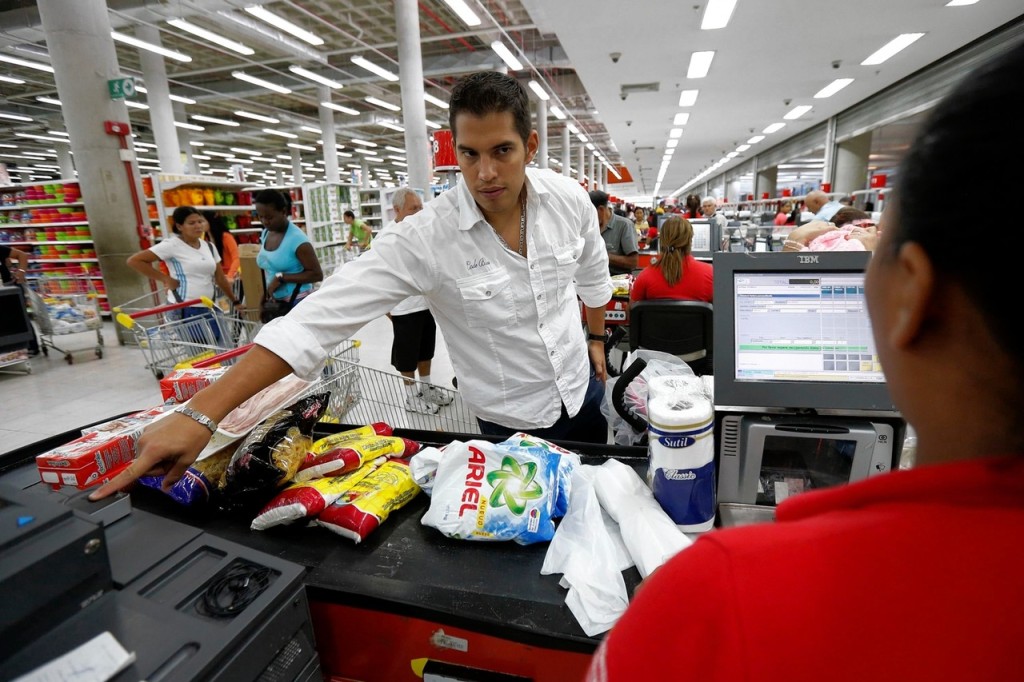
In the United States we are using advanced technology like fingerprint scans to pay for goods. In Venezuela they are using advanced technology like fingerprint scans to ration goods. Here is the WSJ:
Amid worsening shortages, Venezuela recently reached a milestone of dubious distinction: It has joined the ranks of North Korea and Cuba in rationing food for its citizens.
…Under the system in place here, basic price-controlled items—including milk, rice, coffee, toothpaste, chicken and detergent—are rationed, with the fingerprinting machine used to ensure that a shopper doesn’t return over and over to stock up.
The stark contrast between our advanced technology and our primitive ethics has often been noted. Our advanced technology also stands in stark contrast to our primitive economics. Sadly, the problem is not only in Venezuela. Here is the WSJ (!) “explaining” the shortages:
Venezuela is turning to rationing because of shortages caused by what economists call a toxic mix of unproductive local industry—hamstrung by nationalizations and government intervention—and a complex currency regime that is unable to provide the dollars importers need to pay for basics.
No, no, no, a thousand times no! (And I very much doubt that is what the economists told the reporter.) Nationalizations, the currency regime, unproductive industry, Venezuela has many problems but shortages are caused by price controls.
Check out this wonderful photograph and the face of the customer.
The culture that is Republican
A party can deviate only so far from its core voters:
Cutting federal health and retirement spending has long been at the top of the GOP agenda. But with Republicans in striking distance of winning the Senate, they are suddenly blasting the idea of trimming Social Security benefits.
The latest attack came in Georgia, where the National Republican Campaign Committee posted an ad last week accusing Rep. John Barrow (D) of “leaving Georgia seniors behind” by supporting “a plan that would raise the retirement age to 69 while cutting Social Security benefits.”
Crossroads GPS, the conservative nonprofit group founded by GOP strategist Karl Rove, has run similar ads against North Carolina Sen. Kay Hagan (D), Arkansas Sen. Mark Pryor (D) and Rep. Scott Peters (D-Calif.). Crossroads accused Hagan of supporting a “controversial plan” that “raises the retirement age.”
There is more here, from Lori Montgomery.