Category: Current Affairs
Russia and Ukraine facts of the day
The World Bank lists Russia at $14,037 per capita income.
That same source lists Ukraine at $3,867.
Russian per capita income is slightly more than 3.6 times higher. I am not suggesting that Crimea will now experience an economic boom, but this differential is worth keeping in mind as the issue unfolds.
Admittedly the Russian incomes are distributed quite inequitably (Gini of 40 compared to 26 for Ukraine), which lowers the attraction of belonging to that country.
Vox.com
That is the new Ezra Klein-led news site, and a demo version of the site is at www.vox.com, where you can watch an explanatory video. You can follow them on Twitter here. They are on Instagram here. YouTube here.
You can also think of this as a project in history, or on-line education.
The Great Male Reset
Men between the ages of 25 and 54 are in their prime working years. Generally speaking, they’re too old for college and too young for retirement.
In February 2008, 87.4 percent of men in that demographic had jobs.
Six years later, only 83.2 percent of men in that bracket are working.
That is from Binyamin Appelbaum.
Daniel Drezner on sanctions against Russia
The piece is here, here is one excerpt:
The only case of economic coercion succeeding in a similar case in history was the 1956 Suez crisis. In that case, Britain, France, and Israel withdrew their forces from the Suez Canal following a U.S.-inspired run on the pound sterling. Except that the Suez case is not at all similar to Russia/Crimea. Britain was a treaty ally of the United States; not so much with Vladimir Putin’s Russia. The Suez was far away from British soil; the Crimea is just across the Sea of Azov. And, perhaps most importantly, Britain was in a fragile economic state trying to protect a fixed exchange rate. Russia’s economy has its problems, but a shortage of hard currency reserves ain’t one of them.
So the conditions under which sanctions would force Russia’s hand in Ukraine are far from ideal. The proposed sanctions coalition is equally flawed, however, as my FP colleague Colum Lynch has noted. European Union leaders are not exactly keen on the idea of broad-based economic sanctions, for understandable reasons. Britain needs Russian finance capital; the rest of Europe needs Russian energy. France is traditionally the most hawkish country in Europe, but that country is too busy planning to export warships to Russia to organize European sanctions.
And here is Dan’s conclusion:
Sorry, but the fact remains that sanctions will not force Russia out of the Crimea. This doesn’t mean that they shouldn’t be imposed. Indeed, there are two excellent reasons why the United States should orchestrate and then implement as tough a set of sanctions on Russia as it can muster. First, this problem is going to crop up again…
Second, while sanctions cannot solve this problem on their own, they can be part of the solution. Over the long term, Russia does need to export energy to finance its government and fuel economic growth. Even if planned sanctions won’t bite in the present, the anticipation of tougher economic coercion to come is a powerful lever in international bargaining.
My earlier post on Drezner on sanctions is here.
Claims about Bitcoin mystique
Still, Bitcoin watchers said that the creator’s supposed anonymity had played a vital role in the growth of a virtual currency that has become a potent symbol for privacy advocates and critics of government power.
“Having this level of mystery allowed people to project their optimism and their hopes onto the currency,” said Richard Peterson, the chief executive of MarketPsych, a research company that has studied virtual currencies. “If it’s true and people start to believe it, it undermines that mystique.”
There is more here, and Timothy Lee adds relevant remarks. And as you all probably know it remains uncertain whether the Newsweek story is to be trusted.
How many of the previously uninsured have signed up for Obamacare?
Amy Goldstein reports:
The new health insurance marketplaces appear to be making little headway in signing up Americans who lack insurance, the Affordable Care Act’s central goal, according to a pair of new surveys.
Only one in 10 uninsured people who qualify for private plans through the newmarketplaces enrolled as of last month, one of the surveys shows. The other found that about half of uninsured adults have looked for information on the online exchanges or planned to look.
…The McKinsey survey shows that of people who had signed up for coverage through the marketplaces by last month, about one-fourth described themselves as having been without insurance for most of the past year. That 27 percent, while low, compares with 11 percent a month earlier.
There is more here. You will note that a low rate of sign-up is distinct from a rate of sign-up skewed toward the elderly and the sick. In this sense we still do not know how the new law is doing, though in a broader sense a low rate of sign-up should not be considered good news.
The History of Ethno-National Referendums 1791-2011
That is the title of a useful article by Matt Qvortrup (or here, both possibly gated). Here is one excerpt:
To be sure, the British were not adverse to using the referendum as a tactical means of international politics (for example, in the case of the referendum in Moldova in 1857 — where the referendum was a convenient excuse to curb the influence of the Russian Empire after the Crimean War). Here at the request of the British, a poll was held to unify the two territories Moldavia and Walachia (previously an area that had been under Turkish Suzerainty, though often dominated by Russia) under the name Romania. However, it should be noted that the referendum was anything but free and fair; “Intimidations and arrests were not infrequent” and up to “nine-tenth of the population were denied the right to vote,” and that the vote only was held after some “bizarres manoevres diplomatiques.”
Here is an older (free) historical book on the employment of plebiscites to determine sovereignty. Here is the new, well-timed, and not free March 2014 book by Matt Qvortrupp, on same topic. Qvortrup, by the way, helped design the referendum for South Sudan.
Bureaucracies can act swiftly when they wish to
Russia’s takeover of Crimea is already so complete that commercial flights to Kiev from the region’s main airport, located outside Simferopol, the regional capital 50 miles from Sevastopol, now leave from the international terminal instead of the domestic one as they did until last week.
There is more here.
Profile of Satoshi Nakamoto, creator (?) of Bitcoin
Mitchell suspects Nakamoto’s initial interest in creating a digital currency that could be used anywhere in the world may have stemmed from his frustration with bank fees and high exchange rates when he was sending international wires to England to buy model trains. “He would always complain about that,” she says. “I would not say he writes flawless English. He will pick up words and mix the spellings.”
And he worked in secrecy:
Not even his family knew.
The full story is here, fascinating throughout.
Addendum: Andrea Castillo adds comment.
Strange sentences about Mexico and China (and other places too)
Mexican security officials this week launched a major crackdown on the cartel’s business smuggling iron ore to China, which another senior government figure confirmed had become more profitable for the Knights Templar than drug running.
There is an FT article here. The smuggling accounted for 44 percent of the iron ore produced in Mexico. And why smuggle iron ore? The New York Times adds:
Chinese buyers, law enforcement officials have said, have been pressured into buying ore from the gang under threats.
Furthermore many of the mines were not legally registered or the iron ore was stolen. There is more detail here, and here is another exotic sentence:
In a scene that could have been imagined by Gabriel García Márquez, last Christmas three Sinaloa drug cartel members were arrested in a cock fighting farm close to Manila.
The broader question here is whether “drug gangs” could find new outlets for their shenanigans, if drugs were to be legalized or decriminalized. For more on that you can read this older MR post.
By the way, via Craig Richardson, here are photos of a Chinese ghost town in Angola.:
Kilamba is an enormous and largely empty housing development 30 km (18 miles) from Luanda,the capital city of Angola, designed to accommodate 500,000 people, with a dozen schools and other facilities. As of July 2012 only 212 houses had been sold, due to difficulties in obtaining mortgages. The cost is reported as US$3.5 billion, financed by a Chinese credit line and repaid by the Angolan government with oil. The city of Kilamba is a government project that coincides with President Jose Eduardo dos Santos 2008 election pledge to build one million homes in four years. (He just didn’t promise people would live there.)
Can too much cultural similarity cause war?
Akos Lada has a new research paper (pdf) on this question:
Does sharing the same religion, civilization or racial proximity lead to more peaceful relations between countries? This paper argues that cultural similarity can actually cause wars, which occur to combat diffusion. This new theory of war combines the models of Acemoglu and Robinson (2006) and Fearon (1995), and shows that cultural similarity can lead to more warfare when old elites are afraid of losing their position to a newly inspired citizenry, as these elites try to destroy the external source of inspiration. The microfoundation for inspiration is derived from revealed information about the income level under given institutions, which are assumed to have positive correlation with cultural proximity. On the empirical side, I present case studies on the 1848 Revolutions, the 2013 Korean Crisis (using content analysis of official North Korean articles) and on the First World War, as well as statistical analysis on all the wars of the last two centuries.
Here is Lada’s blog post on Ukraine and Russia. Excerpt:
Perhaps because a more democratic Ukrainian government may serve as an example to Russian citizens of how culturally-similar people can be alternatively governed. As history shows, a dictator with an army does not wait for this to happen.
Economic growth in Ukraine, a recent history
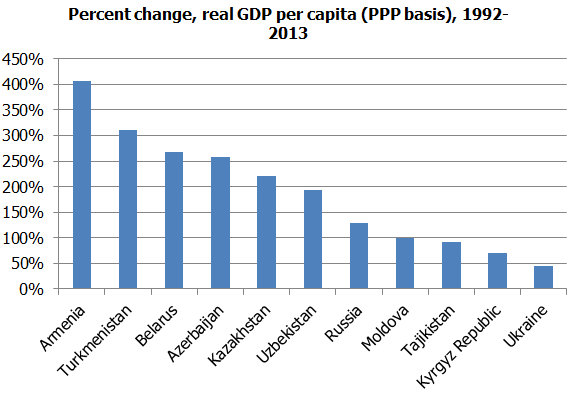
From C.W. at Free Exchange, there is more here.
Robert Ashley has passed away at age 83
The great Robert Ashley, one of the musical geniuses of the last forty years, has passed away. He is one of the few who did something truly new in music. Here is NPR on Ashley. Here is the opera Perfect Lives, perhaps his greatest contribution. Here are parts of that opera on YouTube. Here is Ashley on Wikipedia.
Sadly, Sherwin Nuland has passed away too. His How We Die: Reflections of Life’s Final Chapter is one of my favorite books, recommended to all.
Should we extend EITC to childless workers?
Jason Furmans says yes, here is one bit:
Looking back at the history of poverty and the tax code in the last several decades reveals some important lessons for expanding opportunity and combating poverty going forward, including the value of having a pro-work, pro-family tax code. The most important new prospect in this area is expanding such an approach for households without children, a proposal that President Obama included in his 2015 budget, and an idea that is also being advanced across the political spectrum, from Senator Marco Rubio to Bush Administration economist Glenn Hubbard to Isabel Sawhill at the Brookings Institution.
It becomes more analytical after that. Here are some further basic facts about EITC extension. Here is a 2009 study (pdf).
Recommended reading
Anatol Lieven, Ukraine and Russia: A Fraternal Rivalry. And here is a short essay of his on Ukraine today.
Orlando Figes, A Crimean War.
Vassily Aksyonov, The Island of Crimea, discussed here: “Written in 1979, Vassily Aksyonov’s “The Island of Crimea” imagines an alternative history (abetted by alternative geography—the Crimea is a peninsula) wherein the Russian civil war ends with the tsarist forces able to hold onto this southern scrap of the old empire. “