Category: Data Source
Building networks: Investigating the quid pro quo between local politicians & developers
My latest paper, Building Networks, is with Vaidehi Tandel and Sahil Gandhi in the Journal of Development Economics. We look at the connection between politics and land markets in Mumbai, India. The subject is inherently difficult to analyze because most such connections are illicit and under the table. What we find, however, is that when the local politician loses power development projects slow down which suggests that it takes time to build the connections that are necessary to speed approval through the bureaucratic process. Much more in the paper.
Abstract: Mutually beneficial arrangements between politicians and real estate developers are common in many developing countries. We document what happens when the politician-developer nexus is disrupted by an election. We construct a novel dataset of real estate projects and electoral constituencies in Mumbai’s municipal government. We find that an incumbent party losing the election increases real estate project completion times by 5%. We find no effect of quasi-random redistricting or changes in voter preferences on project delays. We investigate two mechanisms for the slowdown associated with party turnover — delays in construction approvals around the time of the election and increase in litigation against projects after the election. While we see no rise in litigation, we find that delayed approvals near an election explain 23% of the increased total delays due to party change.
The “Deaths of Despair” narrative is somewhat wrong
Matt Yglesias does an excellent job laying out the case against the “deaths of despair” narrative and putting it bluntly.
Over the past few years, Anne Case and Angus Deaton have unleashed upon the world a powerful meme that seems to link together America’s troublingly bad life expectancy outcomes with a number of salient social and political trends like the unexpected rise of Donald Trump.
Their “deaths of despair” narrative linking declining life expectancy to populist-right politics and to profound social and economic decay has proven to be extremely powerful. But their analysis suffers from fundamental statistical flaws that critics have been pointing out for years and that Case and Deaton just keep blustering through as if the objections don’t matter. Beyond that, they are operating within the confines of a construct — “despair” — that has little evidentiary basis.
…Novosad, Rafkin, and Asher have provided a compelling analysis of a very concentrated problem of worsening health outcomes for the worst-off Americans. Case and Deaton, by contrast, have delivered a very misleading portrait of worsening health outcomes for the majority of Americans that (because they mistakenly think it’s a majority) they attribute to broad economic forces that exist internationally but which for some reason only cause “despair” in the United States.
…The point is that we face a set of discrete public health challenges that we need to think about both as policy matters and in terms of politics and public opinion. But there is no “despair” construct driving any of this, and the linkage to big picture political trends is simply that Republicans are more hostile to regulation. Case and Deaton, meanwhile, have sent us on the equivalent of a years-long wild goose chase away from well-known ideas like “smoking is unhealthy” or “it would be good to find a way to get fewer people to use heroin.”
I tend to agree with Matt but I would offer a few cautions. Case and Deaton have been too broad in identifying the at-risk population. Identifying more carefully the at-risk group(s) is important so that we can target different problems with different solutions. Indeed, part of what makes the very important opioid crisis so bedeviling is precisely that it is not limited to “despairing” populations but cuts across many groups.
I wouldn’t, however, throw out despair as an organizing principle. The evidence on “despair” goes beyond death to include a host of co-morbidities such as mental stress, marriage rates, labor force participation rates and other measures of well being. Regardless of the precise population to which these problems attach they are co-morbidities and I suspect not by accident. Education is a proxy for the underlying problem but likely not causal. Matt’s cheeky suggestion to promote ideas like “smoking is unhealthy” illustrates part of the issue. Education and information will not solve that problem. Smokers know that smoking is unhealthy but they do it anyway–perhaps because it’s one of the few easily available pleasures if you are unmarried, out of work and stressed.
Nevertheless, do read the whole thing.
Campus censorship and Israel-Palestine
On college campuses the norm is this:
At campuses that are very left leaning, students are way less likely to self censor on a bunch of issues.
As campuses become politically mixed, students clam up.
There was only one issue where this trend reversed –
Israel-Palestine. pic.twitter.com/JnJPFSaWiP— Ryan Burge 📊 (@ryanburge) October 8, 2023
Do looks matter for an academic career in economics?
We show that physical appearance plays a role in the success of economics PhD graduates and investigate the underlying mechanisms driving this relationship. Leveraging a unique dataset of career and research productivity trajectories of PhD graduates from leading economics departments in the United States, we provide robust evidence that appearance is a predictive factor for both research productivity and job placement. Our analysis goes beyond establishing the association between attractiveness and success within the profession. By jointly examining appearance, job outcome, and research productivity, as well as the longitudinal development of the latter two over time, we show that the effect of appearance can be partially, but not fully, attributed to its role as a predictor of research productivity, with the remainder of the effect reflecting an intrinsic demand for attractiveness.
That is forthcoming in the Journal of Economic Behavior and Organization, by Galina Hale, Tali Regev, and Yona Rubinstein. Via Rolf Degen. And here is a recent piece on lookism and fund managers.
Where have all the young founders gone?
Only 1% of The #Forbes400 is under 40, the lowest percentage in at least two decades.
Link here, via Sean Patrick Hughes.
On U.S. life expectancy disparities
From the excellent Dylan Matthews:
Case and Deaton are highlighting a real problem, confirmed by other researchers: Americans with different levels of education die at different rates, and the least-educated Americans have seen their death rates surge in a way that more-educated Americans have not.
But the relevant divide does not seem to be between people who earned a bachelor’s degree — who remain a minority among American adults — and people who didn’t. Other research suggests that the problem is concentrated in specific areas of the US, and between the very least-educated Americans (particularly high school dropouts) and the rest of the country, rather than between college grads and non-grads.
Moreover, the cause of the divergence between high school dropouts and the rest of the country does not seem to be caused by “deaths of despair.” There is no doubt that the opioid epidemic in particular has wrought spectacular damage in the US. But some researchers are finding that stagnating progress against cardiovascular disease is an even bigger contributor to US life expectancy stalling out, and to mortality divides between the most- and least-educated Americans.
A lot of what you read about “deaths of despair” is in fact wrong or misguided.
The Labor Market Returns of Being An Artist
The labor market penalty to choosing the arts seems to be rising:
Using individual-level data from the Census Bureau’s American Community Survey (ACS) between 2006 and 2021, I study the labor market experiences of artists. First, I find a decline in the relative earnings of artists to non-artists from zero to a 15% disadvantage. After controlling for demographic differences, the decline is sharper, declining from a 15% earnings disadvantage to 30%. That the inclusion of demographic controls raises the earnings gap suggests there is positive selection into the arts. Second, these differences decline in magnitude to 4.4%, but remain statistically significant, after exploiting variation among artists and non-artists in the same industry-year and major occupation. Third, when restricting the set of individuals to those with at least a college degree, those with a fine arts degree also incur an earnings and employment penalty even if they work in the arts. These results highlight the increasing financial precariousness of artists over the past decade.
That is a new paper by Christos Makridis, via the excellent Kevin Lewis. Overall this result makes sense to me. Success in the arts requires extreme talent of some kind in most (not all) cases. Those individuals can earn increasingly more in other endeavors. But if the arts are trapped in a “Malthusian equilibrium,” with intense entry competing down returns because it is fun, artistic earnings may not keep pace.
Work From Home Works
It took firms decades to adjust to electricity by redesigning factories, products, and workflows to take full advantage of the new possibilities. Similarly, the benefits of work from home start to come most profoundly when expensive offices can be shrunk, employers can draw from a much larger pool of workers and workers can adjust when and where they work, including the location of their homes. It’s not surprising, therefore, that with little time for either the workers or the firms to adjust and with few options to choose how much to work from home, productivity fell when COVID sent workers home. But, with more time to plan and more options for hybrid but extensive work from home (e.g. work from home Mondays and Fridays), work from home has large benefits. We are also seeing management redesign to take advantage of work from home in the same way we saw factory redesign to take advantage of electricity. Management, for example, is shifting from input metrics–do you show up?–to output metrics–did the work get done? Designing and validating new metrics takes time, but these changes are helping to increase the benefits of work from home.
Nick Bloom reviews the evidence (slides here).
Looking at micro economic studies on working from home productivity, the classic is “The Stanford Study” I helped oversee in 2010-2012. We randomized 250 employees in a large multinational firm into those who would work from home and those who would report to the office. The expectation, of course, was that home-based employees would goof-off, sleeping or watching TV rather than working.
So, we were shocked to find a massive 13 percent increase in productivity.
The productivity boost came from two sources. First, remote employees worked 9 percent more in minutes per day. They were rarely late to work, spent less time gossiping and chatting with colleagues, and took shorter lunch breaks and fewer sick days. Remote employees also had 4 percent more output per minute. They told us it’s quieter at home. The office was so noisy many of them struggled to concentrate.
The macro evidence also suggests or at least is consistent with work from home working:
In the five years before the pandemic, U.S. labor productivity growth was 1.2 percent; since 2020, this picked up to 1.5 percent. Given the state of the world, that acceleration was miraculous.
What could have caused this? Perhaps rising government expenditure and easy monetary policy? Possibly, but greater government activity traditionally is associated with lower, not higher, productivity growth. Perhaps an acceleration in technology and computerization? Possibly, but the pandemic did not witness any pickup in technological progress. Perhaps the five-fold surge in working from home post-pandemic. Maybe cutting billions of commuting hours, replacing millions of business trips with Zoom meetings, increasing the labor supply of Americans with disabilities or child-care commitments, and saving millions of square feet of office space increased productivity? It is honestly hard to say.
Revealed preference is the most telling piece of evidence. Workers value the option to work from home and many firms now advertise the options for hybrid work as a benefit:
…millions of firms around the world are adopting hybrid and remote work, there has to be something there. I have spoken to many hundreds of managers and firms over the last three years and I repeatedly hear they use home working as a key part of their recruitment and retention strategy. Indeed, another recent experiment on 1600 employees found hybrid reduced employee quit rates by 35 percent. \
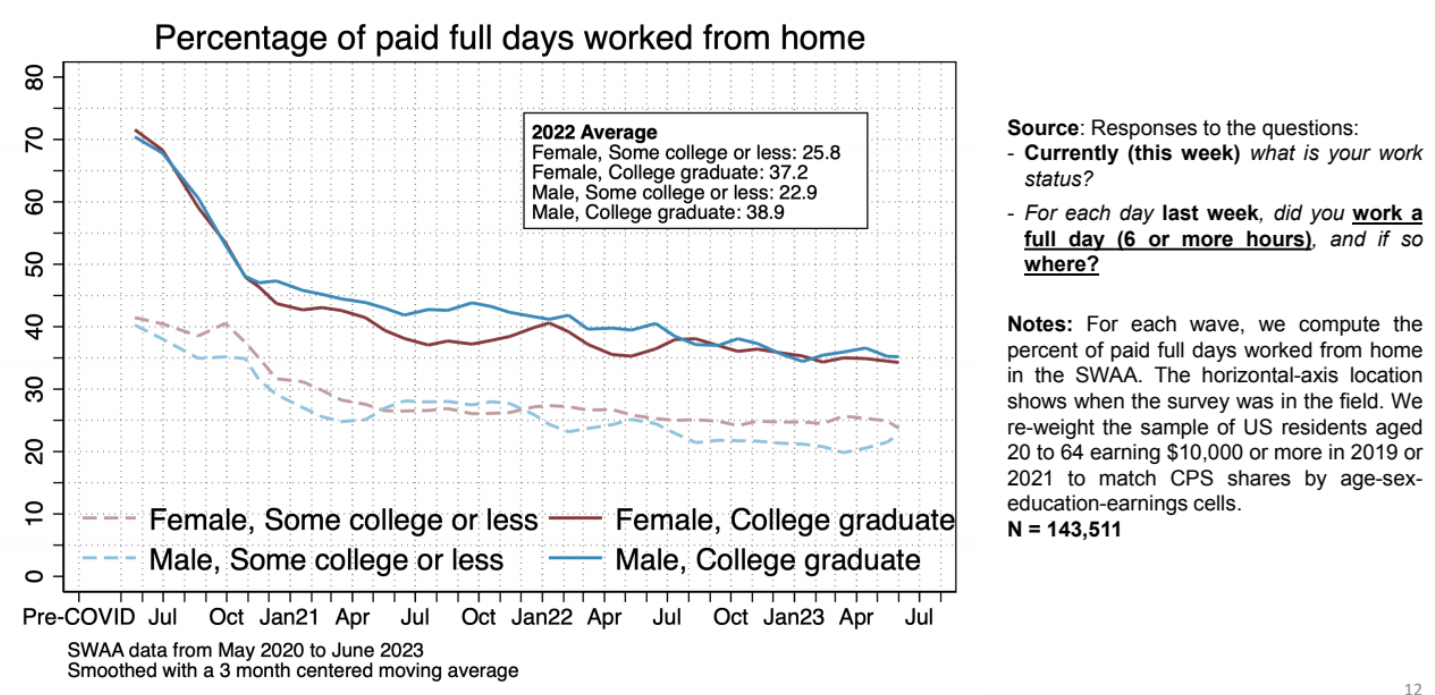
Despite a rocky start, work from home appears to have stabilized at around 25% of work days overall and stunningly, nearly 40% of work days for college educated workers! Work from home thus appears to be a permanent and beneficial change in how work is structured.
Texas fact of the day, educational polarization issue
This is absolutely insane. TAMU was probably one of the most conservative flagship state universities in the nation https://t.co/z3yVLvoe7I
— constans (@constans) September 25, 2023
It is the poor who are lonely (on average)
Lower-income people are more lonely
Jiska Cohen-Mansfield did a literature review with Haim Hazan, Yaffa Lerman, and Vera Shalom of the statistical correlates of loneliness in older adults and found that being low-income is a strong correlate of loneliness. You see the same thing in surveys of middle-aged and elderly Portuguese people, in the Nova Scotia Quality of Life Survey, and in Eastern Europe.
Michelle Lim, Robert Eres, Shradha Vasan have the interesting finding that low income predicts loneliness not only on the individual level but also that “living in poorer neighborhoods” is associated with loneliness.
Sometimes scholarly literatures feature big disputes, or at least nuanced disputes, but in this case there seems to be no dispute at all: loneliness is associated with lower income and thus probably not caused by big houses or lack of huts. I also think it’s notable that at least among rich countries, loneliness seems higher in the poorer (or perhaps “less rich”) ones like Greece and Italy than in the United States and Switzerland.
The low rates of loneliness in egalitarian Sweden and Denmark, in particular, suggest that having more money pretty literally leads to less loneliness. Note as well that while the United States has a somewhat threadbare welfare state, this is data for senior citizens who do enjoy universal health care in the United States and a basic income via Social Security.
It may be, in other words, that being able to afford to do more leisure activities is a significant protector against loneliness. You go do more stuff and you make more friends. Or you have more opportunity to maintain your relationship with friends because you can afford to hang out and do stuff. I don’t think the exact nature of the causal relationship is clear from the studies that I’ve seen, but it bears more examination, especially because a lot of people seem to intuitively spin out to “paradoxical” accounts of loneliness that don’t seem well-supported.
That is from Matt Yglesias ($).
Trends for 12th graders
Percentage of 12th graders who have a driver’s license, who’ve ever tried alcohol, who ever go on dates, and who worked for pay at any point during the last school year. https://t.co/wBtK4YTIkX pic.twitter.com/LeGIA7wWMB
— Steve Stewart-Williams (@SteveStuWill) September 23, 2023
Does GPT represent a triumph of WEIRD values?
Yes, in short:
Is GPT psychologically WEIRD? Using the World Values Survey and other psych measures, we seat GPT within a global perspective. The culturally more distant a place is from the US, the lower the correlation with GPT @MohammadAtari90 @blasi_lang @DorsaAmir pic.twitter.com/6sOZ8s6CiX
— Joe Henrich (@JoHenrich) September 23, 2023
States with high (low) rates of reported mental illness
For youth below the age of eighteen:
High:
District of Columbia
Alaska
Arkansas
Idaho
Maine
Montana
New Hampshire (the highest)
Low:
Florida (least)
Alabama
Mississippi
South Carolina
New Jersey
That is from Liu, Zhou, Cheng, and Vengeepuram, discussed earlier here. Extra hat tip goes to Sean Geraghty.
Patience and educational achievement
That is the topic of my latest Bloomberg column, here is one excerpt:
Economists have once again entered the fray, this time with a study that tries to determine how patience is correlated with better educational outcomes. The results are impressive, albeit unsettling. In Italy, differing degrees of patience account for two-thirds of the achievement variation across the country’s regions. In the US, differing degrees of patience account for one-third of the variation in educational outcomes across states, a smaller amount but still notable.
Before I go any further, you might be wondering which are the most patient states. They are (in alphabetical order) Maine, Montana, Vermont and Wyoming. The least patient state? California. In Italy, patience is highest in the northern region bordering Austria, which has a relatively Germanic culture and history. Patience is the lowest by far in Sicily. In both Italy and the US, patience is generally greater in the North than in the South.
These results do not necessarily mean that lower patience results in lower grades. It could be that doing well in school makes you more patient, because you learn that working hard has its own rewards, and that may lengthen your time horizon. Or there may be some underlying factor, say conscientiousness, that is key to both patience and academic achievement.
Still, it is hard to avoid the overall impression that there is a tight connection between certain “bourgeois virtues” and academic achievement. If you are a parent, you might want to be rooting for your child to be more patient rather than less, no matter how complex all the interrelationships among the various personal and cultural attributes may turn out to be.
The researchers estimated patience by an ingenious method. There is already a widely accepted global preference survey that measures patience across nations. They then used Facebook data on interests, clicks and likes to see which interests were most popular in the more patient nations. Then they examined that data to see how popular those interests were in the various regions of those countries.
Here is the underyling research by Eric A. Hanushek, Lavinia Kinne, Pietro Sancassani, and Ludger Woessmann. I do consider whether “patience” is exactly the right word for what is going on here. Hat tip also to The Wisdom of Garett Jones.
The Rise of and Demand for Identity-Oriented Media Coverage
While some assert that social identities have become more salient in American media coverage, existing evidence is largely anecdotal. An increased emphasis on social identities has important political implications, including for polarization and representation. We first document the rising salience of different social identities using NLP tools to analyze all tweets from 19 media outlets (2008-2021) alongside 553,078 URLs shared on Facebook. We then examine one potential mechanism: outlets may highlight meaningful social identities–race/ethnicity, gender, religion, or partisanship–to attract readers through various social and psychological pathways. We find that identity cues are associated with increases in some forms of engagement on social media. To probe causality, we analyze 3,828 randomized headline experiments conducted via Upworthy. Headlines mentioning racial/ethnic identities generated more engagement than headlines that did not, with suggestive evidence for other identities. Identity-oriented media coverage is growing and rooted partly in audience demand.
That is from a new and important paper by Daniel J. Hopkins, Yphtach Lelkes, and Samuel Wolken.