Category: Economics
A conversation with Angus Deaton about RCTs
The interrogator is Timothy N. Ogden, here is one bit from Deaton:
Something I read the other day that I didn’t know, David Greenberg and Mark Shroder, who have a book, The Digest of Social Experiments, claim that 75 percent of the experiments they looked at in 1999, of which there were hundreds, is an experiment done by rich people on poor people. Since then, there have been many more experiments, relatively, launched in the developing world, so that percentage can only have gotten worse. I find that very troubling.
If the implicit theory of policy change underlying RCTs is paternalism, which is what I fear, I’m very much against it.
The conversation is interesting throughout. Tim indicates:
This is a chapter from the forthcoming book Experimental Conversations, to be published by MIT Press in 2016. The book collects interviews with academic and policy leaders on the use of randomized evaluations and field experiments in development economics. To be notified when the book is released, please sign up here.
The book will contain an interview with me as well.
Economics and the Modern Economic Historian
That is a new NBER paper by Ran Abramitzky, the abstract is here:
I reflect on the role of modern economic history in economics. I document a substantial increase in the percentage of papers devoted to economic history in the top-5 economic journals over the last few decades. I discuss how the study of the past has contributed to economics by providing ground to test economic theory, improve economic policy, understand economic mechanisms, and answer big economic questions. Recent graduates in economic history appear to have roughly similar prospects to those of other economists in the economics job market. I speculate how the increase in availability of high quality micro level historical data, the decline in costs of digitizing data, and the use of computationally intensive methods to convert large-scale qualitative information into quantitative data might transform economic history in the future.
I have for a while been pleased that GMU has one of the largest collections of economic historians (I would say four,) of any department around, UC Davis being another major presence in that area.
Deaton on Deaton
It was during my time at Bristol that John Muellbauer and I worked together on our book. The computer facilities at Bristol were terrible — the computer was a mile away, on top of a hill, so that boxes of punched cards had to be lugged up and down. I was told to get a research assistant, which was sensible advice, but I have never really figured out how to use research assistance: for me, the process of data gathering — at first with paper and pencil from books and abstracts — programming, and calculation has always been part of the creative process, and without doing it all, I am unlikely to have the flash of insight that tells me that something doesn’t fit, that not only this model doesn’t work, but that all such models cannot work. Of course, this process has become much easier over time. Not only are data and computing power constantly and easily at one’s fingertips, but it is easy to explore data graphically. The delights and possibilities can only be fully appreciated by someone who spent his or her youth with graph paper, pencils, and erasers.
Given how far it was up the computer hill, I substituted theory for data for a while, and wrote papers on optimal taxation, the structure of preferences, and on quantity and price index numbers, but I never entirely gave up on applied work.
The entire biographical essay is of interest (pdf).
The Case for Getting Rid of Borders—Completely
In The Atlantic I present the case for open borders. Here is one bit:
No standard moral framework, be it utilitarian, libertarian, egalitarian, Rawlsian, Christian, or any other well-developed perspective, regards people from foreign lands as less entitled to exercise their rights—or as inherently possessing less moral worth—than people lucky to have been born in the right place at the right time. Nationalism, of course, discounts the rights, interests, and moral value of “the Other,” but this disposition is inconsistent with our fundamental moral teachings and beliefs.
Freedom of movement is a basic human right. Thus the Universal Declaration of Human Rights belies its name when it proclaims this right only “within the borders of each state.” Human rights do not stop at the border.Today, we treat as pariahs those governments that refuse to let their people exit. I look forward to the day when we treat as pariahs those governments that refuse to let people enter.
Read the whole thing.
Addenda: I was asked to write this piece for a forthcoming volume called How to Save Humanity that will feature essays by Steven Pinker, Martin Rees, Nick Bostom and others.
Open Borders seems to be having a moment. Time also featured a piece on migration by Bryan Caplan.
The comment section at The Atlantic reminded me of how good the comment section at MR can be. Amusingly, I was called both a zionist Jew and an anti-semite out to destroy Israel. On the other hand, my article has 31,000 likes and counting so I can’t complain.
Is it getting harder to move beyond minimum wage jobs?
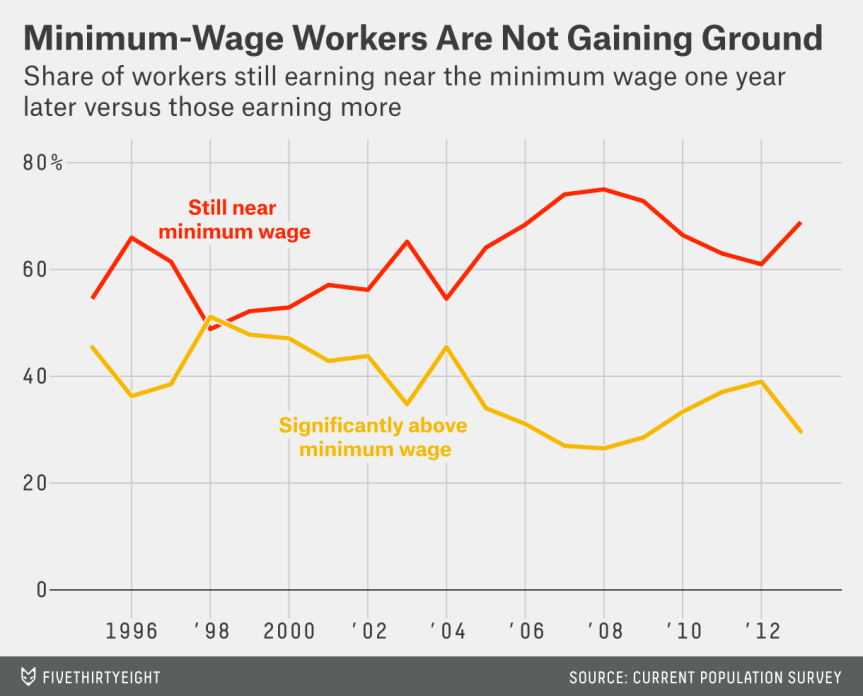
Ben Casselman has a good piece on this question, here is one excerpt:
During the strong labor market of the mid-1990s, only 1 in 5 minimum-wage workers was still earning minimum wage a year later. Today, that number is nearly 1 in 3, according to my analysis of government survey data. There has been a similar rise in the number of people staying in minimum-wage jobs for three years or longer…
Even those who do get a raise often don’t get much of one: Two-thirds of minimum-wage workers in 2013 were still earning within 10 percent of the minimum wage a year later, up from about half in the 1990s. And two-fifths of Americans earning the minimum wage in 2008 were still in near-minimum-wage jobs five years later, despite the economy steadily improving during much of that time.
The piece is of interest throughout.
Angus Deaton update
The Economics Nobel Prize winner is Angus Deaton
A brilliant selection. Deaton works closely with numbers, and his preferred topics are consumption, poverty, and welfare. “Understanding what economic progress really means” I would describe as his core contribution, and analyzing development from the starting point of consumption rather than income is part of his vision. That includes looking at calories, life expectancy, health, and education as part of living standards in a fundamental way. I think of this as a prize about empirics, the importance of economic development, and indirectly a prize about economic history.
Think of Deaton as an economist who looks more closely at what poor households consume to get a better sense of their living standards and possible paths for economic development. He truly, deeply understands the implications of economic growth, the benefits of modernity, and political economy. Here is a very good non-technical account of his work on measuring poverty (pdf), one of the best introductions to his thought.
He brought a good deal of methodological individualism to the field of consumption studies, most of all by using household surveys more than macroeconomic data.
I think of this as a prize for “a whole body of work” rather than for one or two key papers. David Leonhardt has a good NYT summary of some his work and its deep underlying optimism about the situation of the poor in the global economy.
Here is the popular version of the Committee statement, here is the more detailed version (pdf), an excellent overview.
Deaton was born in Scotland but has taught at Princeton for some time. Here is Deaton on Wikipedia. Here is Deaton’s home page. Here are some recent working papers, he even has published in Review of Austrian Economics, an interesting review of Bill Easterly on experts. Here are previous MR mentions of Deaton, there are many of them. Here is Deaton on Google Scholar. Here is a Russ Roberts EconTalk with Angus Deaton. I think of Deaton as someone who is relatively willing to share himself with the world, let’s hope the Prize doesn’t ruin that openness. Here is 21 minutes of Angus on YouTube, on his core ideas.
He is married to Princeton economist Anne Case, a notable scholar in her own right and sometimes a co-author with Deaton. Here are their co-authored papers, many dealing with South Africa.
Deaton has long had a special working relationship with India and South Africa. Here are his key pieces on measuring poverty and poverty reduction in India. Here is his work on the Indian health survey. Here is his 2010 AER piece on how to measure poverty globally in a consistent manner, by the way he suggests that asking people should be part of the answer.
He also has written on gender discrimination within the family in developing nations. Some of his work has helped direct our attention to the viability of cash transfers as a way of fighting poverty.
At first, say circa 1980, he was known for his work in developing Almost Ideal Demand Systems for analyzing consumer expenditures; much of this early work was with Muellbauer. That made a big splash, but it was more of a theoretical and technical advance than what was to follow. One message was that studies based on the idea of a “representative consumer” were likely to prove misleading.
It is interesting to note the trajectory of his career, as Alex noted on Twitter. He first did theory, then filled in the numbers and did empirics, applying the theory. Eventually he took theory + empirics and used it to tackle some of the big issues of poverty and development.
Here is his long survey piece on foreign aid and growth. He favors the move away from project evaluation, is skeptical of instrumental variable methods, and believes that RCTs need to be supplemented with a better theoretical understanding of mechanisms. He knows a lot about many, many topics.
I do not know him, but he is described by many as a colorful character. Dani Rodrik has strong praise for Deaton as a teacher.
Here are short, popular essays by Angus Deaton; you can call that the “what he really thinks page.” He is critical of the Republican war against ACA and connects that topic to Downton Abbey. He argues for regional price indices for the United States. He discusses American inequality and why it is often ignored as an issue. He warns against the creeping regulation of science. And he considers why the Stern report had a greater impact in the UK than in America.
I very much liked Deaton’s recent book The Great Escape, which focuses on how modernity revolutionized standards for consumption.
This award is no surprise at all and he has been on the short list for a while. Is it a slight surprise that Deaton won this prize on his own? Many thought he would be paired with Anthony Atkinson, but I see Deaton as worthy of a stand-alone prize and Atkinson’s chance has not passed him by. In any case, Tirole was a stand-alone prize too, so maybe in that regard there has been a shift in the Swedish regime.
Last but not least here is Alex’s post on Deaton.
Olivier Blanchard on the European economies
His very good point does not receive enough attention:
“I thought that the zero interest rate, the decrease in the price of oil, the depreciation of the euro, the pause in fiscal consolidation, would help more than they have”, he said.
Perhaps we should consider the possibility that many of the European economies are at margins where “one offs” just don’t help very much. That is perhaps easiest to rationalize in a multiple equilibria model where investors are waiting for signs that the European economies are truly committed to growth, but not finding so many such signs. And this:
But Mr Blanchard, who departed the IMF two weeks ago, said radical visions for a full-blown “fiscal union” would not solve fundamental tensions at the heart of the euro.
“[Fiscal union] is not a panacea”, Mr Blanchard told The Telegraph. “It should be done, but we should not think once it is done, the euro will work perfectly, and things will be forever fine.”
The article is here. Today is Nobel day! (later)
Why has productivity dispersion across firms gone up?
Yesterday Alex outlined the facts, which I take to be not in dispute. Firms at the frontier have seen significant productivity gains, the others not so much. Alex calls this a “lack of innovation diffusion” and considers whether IP law might be one cause.
My framing is somewhat different. The result reminds me of the international trade literature on why so few firms export. The notions of increasing returns to scale, and fixed costs to trade abroad, provide the beginnings of an answer. In such a setting, let’s say the world has become more globalized, more IRS, and more based on learning curves, much of those trends being attributable to information technology. In that case we would expect a growing bifurcation of firm productivity outcomes, just as we find a strong bifurcation of export outcomes, with a relatively small percentage of firms doing most of the international trade, or innovating, as the case may be. The “only a small percentage of firms export” and the “only a small percentage of firms are on the productivity frontier” may sometimes even be the same way of describing the same basic fact.
The on the ground reality I observe is that the large, famous, exporting firms put together fantastic O-Ring teams of talent in a way the smaller, medium-size enterprises do not. That is the relevant diffusion barrier, but of course there may be limits on that diffusion as well. Eliminating barriers across firms is a good idea but not enough either.
And does the presence of relatively strict IP law subsidize such O-Ring teams, or limit their diffusion? You can argue it either way.
Lawrence Dennis on what is wrong with economics
The trouble with most of our social thinking is that, being done in terms of eighteenth century rationalism, it takes dynamism for granted and assumes that the chief social problems are those of knowing what you want and how to get it. The chief social problem is that of generating and unifying the social will that creates activity, change and what we have been wont to call progress.
That is from his 1940 book The Dynamics of War and Revolution, p.53. It’s an ever so slightly fascistic version of a common critique of neoclassical economics. Is it entirely wrong?
The future is here, just not evenly distributed
Chiara Criscuolo at HBR discusses a new research report from the productivity group at the OECD.
Our research shows that the slow productivity growth of the “average” firm masks the fact that a small cadre of firms are experiencing robust gains. OECD analysis shows that the productivity of the most productive firms – those on the “global productivity frontier” in economic terms—grew steadily at an average 3.5% per year in the manufacturing sector, or double the speed of the average manufacturing firm over the same period. This gap was even more extreme in services. Private, non-financial service sector firms on the productivity frontier saw productivity growth of 5%, eclipsing the 0.3% average growth rate. Perhaps more importantly, the gap between the globally most productive firms and the rest has been increasing over time, especially in the services sector. Some firms clearly “get it” and others don’t, and the divide between the two groups is growing over time.
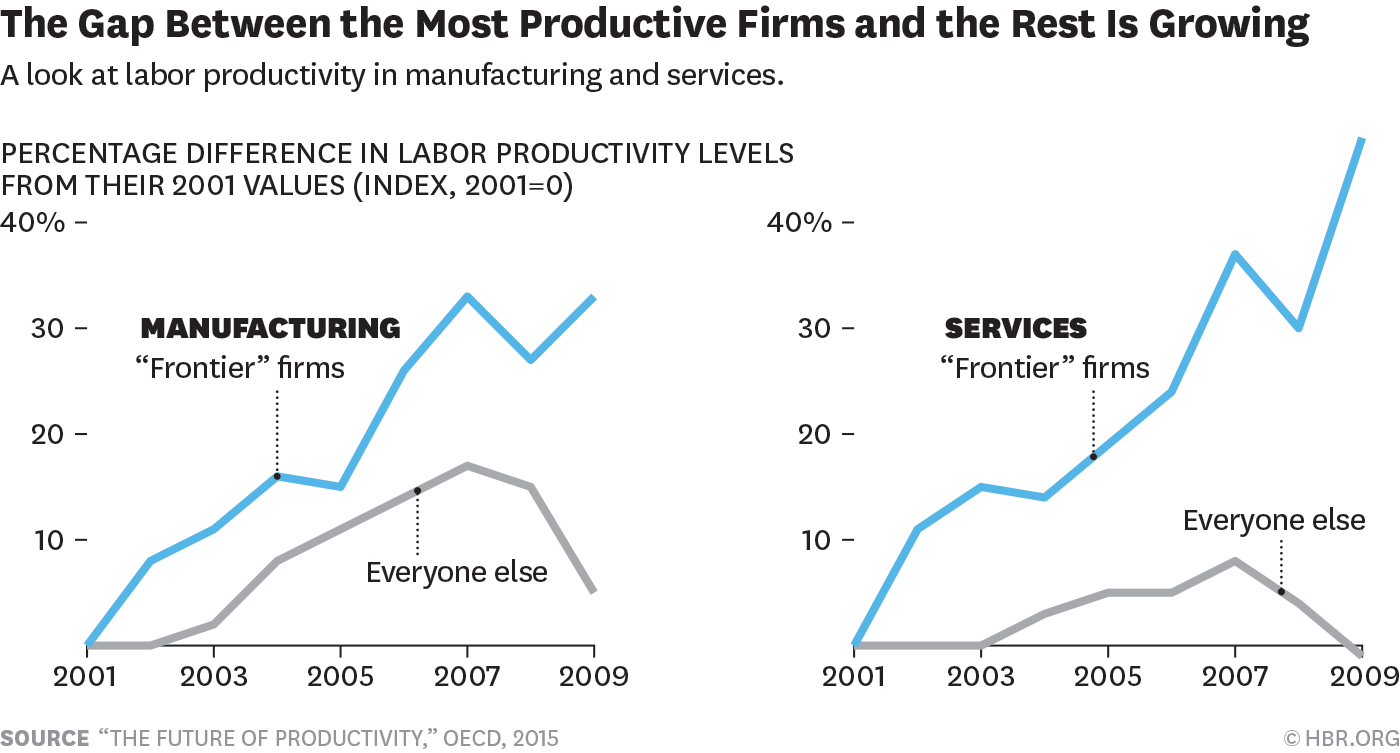
What this means is that the problem is not a lack of innovation it’s a lack of innovation diffusion. Note that a failure of innovation diffusion is also consistent with the argument that much of the rise in income inequality can be attributed to greater inequality among firms.
Why this is happening is unclear. Patents and other intellectual property being locked up in the frontier firms is one possible answer. Greater diffusion of ideas and people could thus increase innovation.Another possibility is that innovations are embedded in capital so you need new investment to diffuse innovation and business investment has been low for some time perhaps for “cyclical” reasons.
In one sense, these views provide some grounds for optimism. It’s easier to spread good ideas than to create good ideas. My Australia report discusses many levers we can pull to increase innovation diffusion.
If the future is here just not evenly distributed then increasing the speed of diffusion holds the promise of a highly productive catch-up period in which the average advances to the frontier.
Who will win the economics Nobel Prize this year?
Diane Coyle mentions some possible picks:
Environmental economics: Partha Dasgupta, William Nordhaus
Update: Twitter folks strongly recommend adding Martin Weitzman in this category.
Growth: Paul Romer, Robert Barro
Inequality: Anthony Atkinson, Angus Deaton
Innovation (and much else): Will Baumol (now 93!)
Econometrics: David Hendry
All good guesses. I’ll add Diamond and Dybvig for banking, and possibly an early grant to Banerjee, Duflo, and Kremer for development and RCTs. That would make economics look scientific, for a year at least. I expect Bernanke, Woodford, and Svensson to get a prize as well for monetary economics, although probably not right now. It is too close to Bernanke’s memoir and Svensson’s tenure at the Swedish central bank.
Here is a WSJ list. What do you think? Since I’ve never once been right about a particular year, trying to pick someone would only curse them. The award will come this Monday of course.
*Chicagonomics: The Evolution of Chicago Free Market Economics*
That is the new book from Lanny Ebenstein, I found it well-written and useful. You can read about Henry Simons, the Cowles Commission, Hayek, Jacob Marschak, of course Milton Friedman, and much mmore. Friedman, by the way, originally had intended to become an actuary.
Here is Friedman on Hayek from an Ebenstein interview from 1995:
Q: How would you describe Hayek personally?
A: In terms of his personal characteristics, Hayek was a very complicated personality. He was by no means a simple person. He was very outgoing in one sense but at the same time very private. He did not like criticism, but he never showed that he didn’t like criticism. His attitude under criticism, as I found, was to say: “Well, that’s a very interesting thing. At the moment, I am busy, but I’ll write to you about it more later.” And then he never would!
Friedman is extremely frank about Hayek in this interview, and repeatedly mentions that he objected to how Hayek treated his first wife. I have never seen Friedman be so negative, or for that matter so emotionally involved, and when it comes to The Fatal Conceit he simply avers: “It’s not up to Hayek at his best.”
You can then turn to two pages of Paul Samuelson, in a letter to Ebenstein, criticizing Milton Friedman. Ebenstein, by the way, argues that Friedman is essentially a left-wing, utilitarian thinker.
Why is Daniel Hamermesh leaving campus at UT Austin?
Economics professor emeritus Daniel Hamermesh will withdraw from his position next fall, citing concerns with campus carry legislation.
The law will allow the concealed carry of guns in campus buildings beginning Aug. 1, 2016. Hamermesh said he is not comfortable with the risk of having a student shoot at him in class. He teaches a course with 475 students enrolled, according to a letter Hamermesh wrote Sunday to UT President Gregory Fenves…
Hamermesh, who said he is under contract to teach his course in fall 2016 and fall 2017, said he will complete the semester at UT and will teach at the University of Sydney next fall.
Hamermesh said he thinks the legislation will impact the University’s ability to draw new faculty and staff to work at UT.
There is more at the link, via Catherine Rampell.
The problems of Harvard economics?
Here is an article in The Crimson, with many interesting bits, including about Raj Chetty. In turns out space is also a problem, even back in the mid-1980s I thought Littauer was not impressive. It has not improved:
Economics faculty also say that the kind laboratory work common in modern economics—and exemplified by Chetty’s work on government policy—require physical space that is lacking in Littauer and scattered around campus.
“You need infrastructure to run the types of projects he is running,” Antràs said.
Bernheim said Stanford was working “on much closer collaboration and integration” between its economics research buildings to provide adequate space because of Chetty’s arrival and other new hires. He would not comment on the specifics of Chetty’s hiring package, including any lab space he may receive.
And of course, Littauer is old. It hasn’t undergone a major renovation in decades and lacks a functioning air conditioning system.
Whether there are plans to renovate Littauer is uncertain. FAS Dean Michael D. Smith would not comment on any plans to add space to the building, though he noted that conversations about department space across FAS are ongoing.
Even more, the Fine Arts Library, which moved temporarily to Littauer in 2007 during the renovation of the Fogg Museum, compounds the problem of tight space in the building.
University professor Jerry R. Green said the move “pained” him and that now many books used by the Economics department are housed in the Harvard Depository.
Here are the current Harvard faculty, all via Matthew Kahn. And here Matt comments. And Niall Ferguson is leaving Harvard for Hoover.