Category: History
*Unequal Gains*
That is the forthcoming book by Peter H. Lindert and Jeffrey G. Williamson, and the subtitle is American Growth and Inequality since 1700. The sections on recent America, while unobjectionable, are ordinary, but the early coverage of American history is very interesting indeed. Here is one excerpt:
Why the Old South reversal of fortune? A benign part of the story seems to have been that the colonial South was still a labor-scarce frontier region with high returns to coastal land producing export crops, like indigo, rice, and tobacco. Its decline after 1774 was echoed in two other frontier cases many decades later. One was the dramatic relative decline of the West South Central income per capita between 1840 and 1860 — from 60 percent of the U.S. average to just 9.5 percent above it…The other was the loss of the Pacific region’s gold-discovery-generated super-incomes after the 1850s and early 1860s (the Pacific states were 213.3 percent above the US average in 1860, and the mountain states were 30.5 percent above).
I hope to report on other interesting sections of the book soon; it is due out in April. Again, most business cycles in history have been real business cycles.
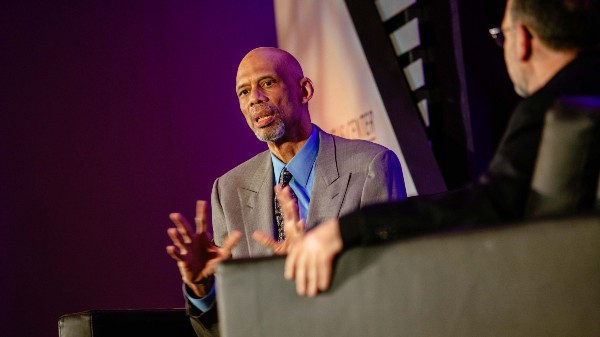
My conversation with Kareem Abdul-Jabbar
Here is the video, the podcast, and the transcript. Kareem really opened up. Here is the summary:
Kareem Abdul-Jabbar joins Tyler Cowen for a conversation on segregation, Islam, Harlem vs. LA, Earl Manigault, jazz, fighting Bruce Lee, Kareem’s conservatism, dancing with Thelonious Monk, and why no one today can shoot a skyhook.
Maybe you think of Kareem as a basketball player, but here is my introduction:
Kareem Abdul-Jabbar is one of America’s leading public intellectuals. I would describe him as an offshoot of the Harlem Renaissance, and what he and I share in common is a fascination with the character of Mycroft Holmes, the subject of Kareem’s latest book — and that of course, is Sherlock Holmes’s brother.
Here is Kareem:
I did know Amiri [Baraka]. I think the difference is I believe in what happened in Europe during what they call the Enlightenment. That needs to happen to black Americans, absolutely a type of enlightenment where they get a grasp of what is afflicting them and what the cures are.
I think that the American model is the best in the world but in order to get everybody involved in it we have to have it open to everyone. That hasn’t always been the case.
The most under-appreciated Miles Davis album?
For me [Kareem], the most under-appreciated one is Seven Steps to Heaven. And that shows, I think, Miles’ best group. There’s a big argument, what was Miles’ best group, the one that had Cannonball Adderley, Coltrane, Bill Evans, and Philly Joe Jones and Red Garland or Herbie Hancock, Ron Carter, Tony Williams, and Wayne Shorter?…number two is Porgy and Bess.
He cites Chester Himes as the underappreciated figure of the Harlem Renaissance. And Kareem thinks like an economist:
It [my instruction] was going well with Andrew Bynum, but Andrew finally got to sign his contract for $50 million, and then at that point Andrew thought that I didn’t know anything and that he didn’t have to listen to me, and we don’t know where Andrew is right now.
Read or hear also his very interesting remarks on Islam, and where its next Enlightenment is likely to come from, not to mention Kareem on the resource curse and of course his new book (and my Straussian read of it). And Kareem on his favorite movies, starting with The Maltese Falcon. Self-recommending!
The End of History in reverse
Every year since 2006 more democracies have experienced erosion in political rights and civil liberties than have registered gains, as we find in our annual Freedom in the World report. In all, 110 countries, more than half the world’s total, have suffered some loss in freedom during the past 10 years.
That is from Mark P. Lagon and Arch Puddington at the WSJ. I would like to see a good theory of how liberty, democracy, and liberalism — or however we wish to characterize that bundle — comove across the globe, in both positive and negative times.
Agriculture matters, the past matters
We match individual-level survey data with information on the historical lifeways of ancestors, focusing on Africa, where the transition away from such modes of production began only recently. Within enumeration areas and occupational groups, we find that individuals from ethnicities that derived a larger share of subsistence from agriculture in the pre-colonial era are today more educated and wealthy. A tentative exploration of channels suggests that differences in attitudes and beliefs as well as differential treatment by others, including less political power, may contribute to these divergent outcomes.
That is from a recent paper by Michalopoulos, Putterman, and Weil. Here are video and ungated versions.
My review of Robert Gordon’s *Rise and Fall of American Growth*
From Foreign Affairs. Here is my bottom line:
His latest entry into this debate [over stagnation], The Rise and Fall of American Growth, is likely to be the most interesting and important economics book of the year. It provides a splendid analytic take on the potency of past economic growth, which transformed the world from the end of the nineteenth century onward.
In a nutshell, Gordon is probably right about the past, but wrong about the future. My greatest reservation about the work is that Gordon thinks he can predict future rates of productivity growth with considerable accuracy:
…although Gordon focuses on the demographic challenges the United States faces, he never considers that today, thanks to greater political and economic freedom all over the world, more individual geniuses have the potential to contribute to global innovation than ever before.
…many past advances came as complete surprises. Although the advents of automobiles, spaceships, and robots were widely anticipated, few foretold the arrival of x-rays, radio, lasers, superconductors, nuclear energy, quantum mechanics, or transistors. No one knows what the transistor of the future will be, but we should be careful not to infer too much from our own limited imaginations.
And here is the “oops” aspect of the book:
What Gordon neglects to mention, however, is that he is also the author of a 2003 Brookings essay titled “Exploding Productivity Growth,” in which he optimistically predicted that productivity in the United States would grow by 2.2 to 2.8 percent for the next two decades, most likely averaging 2.5 percent a year; he even suggested that a three percent rate was possible.
…Gordon offers a brief history of the evolution of his views on productivity. Yet he does not mention the 2003 essay, nor does he explain why he has changed his mind so dramatically. He also fails to cite other proponents of the stagnation thesis, even though…their work predates his book.
Nonetheless this is a tract well worth reading. Again, here is my entire review.
A new issue of Econ Journal Watch
The link is here, the contents include:
A Unit Root in Postwar U.S. Real GDP Still Cannot Be Rejected, and Yes, It Matters: David Cushman examines whether shocks are transitory, permanent, or some of each.
The political ideology of Industrial Relations: Using three metrics, Mitchell Langbert shows the left orientation of the field.
Eli Heckscher’s Ideological Migration Toward Market Liberalism: Benny Carlson explores the intellectual evolution of a great Swedish economist.
Glimpses of Adam Smith: Excerpts from the biography by Ian Simpson Ross.
Symposium:
Classical Liberalism in Econ, by Country: Authors from around the world tell us about their country’s culture of political economy, in particular the vitality of liberalism in the original political sense, historically and currently, with special attention to professional economics as practiced in academia, think tanks, and intellectual networks.
New contributions:
Young Back Choi and Yong Yoon:
Liberalism in KoreaPavel Kuchař:
Liberalism in Mexican Economic Thought, Past and Present(All of the papers from this symposium, which has carried across multiple issues of EJW, are collected at this page.)
EJW Audio
*Illiberal Reformers*, on Progressives and eugenics
The subtitle of Thomas Leonard’s new and excellent book is the apt Race, Eugenics & American Economics in the Progressive Era.
I take it you all know by now this is quite an ugly story, namely that both early progressives and late 19th century American economists were often quite appalling racists and eugenicists, and that such racism was built into the professional structure of economics in a fairly fundamental way, including but not restricted to the American Economics Association.
Kevin Drum had an interesting point in response (and do read his full post, there is more to it than this quick excerpt):
Early 20th century progressives supported eugenics out of a belief that it would improve society. Contemporary liberals support abortion rights and right-to-die laws out of a belief in individual rights that flowered in the 60s.
Most of all Drum is saying that the earlier history is not very illustrative of anything for today.
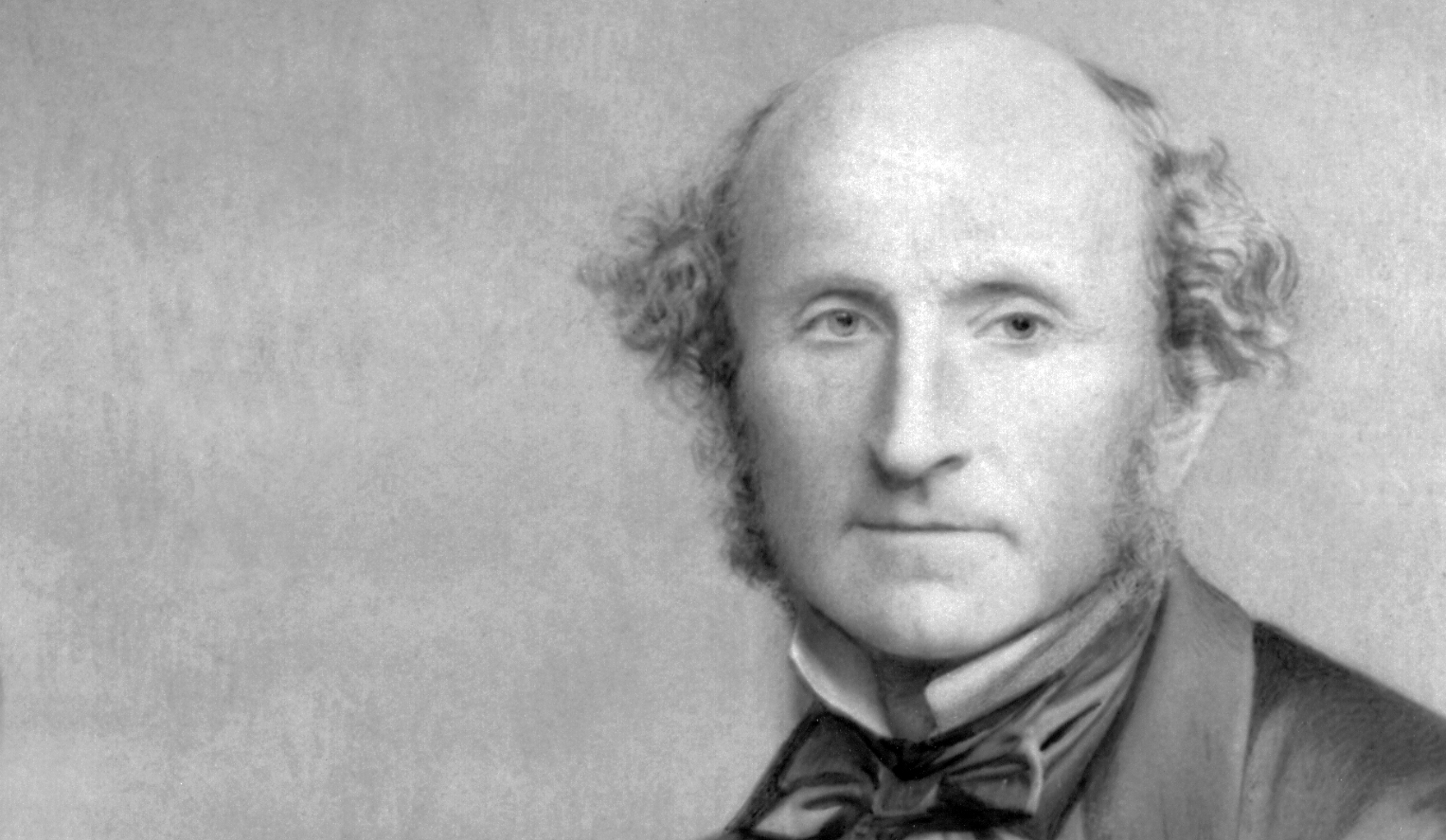
I view it this way. Go back to Millian liberalism of the mid-19th century. Had American or for that matter British Progressivism been infused with more of this philosophy, the eugenics debacle never would have happened. For instance if you look at the British Parliamentary debates of 1912 over the Mental Deficiency Bill, the anti-eugenics forces drew heavily upon Mill for their inspiration. This was standard stuff, but the Progressives of the time didn’t see much of a pro-liberty reason for being pushed into a Millian position, quite the contrary.
The claim is not that current Progressives are evil or racist, but rather they still don’t have nearly enough Mill in their thought, and not nearly enough emphasis on individual liberty. Their continuing choice of label seems to indicate they are not much bothered by that, or maybe not even fully aware of that. They probably admire Mill’s more practical reform progressivism quite strongly, or would if they gave it more thought, but they don’t seem to relate to the broader philosophy of individual liberty as it surfaced in the philosophy of Mill and others. That’s a big, big drawback and the longer history of Progressivism and eugenics is perhaps the simplest and most vivid way to illuminate the point. This is one reason why the commitment of the current Left to free speech just isn’t very strong.
I don’t mean to pick on Kevin, who is one of my favorite bloggers, but I disagree (and find indicative) another one of his claims, namely:
…eugenics died an unmourned death nearly a century ago.
To give one (not the only) example to the contrary, Swedish “progressive” sterilization persisted through the 1970s, as was true for Canada as well. Eugenicist views toward autistic people, among others, remain common across the political spectrum (no special brickbat for Progressives here, but they are guilty too), and with CRISPR a lot of eugenicist debates are already making a comeback.
Do we really want to identify with a general philosophy which embraced eugenics for so many decades, when so many pro-liberty and also social democratic thinkers were in opposition? I think Mill himself would say no.
Duke Summer Institute on the History of Economics
From my inbox, from Bruce Caldwell:
The Center for the History of Political Economy at Duke University will be hosting another Summer Institute on the History of Economics this summer, May 29-June 17. The three week program is sponsored by the National Endowment for the Humanities and is designed primarily for faculty members in economics, other social sciences, and the humanities, though three of the twenty-five slots are reserved for graduate students. Participants will be competitively selected and successful applicants will receive a $2700 stipend for attending, out of which they will pay for their own room and board. Our line-up of discussion leaders is quite impressive, and includes Maria Pia Paganelli, Nicholas Phillipson (author of Adam Smith: An Enlightened Life), Bart Wilson, Duncan Foley, Tim Leonard, Angus Burgin, Eddie Nik-Khah, and Steve Medema. The deadline for applying is March 1. A special bonus for those who attend: the History of Economics Society meetings will be held at Duke from June 17-20. Attendees who wish to do so can stay over for the HES meetings.
More information on the Summer Institute is available at our website,
http://hope.econ.duke.edu
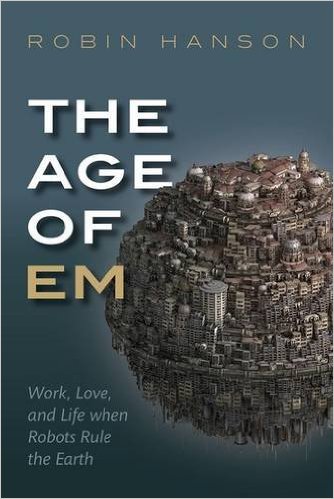
*The Age of Em*, by Robin Hanson
That is the title of the new and forthcoming Robin Hanson book, due out in May. I was asked to supply a blurb, and offered two possibilities. One was:
“Robin Hanson is one of our most original and important thinkers. This is his book.”
The ostensible premise of the book is that people have become computer uploads, and we have an entirely new society to think about: how it works, what problems it has, and how it evolves. One key point about this new world is individuals can be copied. But this is more than just a nerdy tech book, it is also:
- Straussian commentary on the world we actually live in. We are already something-or-other, uploaded into humans,and very often Robin is describing our world in cloaked fashion, albeit with some slight tweaks to parameters for the purpose of moral illumination.
- A reminder of how strange everything is, and how we use self-deception to come to terms with that strangeness. It’s a mock of all those who believe in individual free will.
- An attempt to construct a fully rational theology, proving by various deductions that God is not fully benevolent in the traditional sense.
- An extended essay on the impossibility of avoiding theology, given the imposition of competitive constraints on a world where production and copying are possible. And ultimately it is a theodicy, though it will not feel that way to Westerners, Jews, Christians, or Muslims. It hearkens back to medieval theology, Descartes, and the idea of living in God’s possibly terrifying simulation.
- A satire on the rest of social science, and how we try to explain and predict the future.
- A meta-level growth model in which energy alone matters and the “fixed factor” assumptions of other models are relativized. Copying is taken seriously, besides how special are you anyway? In the meantime, we learn just how much of the world we know depends upon the presence of various fixed factors. But surely that is temporary!
- A challenge to our notions of wherein the true value of a life resides.
I hope enough readers pick up on some of this. And yes, there is a chapter on sex, love, and affairs.
It is hard to excerpt from this book, but here is one short bit:
Compared with humans, ems fear much less the death of the particular copy that they now are. Ems instead fear “mind theft,” that is, the theft of a copy of their mental state. Such a theft is both a threat to the economic order, and a plausible route to personal destitution or torture. While a few ems offer themselves as open source and free to copy, most ems work hard to prevent mind theft. Most long-distance physical travel is “beam me up” electronic travel, but done carefully to prevent mind theft.
I am wildly enthusiastic about everything the Robin upload does, and some of his copies are better yet. Here is the book’s home page.
Addendum: Here is Robin Hanson’s response.
Conversation with Kareem tomorrow is relocated
Robert Parrish could not much push him away from his preferred spots on the floor, but due to snow we are altering the venue:
New venue:
Westin Arlington Gateway, F. Scott Fitzgerald Ballroom (2nd floor), 801 North Glebe Road Arlington, VA
Tuesday, January 26, 2016, 3:30 p.m. – 5:00 p.m.
At the event, you can participate in the conversation by tweeting your questions and comments using the hashtag #CowenKareem.
You can watch the event online at mercatus.org/live
A question about deep reading
Brad asks:
Prof. Cowen – I’m a longtime MR reader, but just came across an old post on your prolific reading. In the post, you mention:
“But it is not like the old days when I would set aside two months to work through The Inferno, Aeneid, and the like, with multiple secondary sources and multiple translations at hand. I no longer have the time or the mood, and I miss this.”
I am intrigued by this process of deep reading the canonical classics – have you detailed your method/routine for this anytime on MR?
Thanks!
Here is my preferred method:
1. Read a classic work straight through, noting key problems and ambiguities, but not letting them hold you back. Plow through as needed, and make finishing a priority.
1b. Mark up the book with bars and questions marks, but don’t bother writing out your still-crummy thoughts. That will slow you down.
2. After finishing the classic, read a good deal of the secondary literature, keeping in mind that you now are looking for answers to some particular questions. That will structure and improve your investigation. But do not read the secondary literature first. You won’t know what questions will be guiding you, plus it may spoil or bias your impressions of the classic, which is likely richer and deeper than the commentaries on it.
3. Go back and reread said classic, taking as much time as you may need. If you don’t finish this part of the program, at least you have read the book once and grappled with some of its problems, and taken in some of its commentators. If you can get through the reread, you’ll then have achieved something.
4. I am an advocate of the “close in time” reread, not the “several years later” reread. The several years later reread works best when it has been preceded by a close in time reread, otherwise you tend to forget lots, or never to have learned it to begin with, and the later reread may be more akin to starting a new book altogether.
5. If you want to find new things in books you already know and love, opt for new editions, new translations, and new typesettings where you will encounter it as a very different visual and conceptual field.
*Congress and the Shaping of the Middle East*
That is the new Kirk J. Beattie book, and I find it one of the very best studies on how Washington actually works; I am less interested in the determinants of Middle East policy per se. Here is one bit:
On the Senate side, I got the distinct impression that the constituents are not, in general, as important to senators as they are to House members. One gets the distinct impression that individuals with financial clout are far more likely to get senators’ attention than others. As one staffer put it, “If you’re talking to me, you’re talking about money. People are not coming to these issues for the first time. But for us, where our constituents are is very marginal.” That said, a small number of well-heeled individuals can get senators’ attention in many but certainly not all cases. The bias here runs distinctly in favor of putative supporters of Israel. While other religious or ethno-religious factors are in play, like the size and strength of a senator’s evangelical community, senators appear to be less concerned about these voices, unless of course the senator either shares or sees utility in that perspective. This parallels views held by House staffers, leaving one to think that evangelical senators’ commitment to Israel exceeds the level of pro-Israel concern by the evangelical masses.
Among other virtues, the book offers a new (to me) channel for how money might affect politics. Even if donors cannot “buy positions” from politicians, the need to stay competitive in a more or less zero-sum fundraising game means that Congressional staff do not have enough time to study or learn issues very well, and thus depend all the more on outside sources of information.
Definitely recommended, you can buy it here.
Bad press for Auschwitz price fixing
Now, the Israel Antitrust Authority has announced that nine tour operator executives have been arrested on suspicion of running a secret price-fixing ring that was aimed at artificially inflating the cost of trips to former Nazi death camps such as Auschwitz.
At least six tour operators are being investigated on suspicion of involvement in the alleged cartel. In some cases, the homes of company executives were searched and property confiscated. According to the publication Haaretz, one of those detained is also suspected of bribery.
…The Israeli government had given a number of tour operators the tenders for the business of flying high school students to Poland. In theory, these companies would be in competition: The schools were supposed to negotiate among the companies to find the best deal. The investigation found that in practice, however, the prices appeared to be fixed among the companies. Although the operators appeared to offer discounts to schools, investigators say, these discounts were secretly coordinated and there was no real competition.
That is from Adam Taylor, via Otis Reid.
The intellectual origins of Ted Cruz?
When Cruz was thirteen his father brought him to Rolland Storey, a kindly and charismatic septuagenarian who ran a conservative foundation aimed at teaching youth about economics and government. Storey educated his pupils about the brightest minds of free market economics: they pored over Friedrich Hayek and Milton Friedman, and marveled at Frederic Bastiat’s denunciations of socialism as legal plunder. A veteran of vaudeville, Storey liked to re-create constitutional conventions and assign students to play delegates in mock debates. Many of his students were gifted, but none could keep up with Cruz in terms of passion and inherent ability. Thrust into some of the momentous scenes from world history, the thirteen-year-old was perfectly at home.
That anecdote is from McKay Coppins, The Wilderness: Deep Inside the Republican Party’s Combative, Contentious, Chaotic Quest to Take Back the White House, a fun read with lots of background information I did not know.
I will never forget the time Gregory Rehmke took me to meet Rolland Storey in Houston. But that is a story for another place and time…
Are queens more warlike?
There is a reason chess evolved the way it did:
…we find that queenly reigns participated more in inter-state conflicts, without experiencing more internal conflict. Moreover, the tendency of queens to participate as conflict aggressors varied based on marital status.
Among married monarchs, queens were more likely to participate as attackers than kings. Among unmarried monarchs, queens were more likely to be attacked than kings. These results are consistent with an account in which queens relied on their spouses to manage state affairs, enabling them to pursue more aggressive war policies. Kings, on the other hand, were less inclined to utilize a similar division of labor.
This asymmetry in how queens relied on male spouses and kings relied on female spouses strengthened the relative capacity of queenly reigns, facilitating their greater participation in warfare.
As Chris Blattman tells us, that is from “A new paper, Queens, by Oeindrila Dube and S.P. Harish.”