Category: History
Has Africa always been the world’s poorest continent?
Jeff Sachs claims that Africa was always the poorest continent in the world, that many parts of Africa have never experienced economic growth, and that comparisons between African countries and Asian countries are highly misleading (see in this video for example).
Until recently it has been hard to establish basic stylized facts about African development because GDP data only goes back to 1960, but Ewout Frankema and Marlous van Waijenburg have been able to compile internationally comparable real wage estimates back to the 1880s (pdf). They follow Bob Allen’s influential methodology, constructing representative consumption bundles, and then seeing how many bundles an unskilled worker could obtain. The welfare ratios that result show that it simply makes no sense to talk about African economic performance in general in the colonial period.
There were at least two distinct economies in British colonial Africa, a comparatively high-wage, labor scarce, economy in West Africa, and a low-wage economy in East Africa. Real wages in many West African cities grew more or less continuously, from the 1880s until the 1930s, as these economies enjoyed a boom in commodity exports, and West African wages exceeded wages in many Asian cities through the colonial period. The story of poverty and stagnation in modern West Africa is not a story of permanent stagnation, but of growth collapses and growth reversals (especially in the 1970s and 1980s).
In contrast, real wages were extremely low in British East Africa. Many East African economies like Kenya never experienced rapid growth in the colonial period. It was the crisis of the 1970s that created the current view we have of all of sub-Saharan Africa as sharing a common set of problems. Modern Ghana, or the Gold Coast was roughly twice as rich as Kenya in the colonial period, but by the 1980s per capita GDP in the two countries was the same. Were the high real wages of the colonial period solely the rest of labor scarcity? (like the high wages recorded in medieval Europe after the Black Death) or did they represent a genuine moment of opportunity that could have led to sustained economic growth?
Consider this evidence in light of recent optimism about growth rates in Africa in the 2000s (see this MR post). Like the increase in real wages that occurred in the colonial period, recent growth has been driven by an export boom and rising commodity prices. These findings suggest that episodes of economic growth are less rare in African history than we might previously have supposed. Instead, perhaps the real difficulty lies in sustaining economic growth, and not in getting growth going for a few years.
*The Great Divide: Nature and Human Nature in the Old World and the New*
That is the new book by the very active and very smart Peter Watson, due out soon but I bought a copy in the UK.
Why has the New World been so different from the Old World? What a splendid seventeenth and eighteenth century question. Imagine Jared Diamond — and with comparable scope — yet with shamans, peyote, and El Niño playing a role in the argument. I recommend it to everyone who can keep in mind how speculative the argument will be.
If we had to sum up what has gone before and describe in a few words the main features shaping early life in the Old World, those words would be: the weakening monsoon, cereals (grain), domesticated mammals and pastoralism, the plough and the traction complex, riding, megaliths, milk, alcohol. One way to highlight the differences between the two worlds is to perform the same summing-up exercise for the Americas…For the New World the crucial and equivalent words would be: El Niño, volcanoes, earthquakes, maize (corn), the potato, hallucinogens, tobacco, chocolate, rubber, the jaguar, and the bison.
Unlike Diamond, this book assigns ideology a central role in the story. Europe and the Middle East generate the ideas of the shepherd, the New World the ideas of the shaman, some of which may have been picked up or carried from the Chukchi of Siberia. Perhaps my favorite point in the book is the observation that the Old World had a greater diversity of ideologies.
Watson touches on many Hansonian themes about the differences between gatherers and foragers. Here is a Guardian review. Here is an Independent review. Here is a Matthew Price review.
This is an easy book to criticize, see the reviews or for instance take this passage:
…artwork was not developed [in the early stages of the New World] because there was no need to establish either dedicated territories or tribal identities. And/or food was in such plentiful supply that they had no need to keep records that assisted their memory of animal habits.
One really does have to take this book as a scenario, not as science. It is nonetheless interesting if used with care.
Estonia fact of the day
There is no movie with the word “Estonia” in its title.
That is from Alexander Theroux’s new and interesting Estonia: A Ramble Through the Periphery. Here is from one Amazon review:
It is one of the most hateful books I’ve ever read. There is even an entire chapter called “Why I hate Estonia”, and almost every sentence starts with “I hate…” Here’s how that chapter starts: “I hate the pointless cold. I hated the fact that most people are sour but consider that normal. I hated the ungrammatical ‘5,2 litre’ alcohol content comma, when it should be a period ‘5.2’ liter!”
The author is badly uninformed about the region.
Most of the reviews are one star, but so far I am enjoying the book, and for that matter the reviews. I can’t vouch for all of the information. Here is another recent controversy about Estonia.
Why were we obsessed with flying cars?
David Graeber has a fascinating albeit uneven essay about our changing visions of the future, here is one excerpt:
Why, these analysts wonder, did both the United States and the Soviet Union become so obsessed with the idea of manned space travel? It was never an efficient way to engage in scientific research. And it encouraged unrealistic ideas of what the human future would be like.
Could the answer be that both the United States and the Soviet Union had been, in the century before, societies of pioneers, one expanding across the Western frontier, the other across Siberia? Didn’t they share a commitment to the myth of a limitless, expansive future, of human colonization of vast empty spaces, that helped convince the leaders of both superpowers they had entered into a “space age” in which they were battling over control of the future itself? All sorts of myths were at play here, no doubt, but that proves nothing about the feasibility of the project.
And this bit:
The growth of administrative work [in universities] has directly resulted from introducing corporate management techniques. Invariably, these are justified as ways of increasing efficiency and introducing competition at every level. What they end up meaning in practice is that everyone winds up spending most of their time trying to sell things: grant proposals; book proposals; assessments of students’ jobs and grant applications; assessments of our colleagues; prospectuses for new interdisciplinary majors; institutes; conference workshops; universities themselves (which have now become brands to be marketed to prospective students or contributors); and so on.
As marketing overwhelms university life, it generates documents about fostering imagination and creativity that might just as well have been designed to strangle imagination and creativity in the cradle. No major new works of social theory have emerged in the United States in the last thirty years.
Interesting throughout, as they say. For pointers I thank Umung Varma and Kevan Huston.
Thoughts on how to avoid another Great Depression
This is another excellent Martin Wolf column, read the whole thing. Here is one excerpt:
Before now, I had never really understood how the 1930s could happen. Now I do. All one needs are fragile economies, a rigid monetary regime, intense debate over what must be done, widespread belief that suffering is good, myopic politicians, an inability to co-operate and failure to stay ahead of events. Perhaps the panic will vanish. But investors who are buying bonds at current rates are indicating a deep aversion to the downside risks. Policy makers must eliminate this panic, not stoke it.
I believe people should take more seriously the notion that the ECB will remain hopeless, and that the crisis can only be addressed by some kind of joint US-German-UK-toss-in-the-other-sound-countries radical multilateral move. Which is not to say I am predicting that. But at least in principle, those three countries can get something done and they also have stronger common interests than those across the eurozone, sorry to say.
Just to make the comparison biting, what if we postponed the costly benefits part of ACA for a year (it may be struck down anyway) and send $200 billion directly to Spain and its banks? Is more money needed? Use this as an excuse to get rid of farm subsidies and cut defense spending. Surely the Germans would then chip in too, and perhaps even the Chinese, if we made the donors club sound exclusive and toney enough. Drop hints about various silly islands (not Taiwan).
Have the new QEwhatever driven by purchases of Spanish mortgages. If they keep the money abroad, we lose only the cost of the paper or the electronic bookkeeping entries. If they buy American goods and services with it, consider it QEwhatever as applied to American exports rather than mortgage paper. No liquidity trap there, and the Fed doesn’t itself have to choose which exports to buy. Combine with the Fed’s FX swap facility in some kind of nefarious way, and we can invent four or five new acronyms. And so on. We would still have a long, grinding worldwide recession but perhaps much less of an AD collapse with it.
I understand that Obama may not be the binding constraint here, but is he even thinking about pulling this off? Is he sitting around wishing for it? Is anyone talking to him about these options?
Thomas Schelling’s Middle East peace plan
With Shlomo Ben-Ami and Jerome Siegal and Javier Solana:
• The U.N. Security Council (or the General Assembly if the United States does not support this approach) will establish a special committee composed of distinguished international figures acting in their own capacity. Possibly it would be headed by a former American statesman or senator.
• UNSCOP-2’s first task would be to determine if there is any possible peace agreement that would be acceptable to a majority of both the Israeli and Palestinian people.
• The committee would go to the region where, over a period of several months, it would conduct a transparent inquiry into the possibility of genuine peace.
First and foremost, it would listen to the Israelis and the Palestinians. Its hearings would be televised. It would conduct public opinion research and study the record of past Israeli-Palestinian negotiations — in particular, the Clinton Parameters and the progress made at Taba and in the Olmert-Abbas round. UNSCOP-2 would seek new ideas for resolving the most difficult issues, such as refugees.
• Assuming the committee concludes that there is sufficient popular support on both sides for a specific peace agreement, it would then develop a draft treaty which it would forward to the Security Council for further action.
• In a departure from 1947, no effort would be made to impose this treaty. Rather, the Security Council would call on Israel and the Palestinians to use the UNSCOP-2 proposal as the starting point for negotiations in which the two sides would seek to determine if they can agree on any mutually acceptable improvements. The United States could be invited into the process to play the role of honest broker.
Here is more. Elliott Abrams doesn’t seem to like it.
“Childhood and child labour in the British industrial revolution”
Here is a new and important paper by Jane Humphries (pdf):
Quantitative and qualitative analysis of a large number of autobiographies by working men who lived through the industrial revolution has demonstrated that there was an upsurge in child labour in the late eighteenth and early nineteenth centuries with children’s work entrenched in traditional sectors as well as spreading in newly mechanized factories and workshops. I have interpreted this rise in terms of the appearance of a new equilibrium in the early industrial economy with more and younger children at work. The new equilibrium, in turn, was related to a number of co-incidental developments including: an increase in the relative productivity of children as a result of mechanization, new divisions of labour, and changes in the organization of work; the dynamics of competitive dependence linking labour market and families; high dependency ratios within families; stumbling male wages and pockets of poverty; family instability; and breadwinner frailty. The establishment of these links forges a new synchronization between revised views of the industrial revolution and a revisionist history of child labour.
The original pointer comes from the now back-up-and-running New Economist blog.
*The Oil Curse*
The author is Michael L. Ross and the subtitle is How Petroleum Wealth Shapes the Development of Nations. It is an excellent book, here is the bottom line:
Most social scientists trace the oil curse to the governments of petroleum-producing states…This book, though, shows that the events of the 1970s, especially nationalization, made the problems of the oil states a lot worse.
Recommended, here is the book’s home page.
Falling public investment in the United Kingdom
Paul Krugman draws our attention to the following chart (via Portes):
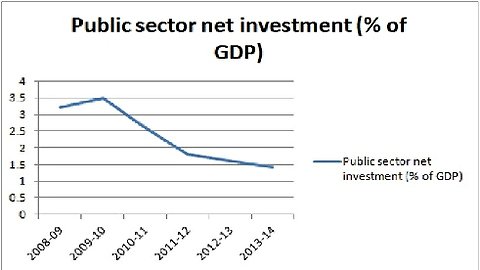
Maybe that really is worrisome. Still, if I look at the longer run chart — which is on p.14 from this pdf — sorry it will not reproduce — I start thinking that the matter is more complex. After all, in the early 1970s the figure for public investment was well over thirty billion pounds, and it is mostly falling sharply except for the late 1980s and very early 1990s. In the year 2000 it ends up at around five billion pounds, about one sixth the initial level. Yet the 1970s were pretty awful times for Great Britain, with pretty awful economic policies.
Why is public sector investment falling so much over the longer term? Mostly it is the decline in the number of public corporations, a healthy development if you ask me. Check out Figure 2 on p.15 of the same paper, noting the difference between net and gross investment. You also will see that changes in local government have been more important than changes at the national level.
If you read this paper, which runs to 2000 or so, you will see that public investment in health services has been plummeting for a long time, well before Cameron or “austerity,” defense spending seems to be included in these figures, and a lot of transport is not included in these numbers at all. I am happy to take corrections if things are done differently now.
Now what is the recent decline in public investment due to? I do not know, and in part I am asking for your help. I really am willing to believe that the United Kingdom is not investing enough in its future, including in science and education, but we haven’t yet gotten to the bottom of this matter. How much of that decline in the first graph is simply due to defense spending cuts and a shifting composition of expenditure for the national health care service, as higher service bills crowd out investment? How much is driven by changes in the housing market? (Here is a good historical source on changes in public housing policy over the longer term.) How do the recent declines in public investment compare to the longer term trend? How much is driven by a change in the gross rather than the net?
By the way, to cite a separate but related debate, to the extent immediate health care expenditures are pushing out health care investment, should that really count as “austerity”? I don’t think so, however mistaken such a policy may be, and thus I don’t see why “net public investment” is the proper metric for the short-run stance of fiscal policy (for that matter the “gross” figure may be more appropriate for short-run macro).
Inquiring minds wish to know. I hope that inquiring British minds wish to know too, or better yet already do know. I will gladly reproduce the best of what we learn from the comments.
Addendum: Here is a published data series. I am not sure I understand the notation, but my initial reading seems to suggest that current data are not out of line with the longer-term trend, including under Labour.
The Father of Microcredit
You’ve heard how microcredit was born. In a nation long shackled by British rule and wracked by famine, a brilliant man was seized with a desire to strike a blow against the poverty all about him. Defying common sense and the skepticism of his colleagues, he began lending tiny sums out of his own pocket to poor people, which they were to invest in tiny businesses. He demanded no collateral, only the vouchsafe of the borrowers’ peers. The borrowers rewarded his faith with punctual repayment. In time, his experiment spawned a national movement that delivered millions of loans to poor men and women and broke the power of money lenders.
The hero of this story is…Jonathan Swift, author of Gulliver’s Travels.
Swift developed the main ideas of microcredit–small sums, co-signers on the loan who knew the recipient, loans to women–in the 1730s. Although the system did not grow large in his lifetime, by the 1840s Irish microcredit institutions served a fifth of the population of Ireland.
The quote and information are from David Roodman’s excellent book Due Diligence: An Impertinent Inquiry into Microfinance. Roodman is a remarkable scholar, equally at ease collecting information in the slums of Bangladesh as writing complex computer code, and Due Diligence is a very good book not just on microcredit but on development more generally.
(Loyal readers may recall that Tyler also noted Swift’s connection to microcredit in a post from 2006.)
Jared Diamond reviews *Why Nations Fail*
There is much in the review, excerpt:
In their narrow focus on inclusive institutions, however, the authors ignore or dismiss other factors. I mentioned earlier the effects of an area’s being landlocked or of environmental damage, factors that they don’t discuss. Even within the focus on institutions, the concentration specifically on inclusive institutions causes the authors to give inadequate accounts of the ways that natural resources can be a curse. True, the book provides anecdotes of the resource curse (Sierra Leone cursed by diamonds), and of how the curse was successfully avoided (in Botswana). But the book doesn’t explain which resources especially lend themselves to the curse (diamonds yes, iron no) and why. Nor does the book show how some big resource producers like the US and Australia avoid the curse (they are democracies whose economies depend on much else besides resource exports), nor which other resource-dependent countries besides Sierra Leone and Botswana respectively succumbed to or overcame the curse. The chapter on reversal of fortune surprisingly doesn’t mention the authors’ own interesting findings about how the degree of reversal depends on prior wealth and on health threats to Europeans.
Do read the whole review (that is not just the usual cliched command to do so), and I will gladly link to any response by Acemoglu and Robinson. Here is Diamond’s bottom line:
My overall assessment of the authors’ argument is that inclusive institutions, while not the overwhelming determinant of prosperity that they claim, are an important factor. Perhaps they provide 50 percent of the explanation for national differences in prosperity. That’s enough to establish such institutions as one of the major forces in the modern world. Why Nations Fail offers an excellent way for any interested reader to learn about them and their consequences. Whereas most writing by academic economists is incomprehensible to the lay public, Acemoglu and Robinson have written this book so that it can be understood and enjoyed by all of us who aren’t economists.
How much structural unemployment was there during the Great Depression?
A few times recently Paul Krugman has raised the issue of structural unemployment in the Great Depression, so I thought I would offer a look at what has been written on the topic. Here is Richard J. Jensen, from a survey article:
Economists agree that Keynesian stimuli would not have helped structural or hard-core unemployment, only cyclical unemployment. As Table 1 suggests, about half of the unemployment was cyclical from 1931 through 1933; it was then that stimulus was needed and might have worked. By 1933, the appearance of a large, new, structural/hard-core element raised the natural level of unemployment from the 5 to 6 percent range to 12 to 15 percent. If a Keynesian stimulus had been tried and it had eliminated cyclical unemployment, the remaining unemployment still would have been io to 15 percent. Further fiscal or monetary stimuli would have resulted in inflation.
Later he moves directly to the key question:
…we need to discover how the war cured hard-core unemployment permanently. On the supply side, the growth of high schools and colleges, the postwar draft, and Social Security retirements removed young and old from the labor force. Wartime training and experience, in industry and in the military, made workers more productive, and upgraded skills so that the supply of unskilled labor was much smaller. In terms of efficiency wages, employers reshaped jobs to suit the skills and increase the productivity of available workers. They had to use men (and women) whom they would not have dreamed of hiring a few years before.
Personnel management became even more important. The number of industrial-relations staff rose from 2.5 per 1ooo employees in 1937 to 8.o in 1948. They were charged with improving productivity despite the extraordinary shortage of manpower, the high quit rates, the government-imposed wage freeze, and the new strength of labor unions. They dropped categorical restrictions against the poorly educated, the unemployed, women, the old, the handicapped, and sometimes, in spite of intense resistance, blacks. Recruitment of new workers became an art form, with sound trucks blaring in the streets beseeching people to come to work and earn big money. Jobs were restructured so that fewer skills were needed. Intensive in-shop and in-school training programs reached millions. Anyone with a modicum of skill was rapidly promoted, even to the status of foreman or instructor. The results further justified the use of efficiency-wage procedures, but this time efforts were made to find the right niches for workers who had been “hopelessly unemployable” in the 1930s.
In other words, the path out of high unemployment involved much more than a mere reflation of nominal values. (By the way, when it comes to terminology I might not use the phrase “structural unemployment,” but it also is not “simple cyclical unemployment.” I would say that in some circumstances the traditional distinction between cyclical and structural unemployment breaks down, but note that in terms of its parent literature this piece is using the terms properly, even if they sound somewhat off in a 2012 blogosphere context.)
In any case, history suggests that stimulus policy has to take some very specific forms to reach those “called cyclically unemployed by some, structurally unemployed by others” unemployed workers and that is the practical upshot.
Another practical upshot is that you still can believe in labor market hysteresis, as presented by DeLong and Summers. Without some analysis like the above, the DeLong/Summers claims are otherwise contradicted by American post-Depression productivity once joblessness lifted. Where were the long-term scars? Well, they were fixed but it wasn’t easy. So the relevance of hysteresis can be saved, but we still are left with proper stimulus being very difficult to do, unemployment being quite sticky, and proper policy requiring lots of structural attention. The Great Depression is evidence for all of those views, not against them.
Here is one more bit, with a sad sting at the end:
The war, by removing millions of prime men from the labor market, by restructuring the work process, by subsidizing wages, and by massive retraining, finally gave the private sector the methods and the incentives to rehire the hard-core. Never since has hardcore unemployment affected more than one worker in a hundred.
Michael A. Bernstein’s book, The Great Depression: Delayed Recovery and Economic Change in America, 1929-1939, also considers the significant role of structural unemployment (don’t forget my taxonomic caveat) in the Great Depression.
It is important to learn from this literature rather than dismiss it.
My favorite things Romania
1. Schubert pianist: Radu Lupu.
2. Conductor: Sergiu Celibadache. A high variance obsessive, Amazon doesn’t seem to carry his important recordings. At his peak he is one of the best conductors ever and can force a total rethink of the music upon you. He demanded so much rehearsal time, and so much perfection, that he was often impossible to work with. There is a short YouTube bit here.
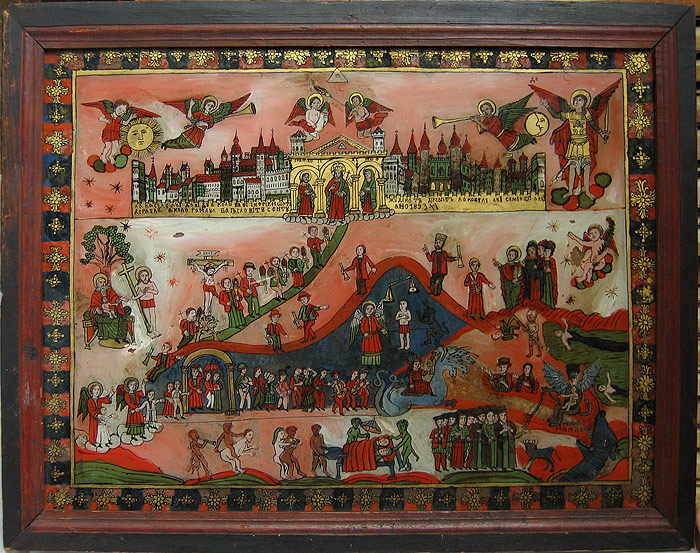
3. Painter: I can’t name one, sorry. I have seen some nice folk art icon paintings on glass, see the image at the bottom of this post.
4. Sculptor: Constantin Brâncuşi, with a preference for Bird in Space.
5. Chopin pianist: Dinu Lipatti, especially the Waltzes.
6. Producer of maxims: Emil Cioran. I have enjoyed all of his books.
7. Poet: Paul Celan. I am surprised he is not more widely read in the United States. At his peaks I don’t think any 20th century poet is better or more important.
8. Novelist: Herta Müller, better in German than English, both linguistically and culturally.
9. Violinist: Georges Enescu, of course he was a composer too.
10. Mozart pianist: Clara Haskil.
11. Movie: I’ve tried a bunch of the famous recent ones, but I can’t get through them and this is from a man who gladly watched the entire 7 hour, 12 minute Sátántangó .
12. Former NBA basketball center: G. Muresan.

13. Economist: Nicholas Georgescu-Roegen.
The bottom line: There is some real beauty here, and aesthetic romance, but I don’t have a good theory for why novels and painting are not stronger.
NPR interview with Ronald Coase
It is here, at age 101. Excerpt:
China’s rapid emergence as a global economic power — one of the most important developments of the past generation — took him completely by surprise.
“I thought it would take 100 years, if not more,” Coase said.
It seemed striking that an economic legend could be so wrong about such an important subject. I asked Coase what he made of this.
“I’ve been wrong so often I don’t find it extraordinary at all,” he said.
For the pointer I thank Daniel Klein.
The Growth of Justice
Justice is a key ingredient for economic growth. People will not invest if they fear that their life, liberty and property may be subject to arbitrary seizure and destruction. The rule of law and limited government provide a sphere of liberty within which individuals can make decisions with confidence that the fruits of their labor will not taken by the more powerful.
Justice is not just about legislation, however. Public and private discrimination diminish a person’s ability to individuate and develop, an ability that drives innovation and growth in the artistic, economic and scientific realms. In India the caste system binds many people to the lives of their ancestors regardless of desire, talent or will. In parts of the world half the population is subjugated and bound to a limited vision of their life, a vision which is not of their own making. Similar if less extreme forces have limited women and blacks in the United States.
In a pathbreaking paper, The Allocation of Talent and U.S. Economic Growth, Jones, Hsieh, Hurst, and Klenow connect a micro allocation model to a macro growth model to estimate that the lifting of much discrimination in the United States since 1960 has had a large effect on economic growth:
In 1960, 94 percent of doctors were white men, as were 96 percent of lawyers and 86 percent of managers. By 2008, these numbers had fallen to 63, 61, and 57 percent, respectively. Given that innate talent for these professions is unlikely to differ between men and women or between blacks and whites, the allocation of talent in 1960 suggests that a substantial pool of innately talented black men, black women, and white women were not pursuing their comparative advantage. This paper estimates the contribution to U.S. economic growth from the changing occupational allocation of white women, black men, and black women between 1960 and 2008. We find that the contribution is significant: 17 to 20 percent of growth over this period might be explained simply by the improved allocation of talent within the United States.
In other words, the United States has benefited greatly from the growth of justice.