Category: Law
My Conversation with Paul Krugman
Here is the audio and transcript, here is part of the summary:
Tyler sat down with Krugman at his office in New York to discuss what’s grabbing him at the moment, including antitrust, Supreme Court term limits, the best ways to fight inequality, why he’s a YIMBY, inflation targets, congestion taxes, trade (both global and interstellar), his favorite living science fiction writer, immigration policy, how to write well for a smart audience, new directions for economic research, and more.
Here is one excerpt:
COWEN: In your view, how well run is New York City as an entity?
KRUGMAN: Not very. Compared to what? Actually, I like de Blasio. I actually think he’s done some really good things. What he’s done on education, and even on affordable housing, is actually quite substantial. But the city is so big and the problems are so large that people may not get it.
I will say, it is crazy that you have a city that is so dependent on public transportation, and yet the public transportation is not actually under the city’s control and has clearly been massively neglected. I don’t suffer the full woes of the subway, but I suffer some of them, even myself.
The city could be run better than it is, but it’s certainly not among the worst-managed political entities in the United States, let alone in the world.
And:
COWEN: Will there ever be interstellar trade in intellectual property? You send your technology to a planet far away. It arrives much later, of course. Or you trade Beethoven to the aliens in return for a transporter beam? Can this work? You’ve written a paper that seems to indicate it can work.
KRUGMAN: I wrote a paper on the theory of interstellar trade when I was an unhappy assistant professor. Are there any happy assistant professors? [laughs] I was just blowing off steam. But it’s an interesting question.
COWEN: It could become your most important paper, right? [laughs]
KRUGMAN: We could imagine that there would be some way. We’d have to find somebody to trade with, although it’s the kind of thing — if you try to imagine interstellar trade for real in intellectual property — it’s probably the kind of thing that would be more like government-to-government exchanges.
It sounds like it would be really, really hard, although some science fiction writers are imagining that something like Bitcoin would make it possible to do these long-range . . . I don’t think something like Bitcoin is even going to work here.
Krugman also gives his opinions on Star Wars and Star Trek and Big Tech and many other matters. Interesting throughout…
Indian airport police are going to smile less
Airport police in India are being instructed to smile less.
This is over concerns cheerfulness could lead to a perception of lax security and a threat of terror attacks.
The country’s Central Industrial Security Force, which is in charge of aviation safety, wants its staff to be “more vigilant than friendly”.
They will move from a “broad smile system” to a “sufficient smile system”, the Indian Express says.
Officials are said to believe that excessive friendliness puts airports at risk of terrorist attacks.
The organisation’s director general, Rajesh Ranjan even said the 9/11 attacks had taken place because of “an excessive reliance on passenger-friendly features”.
Here is the full story, via Anecdotal.
Do higher minimum wages induce more search?
Monopsony models generally imply they should, and that is part of the argument why minimum wage hikes might be good for workers, wages, and yes even employment. But the data don’t seem to support the claim of more search behavior:
Labor market search-and-matching models posit supply-side responses to minimum wage increases that may lead to improved matches and lessen or even reverse negative employment effects. Yet there is no empirical evidence on this crucial assumption. Using event study analysis of recent minimum wage increases, we find that increases to minimum wage do not increase the likelihood of searching, but do lead to large yet very transitory spikes in search effort by individuals already looking for work. The results are not driven by changes in the composition of searchers.
That is from a new NBER Working Paper by Camilla Adams, Jonathan Meer, and Carly Will Sloan.
The Child Care tax credit may have unfavorable incidence
Child care tax credits are intended to relieve the financial burden of child care for working families, yet the benefit incidence may fall on child care providers if they increase prices in response to credit generosity. Using policy-induced variation in the Child and Dependent Care Credit, this paper presents evidence of substantial pass-through: over half of every dollar is passed through to providers in the form of higher prices and wages. Increased non-refundable credit generosity may have the unintended effect of making child care less affordable for low-income families, a result with distributional and spatial implications due to income sorting of families within an urban area.
That is from a new paper by Luke P. Rogers, via the excellent Kevin Lewis.
Politics isn’t about policy don’t put Shetland in a box
New rules barring public bodies from putting Shetland in a box on official documents have come into force.
Islands MSP Tavish Scott had sought to change the law to ban the “geographical mistake” which “irks” locals, by amending the Islands (Scotland) Bill.
The bill’s “mapping requirement” has now come into force, although it does give bodies a get-out clause if they provide reasons why a box must be used.
Mapmakers argue that boxes help avoid “publishing maps which are mostly sea”.
The Islands Bill, which aims to offer greater protections and powers to Scotland’s island communities, was unanimously passed in May.

Here is the full story, via Glenn Mercer. You can’t call it “racist,”or “sexist,” might someone coin a future term for the objectionable act of…”putting my islands into a box”?
What is a good name for a trade deal?
When I see USMCA, I also think of “United States Marine Corps,” a connection Donald Trump himself has noted. Of course the Marines have nothing to do with international trade policy, but given the public’s longstanding confidence in the military, the association is unlikely to hurt politically. Other people may confuse USMCA with USCMA, or the United States Catholic Mission Association, another positive connotation.
This next point may sound slightly cynical, but here goes: Perhaps being so easy to say and remember has been part of Nafta’s problem. The sad reality is that voters do not love the idea of free trade once it is made concrete to them, and both Barack Obama and Trump campaigned against Nafta in its current form. So maybe every time people heard the name Nafta, they were reminded of how much they disliked it.
I recall, more than a decade ago, hearing talk of a supposed “Nafta superhighway,” a series of roads that would supposedly bring the three Nafta countries under some kind of joint, conspiratorial rule, enforced by the movement of vehicles on these connector roads and sometimes in league with Satan himself. The alternative phrase — “USMCA Superhighway” — doesn’t roll off the tongue as easily, so maybe it will be harder to drum up fake news about the new deal.
Here is the rest of my Bloomberg column on the topic. And this:
Looking back, the General Agreement on Tariffs and Trade (Gatt) had a pretty good name for its time. It conveyed that there was in fact a general agreement, and that branding sold well enough in an earlier, more multilateral era. It might have sounded dull and technocratic, but that was OK for policies which were … dull and technocratic. Much worse, however, was the 1995 relabeling into the World Trade Organization, a name which to many people sounds globalist, faceless and sinister. They might as well have called it SPECTRE, the name of the criminal group in many James Bond novels and films.
I even quote a Canadian quoting Shakespeare…
They solved for the equilibrium, China equilibrium of the day
China will be less severe with its smog curbs this winter as it grapples with slower economic growth and a trade war with the United States, according to a government plan released on Thursday.
Instead of imposing blanket bans on industrial production in the Beijing-Tianjin-Hebei area as it did last winter, the Ministry of Ecology and Environment said it would let steel plants continue production as long as their emissions met standards.
Targets for overall emissions cuts have also been revised down. In the next six months, 28 cities in northern China are required to cut levels of PM2.5 – the tiny airborne particles that are most harmful to human health – by about 3 per cent from a year ago.
That is less than the 5 per cent cut proposed in an initial plan seen by the South China Morning Post last month.
Meanwhile, the new plan stipulates that the number of days of severe air pollution should be reduced by about 3 per cent, also revised down from 5 per cent in last month’s draft.
Here is more from Orange Wang at SCMP. As I am sure you all know, air pollution (and I don’t just mean carbon emissions) is one of the great underrated problems in the world today. The trade war with China is making it worse.
Is it better to have more corporations?
A reduction in the corporate income tax burden encourages adoption of the C corporation legal form, which reduces capital constraints on firms. Improved capital reallocation increases overall productive efficiency in the economy and therefore expands the labor market. Relative to the benchmark economy, a corporate income tax cut can reduce the non-employment rate by up to 7 percent.
That is from the new AEJ: Macroeconomics, by Daphne Chen, Shi Qi, and Don Schlagenhauf.
The Kavanaugh saga from afar
That is the theme of my latest Bloomberg column, here is one bit:
There is an asymmetry between male and female perceptions.
Most men are not abusers, yet very large numbers of women have been abused. So if a man is an abuser, there is a good chance he has abused a fair number of women.
That means many well-meaning men experience sexual abuse as a relatively rare phenomenon. They haven’t done it, and most of their male friends haven’t either. At the same time, most women have abuse, rape or #MeToo stories, and they experience these phenomena as relatively common and often life-altering. Probably they also have heard multiple such stories from their female friends. This structural asymmetry of perspectives is crucial to understanding the discourse and the often fundamental differences in opinion.
Our criminal justice system isn’t very good.
Whether you think Kavanaugh is innocent or guilty, we can all agree there are large numbers of intelligent people on both sides of the debate, and even after a week of intense national scrutiny there is no resolution. The reality is that ordinary accused people, who are basically presumed guilty by the criminal justice system, don’t receive very fair judgments. And if Kavanaugh is innocent, might we hope that this experience will make him more sympathetic to the plight of the unjustly imprisoned and accused?
But perhaps now we can move on to talking about the renegotiation of the trade agreement formerly known as NAFTA…
That was then, this is now
Negotiations for the preliminary agreement would be conducted under a new process, which the State Department, employing classic bureaucratic jargon, called “the selective nuclear-multilateral approach.” In preliminary discussions held in July 1945, the Canadians had proposed this method of negotiations led by a small group of influential nations — which effectively became the model for multilateral trade negotiations for the remainder of the twentieth century — as a compromise between the strictly bilateral approach, which had been favored politically by FDR and Cordell Hull, and the broader multilateral approach the British insisted upon. The Americans believed they were constricted by the requirements of the Reciprocal Trade Agreements Act specifically, and by political realities in Congress more generally, to negotiating bilaterally on select tariffs on an item-by-item basis.
That is from the new and highly useful and still under-discussed book The Wealth of a Nation: A History of Trade Politics in America, by C. Donald Johnson, Oxford University Press. I am happy to second Doug Irwin’s blurb: “This splendid book covers the politics of American trade policy from the country’s beginnings through Trump. Johnson provides a great overview of a fascinating subject.”
The Liberal Radicalism Mechanism for Producing Public Goods
 The mechanism for producing public goods in Buterin, Hitzig, and Weyl’s, Liberal Radicalism is quite amazing and a quantum leap in public-goods mechanism-design not seen since the Vickrey-Clarke-Groves mechanism of the 1970s. In this post, I want to illustrate the mechanism using a very simple example. Let’s imagine that there are two individuals and a public good available in quantity, g. The two individuals value the public good according to U1(g)=70 g – (g^2)/2 and U2(g)=40 g – g^2. Those utility functions mean that the public good has diminishing utility for each individual as shown by the figure at right. The public good can be produced at MC=80.
Now let’s solve for the private and socially optimal public good provision in the ordinary way. For the private optimum each  individual will want to set the MB of contributing to g equal to the marginal cost. Taking the derivative of the utility functions we get MB1=70-g and MB2= 40 – 2g (users of Syverson, Levitt & Goolsbee may recognize this public good problem). Notice that for both individuals, MB<MC, so without coordination, private provision doesn’t even get off the ground.
What’s the socially optimal level of provision? Since g is a public good we sum the two marginal benefit curves and set the sum equal to the MC, namely 110 – 3 g = 80 which solves to g=10. The situation is illustrated in the figure at left.
We were able to compute the optimum level of the public good because we knew each individual’s utility function. In the real world each individual’s utility function is private information. Thus, to reach the social optimum we must solve two problems. The information problem and the free rider problem. The information problem is that no one knows the optimal quantity of the public good. The free rider problem is that no one is willing to pay for the public good. These two problems are related but they are not the same. My Dominant Assurance Contract, for example, works on solving the free rider problem assuming we know the optimal quantity of the public good (e.g. we can usually calculate how big a bridge or dam we need.) The LR mechanism in contrast solves the information problem but it requires that a third party such as the government or a private benefactor “tops up” private contributions in a special way.
The topping up function is the key to the LR mechanism. In this two person, one public good example the topping up function is:
 Where c1 is the amount that individual one chooses to contribute to the public good and c2 is the amount that individual two chooses to contribute to the public good. In other words, the public benefactor says “you decide how much to contribute and I will top up to amount g” (it can be shown that (g>c1+c2)).
Now let’s solve for the private optimum using the mechanism. To do so return to the utility functions U1(g)=70 g – (g^2)/2 and U2(g)=40 g – g^2 but substitute for g with the topping up function and then take the derivative of U1 with respect to c1 and set equal to the marginal cost of the public good and similarly for U2. Notice that we are implicitly assuming that the government can use lump sum taxation to fund any difference between g and c1+c2 or that projects are fairly small with respect to total government funding so that it makes sense for individuals to ignore any effect of their choices on the benefactor’s purse–these assumptions seem fairly innocuous–Buterin, Hitzig, and Weyl discuss at greater length.
Notice that we are solving for the optimal contributions to the public good exactly as before–each individual is maximizing their own selfish utility–only now taking into account the top-up function. Taking the derivatives and setting equal to the MC produces two equations with two unknowns which we need to solve simultaneously:
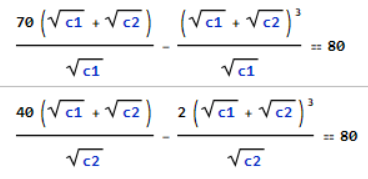
These equations are solved at c1== 45/8 and c2== 5/8. Recall that the privately optimal contributions without the top-up function were 0 and 0 so we have certainly improved over that. But wait, there’s more! How much g is produced when the contribution levels are c1== 45/8 and c2== 5/8? Substituting these values for c1 and c2 into the top-up function we find that g=10, the socially optimal amount!
In equilibrium, individual 1 contributes 45/8 to the public good, individual 2 contributes 5/8 and the remainder,15/4, is contributed by the government. But recall that the government had no idea going in what the optimal amount of the public good was. The government used the contribution levels under the top-up mechanism as a signal to decide how much of the public good to produce and almost magically the top-up function is such that citizens will voluntarily contribute exactly the amount that correctly signals how much society as a whole values the public good. Amazing!
Naturally there are a few issues. The optimal solution is a Nash equilibrium which may not be easy to find as everyone must take into account everyone else’s actions to reach equilibrium (an iterative process may help). The mechanism is also potentially vulnerable to collusion. We need to test this mechanism in the lab and in the field. Nevertheless, this is a notable contribution to the theory of public goods and to applied mechanism design.
Hat tip: Discussion with Tyler, Robin, Andrew, Ank and Garett Jones who also has notes on the mechanism.
My Conversation with Bruno Maçães
Here is the audio and transcript, here is the opening summary:
Political scientist Bruno Maçães has built a career out of crossing the globe teaching, advising, writing, and talking to people. His recent book, born out of a six-month journey across Eurasia, is one of Tyler’s favorites.
So how does it feel to face Tyler’s rat-a-tat curiosity about your life’s work? For Bruno, the experience was “like you are a politician under attack and your portfolio is the whole of physical and metaphysical reality.”
Read on to discover how well Bruno defended that expansive portfolio, including what’s missing from liberalism, Obama’s conceptual foreign policy mistake, what economists are most wrong about, how to fall in love with Djibouti, stagnation in Europe, the diversity of Central Asia, Hitchcock’s perfect movie, China as an ever-growing global force, the book everyone under 25 should read, the creativity of Washington, D.C versus Silicon Valley, and more.
Here is one bit:
MAÇÃES: This raises deep philosophical questions and political questions. If you want Turkey to become like Europe, then you have to project European power across Turkey. If Europe no longer has that ability, then you shouldn’t be surprised that Turkey looks elsewhere.
It’s very simple. I think I say in the book that in order to be loved, you also have to be feared. This idea that you find in Europe now, that without projecting any kind of power, other countries will be attracted to the European model, that’s a form of utopianism. I just cannot see that happen.
COWEN: So Europe lacks the spirit of adventure.
MAÇÃES: That is certainly the case. I think you see that. One of the areas where the spirit of adventure today is more relevant and important is technology. You see in Europe the idea that technology’s against us, and we should resist this rather than embrace it. A very negative spirit, which I think is a good example of how adventure has disappeared from the European psyche.
And:
COWEN: Russia. Why is Russia as a world power currently underrated?
MAÇÃES: The most impressive thing about Russia is, in fact, something that you might not think at first: the power of organization. We have this image of Russia as a failed state in many respects.
But in order to keep that empire, in order to keep it together throughout the centuries, in order to develop it to some extent, in order to bring together so many ethnicities, so many religions . . . it’s fair to say that Russia has done a better job of integrating its Muslim population, which is close to 15 percent, than any other country, I would argue — certainly any other major country.
The power of the Russian state, the ability to organize, to dispose, to connect, is one of the great political stories of mankind — to see how the Russian state was able to grow and to extend itself. And that’s still there.
Original and highly recommended. Again, here is Bruno’s book The Dawn of Eurasia: On the Trail of the New World Order.
Do moving and making big decisions tend to happen together?
We use exogenously determined, long-distance relocations of U.S. Army soldiers to investigate the impact of moving on marriage. We find that marriage rates increase sharply around the time of a move in an event study analysis. Reduced form exposure analysis reveals that an additional move over a five year period increases the likelihood of marriage by 14 percent. Moves increase childbearing by a similar magnitude, suggesting that marriages induced by a move are formed with long-term intentions. These findings are consistent with a model where the marriage decision is costly and relocation lowers the costs to making this decision. Our results have implications for understanding how people make major life decisions such as marriage, as well as the cost of migration.
That is from a new paper by Susan Payne Carter and Abigail Wozniak. It’s as if the move jolts you out of complacency and activates your long-term planning modules. Here are some bits from the paper, as assembled by an MR reader:
– …marriage rates rise sharply shortly before and in the first two months after a move.– Additional moves encourage marriage, raising the likelihood of marriage and of having children present as dependents.– The likelihood of marrying prior to five years of Army service rises by 8 percentage points with an additional domestic move, representing an increase of 14 percent from the mean marriage rate.– We first considered a model in which relocation likely requires investment in thinking about long-term plans that may simultaneously lower the cost of considering other types of long-term commitments, like marriage.– This suggests that the decision to marry may be affected by other events requiring long-term planning. This in turn implies that a disruptive event, like a relocation, may actually strengthen family ties rather than strain them.
For the pointers I thank two MR readers.
Reihan Salam on the immigration crisis
Here is Reihan in the WSJ (good photos!):
…we need to recognize that the immigration debate isn’t really about immigrants. In truth, it’s about the children of immigrants.
…Like it or not, we are a country with an implicit social contract. If we welcome you in as part of the flock, we also welcome your offspring. In past eras, high immigration levels were matched by high native birthrates. The end result was that, even if immigrants had large families, these second-generation youth were greatly outnumbered by the descendants of the native-born. Investing in the next generation meant investing in the children of immigrants, yes, but also in the children of natives, who, by virtue of their numbers, would set the cultural tone.
Collapsing native birthrates have changed the picture, setting off a cultural panic among the likes of Rep. Steve King, the Iowa congressman who infamously tweeted, “We can’t restore our civilization with somebody else’s babies.”
Here is Reihan’s new book Melting Pot or Civil War?: A Son of Immigrants Makes the Case Against Open Borders. Here is Katie’s sketch of my blurb:
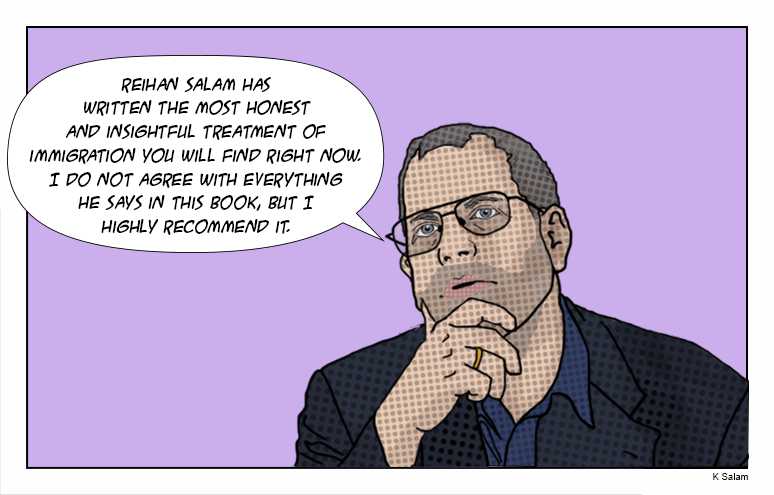
Out today, and definitely recommended!
The forthcoming Chinese charter city?
From Bloomberg BusinessWeek:
The government intends to ring-fence Port City from Sri Lanka’s legal system to facilitate currency movement and create favorable tax and investment incentives. Harsha de Silva, a state minister who once campaigned against the project but is now one of its most vocal supporters, is involved in drafting the separate legal structure. “This must be a top-10 city for doing business in the world,” he says. “Otherwise, what’s the point?” Sri Lanka is currently ranked 111 out of 190 nations on the World Bank’s ease-of-doing-business index.
And here is the take on one of the nearby port projects:
Today, Hambantota handles about one ship a day, not enough to make it commercially viable, and wild elephants regularly breach the perimeter fencing. At a nearby airport, which CCCC also helped build during Rajapaksa’s administration, the only commercial flight was canceled in June because of frequent peacock strikes and low demand.
Is it fair to call all this a “hegemon charter city“?