Category: Law
Should a state government decide marginal increments of health care?
That is one of the debates swirling around the resuscitated Republican health care plan (NYT summary), which now seems to have some chance of passing. Sarah Kliff writes:
The Republican solution to sick people who need health insurance in a post-Obamacare world is increasingly coming to center on three words: high-risk pools.
The White House has reportedly secured the support of Rep. Fred Upton (R-MI), a longtime legislator, by promising an additional $8 billion to fund these programs. That would mean the Republican plan has nearly $115 billion that states could use, if they wanted to, for high-risk pools.
…There were 35 state high-risk pools before the Affordable Care Act passed. To control costs, they would often do things like charge higher premiums than the individual market. Most had waiting periods before they would pay claims on members’ preexisting conditions, meaning a cancer patient would need to pay premiums for six months or a year before the high-risk pool would cover her chemotherapy treatments.
Kliff then notes those pools have proved quite expensive. And:
The Republican bill doesn’t require states to build high-risk pools — it just gives them the option. And it has little to say about how states should build them if they decide to do so. It is possible they would also have lifetime limits and preexisting condition waiting periods. Those details are hugely important, but are unlikely to get sorted out until after the bill passes and the Trump administration begins to write regulations.
I don’t favor ACHA, which I see as bringing no benefit and also as involving a cynical desire to repeal Obamacare simply to fulfill a campaign promise (and it needs a CBO score). Still, I see many people fulminating about this change toward high risk pools, yet without defending their position much beyond a hand wave. Should all requests for emergency medical care receive additional government funding? Obamacare itself does not embody anything remotely like that principle, for instance consider all the medical conditions not covered under the mandate, or covered only imperfectly. Not to mention the rare diseases that receive only limited R&D dollars. And we’re about to run out of yellow fever vaccine — nasty! The list goes on and on. How are those pandemic preparations coming?
If the federal government is asked to pick up the tab for high-risk pools or some rough equivalent, it probably visualizes the cost in terms of either additional borrowing or as a common pool problem. It is close to a free lunch in political terms, arguably even a political benefit, now that Obamacare is more popular.
If balanced-budget state governments are asked to pick up the tab, they will wonder whether that money should better be spent on schools, roads, and prisons. Many of them will be reluctant. Maybe that is right or wrong, but is “let’s have a democratically elected state government decide how much to subsidize medical care for those with preexisting conditions” such a morally outrageous view? I guess it is these days. The simple but underemphasized truth is that under the new bill state governments can spend as much as they want on high-risk pools.
(Is it not sobering to think that if the high-risk patients are put into a separate pool, and have to ask for state-level but taxpayer-sourced money in a direct and transparent manner, the political support for that funding is not so strong? That is perhaps the real lesson here. In this debate, both sides are the enemies of transparency.)
Which is the better perspective? Federal or local? The answer is obvious if you believe all requests for emergency medical care should receive additional government funding. But, as I’ve mentioned, no one believes that. I do see people who cite that principle when it is convenient in one part of a debate, and who forget about the same principle for other policy choices.
And please, don’t compare these marginal health care expenditures to “tax cuts for the rich” — instead advocate for where you most want to see the money spent! Don’t let the silly Republicans bail out your analytical apparatus once again; any program is easy to justify in your own mind if you put it up against what you consider to be a very weak alternative use of the funds. It is fine to say “bigger subsidies for high-risk pools are better than tax cuts for the rich, but they are still only my 17th most preferred use for the funds.”
Along related lines, while I favor taking in many more refugees, I also understand that any feasible migration policy involves leaving many refugees and potential migrants to their possible deaths, and with a relatively high probability in some cases. So if your moral argument is “we should let in person x, or person x will die,” you need to provide a limiting principle once again.
Most generally, beware of moral arguments that a) lower the status of some other group of people, and b) do not state and justify their limiting principles. They are ways of substituting in pleasurable moralizing in lieu of dealing with the really tough questions.
Addendum: Here are some new and relevant results cited by David Leonhardt, I haven’t had time yet to read through them.
What is the relevant uncertainty for climate change policy?
A number of people have climbed onto Twitter and outlined (correctly) how increased uncertainty about the impact of climate change increases the value of doing something about it. There is downside risk, and of course we wish to buy insurance against that in the form of a more active climate change policy. Still, that is not looking deeply enough. I see some of the relevant uncertainties as embodied in the following scenario, which is more about policy means than climate change science:
Following a Trump debacle, finally the Democrats win all branches of government and pass a climate change bill. There is a carbon tax, and further anti-coal measures, but it isn’t enough to shift energy regimes in a transformational sense (besides, truly transformational technologies require luck and “the right time” far more than price incentives). Instead the United States becomes more like Western Europe, with higher levels of conservation but no ground-breaking new energy source. Solar goes up by ten percentage points, and wind by two or three, given NIMBY opposition. Fracking becomes more efficient yet, which nudges fossil fuels back a bit onto center stage. Nuclear is closed down altogether, and hydroelectric also goes in reverse or stagnates. China is as China does, and they slowly move away from their installed coal base, in the meantime taking steps to control their particulate matter but not so much their carbon, copying America in this regard. India starts a shift from coal to natural gas but still has rising carbon emissions. Africa and Vietnam exceed growth expectations, with a lot of solar power to be sure, but not enough to counteract their growing industrialization. The carbon tax causes a mild recession in America, and environmentalism becomes less popular. The global boost in temperature continues, unchecked. The people who die each year from regular air pollution — six to seven million at last count — diminish in number with economic growth, but we react largely with indifference to that problem, because it doesn’t fit into domestic political struggles very neatly.
Now, to me something like that is the single most likely scenario, albeit with a lot of uncertainty. I am still happy to try remedial policy measures, and to try them now, if only out of non-complacency or perhaps just desperation. But come on, let’s be honest. If all you are doing is trying to combat uncertainty about the science, you are unwilling to look the actual problem square in the eye, just like the climate deniers, the very people you so much decry.
Baptists *are* bootleggers, medical marijuana edition
Four of New York’s five medical marijuana companies have filed suit against the state Department of Health to stop it from licensing additional operators to take part in the tightly run state program. The companies argue that the expansion could tank the nascent industry and potentially harm thousands of patients who rely on medical marijuana to treat their ailments.
Here is the article, via Peter Metrinko.
That was then, this is now, immigration edition
Some of Trump’s first actions in office were two executive orders meant to crack down on illegal immigration by implementing tougher enforcement not just at the border but also within the country. This week The Washington Post reported that U.S. Immigration and Customs Enforcement had arrested 21,362 unauthorized immigrants across the country since Trump took office, a 32.6 percent increase from the previous year. (The data runs through mid-March.) At first glance these numbers might seem consistent with Trump’s promise to get “the bad ones” out of the country. But the Post also noted that of those arrested roughly a quarter, or 5,441, had no criminal record. That’s more than double the number of noncriminal arrests of undocumented immigrants during the same period in 2016. (Many of those arrested eventually will be deported, but because that process can be slow, changed enforcement patterns show up more quickly in arrest data.)
Look back a bit further, however, and the recent increase in enforcement looks less dramatic. The pace of arrests is running well behind the 29,238 made during the same period in 2014; that year, there were 7,483 noncriminal arrests through mid-March, which represented a similar share of the total as this year’s numbers.
That is from Ben Casselman, et.al. at 538.
Insider trading terrorism
German police arrested a man on Friday suspected of detonating three bombs that targeted the Borussia Dortmund soccer team bus in the hope of sending the club’s shares plummeting and making a profit on an investment, prosecutors said.
In a statement, the federal chief prosecutor said the 28-year old man, a dual German and Russian national identified as Sergei V., had bought options on Borussia Dortmund’s stock before the attack.
The team bus was heading to the club’s stadium for a Champions League match against AS Monaco on April 11 when the explosions went off, wounding Spanish defender Marc Bartra and delaying the match by a day.
Prosecutors last week expressed doubts about the authenticity of three letters left at the site of the attack that suggested that Islamist militants had carried it out.
The prosecutor’s office said the suspect had bought 15,000 put options, or contracts giving him the right to sell Borussia Dortmund’s shares at a pre-determined price, on the day of the attack, using a consumer loan he had signed a week earlier.
Here is the full story at Reuters.
The Chinese influence on Hollywood box office
Two years later, the quota of imported movies permitted into China was raised to 34 from 20 in a deal negotiated between then-Vice President Joe Biden and then-Vice President Xi. The deal all but guaranteed that most big-budget Hollywood features—except those with content deemed objectionable—would be shown in China.
“I prefer to watch Hollywood films because the chance of a domestic film being crappy is much bigger than a Hollywood film,” said Liu Jing, a 25-year-old postgraduate student studying finance policy in Beijing.
Ms. Jing said she became a fan of superhero films from Marvel Studios as a high-school student and now goes to movie theaters at least once a month.
Hollywood executives can rattle off the rules for getting a movie approved by Chinese censors: no sex (too unseemly); no ghosts (too spiritual). Among 10 prohibited plot elements are “disrupts the social order” and “jeopardizes social morality.” Time travel is frowned upon because of its premise that individuals can change history.
U.S. filmmakers sometimes anticipate Chinese censors and alter movies before their release. The Oscar-winning alien-invasion drama “Arrival” was edited to make a Chinese general appear less antagonistic before the film’s debut in China this year.
The superhero hit “Logan” was 14 minutes shorter in China after Chinese censors cut scenes of beheading and impalement.
For “Passengers,” the space adventure starring Chris Pratt and Jennifer Lawrence, a scene showing Mr. Pratt’s bare backside was removed, and a scene of Mr. Pratt chatting in Mandarin with a robot bartender was added.
Here is the full Eric Schwartzel WSJ piece.
Hedging FDA Risk?
In the words of a recent article, the FDA’s rejection of a recent drug application was a stunning setback. Stunning setbacks are by definition unpredictable and unpredictable risks aren’t correlated with other risks which means that they can be easily priced and bought and sold. The all-star team of Adam Jørring, Andrew W. Lo, Tomas J. Philipson, Manita Singh and Richard T. Thakor propose just this in Sharing R&D Risk in Healthcare via FDA Hedges.
The idea is to create FDA Hedges that pay out a fixed fee if a drug fails to be approved and zero otherwise. Pharmaceutical firms could then buy some of these contracts and reduce their risk exposure which in turn would increase their incentive to invest in R&D.
The idea is clever but firms and even more so firm owners already have many ways to diversify and its not clear what the value of an additional source of diversification is, even one that is more closely tuned to the firm’s profits. It’s also not clear how much additional R&D would be driven by offloading these risks. Pharmaceutical R&D is valuable, however, so even small increases in R&D are welcome even if more fundamental changes would be better. Prices in these markets would also provide useful information.
I also worry that we are asking a lot of FDA reviewers and firm insiders to keep their inside information private. Information about FDA approval decisions is already very valuable and there have been a few cases where insiders trade on their information or leak it to make millions. FDA Hedges might make this problem worse which should be balanced against the possible gains.
How to think about “The Deep State”
I don’t believe in many (any?) conspiracy theories, and if there hasn’t been talk about “the deep state” on MR to date, there is a reason for that. Still, I have been wondering how one might think about the deep state in public choice terms, even if you have a rather modest view of what it is all about. Day to day, we mostly get “the shallow state,” so what might the deep state mean?
I can think of a few options:
1. The deep state can selectively blackmail individuals in politics, and for the innocent ones the deep state can fabricate something. Therefore in equilibrium most politicians shy away from talking about the deep state, even to praise it. The balance here seems easy enough to understand, but I can’t say I’ve seen evidence for this mechanism. I suppose if there is any test for it, it is the Trump Administration.
2. The deep state exists to protect the American public (and itself) against very unfavorable policy choices and thus outcomes. The deep state therefore would move against a very irresponsible president, either by leaks or blackmail or perhaps something more dramatic. In this model, having a deep state is like buying a put against very unfavorable world-states. Note that the weaker and harder to coordinate you think is the deep state, the more this is an “out of the money” put, protecting against only the most extreme existential risks. You might never observe this kind of deep state, though it can be worth a good deal in relatively volatile world states.
Do note that in these games a president will take steps to limit a potential “coup” from the deep state. One counter-strategy would be to increase the level of background noise, so that the deep state would not be sure whether moving against the president would in fact be justified.
3. The deep state is the Federal Reserve System. I believe it was Matt Yglesias who first suggested this idea. And there is indeed a literature on political business cycles.
4. The deep state is active on a day-to-day basis, mostly by manipulating the flow of information to the president and National Security Council and related parties. Intelligence is more filtered than we outsiders may think. Presumably the president realizes this sooner or later, and tries to adjust for the filter. Over time, the filter becomes an increasing distortion, so to keep the chance higher that the president is being fooled by the information flow.
5. The president cultivates the deep state to strengthen his or her bargaining position vis-a-vis Congress or perhaps foreign leaders. “The deep state won’t let me do that,” or “the deep state will blackmail me,” or…?…cannot be stated outright but perhaps subordinates can hint at such constraints. Or the president may cultivate the deep state so as to have an option on blackmailing members of Congress, should “the shit hit the fan.”
What else? And which of those are most plausible?
I thank an MR reader for a useful email on these issues.
A Twisted Tale of Rent Control in the Maximum City
Walking around Mumbai it’s common to see some lovely, older buildings (circa 1920s perhaps) that are  in a great state of disrepair. A well maintained building can last for hundreds of years so why are these buildings falling apart? The answer is rent control. Bombay passed a rent control act in 1947 that froze rents at 1940 levels.
More than fifty years later, rents remained frozen at 1940 levels. It wasn’t until 1999 that the Act was modified slightly to lift controls on some new construction and to allow rent increases of 4% per year. After a fifty two year freeze, however, a 4% increase was a pittance. Thus, even today there are thousands of flats where tenants are paying rents of 400-500 rupees a month (that’s $6 to $8 a month!)–far, far below market rates.
The rent control law meant that there was virtually no construction of rental housing (WP) for decades and a slowly dilapidating housing stock. (Ironically, the only free market in rental housing is in the 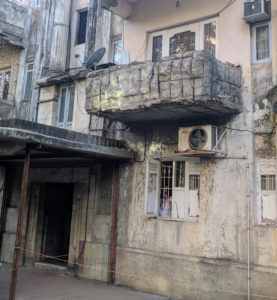 slums.)
The nominal landlords have neither the incentive nor the funds to maintain the buildings so every year during monsoon season some of the buildings collapse and people die. As the World Bank put it, the monsoons are Natural Hazards but the collapses are Unnatural Disasters:
Rent controls in Mumbai may have initially benefited tenants at the expense of landlords, but over time everyone suffers. Rent controls cause landlords to forgo maintenance and neglect their properties, and tenants not only live in dilapidated buildings but die when they collapse in heavy rains. Even if tenants are willing to either pay higher rents or to maintain the building, each tries to not pay his share of the expense (free riding), especially if appropriate retrofitting involves structural changes to the entire residential structure and not to individual apartments. Tenants also may lack the legal authority to make changes to their building’s structure.
Consider the photo at top, it’s an elegant building on a nice plot in a highly desirable part of town but take a closer look and you can see that it is falling apart (second photo). Several businesses and flats operate in the building. Now read the sign on the wall.
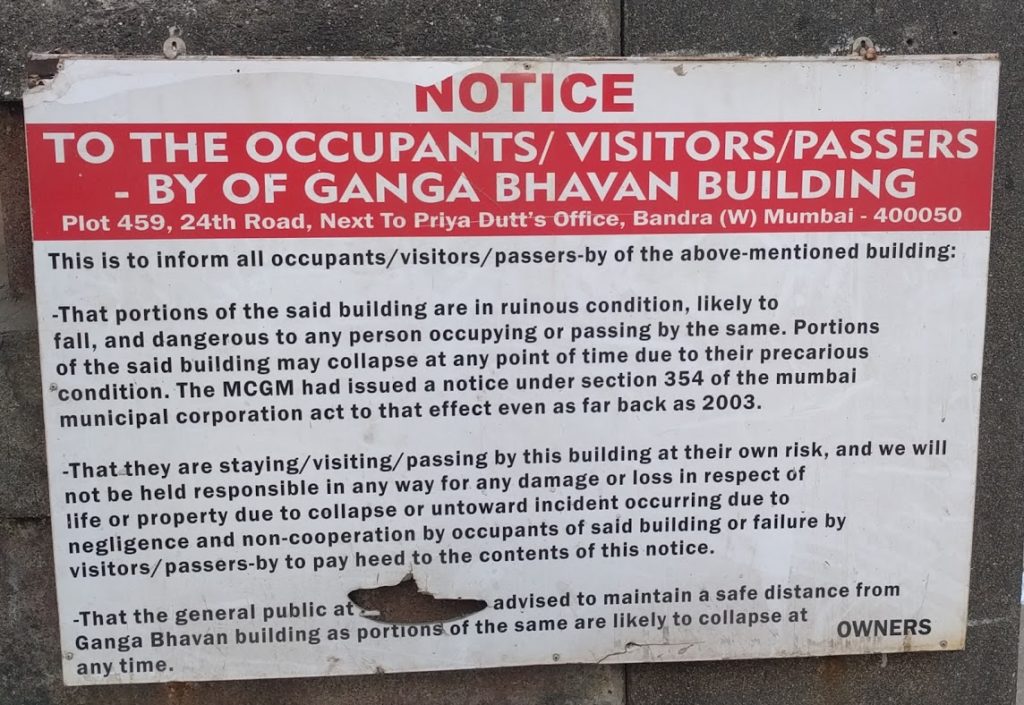 I don’t doubt that the sign is largely accurate but it also illustrates another aspect of rent control. Rent control transforms a mutually profitable exchange into a zero-sum war of misery. As I discovered in my investigations, a remarkable and sometimes hilarious example is illustrated by this very building.
The tenant, called the “victim lady”, in the Bombay High Court case that she initiated alleges that her landlord has vexed her with many frivolous lawsuits and harassed her in various and sundry ways:
It is alleged that the Respondent, on the pretext of reading books and doing meditation, continues to sit near the window of the victim lady reading law books and passing unwanted remarks stating that he will become a better lawyer by reading law books and will teach the victim lady a lesson. The Respondent is also alleged to have killed the kitten to whom the victim lady regularly used to feed. He is also alleged to have called three men to remove coconuts from the coconut tree and in the process broke number of flower pots belonging to the victim lady and destroyed the garden maintained by her.
In addition, and the judges of the High Court find this especially distasteful, the landlord “has also cast aspersions on the judiciary by making certain statements” about the “inefficiency of the judicial system”. Indeed, in his affidavit-in-reply, the respondent doubled down arguing:
…”the judiciary is perceived as inefficient by most citizens of India” as a justification for what he had stated.
Where could the respondent have gotten such absurd ideas? How dare he claim to know what most citizens think!
The Respondent may be free to express his views about the judiciary, but obviously had no right to project his views as of “most citizens in India”. What survey or research has been made by the Respondent to ascertain the views of “most citizens in India”, has not been disclosed, and considering the number of the citizens in India it is impossible to believe that the Respondent has made any survey or research on these aspects, so as to be able to make an authoritative statement of what “most citizens” feel. The impropriety is so obvious that we do not wish to comment upon the same any further…[to which, of course, the judges then proceed to comment further, AT]
The landlord does come off as a troublesome fellow but dig a little deeper and it’s not hard to see the source of his frustration. The judges, to give credit where credit is due, careful sift through the history of the case and they learn that the landlord has not actually filed many lawsuits against the plaintiff. Instead of many lawsuits, it turns out that there is only one very, very lengthy lawsuit.
Now, coming to the details given in part-B of the petition classified as “facts of the case”, there is reference of the suit bearing RAE No.537/4434/63, but this suit has, admittedly, not been filed by the Respondent and apparently the same has been filed by the grandfather [emphasis added, AT] of the Respondent….It is clear from the averments in the petition itself that the legal proceedings are pending between the parties since the year 1963.
Since landlord junior “came in picture in the year 1998 only”, and was only filling in the shoes of landlord father, who was only filling in the shoes of landlord grandfather, junior can’t be said to have initiated many lawsuits against the tenant. Thus, despite the landlord’s clearly outrageous comments about the inefficiency of the judiciary and whatever else junior may have done to the kitten, the judges throw out the tenant’s petition. The lawsuit that began in 1963 moves forward! Perhaps to be taken up by the next generation.
Addendum: I talk rent control in Mumbai with Amit Varma on his excellent podcast, The Seen and the Unseen.
How to invest to fight global warming
Here is a query from a loyal MR reader:
If you had net assets in the six figures, and were very concerned about global warming (some combination of wanting a good life for your children, and believing human civilization is valuable over a time horizon longer than your lifetime), how would you invest those assets?
Some thoughts I’ve had:
Invest in renewable energy companies: Extremely hard industry to figure out where your money would have most value added. Not easy to invest in Tesla.
Invest in water utilities: a lot of the problems with water are regulatory rather than investment.
Buy a house in an urban center: NIMBYism means that this likely just crowds out someone else, with unclear impact on carbon reduction
Housing ETF: Might have more political impact than personal purchase but difficult industry to figure out.
Give money to politicians: Does money actually impact political results?
Buy a house with access to water and a lot of guns: Not an ideal solution
Quit your job and become an activist: seems to have been moderately effective in recent years.
What non-complacent answers am I missing? How would your answer change if someone had 5 figure assets? 7 figures? 8 figures?
My answer is pretty simple: invest in fighting indoor air pollution in developing nations. (Here are further research sources.) The burning of wood indoors, for instance, leads to pretty significant carbon emissions, as does the burning of charcoal, dung, and plant residue. These burnings are also harmful to human health, accounting for perhaps as many as four million (!) deaths last year, maybe more. Some of the problem is inadequate ventilation, but also safer and cleaner gas stoves, among other technologies, represent a better and environmentally friendlier option for many of these households. Pilot projects in India, Kenya, and China have shown positive results.
The nice thing about this target is that you can save lives even if global warming can’t really be stopped. And rather than (implicitly or explicitly) taxing poor people in poor countries, you are helping them out. The broad steps one wishes to take are consistent with these locales become wealthier rather than poorer regions. Here is a paper on indoor air pollution and carbon emissions in Nigeria.
That said, I do not know which are the best non-profits or commercial projects in these areas — could any of you help out in the comments?
Another option would be to continue to apply pressure to Indonesia to limit the burning of their forests: “Indonesia’s carbon emissions from the 2015 forest fires were bigger than the daily emissions rate of the whole European Union, a study reveals.” This would involve working through international organizations and perhaps NGOs in Indonesia itself, again your suggestions are welcome.
The Spirit of the Law
To get around the Indian Supreme Court’s ban on selling alcohol within 500 meters of a highway, a bar in Kerala added some distance. Here is one case where obeying the letter of the law is producing the spirit of the law. As an added bonus it will be easier to enter the bar than to exit.

Hat tip: Anjan Rao.
When usury laws are counterproductive
We study the effects of interest rate ceilings on the market for automobile loans. We find that loan contracting and the organization of the loan market adjust to facilitate loans to risky borrowers. When usury restrictions bind, automobile dealers finance a greater share of their customers’ purchases, which allows them to price credit risk through the mark-up on the product sale rather than the loan interest rate. Despite having little effect on who receives credit, usury limits therefore have a substantial effect on who provides credit and on the terms of credit granted. Usury limits may harm defaulting borrowers, who face greater liabilities in default than they would if loan contracts were unconstrained.
That is from a new paper by Brian Melzer and Aaron Schroeder, via Kevin Lewis.
The Relevance of BR Ambedkar in Modern India
Outside my apartment a cobbler has a sidewalk shop where he sits and fixes shoes. One of the things that interests me in this photo is the picture the cobbler hangs behind him, that’s BR Ambedkar. In the  independence movement BR Ambedkar was the leader of the Dalit (untouchable) class and the guiding force in writing the Indian constitution, which in India makes him a combination of Martin Luther King and James Madison.
Ambedkar died in 1956 but he continues to be highly regarded, especially, but by no means solely, among the Dalits. Indeed, of the great triumvirate, Gandhi, Nehru, and Ambedkar, only Ambedkar seems to have grown in stature since his death. Gandhi is given lip service but his image no longer carries meaning. As Arundhati Roy put it, “Gandhi has become all things to all people…he is the Saint of the Status Quo.” The image of Ambedkar, however, still signals a demand for justice and an insistent claim that not all is yet right.
Today is Ambedkar’s birthday and at the stroke of midnight my neighborhood, which happens to be on Ambedkar Road, erupted in a party and parade that lasted until two in the morning.
Of the great triumvirate, I’ve always been partial to Ambedkar. He had a PhD in economics from Columbia where he worked under Edwin Seligman and later also graduated from the London School of Economics writing another dissertation under Edwin Cannan. Ambedkar was not a free market advocate and he didn’t write much in pure economics after the 1920s but he was an early supporter of monetary rules because he had a sophisticated understanding of the distributional consequences of monetary interventions and feared government manipulation.
A managed currency is to be altogether avoided when the management is in the hands of the government.
Ambedkar also wrote insightfully on the problem of India’s small farms, a problem that continues to plague India (although some of his solutions such as government ownership of land actually don’t fit the problem, lack of capital, that he emphasized).
So why does Ambedkar continue to resonate in modern India? Ambedkar never had Gandhi’s worship of the village and tradition. He understood that progress would come with cities, industrialization and education. Exactly the forces that are transforming India today. Ambedkar did not mince words:
The love of the intellectual Indian for the village community is pathetic. What is the village but a sink of localism, a den of ignorance, narrow mindedness, and communalism?
Most importantly, quoting Luce’s excellent In Spite of the Gods (still the best introduction to modern India):
Ambedkar gave India’s most marginalised human beings their first real hope of transcending their hereditary social condition. He saw the caste system as India’ greatest social evil, since it treated millions of people as sub-humans by the simple fact of their birth.
But even as the caste system declines in importance (in some ways), there remain those who are marginalized and downtrodden. Ambedkar, for example, resigned as law minister in post independence India when his bill to bring greater equality and property rights to women was rejected. Even today, Ambedkar’s vision is not complete. Ambedkar was a modernist, a rationalist, a believer in the principles of liberty, equality, and the rule of law for all, and for these reasons he remains relevant in modern India.
Are there too many speed bumps?
Probably yes. That is the topic of my latest Bloomberg column, here is one excerpt:
Another economic approach would consider whether the private sector, when trying to accommodate customer demand, finds that speed bumps help or hurt business. That’s a kind of market test of the concept, and indeed I often see speed bumps in shopping mall parking lots, to slow down traffic and ease the risk of accidents, including to pedestrians. The mall and parking lot owners have decided that the benefits of greater safety will attract more customers than the inconveniences of driving more slowly, and other possible costs, will put customers off. That is a seat-of-the-pants cost-benefit test, and it suggests some role for the bumps in the broader world.
That said, my personal impression is that these private-sector speed bumps are smoother and gentler than the ones I often find in neighborhoods. When it comes to local roads, the residents are actively trying to keep outside drivers away, whereas the shopping mall and parking lot owners seek the best overall environment for commercial reasons. As a tentative conclusion, I think some speed bumps are a good idea, but many are too obstructive, and perhaps they are too numerous as well; this view is supported by some recent research.
Another angle of the speed bumps debate is how much it revolves around issues of symbolic value, and that in part explains why the discussion can become so heated.
By its very design, a speed bump is a deliberate obstruction with maximum transparency as such. It is sending a message that the social goals of safety or neighborhood quiet are sufficiently important that it is worth slowing people’s progress when they travel. There are many regulations that try to make our lives safer, but most of them are hidden, with nontransparent costs, such as auto-safety regulations as applied through crash tests. A speed bump, in contrast, can work only if people notice it each time. So to the extent a society accepts speed bumps, it is visibly advertising the notion that limits to fast transportation — a symbol of progress — are acceptable in the name of safety and cozy locality.
Do read the whole thing.
An economic critique of prison
That is a new article by Peter N. Salib, at the University of Chicago, here is the abstract:
This Article argues that we should not imprison people who commit crimes. This is true despite the fact that essentially all legal scholars, attorneys, judges, and laypeople see prison as the sine qua non of a criminal justice system. Without prison, most would argue, we could not punish past crimes, deter future crimes, or keep dangerous criminals safely separate from the rest of society. Scholars of law and economics have generally held the same view, treating prison as an indispensable tool for minimizing social harm. But the prevailing view is wrong. Employing the tools of economic analysis, this Article demonstrates that prison imposes enormous but well-hidden societal losses. It is therefore a deeply inefficient device for serving the utilitarian aims of the criminal law system — namely, optimally deterring bad social actors while minimizing total social costs. The Article goes on to engage in a thought experiment, asking whether an alternative system of criminal punishment could serve those goals more efficiently. It concludes that there exist economically superior alternatives to prison available right now. The alternatives are practicable. They plausibly comport with our current legal rules and more general moral principles. They could theoretically be implemented tomorrow, and, if we wished, we could bid farewell forever to our sprawling, socially-suboptimal system of imprisonment.
One of the suggested alternatives is (non-prison) mandatory labor in the highest-value available jobs, combined with monitoring, and also restitution to the victims or the government.