Category: Law
Theft! A History of Music
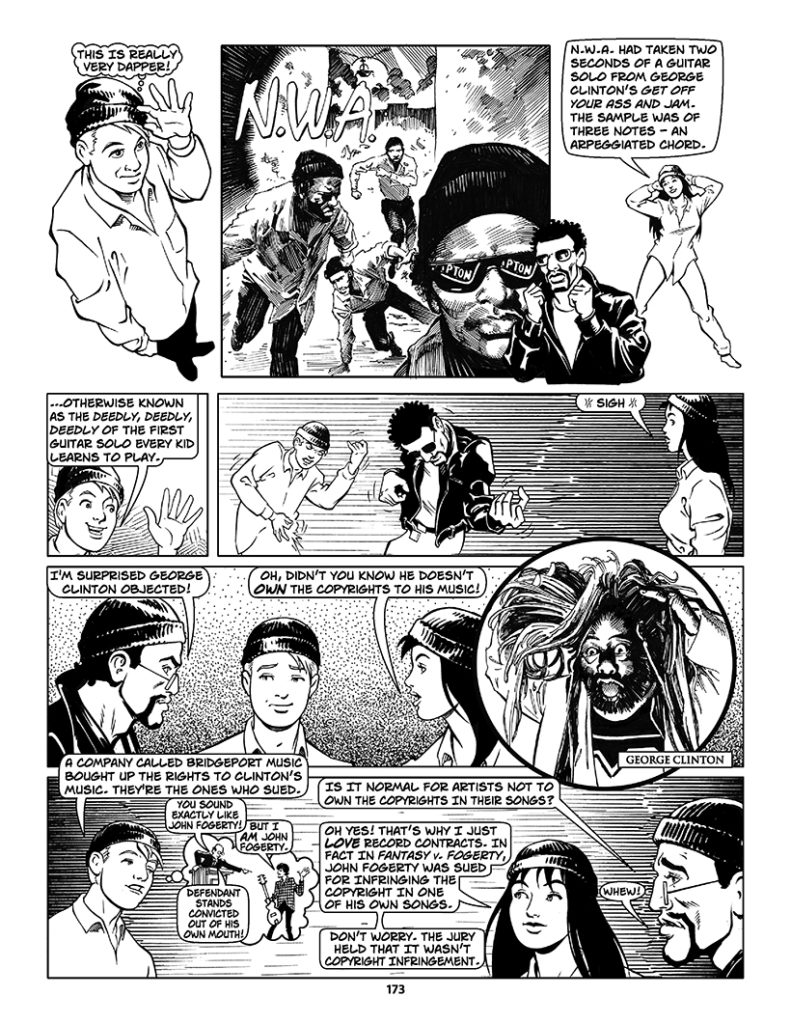
Theft! A History of Music is a graphic novel by James Boyle, Jennifer Jenkins and the late Keith Aoki. It’s about musical borrowing and the laws that have attempted to regulate musical borrowing and inter-mixing over the past 2000 years.
The history in this book runs from Plato to Blurred Lines and beyond. You will read about the Holy Roman Empire’s attempts to standardize religious music with the first great musical technology (notation) and the inevitable backfire of that attempt. You will read about troubadours and church composers, swapping tunes (and remarkably profane lyrics), changing both religion and music in the process. You will see diatribes against jazz for corrupting musical culture, against rock and roll for breaching the color-line. You will learn about the lawsuits that, surprisingly, shaped rap. You will read the story of some of music’s iconoclasts—from Handel and Beethoven to Robert Johnson, Chuck Berry, Little Richard, Ray Charles, the British Invasion and Public Enemy.
Theft! is informative and quite fun. I enjoyed it a lot. You can buy a paperback or get a free download. Here’s one page:
Global trade Danish shipping company fact of the day
Maersk had found that a single container could require stamps and approvals from as many as 30 people, including customs, tax officials and health authorities.
While the containers themselves can be loaded on a ship in a matter of minutes, a container can be held up in port for days because a piece of paper goes missing, while the goods inside spoil. The cost of moving and keeping track of all this paperwork often equals the cost of physically moving the container around the world.
That is by Nathaniel Popper and Steve Lohr, mostly about blockchains, via Ángel Cabrera.
Mumbai Razes Apartment Building, I Raise Questions
 A story in The Times of India unwittingly illustrates the problems of construction in Mumbai. It is headlined, 11-storey illegal building near tracks finally razed. Many newspapers carried the story and all of the ones that I read took a righteous tone. ‘Finally this illegal monstrosity has been demolished’, they said. The authors appeared to regret only that the city had taken so long to act.
The building was not illegally constructed on public property or park land nor on a historical landmark. There were no safety claims, as far as I could find, although people worried about the safety of the demolition job given the nearness to the railroad. The photo at right shows a before and after picture. The after does not look better to me than the before.
Not everyone was pleased. The locals, presumably mostly residents (or perhaps hired thugs), tried to stop the demolition:
The BMC began demolition of the structure in June 2016, but owing to severe resistance from locals and no adequate police protection, the work had to be stopped abruptly.
The demolition resumed in August 2016 with the help of around 80 labourers. Though locals again threatened the labourers, the BMC continued the work amid police protection.
Eventually, however, the building was razed to the ground. But here is where it gets interesting. Amazingly, this is not the first time a building on this site has been demolished. According to another report this is in fact the third demolition. Now either the developer is an idiot or it must be so costly to construct a building legally that it’s worth the very real risk of demolition to construct it illegally.
I understand the frustration that people feel when the law is flouted but the real question stories like this raise is, What kind of law makes it so expensive to construct new apartment buildings in a city that by some measures is the most unaffordable in the entire world?
The bureaucratization of protest
That is the topic of my latest Bloomberg column, here is one excerpt:
Take the famed Selma civil-rights marchers of 1965, when the protesters had obtained the legal right, through petition, to conduct a 52-mile, five-day march down an interstate highway. Of course, that blocked the highway and inconvenienced many motorists and truckers. America’s NIMBY mentality would most likely prevent a comparable event today.
Starting in the 1970s, the federal courts began to assert that public spaces are not automatically fair game for marches and demonstrations, and so local governments have sought to please the users of such facilities rather than marchers and protesters. For instance, during the 2004 Democratic National Convention, numerous would-be demonstrators ended up being confined to a “demonstration zone,” which one federal judge described as analogous to Piranesi’s etchings of a prison. The zone was ringed by barricades, fences and coiled razor wire.
Here is the closer:
Could we not have kept public demonstrations and protests more alive as a vital and nonbureaucratized tradition?
For a long time, most people ignored this issue, but I wonder if it won’t start to seem urgent once again.
Do read the whole thing.
Ji Haan, Minister
One of the unfortunate legacies of British colonial rule in India is a permanent civil service that tends to subvert any change that it deems against its interests, even when such change is promoted by elected officials. This is one reason why change in India is often two steps forward, 1.9 steps back. A case in point is India’s newly passed Goods and Service Tax (GST).
The GST was supposed to solve a long-standing problem of Indian intra-national trade. Unlike say the US common market, Indian states erect tariff and non-tariff barriers against the products of other states. As a result, production is allocated inefficiently–Indian firms with high costs hide behind barriers and produce too much while Indian firms with low costs can’t expand sales to other states and so produce too little.
(Canada, by the way, also has this problem. It’s often cheaper for a Canadian firm to ship to the US than to another province in Canada. You can find similar problems in Southern Africa where it is cheaper for South Africa to import produce from South America than from Zambia, as this excellent video discusses.)
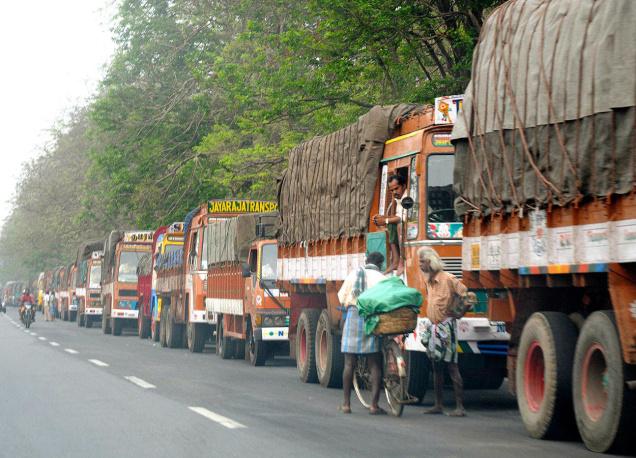 In addition to the inefficient allocation of production, barriers to internal trade have also raised India’s transportation and logistics costs.
At the Walayar checkpoint in southern India, lines of idle trucks stretch as far as the eye can see in both directions along the tree-lined interstate highway, waiting for clearance from tax inspectors that can take days to complete.
Delays are so bad that textile entrepreneur D. Bala Sundaram has stopped sending his trucks to the international container terminal at nearby Cochin, instead diverting them hundreds of kilometres to a smaller regional port and onwards via Sri Lanka…
Two-thirds of India’s freight travels by road. But only 40% of the travel time is consumed by driving, according to the World Bank. The rest is spent on waiting at state border checkpoints, paying state government levies and dealing with regulatory bureaucracies that vary from state to state.
The sad irony is that India spends billions improving its roads only to force its trucks to stop at state border checkpoints, sometimes for days, undermining the gains from the investment in roads.
The GST was going to simplify all this with a single umbrella tax creating one-tax, one-nation. Alas, the dream is being subverted. The law created a GST council of federal and state ministers and through this council the GST is rapidly becoming more complex and convoluted. First, one-tax was changed into four and with numerous exemptions the final number may end up being more like seven or eight.
Second, as I witnessed traveling between Uttar Pradesh and Rajasthan recently, the trucks are still lining up and may continue to do so:
The revolution the proposed goods and services tax (GST) promised might not be all that rosy because it would be hobbled by the need for an e-permit to be flashed at inter-state borders as the states insisted the old analogue practises continue.
The states seem to have gotten their way and will continue with the old ‘permit raj’ system, undermining one the biggest gains of GST.
The E-permit, by the way, sounds modern but don’t be fooled. Like India’s e-visa there is really nothing e about it–it’s just modern labeling for an old system.
Eventually the GST will be beneficial to India but it’s two steps forward, 1.9 steps back.
Me in Teen Vogue, on TPP
Here is the link, a very nice spread, here is an excerpt:
Cowen’s concerns about withdrawing from the TPP are far graver than that. “I think it’s saying [to the other countries], ‘We won’t be there for you,’” he says. “It’s signaling there is no pivot to Asia, America will go back into its shell. And I think 50 years from now, through largely intangible factors, that will mean a much worse world…. It’s [about] the whole vision of America engaging with the world.”
For example, Cowen points to both Japan and South Korea and the domino effect this could have on them. “If you’re South Korea and your best and biggest ally just told you, ‘We’re not even going to run this trade agreement,’ [but] they’re still telling you, ‘We’re gonna defend you against North Korea,’ I think at some point you start doubting that,” he says. “And [with] Japan, [if] the U.S. says, ‘No, you don’t need to build nuclear weapons — we’ve got your back,’ I think, as Japan, you need to start doubting that. I’m not sure either of those are things that will change overnight, but if we don’t reverse the unraveling perceptions, you’ll find those countries looking for their own solutions. South Korea would probably cut a deal with China. Japan might rearm more.”
…Cowen, for his part, hopes that Trump and his advisors come to their senses and figure out a way to continue some sort of free trade. “The best-case scenario is that Trump’s advisors go to him and say, ‘Look, you promised to renegotiate NAFTA. TPP does that. You’re very willing to tell people lies. Why not just tell people this is a new and better TPP? If need be, change some cosmetic things in it so it’s not a strict lie and then call it your own, rename it, and pass it,’” Cowen says. Though he doesn’t expect that to actually happen, he believes it would be a big win not only for America but also for Trump, the Republicans in Congress, and the businesses that would benefit from it. “I think it’s a pure political win.”
Self-recommending….
The repeal of China’s one-child policy isn’t mattering very much
Crude birth rates in Guangxi and Gansu edged down in 2016 from a year earlier. Both poor, western provinces have a large share of ethnic minorities, who were already exempt from the one-child policy, but are now assimilating the low-birth habits of the richer ethnic Han majority.
More surprising are the minuscule birth rate increases in China’s heartland. In Jiangxi province, the birth rate ticked up from 13.2 births per 1,000 people in 2015 to 13.45 last year, while in central Shaanxi province the rate rose from 10.1 to 10.64. The overall number of women of childbearing age has declined, meaning the potential impact of looser policy is limited, but changing social norms also play a role.
Here is more from Gabriel Wildau in the FT.
Are the Articles of Confederation underrated?
That is the topic of my latest Bloomberg column, here is one bit:
But I would say that the Articles, for all their formal flaws, are badly underrated. They are a brilliant construction for a power vacuum, given that the relevant parties in the 1780s couldn’t agree on very much, but nonetheless needed some path forward.
In other words, think of the Articles as an early business plan or charter for a startup. The point isn’t to get everyone’s roles and responsibilities right on first crack, but rather to make sure that the institution survives and that continued growth is possible.
By this metric, the Articles were an unprecedented success. Keep in mind that many European thinkers of the time thought that America was hopelessly disunited and that its system of government was due to collapse. The Articles proved them wrong by serving as a bridge from the Revolution to the later development of America as a fully fledged nation.
It is sometimes forgotten just how fruitful the Articles period was for laying the foundations for the further growth of the country. A system of relatively egalitarian and transferable property rights was codified for the settlement of external lands. Most importantly, the Northwest Ordinance of 1787 determined that future settlements could be incorporated into the country as states rather than subordinate territories or colonies. The independence and sovereignty of the initial founding states allowed them to support such policies, without fearing much dilution of their power or influence.
Alas I did not have the space to consider either Native Americans or slavery in the column. National expansion was of course in general bad for Native Americans. Slavery is a trickier matter, however. Since the Articles gave states stronger rights, it may seem like they must have been bad for slaves. But is that true? Under the Articles, precisely because states’ rights were stronger, it might have been easier to create more free states on the rest of the continent. I would judge the comparison as uncertain, plus we know the history with the Constitution involved an extremely bloody civil war.
The column has much more, including a discussion of the EU and also the emoluments clause in the Articles, do read the whole thing.
Why do governments leak information?
That is the topic of my latest Bloomberg column, here is part of the argument:
Sometimes governments trade leaked information to reporters, to curry favor. Other times leaks are used to hurt rivals within the public sphere, or a leak can serve as a trial balloon to test the popularity of an idea. Leaks also may help a president’s Cabinet members build up their own internal empires, which can boost a president’s agenda.
Or the American government may want to inform its people about, say, drone operations in Yemen, but without having to answer questions about the details. In this regard, leaks may substitute for more direct congressional oversight, to the benefit of the executive.
In other words, leaks are part of how the government manages the press and maintains its own popularity. A leak can get a story onto the front page, or if the first leak did not create the right impression, the information flow can be massaged by yet another leak.
Leaks are also a way of threatening other governments, yet without the president putting all of his credibility on the line. For instance, it can be leaked that the national security establishment would be especially unhappy with a further expansion of Israeli West Bank settlements. That sends a message, yet without committing the American government to any particular response if the settlements proceed. Or leaks can signal to foreign terrorists or governments that we know what they are up to.
Of course, many leaks are unwelcome, such as when national security confidences are disclosed. Given that reality, why haven’t American governments worked harder to prosecute unwelcome leaks and leakers?
Well, if that policy were pursued successfully, the only leaks that would occur would be “approved” or government-intended leaks, and everyone would figure this out. The government could no longer use leaks as a way of providing information or making threats in a distanced manner with plausible deniability.
Leak-receiving media outlets would feel more like pawns, and they would distance themselves from the leaking administration. Leaks would end up not being so different from announcements, which would counter the very purpose of leaks. And so whistle-blowing leaks and also security-diminishing leaks get pulled into the mix and tolerated to some degree.
Much of the rest of the column considers how matters have been changing under both Obama and Trump, and not generally for the better.
How disorderly is Sweden really?
Here is the latest, which is in the media but not being plastered all over my Twitter feed:
Just two days after President Trump provoked widespread consternation by seeming to imply, incorrectly, that immigrants had perpetrated a recent spate of violence in Sweden, riots broke out in a predominantly immigrant neighborhood in the northern suburbs of Sweden’s capital, Stockholm.
The neighborhood, Rinkeby, was the scene of riots in 2010 and 2013, too. And in most ways, what happened late Monday night was reminiscent of those earlier bouts of anger. Swedish police apparently made an arrest around 8 p.m. near the Rinkeby station. For reasons not yet disclosed by the police, word of the arrest prompted a crowd of youths to gather.
Over four hours, the crowd burned about half a dozen cars, vandalized several shopfronts and threw rocks at police. Police spokesman Lars Bystrom confirmed to Sweden’s Dagens Nyheter newspaper that an officer fired shots with intention to hit a rioter, but did not strike his target. A photographer for the newspaper was attacked by more than a dozen men and his camera was stolen, but ultimately no one was hurt or even arrested.
It remains correct that an American city such as Orlando typically will have more murders than all of Sweden in a year. But it is also important to process the distinction between objective and subjective metrics of disorder. A jaywalker in Germany disrupts public order and flouts norms more than is the case for a single jaywalker in New Jersey, for instance. Sweden is relatively orderly, in part, because the public and psychological reactions to acts of disorder are relatively severe and traumatic, even if those same acts might be perceived as less significant in other contexts. It is quite possible that Swedish norms are being threatened by the level of disorder currently in the country, even if to a Nigerian it all might seem absurdly neat and tidy.
There is also reasonable evidence that immigrants to Sweden are a major reason for the decline in the average quality of Swedish schooling and also Swedish PISA scores. In other contexts, we will be told that such variables are incredibly significant, but in this context the result ends up largely ignored.
The simplest metric, however, would simply be to poll citizens of Nordic and European countries who are familiar with Sweden, but don’t have direct self-interest at stake, and ask them if they want the immigration history of their country to go the Swedish route. I haven’t seen the data, but I believe the rate of “yes” on that one would be quite low. You could not say the same about Canada or Australia, I suspect, or for that matter the United States.
On this whole matter, I would not say that Trump’s remarks have been correct and for sure they have been irresponsible on the diplomatic front. Still, the overall presentation of his critics arguably has been further yet from the reality, and that is part of the reason why Trump finds such an audience.
Outline of the new Robin Hanson and Kevin Simler book
The Elephant in the Brain: Hidden Motives in Everyday Life, and here is the opening bit of the summary:
Human beings are primates, and primates are political animals. Our brains were designed not just to gather and hunt, but also to get ahead socially, often by devious means. The problem is that we like to pretend otherwise; we’re afraid to acknowledge the extent of our own selfishness. And this makes it hard for us to think clearly about ourselves and our behavior.
The Elephant in the Brain aims to fix this introspective blind spot by blasting floodlights into the dark corners of our minds. Only when everything is out in the open can we really begin to understand ourselves: Why do humans laugh? Why are artists sexy? Why do people brag about travel? Why do we so often prefer to speak rather than listen?
Like all psychology books, The Elephant in the Brain examines many quirks of human cognition. But this book also ventures where others fear to tread: into social critique. The authors show how hidden selfish motives lie at the very heart of venerated institutions like Art, Education, Charity, Medicine, Politics, and Religion.
Acknowledging these hidden motives has the potential to upend the usual political debates and cast fatal doubt on many polite fictions. You won’t see yourself — or the world — the same after confronting the elephant in the brain.
Due out January 1, 2018, of course this is essential reading.
America very rough calculation of the day those who walk amongst us
…only a tiny fraction of all living Americans ever convicted of a felony is actually incarcerated at this very moment. Quite the contrary: Maybe 90 percent of all sentenced felons today are out of confinement and living more or less among us. The reason: the basic arithmetic of sentencing and incarceration in America today. Correctional release and sentenced community supervision (probation and parole) guarantee a steady annual “flow” of convicted felons back into society to augment the very considerable “stock” of felons and ex-felons already there. And this “stock” is by now truly enormous.
…Very rough calculations might therefore suggest that at this writing, America’s population of non-institutionalized adults with a felony conviction somewhere in their past has almost certainly broken the 20 million mark by the end of 2016. A little more rough arithmetic suggests that about 17 million men in our general population have a felony conviction somewhere in their CV. That works out to one of every eight adult males in America today.
That is by Nicholas N. Eberstadt, via Arnold Kling. The broader piece is a useful litany of everything that has gone wrong since 1999 in this country.
North Korean tragedy markets in everything
The Indonesian woman arrested for suspected involvement in the killing of the North Korean leader’s half brother in Malaysia was duped into thinking she was part of a comedy show prank, Indonesia’s national police chief said Friday, citing information received from Malaysian authorities.
Tito Karnavian told reporters in Indonesia’s Aceh province that Siti Aisyah, 25, was paid to be involved in “Just For Laughs” style pranks, a reference to a popular hidden camera show.
He said she and another woman performed stunts which involved convincing men to close their eyes and then spraying them with water.
Here is the story, via Ray Lopez.
*Exception Taken: How France Defied Hollywood’s New World Order*
That is the new and excellent book by Jonathan Buchsbaum, offering the first comprehensive history of the debates over free trade and the “cultural exception,” as it has been called. It is thorough, readable, and goes well beyond the other sources on this topic.
To be sure, I disagree with Buchsbaum’s basic stance. He views “advertising dollars” as something attached to Hollywood movies like glue, giving them an unassailable competitive advantage, rather than an endogenous response to what viewers might wish to watch. The notion that French or other movie-makers could possibly thrive by innovating and exploring new quality dimensions seems too far from his thought. And he writes sentences such as: “France sought quickly to regulate multiplex development,” yet without wincing.
Perhaps his best sentence is the uncharacteristic: “Other commentators during the 1980s observed wryly that the only real European films were U.S. films, for only U.S. films succeeded in crossing borders in Europe.”
He spends a fair amount of time criticizing me, usually a positive feature in a book. Furthermore, he delivers very strongly on the basic history and narrative, and draws upon a wide variety of sources. So this one is definitely recommended to anyone with an interest in these topics.
China penalty of the day
China has banned almost 7m people from taking flights and high-speed trains over the past four years as a penalty for not repaying their debts, the country’s Supreme Court has announced.
The penalty system is part of efforts to build a nationwide “social credit” system that will eventually rate every Chinese citizen by collecting big data on financial, legal or social misdeeds. The debtors’ travel ban has been touted as an important first step for building the structural links needed to implement such a comprehensive monitoring programme.
“We have signed a memorandum . . . [with over] 44 government departments in order to limit ‘discredited’ people on multiple levels,” Meng Xiang, head of the executive department of the Supreme Court, told state media on Wednesday.
…In addition to not paying debts on time, one can also be blacklisted for lying in court, hiding one’s assets and a host of other crimes. The Supreme Court said on Tuesday it was working on adding new forms of penalties.
Here is the FT story by Yuan Yang. Keep in mind that the country does not have a real personal bankruptcy law, nor well-developed credit institution penalties, so this is viewed as one of the few options available.