Category: Law
Authoritarians Distract Rather than Debate
It’s long been known that the Chinese government hires people to support the government with fabricated posts on social media. In China these people are known as the “50c party”, so called because the posters were rumored to be paid 50 cents (5 jiao or about $.08) to write the posts. The precise nature and extent of the 50c party has heretofore been unknown. But in an amazing new paper, Gary King, Jennifer Pan and Margaret Roberts (KPR) uncover a lot of new information using statistical sleuthing and some unusual and controversial real world sleuthing.
KPR’s data-lever is an archive of leaked emails from the Propaganda Office of Zhanggong. The archive included many 50c posters who were sending links and screenshots of their posts to the central office as evidence of their good work. Using these posts, KPR are able to trace the posters though many social media accounts and discover who the posters are and what they are posting about. Both pieces of information reveal surprises.
First, the posters are government workers paid on salary not, as the 50c phrase suggests, piece-rate workers. Second, and more importantly, it has long been assumed that propaganda posts would support the government with praise or criticize critics of the government. Not so. In fact, propaganda posts actively steer away from controversial issues. Instead, the effort appears to be to distract (especially to distract the people from organizing collective action; thus distraction campaigns peak around times and places where collective action like marches and protests might become focal). KPR write:
Distraction is a clever and useful strategy in information control in that an argument in almost any human discussion is rarely an effective way to put an end to an opposing argument. Letting an argument die, or changing the subject, usually works much better than picking an argument and getting someone’s back up…
Debate is about appealing to an individual’s reason; debate is thus implicitly individualistic, respectful of rights and epistemically egalitarian. (As I argued earlier, respect for the truth is tied to individualism because any person may have truth and reason on their side.) Authoritarians don’t care about these things and so they lie and distract with impunity and without shame. In this case, the distraction is done subtly.
From the initial archive, KPR are able to create a statistical picture of 50c posters. In one of the most remarkable parts of the paper they use this picture to identify many other plausible 50c posters not in the original archive. Then KPR test their identification with a kind of academic catfish–essentially they trick the 50c posters into self-identifying. It’s at this point that KPR’s paper begins to read more like the description of a CIA op than a standard academic paper.
We began by creating a large number of pseudonymous social media accounts. This required many research assistants and volunteers, having a presence on the ground in China at many locations across the country, among many other logistically challenging complications. We conducted the survey via “direct messaging” on Sina Weibo, which enables private communication from one account to another. With IRB permission, we do not identify ourselves as researchers and instead pose, like our respondents, as ordinary citizens.
Using their own fake accounts, KPR directly message people they think are 50c posters with a message along the lines of:
I saw your comment, it’s really inspiring, I want to ask, do you have any public opinion guidance management, or online commenting experience?
The question is phrased in a positive way and it uses the official term “public opinion guidance” rather than the 50c term which has a negative connotation. Amazingly, 59% of the people KPR identify as 50c posters answer yes, essentially outing themselves.
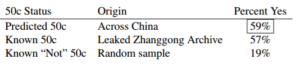 Now, one might wonder whether such a question has evidentiary value but KPR do a clever validation exercise. First, they ask the same question to people from the original leaked archive, people whom KPR know are actual 50c posters. Second, they ask the same question of people who are very unlikely to be 50c posters. The result is that 57% of the known 50c posters answer the question, yes. Almost exactly the same percentage (59%) as in the predicted 50c sample. At the same time, only 19% of the posters known not to be 50c answer yes (that doesn’t mean that 19% are 50c but rather that 19% is a measure of the noise created by asking the question in a subtle way). What’s important is that the large 40 point difference gives good statistical grounds for validating the predicted 50c sample.
Using this kind of analysis and careful, documented, extrapolation, KPR:
…find a massive government effort, where every year the 50c party writes approximately 448 million social media posts nationwide. About 52.7% of these posts appear on government sites. The remaining 212 million posts are inserted into the stream of approximately 80 billion total posts on commercial social media sites, all in real time. If these estimates are correct, a large proportion of government web site comments, and about one of every 178 social media posts on commercial sites, are fabricated by the government. The posts are not randomly distributed but, as we show in Figure 2, are highly focused and directed, all with specific intent and content.
As if this weren’t enough, an early version of KPR’s paper leaked and when the Chinese government responded, KPR became part of the story that they had meant to observe. The government’s response is now in turn used in this paper to verify some of KPR’s arguments. Very meta.
It took courage to write this paper. I do not think any of the authors will be traveling to China any time soon.
As a thinker, Donald Trump is in some ways underrated
President-elect Donald Trump criticized a cornerstone of House Republicans’ corporate-tax plan, which they had pitched as an alternative to his proposed import tariffs, creating another point of contention between the incoming president and congressional allies.
The measure, known as border adjustment, would tax imports and exempt exports as part of a broader plan to encourage companies to locate jobs and production in the U.S. But Mr. Trump, in his first comments on the subject, called it “too complicated.”
“Anytime I hear border adjustment, I don’t love it,” Mr. Trump said in an interview with The Wall Street Journal on Friday. “Because usually it means we’re going to get adjusted into a bad deal. That’s what happens.”
Here is the WSJ piece. I am not suggesting, however, that I favor his preferred alternative or for that matter most of his other policy ideas. By the way, here is Trump on heroes. A willingness to think things through from scratch is in some ways admirable, but dangerous in matters of foreign policy and nuclear weapons, where predictability is at a premium.
And see some related remarks from Conor Sen.
Some new results on family policies and women
Most estimates of the impact of parental leave entitlement on female labor market outcomes range from negligible to weakly positive. There is stronger evidence that spending on early education and childcare increases labor force participation of women and reduces gender gaps.
That is from a new NBER paper by Claudia Olivetti and Barbara Petrongolo. A different new paper, by Hope Corman, Dhaval Dave, Ariel Kalil, and Nancy E. Reichman, offers these results:
We find that welfare reform led to reduced youth arrests for minor crimes, by 7-9 %, with similar estimates for males and females, but that it did not affect youth arrests for serious crimes. The results from this study add to the scant literature on the effects of maternal employment on adolescent behavior by exploiting a large-scale social experiment that is still in effect to this day, and provide some support for the widely-embraced argument that welfare reform would discourage undesirable social behavior, not only of mothers, but also of the next generation.
Overall I still consider Clinton-era welfare reform to be underrated.
Ransomware Goes Big Time
Washington Post: The cyberattack struck Los Angeles Valley College late last month, disrupting email, voice mail and computer systems at the public community college in Southern California. Then, school officials found a ransom note.
The missive advised the college that its electronic files had been encrypted and that the files could only be unlocked with a “private key.” The attackers would supply the key after receiving payment in the valuable digital currency known as bitcoin, which can be used anonymously without a centralized bank.
“You have just 7 days to send us the BitCoin after 7 days we will remove your private keys and it’s impossible to recover your files,” the attackers warned, according to a copy of the note obtained by The Washington Post.
Leaders of the Los Angeles Community College District decided to pay the ransom.
The college paid $28,000 and the files were restored.
ArsTechnica: According to the FBI, ransomware payouts in the United States jumped from $25 million in all of 2015 to over $209 million in just the first quarter of 2016.
Clearly, this is just the beginning.
Would you rather be ruled by the people or the experts?
In my latest Bloomberg column I consider William F. Buckley’s old conundrum:
William F. Buckley famously said he would rather be ruled by the first 2,000 people listed in the Boston telephone directory than by the faculty of Harvard University.
Here is part of my take:
For better or worse, direct rule by Buckley’s 2,000 American citizens probably would mean a slower pace of immigration, less emphasis on free trade, more law and order politics, and a blunter form of nationalism in foreign policy.
Those don’t match my policy preferences (I am more of a globalist, and also a professional academic), but I fear what the Harvard faculty could bring. I can imagine an America closer to Bernie Sanders’s vision, with single-payer health insurance, levels of taxation exceeding 50 percent of GDP, levels of immigration unsustainable with a large welfare state, too many aggressive attempts to legislate equal treatment for various groups, excessive fondness for a universal basic income, and too many humanitarian interventions abroad.
Don’t forget:
It’s a good rule of governance that policy cannot race too far ahead of the citizenry, and I don’t view faculty as a class of people well-suited for that kind of humility.
But for the Fed and the EPA, among other areas, I very much want Harvard. My conclusion is this:
The real issue here isn’t intellectuals versus populism writ large. There is a time and place for populist sentiment, but an excess can be counterproductive on its own terms. As expertise is pushed out the door, the citizenry itself gets a bad name, precisely when we most need it to step up to the plate and demand some excellence.
Do read the whole thing.
I should note that on this topic I have been very much influenced by my colleague David Levy and also his work with Sandra J. Peart, see for instance their newly arrived book Escape from Democracy: The Role of Experts and the Public in Economic Policy.
Is it boring to have too little corruption?
A few years ago I wrote this about Bolivia:
It is much debated in Bolivia whether corruption is going up or down. I believe it is going up, but partially for good reasons. For instance the construction sector is doing well, and construction tends to be corrupt in many countries, for reasons intrinsic to the activity itself (e.g., lots of big contracts, easy to claim invisible expenses, etc.). That means higher corruption but also a better corruption than the penny ante bribes of a shrinking economy.
I still think that is correct, and at the time it didn’t meet up with mass moral opprobrium, even though with some very very small chance I may have condemned the citizenry of Bolivia to corrupt, exploitative rule for ever and ever. I should add that such points are standard fare in the literature, see for instance the book on corruption by Susan Rose-Ackerman.
Now, these days, with more American status relationships on the line, everyone is up in arms because Peter Thiel had the following exchange with Maureen Dowd:
When I remark that President Obama had eight years without any ethical shadiness, Mr. Thiel flips it, noting: “But there’s a point where no corruption can be a bad thing. It can mean that things are too boring.”
As I interpret Peter, he is not saying it would have been good to have an exogenous increase in the corruption of Obama the individual. Rather, had some other conditions been different/better, the overall level of corruption in government would have been higher and that combination might very well have been a net plus. If you would like a “left wing example,” had the fiscal stimulus been twice as large, corruption in government probably would have been higher too (pointing out “the stimulus wasn’t very corrupt” is missing the point and in fact is a sign that you are a rampant mood affiliator, determined to restore the mood you feel is just, rather than tracing the analytic point at hand). In other words, Peter’s point is entirely defensible and probably correct. He’s not saying that “corruption is good.”
Now, to be sure, there is another dimension here. The incoming Trump administration is showing too many signs of being corrupt, and many people are condemning it on these grounds. Peter’s remark does not fit into that narrative and Peter has been a significant Trump supporter. But let’s think about this a little more. First, is there a role for some outsiders who eschew the dominant moral choruses of approbation and condemnation, in favor of making other, different points? I certainly hope so, because often I try to be one of them (though unlike Peter I have not supported Trump). Second, Peter is not an outsider in this process, rather he has taken on an important position on the Trump transition team. Given that reality, you can’t expect him to produce a quotation here condemning Trump. So he instead makes some other (valid) outsider-like point about corruption. Now, you might object to Peter’s role on the transition team, but that is old news at this point. You shouldn’t be holding any extra grudge against him for his corruption answer. And above all, keep in mind these are reporter-chosen excerpts from a four-hour dinner/interview, and so we don’t know the surrounding context and qualifications and possibly accompanying off the record statements.
People, you need to pick your targets. Get upset about the things worth getting upset about, such as the absence of a sustained foreign policy plan to head off imminent volatility in global relations.
The culture that is Swiss not Dutch
How many of you have been expecting that heading? Of course it involves cows:
A Dutch woman has seen her request for Swiss citizenship refused for the second time by local residents who object to her media campaigning against cowbells and other Swiss traditions.
Nancy Holten, 42, was born in the Netherlands but grew up in Switzerland from the age of eight, speaks fluent Swiss German and has children with Swiss citizenship.
A vegan and supporter of animal rights, she gained a reputation in her community of Gipf-Oberfrick, in the canton of Aargau, after campaigning against cowbells, claiming they were damaging to cows’ health.
She has also objected to hunting and piglet racing, and complained about the noise of church bells in the village, campaigns that have seen her regularly interviewed in the Swiss press over the past few years.
Last November, Holten had her citizenship application turned down for the second time by the residents’ committee. That’s despite her meeting all legal requirements and the municipal and cantonal authorities having no formal objection.
In Switzerland local residents often have a say in citizenship applications, which are decided primarily by the cantons and communes where the applicant lives, rather than federal authorities.
In Holten’s case it seems her campaigning has not won her many friends in the village, with the president of the local branch of the Swiss People’s Party, Tanja Suter, telling the media that Holten has a “big mouth”.
The commune did not want to give Holten the “present” of Swiss citizenship “if she annoys us and doesn’t respect our traditions”, said Suter.
Is this not what politics should be about, namely the relationship between man and nature? Here is Gipf-Oberfrick, the community in question:

Here is the full story, with a variety of interesting points and examples at the link, via Ted Gioia and Dan Wang.
What to protest Black Lives Matter continued
Following up on yesterday’s discussion, I received this in my email:
I think you protest society (and whatever you think the cause is) on the unconditional probabilities but only protest cops on the conditional probabilities.
That is from a very high quality correspondent. Since I think BLM is in large part trying to raise consciousness about society at large, and not just complaining about the cops, it is fine for them to protest the large number of bad outcomes for many black people without getting too caught up in the “conditional upon x, y, and z, is a cop more likely to shoot a black or a white person?” sort of question. Body cameras, reforming/ending the War on Drugs, stronger civil liberties, and other changes make sense for macro reasons, no matter what your view on the conditional probabilities. So a big chunk of your 300+ comments are simply off the mark.
My response to the correspondent included the following good advice:
Every movement…has a smart version and a stupid version, I try to (almost) always consider the smart version. The stupid version is always wrong for just about anything.
If you focus on the stupid version, you too will end up as the stupid version of your own movement.
China fact of the day
RMB accounted for 98% global bitcoin trading volume over past six months
Here is the link, picture, and source. Of course that is all about capital controls, and a capital control-evading mechanism is what Bitcoin has evolved into. I wonder how it will evolve further, especially if the Chinese crack down on the practice, which they are more than capable of doing.
The FDA Fails to Prevent Traveler’s Diarrhea
I’ve been getting lots of vaccinations in preparation for my sabbatical in India. A Canadian friend recommended Dukoral. Dukoral is a vaccine for cholera, a very serious disease although one that’s rare for travelers even in undeveloped countries. (It’s roughly comparable in prevalence to Japanese encephalitis, however, which most travel physicians recommend vaccinating for.) As a side-effect, however, Dukoral is also quite effective (60%) against the most common cause of traveler’s diarrhea, that caused by enterotoxigenic E. coli.
 Dukoral was approved in the European Union in 2004 but it has not been approved in the United States (a different cholera vaccine was approved late last year but it is not yet widely available). Moreover, Dukoral is available without a prescription in Canada (and also I believe in New Zealand). It’s a big seller in Canada and widely used by Canadians abroad.
It has long been my position that if a medical drug or device has been approved in another developed country then it ought to be approved in the United States. If it’s good enough for the Canadians then it’s good enough for me.
Never let it be said that I don’t follow through on my beliefs. I arranged for someone to buy me some Canadian Dukoral and ship it over the border. Unfortunately, my “connect” is not as practiced in the art of evading U.S. customs as would be ideal and in a fit of regrettable honesty wrote “gift, diarrhea medicine” on the package. The ever-vigilant U.S. Customs intercepted and confiscated my package, thus saving me from the dangers of FDA-unapproved medicine. So I am out $150 (2 doses) and will be less than fully protected on my trip.
If my son or I become “indisposed” in India, I will know who to blame.
Understudied conflicts of interest in American government
Roger Barris emails me:
I am not sure that this is a suitable subject for a blog post, probably more a project for an aspiring PhD student, but with all the discussion of conflicts of interest in the Trump cabinet, it strikes me that the most glaring conflict in the public sector is ignored: The CoI between state and local politicians elected with the support of public sector unions who then participate in compensation negotiations for the members of those unions. Here the temptation of the politicians to buy the support of the unions with public money is overwhelming. The impact of this is potentially trillions when public pension liabilities are included.
This is such an obvious conflict that I have looked to see if there are laws preventing this, but my initial research shows nothing.
It would be interesting to see if there is a statistical relationship between union support and subsequent pay rises. I would expect this relationship to be especially strong with deferred compensation (such as pensions) since this is very difficult for voters to monitor and can be easily gamed with unrealistic assumptions about, for example, investment returns.
Are you aware of any work that has been done in this field? I think that the looming disaster with underfunded public pension funds is one of the biggest financial risks in the economy, with ZIRP making it even worse.
Can any of you direct Roger to the appropriate secondary literature on this question? A related question is whether this conflict of interest makes you more or less upset than the more corporate-connected conflicts of interest found in the incoming Trump administration.
From the comments, on the new Republican tax plan
The non-deductibility of imports is simply crazy. It will immediately increase inflation. Take IKEA, for example, they cannot source locally, they will increase prices immediately by 20%, or whatever the tax will be. At all effects, it is a flat tariff of 20% on every import. This guy seems to want to transform the US into North Korea. And think about the distortions: Boeing will become a purchasing company, making more money using the tax-credit to buy prosciutto and Camembert to sell to retailers at prices lower than the marginal cost, than producing planes.
That is Coasean reasoning from Massimo, there are other good comments as well. For instance Bob noted:
There will be a huge move to asset based leasing. So Wal-mart, instead of borrowing money will sell thier real estate to a REIT and lease it back. They essentially can keep the deduction.
Computer bot sentences to ponder
…as pricing systems become ever more autonomous, aspiring monopolists like Mr Topkins eventually will not even need to speak to their competitors to fix prices. Computers will do the colluding for them, either by using the same algorithm or learning from their interactions with other machines — all without leaving behind trails of incriminating emails or voicemails.
“Finding ways to prevent collusion between self-learning algorithms might be one of the biggest challenges that competition law enforcers have ever faced,” said a recent paper by the OECD, the Paris-based club of mostly rich nations.
These digital tools automatically calculate prices based on instantaneous assessments of supply and demand and a seller’s own instructions, such as specific profit or price targets.
…It [the OECD] added: “Particularly in the case of artificial intelligence, there is no legal basis to attribute liability to a computer engineer for having programmed a machine that eventually ‘self-learned’ to co-ordinate prices with other machines.”
That is from David J. Lynch at the FT. Will this prove more or less stable than traditional, human-based collusion? Here are comments from Henry. Can the bots send buyers “we are breaking the collusion now” alerts? Will monitoring third party bots perform that function? Or will collusion reign supreme?
When should the federal government own land?
Public land would be interesting.
That was a request for topic coverage from Ryan, from last night. Here is a 2014 CRS survey piece with good background information.
I can think of a few reasons for federal government ownership of public land:
1. For some specific purpose, such as a national park or a nuclear weapons facility or the White House.
1b. There is a conservation argument for land holdings, but again I think it has to be for a specific purpose, thus collapsing into #1 proper.
2. As a revenue-maximizing strategy, a’la Irvine Company, so the government can sell off pieces of land successively, over time, to take in more revenue than if it sold off everything all at once.
3. To hold land off the market and thus force more people to squeeze into cities, thereby reaping extra returns to scale and density, shades of Edward Gibbon Wakefield.
4. To limit rent-seeking games, since much of the land might be low value in the present, but a race to homestead it would consume resources. In the longer run, that homesteading race would lead to suboptimal owners, since we don’t now know exactly what the land will be good for.
5. It’s the only way we can run an asset surplus, since cash would be grabbed by the political process and redistributed. Think of it as akin to those poorer villages where you save in the form of cows or pigs, because your uncle cannot come to you when he needs to fund a wedding and demand a piece of the pig.
I say #1 is unproblematic and can be decided on a case-by-case basis. #2 is fine if the government were doing that, but they’re not. #3 would seem to require much more federal ownership of land than what we have. It’s still much, much cheaper to live in Idaho. #4 is an OK argument, but I don’t see why it would apply to properly done land auctions, which is indeed how federal disposal of the land has evolved.
So #5 is actually the main argument, at least once we get past #1.
Overall, I don’t see why the federal government needs to own about 28% of the country. Nonetheless, in the meantime the government does allow grazing and mining to take place on those lands, often at below-market rents. (By the way, for now I am putting on hold a possible #6: “federal land ownership is the most efficient way to regulate mining and fossil fuel extraction.” It raises issues far beyond the scope of the current discussion, though it is significant.)
You will note that the federal government owns 47% of the land in “the West,” but only 4% of the land east of the Mississippi. Unfortunately:
Congress in 1976 passed a law declaring that “the remaining public domain lands generally would remain in federal ownership.”
Though note a few days ago the House acted to ease land giveaways, so this may be changing. Yet I feel no great thrill at simply giving this land to the state governments, though that may be an intermediate step toward privatization.
I would prefer to lower the percentage of federal land ownership in the West, but in the meantime I don’t see this as an incredibly pressing issue. The government can either waste some of your land or some of your money, take your pick. I do think the gdps of Nevada and Idaho could be higher, just not by that much. Alaska may be a story of its own.

Might The Great Stagnation end with The Great Medication?
That is the topic of my latest Bloomberg column, here is the last bit:
I don’t mean to say that technological stagnation is a good thing. But sometimes the biggest advances lead to more tragedy than comfort, especially in the short run, before we learn how to adjust to their challenges. To paraphrase Peter Thiel, they promised us flying cars, and what we got was a bunch of stoned characters, and more than 140 of them. Beware the end of the productivity slowdown.
Do read the whole thing.