Category: Law
England is underrated, a continuing series
The UK has said it will refrain from regulating the British artificial intelligence sector, even as the EU, US and China push forward with new measures. The UK’s first minister for AI and intellectual property, Viscount Jonathan Camrose, said at a Financial Times conference on Thursday that there would be no UK law on AI “in the short term” because the government was concerned that heavy-handed regulation could curb industry growth.
Here is more from the FT. And also from the FT: “UK approves Crispr gene editing therapy in global first.“
A Tax Puzzle
Analyze the following four images. For each image, guess what is being taxed. Use only the information in the image.

FYI ChatGPT was not able to solve this question directly, although it was very good at analyzing what was distinctive or odd about each image and thus suggesting some possible answers.
Hat tip: Lionel Page, via Shruti Rajagopalan, includes answers and some variants.
Pharmaceutical Price Controls and the Marshmallow Test
The pharmaceutical market is in turmoil. On the one hand we have what looks like a golden age of medicine with millions of lives saved by COVID vaccines, a leap in mRNA technology, excellent new obesity and blood sugar drugs, breakthroughs in cancer treatments and more. On the other hand, the Inflation Reduction Act includes the most extensive price controls on pharmaceuticals we have ever seen in the United States.
In Washington-speak the “Inflation Reduction Act” requires HHS to “negotiate” drug prices for Medicare Part D and Part B to establish a maximum “fair” price. In reality there is no negotiation–firms who refuse to negotiate are hit with huge taxes. The “negotiation,” if you want to call it that, is “your money or your life” and fairness has little to do with it. The IRA also requires very costly inflation rebates, i.e. a price control/tax. In essence, the IRA is a taking; for drugs with a large Medicare market it is similar to abrogating patents to 9 years for small molecule drugs and 13 years for biologics. For the included drugs there will be a significant reduction in revenues. Moreover, we don’t yet know whether the plan will be extended to more and more drugs. There is significant uncertainty affecting the entire market. What will be situation in 10 years? Will the US be like Europe?

Reduced revenues mean less R&D. The value of extending life is very high and so in my view medical R&D is underprovided. Thus, price controls are taking us in the wrong direction.
The positive effects of price controls are immediate and easy to see: Prices are reduced.
The negative effects of price controls take time and are harder to see. Namely:
- Fewer drugs for Medicare market.
- Less research on post-approval indications and confirmatory trials.
- Reduced incentive for generics to enter quickly.
- Most importantly: Less R&D spending leading to fewer new drugs, a reduced pharmaceutical armory, lower life expectancy and higher morbidity. By one calculation, ~135 fewer new drugs through to 2039 (see also here and here and here and here).
- Fewer new drugs means more spending on physicians and hospitals so in the long run price controls may not even save money! (Most prescriptions are for generics. Drugs fall greatly in price when they go generic but physicians and hospitals never go generic!)
Price controls are a classic example of political myopia. Price controls, like rent controls and deficit financing, have modest benefits now and big future costs and thus they are supported by politicians who want to be elected now. Unfortunately, current citizens don’t forecast the future well and future citizens don’t have a vote so it’s easy to create big future costs without engaging an opposition.
The emergence of groundbreaking pharmaceuticals and the increasing implementation of price controls are probably related trends. Everyone wants the great new pharmaceuticals without paying for them. We need to think more long-term–we have much more to gain from a continuing flow of new pharmaceuticals than from lower prices on the last generation. Don’t forget that children who fail the marshmallow test do less well later in life. Well, our government is failing the marshmallow test, big time.
Pharmaceutical price controls driven by myopia and the failure to delay gratification are greatly harming future patients.
Zoning Deregulation Increases Affordable Housing
Geetika Nagpal and Sahil Gandhi study zoning deregulation in Mumbai, India. As I pointed out in my video, Skyscrapers and Slums: What’s Driving Mumbai’s Housing Crisis?, Mumbai has very restrictive floor area ratio regulations (also called Floor Space Index, FSI, regulations, see the video for an explanation) which means taller buildings require more unused land. In 2018, however, FAR was liberalized for some streets:
Mumbai’s stringent FAR limits, which are much lower than those of comparable megacities, are often criticized for causing housing unaffordability (Bertaud, 2004). Despite the criticism, establishing a causal effect has been challenging because of a lack of changes in FAR regulations. The relaxation in 2018 linked a parcel’s FAR to the width of its bordering road, providing incremental FAR relaxation for parcels on roads wider than 12 meters. Parcels on narrower roads remained ineligible for the relaxation. Our reduced-form specification uses a DID design to compare developments built between 2014 and 2022 on wider roads with FAR relaxation with those on narrower roads that remained ineligible.
…The FAR relaxation results in a significant supply response, driven by less expensive, smaller housing units. Developers fully utilize the FAR relaxation, increasing the average
number of apartments in each treated multifamily development by 28% relative to the control.…We develop a structural model of housing supply and demand that incorporates the provision of amenity floorspace and shows that average home buyer incomes are 3.18% lower post-relaxation.
GO YIMBY!
Geetika Nagpal is on the market from Brown.
Freer Indian reservations prosper more
Several disciplines in social sciences have shown that institutions that promote cooperation facilitate mutually beneficial exchanges and generate prosperity. Drawing on these insights, this paper develops a Reservation Economic Freedom Index that classifies institutions on a sample of Indian reservations concerning whether these intuitions will enhance the prosperity of Indians residing on these reservations. The development of this index is guided by the research of political scientists, economists, other social science disciplines, and research in law. When correlating this index with Indian incomes, the evidence shows a statistically significant positive correlation between reservations with prosperity-enhancing institutions and their economic prosperity.
That is from a recent article by my colleague Thomas Stratmann, recently published in Public Choice. Here is the SSRN version. Here is the index itself. Here is a related Op-Ed.
The Latin American option
Estimates for the number of Palestinians, Syrians, and Lebanese in Brazil range from 10 to 12 million, with a reasonable degree of uncertainty. Most of them came over before those were distinct countries, for one thing. Other Latin American countries also have migrants from that region, Panama in particular, and as you may know Bukele of El Salvador is of Palestinian origin.
I don’t know of any formal statistics, but by repute those individuals have done quite well in Latin America. And it is hard to argue they have increased rates of violence or political disorder.
I would gladly see Brazil and other Latin polities open their immigration to current Palestinians in the Middle East.
The major Latin economies have very low fertility rates, about 1.55 for Brazil. They will need more people, and more young people, in any case. Now seems like a good time to act.
What the Kia-Hyundai Crime Wave Tells Us About the Long-Term Decline in Crime
 Motor vehicle thefts (per capita) are about one third the level they were in the early 1990s, a drop which is consistent with the Great Crime Decline, the large fall in many crimes since the early 1990s. A lot of ink has been spent trying to explain the great crime decline–abortion legalization, lead abatement, increased imprisonment, more policing–these are just some of the leading theories.
In recent years, however, there has been a notable increased in motor vehicle theft–not back to earlier peaks–but a substantial increase. Theft hasn’t increased uniformly across the board, however. Thefts of Kias and Hyundais have seen massive increases–in some places thefts of these cars have increased by a factor of five or ten in just a few years. The reason is simple–most cars today have electronic immobilizers which mean that without the key present these cars can’t easily be hotwired. Some enterprising thieves, however, discovered that Kia and Hyundai neglected to install these devices and they spread the word through Tik-Tok videos about a method to quickly and efficiently jack these cars.
I propose that the micro can shed light on the macro. Consider the four theories for the great crime decline that I mentioned earlier–abortion legalization, lead abatement, increased imprisonment and more policing. The first two, abortion legalization and lead abatement, are theories about why there are fewer criminals–these theories say that people improved and that is why crime declined. But better people shouldn’t steal any car models, including Kias and Hyundais! Moreover, people haven’t suddenly become worse. Thus, offender-based theories cannot explain the sharp rise in motor vehicle thefts. There have been some changes in punishment, imprisonment and policing, in recent years but these have been slow moving and fairly small and in addition they also don’t explain the rise in Kia and Hyundia thefts in particular.
Obviously, what explains the rise in thefts of Kias and Hyundias in particular is the discovery that these vehicles were unguarded, unprotected and unsecured. Notice that being unguarded, unprotected and unsecured swamped any effect coming from abortion legalization, lead abatement, increased imprisonment or more policing.
The failure of the big four to explain the rise in Kia and Hyundai thefts isn’t proof that these theories are wrong. But lets ask the inverse question, can the rise in Kia and Hyundai thefts suggest an explanation for the great crime decline? In other words, can we explain the great crime decline by an increase in security. Begin with the most direct case, motor vehicle theft. Car immobilizes and other security devices began to be installed in the 1990s so the timing fits. Moreover, the timing fits multiple countries. One of the weaknesses of theories of the great crime decline such as increased imprisonment and policing is that these theories work for the United States but the crime decline occurred in many industrialized countries at about the same time. Canadian crime rates, for example, fall in near lockstep with US rates but with very different prison and policing strategies. Immobilizer technology, however, happened at similar times in similar places and where we saw delays or early adoption we also see delayed or early falls in motor vehicle theft. In addition, motor theft declined first for newer cars (secured) rather than for older cars despite the fact that the newer cars are the more desirable for thieves–again this fits the security hypothesis better than an offender or punishment hypothesis.
The security hypothesis fits motor vehicle theft but the connection is less clear with respect to other crimes. Home security devices have increased and become higher quality over time but the change was less rapid and less precisely timed to the early 1990s. The rise of credit cards and decline of cash could have reduced muggings, although again the timing doesn’t appear to be precise. Violent crime would seem even less likely to be security related–although cameras and lights surely matter–but keep in mind that a lot of violent crime is a side-effect of property crime. Vehicle thefts, muggings and drug deals turn into homicides, for example. In addition, there are “life of crime” or “career” effects. If you make motor vehicle theft and burglary less profitable that makes a life of crime less profitable which can reduce crime in general even without specific deterrence.
Overall, the security hypothesis carries some weight, especially in explaining multiple countries. I don’t fully discount any of the major theories, however. Multiple causation is important.
The main less I draw is this: The increase in Kia and Hyundai thefts suggests that the crime wave declined not because the ocean became more gentle but because we built more secure sea walls. The big waves are still out there in the vast ocean and if we lower the walls we shouldn’t be surprised if another big crime wave comes rolling in.
My Conversation with Harriet Karimi Muriithi
This is another CWT bonus episode, recorded in Tatu City, Kenya, outside of Nairobi. Harriet is a 22-year-old waitress. Here is the audio, video, and transcript. Here is the episode summary:
Harriet is a 22-year-old hospitality professional living and working in Tatu City, a massive mixed-used development spearheaded by Jennings. Harriet grew up in the picturesque foothills of Mount Kenya before moving to the capital city as a child to pursue better schooling. She has witnessed Nairobi’s remarkable growth firsthand over the last decade. An ambitious go-getter, Harriet studied supply chain management but and wishes to open her own high-end restaurant.
In her conversation with Tyler, Harriet opens up about her TikTok hobby, love of fantasy novels, thoughts on improving Kenya’s education system, and how she leverages AI tools like ChatGPT in her daily life, the Chinese influence across Africa, the challenges women face in village life versus Nairobi, what foods to sample as a visitor to Kenya, her favorite musicians from Beyoncé to Nigerian Afrobeats stars, why she believes technology can help address racism, her Catholic faith and church attendance, how COVID-19 affected her education and Kenya’s recovery, the superstitions that persist in rural areas, the career paths available to Kenya’s youth today, why Nollywood movies captivate her, the diversity of languages and tribes across the country, whether Kenya’s neighbors impact prospects for peace, what she thinks of the decline in the size of families, why she enjoys podcasts about random acts of kindness, what infrastructure and lifestyle changes are reshaping Nairobi, if the British colonial legacy still influences politics today, and more.
Here is one excerpt:
COWEN: How ambitious are you?
MURIITHI: On a scale of 1 to 10, I will say an 8.5.
This episode is best consumed in combination with the episode with the village elder Githae Gitinji. The contrast between the two perspectives is startling. And here is my CWT episode with Stephen Jennings, concerning Tatu City itself.
My Conversation with Githae Gitinji
This is a special bonus episode of CWT, Githae is a 58-year-old village elder who mediates disputes and lives in Tatu City, Kenya, near Nairobi. Here is the audio, video, and transcript. Here is the episode summary:
In his conversation with Tyler, Githae discusses his work as a businessman in the transport industry and what he looks for when hiring drivers, the reasons he moved from his rural hometown to the city and his perspectives on urban vs rural living, Kikuyu cultural practices, his role as a community elder resolving disputes through both discussion and social pressure, the challenges Kenya faces, his call for more foreign investment to create local jobs, how generational attitudes differ, the role of religion and Githae’s Catholic faith, perspectives on Chinese involvement in Kenya and openness to foreigners, thoughts on the devolution of power to Kenyan counties, his favorite wildlife, why he’s optimistic about Kenya’s future despite current difficulties, and more.
Excerpt:
COWEN: What do you do that the court system does not do? Because you’re not police, but still you do something useful.
GITHINJI: What we normally do, we as a group, we listen to one another very much. When one person reaches that stage of being told that you are a man now, you normally have to respect your elder. Those people do respect me. When I call you, when I tell you “Come and we’ll talk it out,” with my group, you cannot say you cannot come, because if you do, we normally discipline somebody. Not by beating, we just remove you from our group. When we isolate you from our group, you’ll feel that is not fair for you. You come back and say — and apologize. We take you back into the group.
COWEN: If you’re isolated, you can’t be friends with those people anymore.
GITHINJI: When we isolate you, we mean you are not allowed to interact in any way.
COWEN: Any way.
GITHINJI: Any business, anything with the other community [members]. If it is so, definitely, you have to be a loser, because you might be needing one of those people to help you in business or something of the sort. When you are isolated, this man tells you, “No. Go and cleanse yourself first with that group.”
If you find his Kikiyu accent difficult, just read the transcript instead. This episode is best consumed in a pair with my concurrently recorded episode with Harriet Karimi Muriithi, a 22-year-old Kenyan waitress — the contrasts in perspective across a mere generation are remarkable.
Apple Ad From 1999
My excellent Conversation with Stephen Jennings
Recorded in Tatu City, Kenya, not far from Nairobi, Tatu City is a budding Special Enterprise Zone. Here is the transcript, audio, and video. Here is the episode overview:
Stephen and Tyler first met over thirty years ago while working on economic reforms in New Zealand. With a distinguished career that transitioned from the New Zealand Treasury to significant ventures in emerging economies, Stephen now focuses on developing new urban landscapes across Africa as the founder and CEO of Rendeavour.
Tyler sat down with Stephen in Tatu City, one of his multi-use developments just north of Nairobi, where they discussed why he’s optimistic about Kenya in particular, why so many African cities appear to have low agglomeration externalities, how Tatu City regulates cars and designs for transportation, how his experience as reformer and privatizer informed the way utilities are provided, what will set the city apart aesthetically, why talent is the biggest constraint he faces, how Nairobi should fix its traffic problems, what variable best tracks Kenyan unity, what the country should do to boost agricultural productivity, the economic prospects for New Zealand, how playing rugby influenced his approach to the world, how living in Kenya has changed him, what he will learn next, and more.
Here is one excerpt:
COWEN: Just give us some basic facts. Where is Tatu City right now, and where will it be headed when it’s more or less finished?
JENNINGS: Tatu City is the only operational special economic zone [SEZ] in the country. It is 5,000 hectares of fully planned urban development. It is at quite an advanced stage. We have 70 large-scale industrial companies with us, including major multinationals and many of the regional leaders. We have 3,000 students come on site every day to our four new schools. We’re advanced in building the first phase of the first new CBD for the region. We have tens of thousands of core center jobs moving into that area, together with other modern office amenities. All of the elements — we have many residential modules, thousands of new residential units at a wide range of price points — all of the elements of a new city are in place.
COWEN: How many people will end up living here?
JENNINGS: Around 250,000.
COWEN: And how many businesses?
JENNINGS: There’ll be thousands of businesses.
And delving more deeply into matters:
COWEN: What do you think is the book [on economic development] that has influenced you most?
JENNINGS: It’s a very good question. I think I’ve read just about everything in development. There’s nothing I really like very much. Development is a black box. I don’t think there’s anything that has much predictive power. There’s a lot of ex post explanations, whether they be policy settings, location, culture. I think 90% of them are ex post; very few of them are predictive. Some of them are just tautologies. I really like factualization.
It’s descriptive more than analytical, but it just makes it clear that most of the world has been on a very similar development trajectory. It’s just not sequenced. Sweden started early; Ethiopia started late. But the nature of the transition and the inevitability of that transition, other than very extreme circumstances, is kind of the same.
COWEN: What do you think economists get wrong?
JENNINGS: I don’t think we really understand development at all, because if we could, we could predict it. We can predict virtually nothing. It’s just too complicated. It’s too connected with politics. I think there’s a lot of feedback loops and elements of development that we don’t understand properly. We certainly can’t quantify them because the development’s happening in such a wide range of settings, from communism dictatorships through to very liberal systems and with all different kinds of industrial — on every dimension, there’s a huge range of variables.
Excellent and interesting throughout.
The Burial
I loved The Burial on Amazon Prime. Not because it’s a great movie but because it serves as a cinematic representation of my academic paper with Eric Helland, Race, Poverty, and American Tort Awards. Be warned—this isn’t a spoiler-free discussion, but the plot points are largely predictable.
 The Burial is a legal drama based on real events starring Jamie Foxx as Willie Gary, a flashy personal injury lawyer who takes the case of Jeremiah O’Keefe, a staid funeral home operator played by Tommy Lee Jones. O’Keefe is suing a Canadian conglomerate over a contract dispute and he hires Gary because he’s suing in a majority black district where Gary has been extremely successful at bringing cases (always black clients against big corporations).
As a drama, I’d rate the film a B-. The major failing is the implausible friendship between the young, black, flamboyant Willie Gary and the older, white subdued Jeremiah O’Keefe. Frankly, the pair lack chemistry and the viewer is left puzzled about the foundation of their friendship. The standout performance belongs to Jurnee Smollett, who excels as the whip-smart opposing counsel.
What makes The Burial interesting, however, is that it tells two stories about Willie Gary and the lawsuits. The veneer is that Gary is a crusading lawyer who uncovers abuse to bring justice. Most reviews review the veneer. Hence we are told this is a David versus Goliath story, a Rousing True Story and a story about the “dogged pursuit of justice.” The veneer is there to appease the simple minded, an interpretation solidified by The Telegraph which writes, without hint of irony:
The audience at the showing was basically adult and they applauded at the end which you often see in children’s movies but rarely in adult films.
The real story is that Gary is a huckster who wins cases in poor, black districts using a combination of racial resentment and homespun black-church preaching to persuade juries to redistribute the wealth from out-of-state big corporations to local knuckleheads. I use the latter term without approbation. Indeed, Gary says as much in his opening trial where he persuades the jury to give his “drunk”, “tanked” “wasted”, “no-good”, “depressed,” “suicidal” client, $75 million dollars for being hit by a truck! Why award damages against the corporation? Because, “they got the bank.” (He adds that his client had a green light–this is obviously a lie. Use your common sense.)
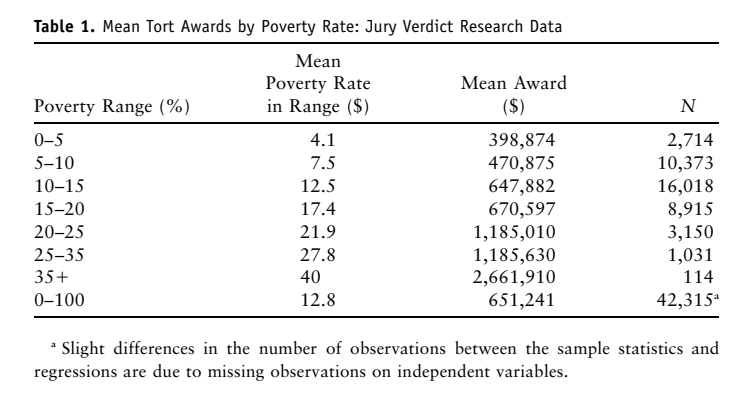 My paper with Helland, Race, Poverty, and American Tort Awards, finds that tort awards during this period were indeed much higher in counties with lots of poverty, especially black poverty. We find, for example, that the average tort award in a county with 0-5% poverty was $398 thousand but rose to a whopping $2.6 million in counties with poverty rates of 35% or greater! The Burial is very open about all of this. The movie goes out of its way to explain, for example, that 2/3rds of the population of Hinds county, the county in which the trial will take place, is black and that is why Willie Gary is hired.
The case on which the movie turns is as absurd as the opening teaser about the drunk, suicidal no-good who collects $75 million. Indeed, the two trials parallel one another. The funeral home conglomerate, the Loewen group, offered to buy three of O’Keefe’s funeral homes but after shaking on a deal they didn’t sign the contract. That’s it. That’s the dispute. The whole premise is bizarre as Loewen could have walked away at any time. Moreover, O’Keefe claims huge damages–$100 million!–when it’s obvious that O’Keefe’s entire failing business isn’t worth anywhere near as much. So why the large claim of damages? Have you not being paying attention? Because the Loewen group, “they got the bank.”
Furthermore, and in parallel with the earlier case, it’s O’Keefe who is the no-gooder. O’Keefe’s business is failing because he has taken money from burial insurance premiums–money that didn’t belong to him and that should have been invested conservatively to pay out awards–and lost it all in a high-risk venture run by a scam artist. Negligence at best and potential fraud at worst. Moreover, in a strange scene motivated by what actually happened, O’Keefe agrees to sell to Loewen only if he gets to keep a monopoly on the burial insurance market. Thus, it’s O’Keefe who is the one scheming to maintain high prices.
Indeed, the whole point of both of Gary’s cases is that he is such a great lawyer that he can win huge awards even for no-good clients. As if this wasn’t obvious enough, there is an extended discussion of Willie Gary’s hero….the great Johnnie Cochran, most famous for getting a murderer set free.
Loewen should have won the case easily on summary judgment but, of course, [spoiler alert!] the charismatic Gary wows the judge and the jury with entirely irrelevant tales of racial resentment and envy. The jury eats it up and reward O’Keefe with $100 million in compensatory damages and $400 million in punitive damages! The awards are entirely without reason or merit. The awards drive the noble Canadians of the Loewen group out of business.
The Burial is a courtroom drama surfaced with only the thinnest of veneers to let the credulous walk away feeling that justice was done. But for anyone with willing eyes, the interplay of racism, poverty, and resentment is truthfully presented and the resulting miscarriage of justice is plain to see. I enjoyed it.
Addendum: My legal commentary pertains only to the case as presented in the movie although in that respect the movie hews reasonably close to the facts.
Denmark takes forceful measures to integrate immigrants
After they fled Iran decades ago, Nasrin Bahrampour and her husband settled in a bright public housing apartment overlooking the university city of Aarhus, Denmark. They filled it with potted plants, family photographs and Persian carpets, and raised two children there.
Now they are being forced to leave their home under a government program that effectively mandates integration in certain low-income neighborhoods where many “non-Western” immigrants live.
In practice, that means thousands of apartments will be demolished, sold to private investors or replaced with new housing catering to wealthier (and often nonimmigrant) residents, to increase the social mix.
The Danish news media has called the program “the biggest social experiment of this century.” Critics say it is “social policy with a bulldozer.”
The government says the plan is meant to dismantle “parallel societies” — which officials describe as segregated enclaves where immigrants do not participate in the wider society or learn Danish, even as they benefit from the country’s generous welfare system.
Here is more from the NYT, and do note that Singapore has its own version of this policy. I would make a few observations:
1. Putting aside the normative, analyzing the effects of such policies will be increasingly important. Economists are not especially well-suited to do this, nor is anyone else. I am well aware of the Chetty “Moving to Opportunity” results. That is good work, but a) it probably doesn’t apply to coercive Danish resettlements, and b) cultural context is likely important for the results. At least for the countries that migrants wish to move to, most will have their own versions of this dilemma.
2. “Open Borders” as a sustainable political equilibrium is looking much weaker than it did a month ago. The key question in immigration policy is not “how many migrants should we take in?” (a lot, I would say), but rather “how can we make continuing immigration a politically sustainable proposition?” Many immigration advocates are in a fog about their inability to offer better answers to that question.
3. Will this Danish action, once the entire political economy is worked through, increase or decrease the allowed number of migrants to the country? Looking at the demand side to migrate, will this policy end up attracting a higher or lower quality of migrants to Denmark? Is Denmark even attractive enough as a destination to get away with this? Or will it send a better signal to would-be migrants and thus raise quality?
I would not be too confident about my answers to those questions, nor should you be so confident.
“Does Paid Sick Leave Facilitate Reproductive Choice?”
I might give the paper a slightly different title, but:
Unlike most advanced countries, the U.S. does not have a federal paid sick leave (PSL) policy; however, multiple states have adopted PSL mandates. PSL can facilitate healthcare use among women of child−bearing ages, including use of family planning services such as contraception, in−vitro fertilization, or abortion services. Use of these services, in turn, can increase or decrease birth rates. We combine administrative and survey data with difference-in-differences methods to shed light on these possibilities. Our findings indicate that state PSL mandates reduce birth rates, potentially through increased use of contraception but not changes in abortion services. We offer suggestive evidence of heterogeneity in birth rate effects by age, education, and race. Our findings imply that PSL policies may help women balance family and work responsibilities, and facilitate their reproductive choices.
That is a new NBER working paper by Johanna Catherine, Maclean, Ioana Popovici, and Christopher J. Ruhm.
A Taxonomy of Methods for Discriminating, Revisited
Twenty years ago, GMU law professor Lloyd Cohen (RIP) guest blogged at MR. His taxonomy of methods of discrimination in university admissions remains timely. What follow is from Lloyd (I have added only the two links). No indent.
—
Not all procedures for engaging in racial discrimination are equal. They differ in their legal standing, their social meaning, and their “economic” efficiency. The Supreme Court in distinguishing Grutter and Graatz, and the admissions regimes of the various state universities suggest a useful taxonomy.
There are three generic forms of racial discrimination not merely in admissions decisions but in other practices and policies as well: (1) express and objective (i.e., points and quotas); (2) facially neutral and objective (e.g., the top 10% of graduates from each high school); and (3) implied and subjective (“we look at the whole person”). From an efficiency perspective the first form of discrimination is the least harmful. It does not corrupt the measure of merit, it only sets a different standard for “minorities.” Its shortcomings are twofold. First, as the Supreme Court decisions in Grutter and Grattz makes abundantly clear it is the one method most likely to be found illegal. This is implicitly related to its second shortcoming, it is so barefaced. It makes clear to both those favored and those harmed that the favored are otherwise inferior in their qualifications.
The second method, using a facially neutral operational measure to achieve a suspect theoretical goal, now favored by the state universities of California, Texas and Florida, in granting admission to those who finish in the top X% of their high school class and by the United Network for Organ Sharing in granting more “points” in the organ allocation scheme for time on the waiting list, has the virtue of being an objective measure, and the virtue (?) of a disguise that reduces shame. Its shortcoming is that its effectiveness in bringing about the preferred ethnic distribution is tied to its inefficiency. It employs an objective measure of merit that substantially distorts. Thus, the rankings of both the favored and the unfavored groups are mis-aligned.
The third measure, a subjective, ad-hoc eclectic judgment, can in practice be a mimic of the first, the second, or anything else. The process becomes a beclouded mystery. This is both its virtue and its vice. There is no clear trail, evidence or standards that mark the favored as inferior–feelings are spared. On the other hand the absence of an objective measure means that the decisionmakers are effectively unanswerable and may indulge in any form of corruption.
Method (1) is clearly falling by the wayside. Is there likely to be a clear political winner between (2) and (3)?