Category: Medicine
Sugar Consumption
From Paul Kedrosky this graph which casts doubt on a sugar mono-causal theory of obesity. Yes, it includes corn syrup.:
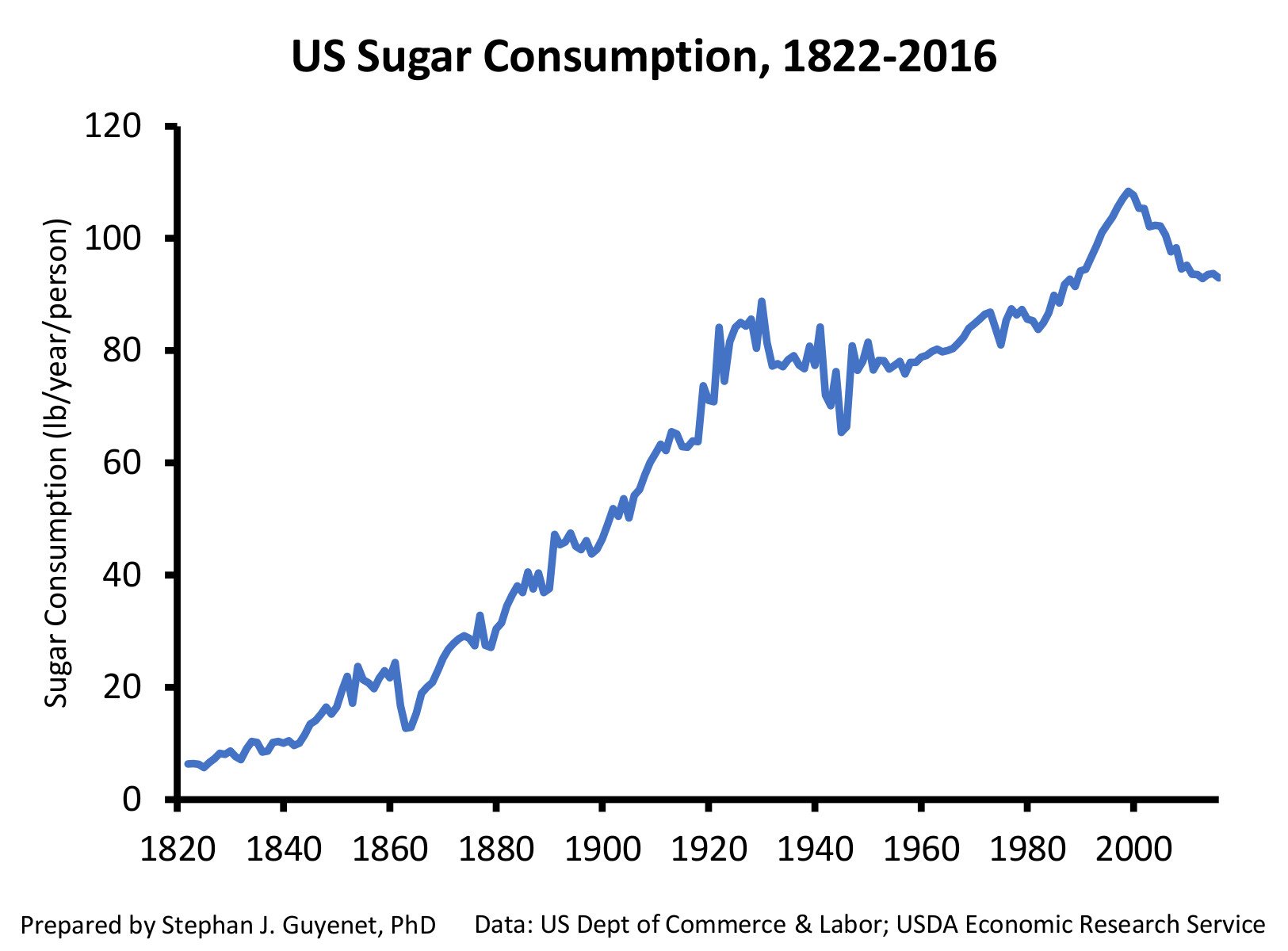
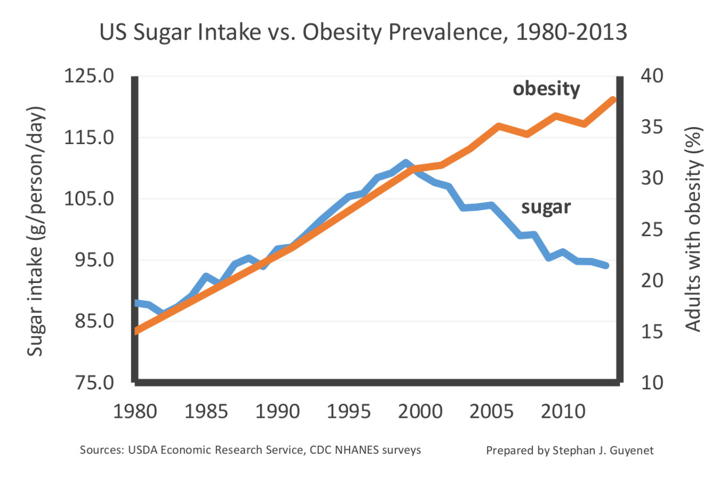 A longer series, also from Stephan Guyenet, shows that we are well above historical averages in sugar consumption even after the more recent decline. Obesity didn’t really increase from say to 1820-1920, however.
Clement and Tribe Predicted the FDA Catastrophe

Laboratory developed tests are not FDA regulated–never have been–instead the labs are regulated under the Clinical Laboratory Improvement Amendments (CLIA) as overseen by the CMS. Laboratory developed tests are the kind your doctor orders, they are a service not a product and are not sold directly to patients. Labs develop new tests routinely and they do not apply to the FDA for approval. Despite this long history, the FDA has claimed that it has the right to regulate lab tests and they have merely chosen not to exercise this right for forty years. In 2015, Paul Clement, the former US Solicitor General under George W. Bush, and Laurence Tribe, considered by many to be the leading constitutional lawyer in the United States, wrote an article that rejected the FDA’s claims writing that the “FDA’s assertion of authority over laboratory-developed testing services is clearly foreclosed by the FDA’s own authorizing statute” and “by the broader statutory context.”
Despite lacking statutory authority, the FDA has continued to claim it is authorized to regulate laboratory tests. Indeed, a key failure in the pandemic happened when the FDA issued so-called “guidance documents” saying that any SARS-CoV-II test had to be pre-approved by the FDA. Thus, the FDA reversed the logic of emergency. In ordinary times, pre-approval was not necessary but when speed was of the essence it became necessary to get FDA pre-approval. The FDA’s pre-approval process slowed down testing in the United States and it wasn’t until after the FDA lifted its restrictions in March that tests from the big labs became available.
Clement and Tribe rejected the FDA claims of regulatory authority over laboratory developed tests on historical, statutory, and legal grounds but they also argued that letting the FDA regulate laboratory tests was a dangerous idea. In a remarkably prescient passage, Clement and Tribe (2015, p. 18) warned:
The FDA approval process is protracted and not designed for the rapid clearance of tests. Many clinical laboratories track world trends regarding infectious diseases ranging from SARS to H1N1 and Avian Influenza. In these fast-moving, life-or-death situations, awaiting the development of manufactured test kits and the completion of FDA’s clearance procedures could entail potentially catastrophic delays, with disastrous consequences for patient care.
Clement and Tribe nailed it. Catastrophic delays, with disastrous consequences for patient care is exactly what happened.
Addendum: See also my pre-pandemic piece on this issue, Our DNA, Our Selves.
Covid facts to ponder
- The overall death rate for men is 1.6 times higher than the death rate for women.
Here is the underlying Brookings study by Richard V. Reeves and Beyond Deng, based on U.S. data. That is a pretty big gap. We have done plenty to vaccinate older people first, but men are never given priority place in these lines. Why not?
Understanding the Rise in Life Expectancy Inequality
We provide a novel decomposition of changing gaps in life expectancy between rich and poor into differential changes in age-specific mortality rates and differences in “survivability”. Declining age-specific mortality rates increases life expectancy, but the gain is small if the likelihood of living to this age is small (ex ante survivability) or if the expected remaining lifetime is short (ex post survivability). Lower survivability of the poor explains between one-third and one-half of the recent rise in life expectancy inequality in the US and the entire change in Denmark. Our analysis shows that the recent widening of mortality rates between rich and poor due to lifestyle-related diseases does not explain much of the rise in life expectancy inequality. Rather, the dramatic 50% reduction in cardiovascular deaths, which benefited both rich and poor, made initial differences in lifestyle-related mortality more consequential via survivability.
Via the excellent Kevin Lewis. And RAD from the comments: “Greater survivability of cardio vascular events allows lifestyle choices to catch-up with people.”
Long soccer Covid
This paper estimates the workplace productivity effects of COVID-19 by studying performance of soccer players after an
infection. We construct a dataset that encompasses all traceable infections in the elite leagues of Germany and Italy. Relying on a staggered difference-in-differences design, we identify negative short- and longer-run performance effects. Relative to their preinfection outcomes, infected players’ performance temporarily drops by more than 6%.Over half a year later, it is still around 5% lower.
Here is the full paper, by Kai Fischer, J. James Reade, and W. Benedikt Schmal, via Florian Ederer. How about chess?
Medicaid coverage doesn’t seem to help for diabetes and asthma
…we use Oregon’s 2008 Medicaid lottery to assess the management of diabetes and asthma, as well as several markers of physical health. This analysis complements several prior studies by introducing new data elements and by analyzing chronically ill subpopulations. While we had previously found that having insurance increases the diagnosis and use of medication for diabetes, we show here that it does not significantly increase the likelihood of diabetic patients receiving recommended care such as eye exams and regular blood sugar monitoring, nor does it improve the management of patients with asthma. We also find no effect on measures of physical health including pulse, obesity, or blood markers of chronic inflammation. Effects of Medicaid on health care utilization appear similar for those with and without pre-lottery diagnoses of chronic physical health conditions. Thus, while Medicaid is an important determinant of access to care overall, it does not appear that Medicaid alone has detectable effects on the management of several chronic physical health conditions, at least over the first two years in this setting. However, sample limitations highlight the value of additional research.
That is from a new NBER working paper by Heidi Allen and Katherine Baicker. To be clear, my intuition here is to blame “medicine,” and also the patients, not Medicaid per se.
Make TeleMedicine Permanent
One of the silver linings of the pandemic was the ability to see a doctor and be prescribed medicine online. I used telemedicine multiple times during the pandemic and it was great–telemedicine saved me at least an hour each visit and I think my medical care was as good as if I had been in person. I already knew I had poison ivy! No need for the doctor to get it also.
Telemedicine has been possible for a long time. What allowed it to take off during the pandemic wasn’t new technology but deregulation. HIPAA rules, for example, were waived for good faith use of standard communication technologies such as Zoom and Facetime even though these would ordinarily have been prohibited.
The Federal Ryan Haight Act was lifted which let physicians prescribe controlled substances (narcotics, depressants, stimulants, hallucinogens, and anabolic steroids) in a telemedicine appointment–prior to COVID an in-person appointment was required.
Prior to COVID Medicaid and Medicare wouldn’t pay for many services delivered over the internet. But during the pandemic the list of telemedicine approved services was expanded. Tennessee, for example, allowed speech therapists to bill for an online session. Alaska allowed mental health and counseling services and West Virginia allowed psychological testing to be delivered via telemedicine. Wisconsin allowed durable medical equipment such as prosthetics and orthotics to be prescribed without a face-to-face meeting.
Another very important lifting of regulation was allowing cross-state licensing which let out-of-state physicians have appointments with in-state patients (so long, of course, as the physicians were licensed in their state of residence.)
The kicker is that almost all of these changes are temporary. Regulatory burdens that were lifted for COVID will all be reinstated once the Public Health Emergency (PHE) expires. The PHE has been repeatedly extended but that will only push off the crux of the issue which is whether many of the innovations that we were forced to adopt during the pandemic shouldn’t be made permanent.
Working from home has worked better and been much more popular than anyone anticipated. Not everyone who was forced to work at home because of COVID wants to continue to work at home but many businesses are finding that allowing some work from home as an option is a valuable benefit they can offer their workers without a loss in productivity.
In the same way, many telemedicine innovations pioneered during the pandemic should remain as options. No one doubts that some medical services are better performed in-person nor that requiring in-person visits limits some types of fraud and abuse. Nevertheless, the goal should be to ensure quality by regulating the provider of medical services not regulating how they perform their services. Communications technology is improving at a record pace. We have moved from telephones to Facetime and soon will have even more sophisticated virtual presence technology that can be integrated with next generation Apple watches and Fitbits that gather medical information. We want medical care to build on the progress in other industries and not be bound to 19th and 20th century technology.
The growth of telemedicine is one of the few benefits of the pandemic. As the pandemic ends, let’s make this silver lining permanent.
Worrying Sentence(s) of the Day
NYTimes: An examination of hundreds of health departments around the country shows that the nation may be less prepared for the next pandemic than it was for the current one.
…State and local public health departments across the country have endured not only the public’s fury, but widespread staff defections, burnout, firings, unpredictable funding and a significant erosion in their authority to impose the health orders that were critical to America’s early response to the pandemic.
People have had it. Let’s hope we aren’t tested again soon.
FDA relents on mix and match for third dose
Here is the NYT account, they sound both confused and confusing. How about “if you have had J&J, it is fine and probably preferable to get a further dose of Moderna or Pfizer”? Yet suddenly it is fine.
And it is the usual story — people have been doing this for months, and the FDA would not say it is terrible. Because they knew it wasn’t. But they wouldn’t say so. And now the status quo has shifted, and so everyone will treat it as fine, as if the supposed fears of yesterday never ever existed.
Maybe I should insult people more often?
Some of them are frauds
The panel also seemed intrigued by preliminary data suggesting that Johnson & Johnson recipients may be better off with a booster shot from Moderna or Pfizer. Although no vote was taken, Dr. Peter Marks, who oversees the F.D.A.’s vaccine division, said regulatory action to allow boosters with a different vaccine was “possible.”
While some experts emphasized that the data was based on small groups of volunteers and short-term findings, others urged the F.D.A. to move quickly with what has fast become known as a mix-and-match approach, especially for recipients of Johnson & Johnson’s vaccine, which is much less widely available.
“I’m sold already,” said Dr. Mark Sawyer, an infectious disease specialist with the University of California San Diego School of Medicine. “We need flexibility and to improve access to everyone.”
Others said they worried that the public would end up bewildered if the government kept broadening the categories of people eligible for boosters and which vaccine could be used for extra shots.
“I hope we can do this in a way that doesn’t look like we’re changing rules all the time,” said Dr. Stanley Perlman, a professor of immunology at the University of Iowa.
Health officials and committee members suggested on Friday that the single-shot Johnson & Johnson vaccine had long been less protective. In a particularly biting critique, Dr. Amanda Cohn, a high-ranking C.D.C. medical officer, said a single dose of Johnson & Johnson’s vaccine offered less protection than two doses of the mRNA vaccines made by Pfizer or Moderna — a gap that would only grow if it remained a one-shot regimen while the other two-shot vaccines were followed by a booster…
The experts generally agreed that the protection conferred by a single dose was inadequate, but at least some were unconvinced that the second dose would bolster that protection significantly.
The smart people I know who started with J&J took this matter into their own hands some time ago, typically opting for an mRNA supplement. They are just “people,” yet they had “skin in the game” and they are miles ahead of the FDA and CDC as formal institutions. Here is a research paper on the question. Here is another. And here is a Paul Sax tweet and Op-Ed: “Don’t know anyone who disagrees with this, and the data have been highly suggestive for months.” And this is after the authorities insisted for months that all vaccines will be treated the same.
Again, I will repeat the perennial question: do our public health agencies wish to maximize their own status and control and feeling of “having done everything properly as they were trained,” or do they wish to maximize the expected value of actual outcomes for the citizenry? If it is not the latter, and too often it is not, I say they are oppressive frauds. (And please don’t try to tell me this kind of craperoo is boosting their credibility — in fact they have lost massive credibility with America’s public intellectual class, both left wing and right wing and for that matter centrist.)
I really do not have much sympathy for Kyrie Irving and Bradley Beal and their ilk, but in fact their views are more understandable than you might think from reading MSM. Their generalized mistrust is not so crazy, even though they are quite wrong in this particular instance. By the way, don’t take those aspirin any more!
Here is the full NYT article, cringeworthy throughout, and I thank Jordan for the pointer.
Solve for the Kiwi Covid equilibrium?
Elimination was so popular with voters that every major political party backed it.
But over the past two weeks, the National, Act and Green parties have all peeled off from the government, vocally denouncing the new approach or offering new plans of their own. Ardern and her ministers continue to equivocate on whether elimination is over at all – a hemming and hawing that Smith says could hinder them from communicating a clear new vision for New Zealand’s path forward.
In one sense, Ardern could now be a victim of her own success, says Ben Thomas, a communications consultant and former National government staffer. The government’s elimination campaign was so compelling and its results so strong, that it won huge support – polling above 80% through most of the pandemic.
“Part of the prime minister’s problem is that she did such a good job of rallying New Zealanders to this cause, of convincing them – correctly – that elimination was an achievable goal, and of instilling a real fear of the virus. That’s a very hard thing to unwind from,” Thomas says.
Smith says: “Elimination was something that New Zealanders could be proud of, it brought us together and became a common goal.” And the challenge now is to find – what is the common goal during a suppression strategy? Probably vaccination rates – but to give us this same pride that we had last year in our Covid response again that is the big challenge facing Jacinda and her team now.”
The most likely candidate for that new vision is vaccination, but it’s harder to capture the urgency of that message while simultaneously arguing the country is still eliminating the virus.
Here is the full story, via Rich Dewey.
Servers are masked, the elites are unmasked
That is the main topic of my latest Bloomberg column. Here is one bit:
Even if the attendees are wearing masks at the beginning, the masks come off once they start wining and dining — and they usually don’t go back on. Isn’t this a sign that mask-wearing is no longer so essential? At the very least, it sends a mixed message: If you want to be comfortable eating and drinking with your peers, it’s OK to take off your mask — but it’s not OK if you want to be comfortable serving food, carrying heavy trays and describing the dessert menu…
By now everyone must realize just how selective the enforcement of mask rules can be. If those same employees are drinking or eating together in the back room, their masks are off and everyone is fine with that. All of a sudden, the possibility of spreading a Covid infection is not such a big deal.
And:
Many public health intellectuals and pundits may be uncomfortable with mask apartheid. But they have so strongly promoted the mask-wearing norm it is hard for them to object. They could argue that the elite guests should be required to wear their masks before and after the food and drinks are served, or even between bites, but at this point such a recommendation would be ignored.
If you read the whole piece, some of my readers will notice I am actually presenting one of the versions of Sen’s Paretian Liberal Paradox.
The Promising Pathway Act
Operation Warp Speed showed that we can move much faster. FDA delay in approving rapid tests shows that we should move much faster. There is a window of opportunity for reform. The excellent Bart Madden and Siri Terjesen argue for the Promising Pathways Act.
One particularly exciting development is the Promising Pathway Act (PPA), recently introduced in Congress. PPA would reduce bureaucracy via legal changes and provide individuals with efficient early access to potential new drugs.
Under PPA, new drugs will receive provisional approval five to seven years earlier than the status quo via a two-year provisional approval. Drugs that demonstrate patient benefits could be renewed for a maximum of six years, and the FDA could grant full approval at any time based on real-world as opposed to clinical trial data documenting favorable treatments results.
The PPA allows patients, advised by their doctors, to choose early access to promising but not-yet-FDA -approved drugs. Patients and doctors would make informed decisions about using either approved or new medicines that demonstrate safety and initial effectiveness compared to approved drugs.
…Patients and doctors can log into an internet registry database for early access drugs that would contain treatment outcomes, side effects, genetic data, and biomarkers. Scientific researchers, as well as patients, will also benefit from the identification of subgroups of patients who do exceptionally well or fail to respond.
Data from the registry will open knowledge pathways to improve the biopharmaceutical industry’s research outlays to benefit future patients.
With radically lower regulatory costs plus heightened competition as more companies participate, expect substantially lower prescription drug prices for provisional approval drugs.
Here is the text of the PPA.
FDA Approves American Rapid Antigen Test
What makes the FDAs failure to approve more rapid antigen tests even more galling is that the test being sold cheaply in the Amsterdam supermarket is the Flowflex, an American test made by Acon Labs in San Diego.
Well the FDA has finally approved the Acon test! Apparently it is good enough for the Germans and for US citizens. Hoorah! USA Today notes:
ACON expects to make 100 million tests per month by the end of this year. Production could double to 200 million monthly tests by February, according to the FDA.
…The United Kingdom and Germany have made significant purchases of home tests and widely distributed them to their residents to slow the spread of coronavirus. Such large government purchases allowed manufacturers to continue making tests even when demand softened as cases dropped.
The Biden administration will spend nearly $1.2 billion to purchase up to 187 million home tests from Abbott Laboratories and Celltrion Inc., company officials confirmed. The Department of Defense announced additional contracts totaling $647 million to buy 60 million kits from Abbott and three other testing vendors: OraSure Technologies, Quidel and Intrivio Holdings.
The FDA has authorized seven antigen-based tests that can be used at home without a prescription. The EU has authorized 21 tests beginning with the letter A (I am not sure all of these are authorized for home use but you get the idea.) Turtle slow. Still this is a big improvement.
Frankly, I think all the pressure from people like Michael Mina amplified by myself and others over 18 months and culminating in David Leonhartd’s NYTimes article Where Are the Tests? finally pushed them over the edge.
UV-C and the Future
Are you surprised that the airport pictured below (I assure you, it is a real place) has also installed high-capacity air filters and UV sanitization?
Since the onset of COVID-19, the air-conditioning system filters across the passenger terminals have been upgraded from MERV-7-rated models to MERV-14-rated ones. These higher grade filters can effectively remove about 85 per cent of the particles of 0.3 to 1.0 micrometres in size in the air, smaller than the size of a COVID-19 particle in a respiratory droplet.
To ensure the MERV-14 rated filters continue to operate at effective efficiency, they are replaced every one to two months, depending on the condition of use. All used filters are sealed for proper disposal by maintenance workers donning the highest level of personal protective equipment (PPE) for safe handling.
In addition, fresh air intake for the air-conditioning systems have also been maximised by fully opening the dampers to admit outdoor air.
As a further layer of protection, Changi Airport is installing Ultraviolet-C (UV-C) sanitisation equipment in Air-Handling Stations (AHS) and Air-Handling Units (AHU) progressively across all terminal air-conditioning systems. The UV-C kills any remnant virus traces in the mixture of fresh and returned air passing through the cooling coil, providing a second level of defence after the MERV-14 rated filters.
Singapore will thus have air filtration and UV sanitization in the airport before we have it in the hospitals.
Is the future slipping away from the United States? It seems that way sometimes. Only the high-tech sector is keeping us afloat and, of course, that is under attack by the elites.
Here and here are my previous posts on UV-C sanitization.

Hat tip: Randall Parker.
Photo Credit: Matteo Morando.
