Category: Medicine
Don’t judge Covid conditions by the current rate of Covid growth
These days when I go to Twitter I see so many claims that current caseload or hospitalization numbers (in some not all regions) are approaching their peaks from the third wave last winter.
But don’t be misled by that rhetoric — speed of growth is not at this stage of the pandemic a good metric for evaluation. Obviously, speedy Covid growth is bad news compared to having no Covid at all, but relative to actual constraints inference here is difficult. Even the growth of hospitalizations, much less the growth in cases, is a misleading signal for how well we are doing.
First, there is a diehard core of individuals who just won’t get vaccinated. That is highly unfortunate, but possibly it is better if those individuals get Covid sooner rather than later, at least provided they are not so numerous as to overwhelm the hospital system all at once. The Covid case is in essence their preferred form of vaccination. Stupid, yes, but later is not necessarily better.
A second possibility is that we will see waves of Delta Covid, rising rapidly and then declining rapidly. That seemed to happen in the most badly afflicted parts of India, and maybe has been happening in England and the Netherlands, noting that the English numbers have begun a recent (minor?) uptick again, so we cannot be sure of the dynamics. The general point stands that it is better to get a given amount of Covid over with more quickly rather than less quickly, again subject to the constraint that you do not overwhelm your hospital system. Circa August 2021, we are no longer in the older position of “waiting for the vaccines to arrive.”
A third possibility is that Delta really is extremely contagious and that non-pharmaceutical interventions just aren’t going to succeed in checking it. (Oddly, few elites are willing to mention this possibility. Though they are willing to tell us how terrible it is, which it is!) Yes, boosters may help out, but most of the “cavalry” — vaccines in this case — already has arrived, at least for those willing to take them. OK, so if most people are going to be hit by this thing, and vaccinations do make that event much safer than before, again you want to get that process over with more quickly rather than less quickly. And to the extent vaccine protection decays (an unknown variable but a real worry), speed really is of the essence here. Again, all subject to the “don’t overwhelm your hospital system” caveat.
Clearly there are scenarios where the rapid case growth is a bad thing, even taking relevant constraints into account. For instance, vaccinating younger individuals might be a relevant “cavalry” still to arrive, and maybe it can arrive before most of our young people are exposed to Covid. Or maybe most of the unvaccinated are pretty “elastic” in their status, and a high but not too high case and hospitalization growth will scare them enough to bring them over to the vaccinated side of the ledger. Those really are possibilities.
But rapid growth per se — even on the hospitalization side of the ledger — has to be used with care as an indicator of where we stand. Generating a lot of Covid cases and hospitalizations in a short period of time is a very tricky signal, again relative to the constraints we face. You need to define your counterfactual very carefully, and recognize that the mood affiliations you were promoting earlier in the pandemic may or may not make sense now.
The performance of the NIH during the pandemic in 2020
“A new research study by one of us and his Johns Hopkins colleagues found that of the $42 billion the National Institutes of Health spent on research last year, less than 2% went to Covid clinical research…
Here is the WSJ source. Here is the full report from Johns Hopkins, and here is the executive summary:
● Of the $42 Billion 2020 NIH annual budget, 5.7% was spent on
COVID-19 research
● Public health research was underfunded at 0.4% of the 2020 NIH
budget
● Only 1.8% of the 2020 NIH budget was spent on COVID-19 clinical
research
● Average COVID-19 NIH funding cycle was 5 months
● Aging was funded 2.2 times more than COVID-19 research
● By May 1, 2020, 3 months into the pandemic, the NIH spent 0.05%
annual budget on COVID-19 research
● Of the 1419 grants funded by the NIH:
• NO grants on kids and masks specifically
• 58 studies on social determinants of health
• 57 grants on substance abuse
• 107 grants on developing COVID-19 medications
• 43 of the 107 medication grants repurposed existing drugs
Ouch. Here is a not entirely random sentence from the report:
The COVID-19 pandemic has only exacerbated the NIH institutional challenges and inability to reallocate funds quickly to
critical research.
Here is another damning sentence, though it damns someone other than the NIH:
…to date, no research has investigated NIH COVID-19 funding patterns to the best of our knowledge.
Double ouch. Might the NIH have too much influence over the allocation of funds to be investigated properly? Rooftops, people…
The American Academy of Pediatrics Tells the FDA to Speed Up and Stop Endangering Patients
 The American Academy of Pediatrics has written a stunning letter to the FDA:
We understand that the FDA has recently worked with Pfizer and Moderna to double the number of children ages 5-11 years included in clinical trials of their COVID-19 vaccines. While we appreciate this prudent step to gather more safety data, we urge FDA to carefully consider the impact of this decision on the timeline for authorizing a vaccine for this age group. In our view, the rise of the Delta variant changes the risk-benefit analysis for authorizing vaccines in children. The FDA should strongly consider authorizing these vaccines for children ages 5-11 years based on data from the initial enrolled cohort, which are already available, while continuing to follow safety data from the expanded cohort in the post-market setting. This approach would not slow down the time to authorization of these critically needed vaccines in the 5–11-year age group.
In addition, as FDA continues to evaluate clinical trial requirements for children under 5 years, we similarly urge FDA to carefully consider the impact of its regulatory decisions on further delays in the availability of vaccines for this age group. Based on scientific data currently available on COVID-19 vaccines, as well as on 70 years of vaccinology knowledge in the pediatric population, the Academy believes that clinical trials in these children can be safely conducted with a 2-month safety follow-up for participants. Assuming that the 2-month safety data does not raise any new safety concerns and that immunogenicity data are supportive of use, we believe that this is sufficient for authorization in this and any other age group. Waiting on a 6-month follow-up will significantly hinder the ability to reduce the spread of the hyper infectious COVID-19 Delta variant among this age group, since it would add 4 additional months before an authorization decision can be considered. Based on the evidence from the over 340 million doses of COVID-19 doses administered to adults and adolescents aged 12-17,as well as among adults 18 and older, there is no biological plausibility for serious adverse immunological or inflammatory events to occur more than two months after COVID-19 vaccine administration.
In my many years of writing about the FDA, I can’t recall a single instance in which a major medical organization told the FDA to use a smaller trial and speed up the process because FDA delay was endangering the safety of their patients. Wow.
The invisible graveyard is invisible no more.
Iceland and Covid
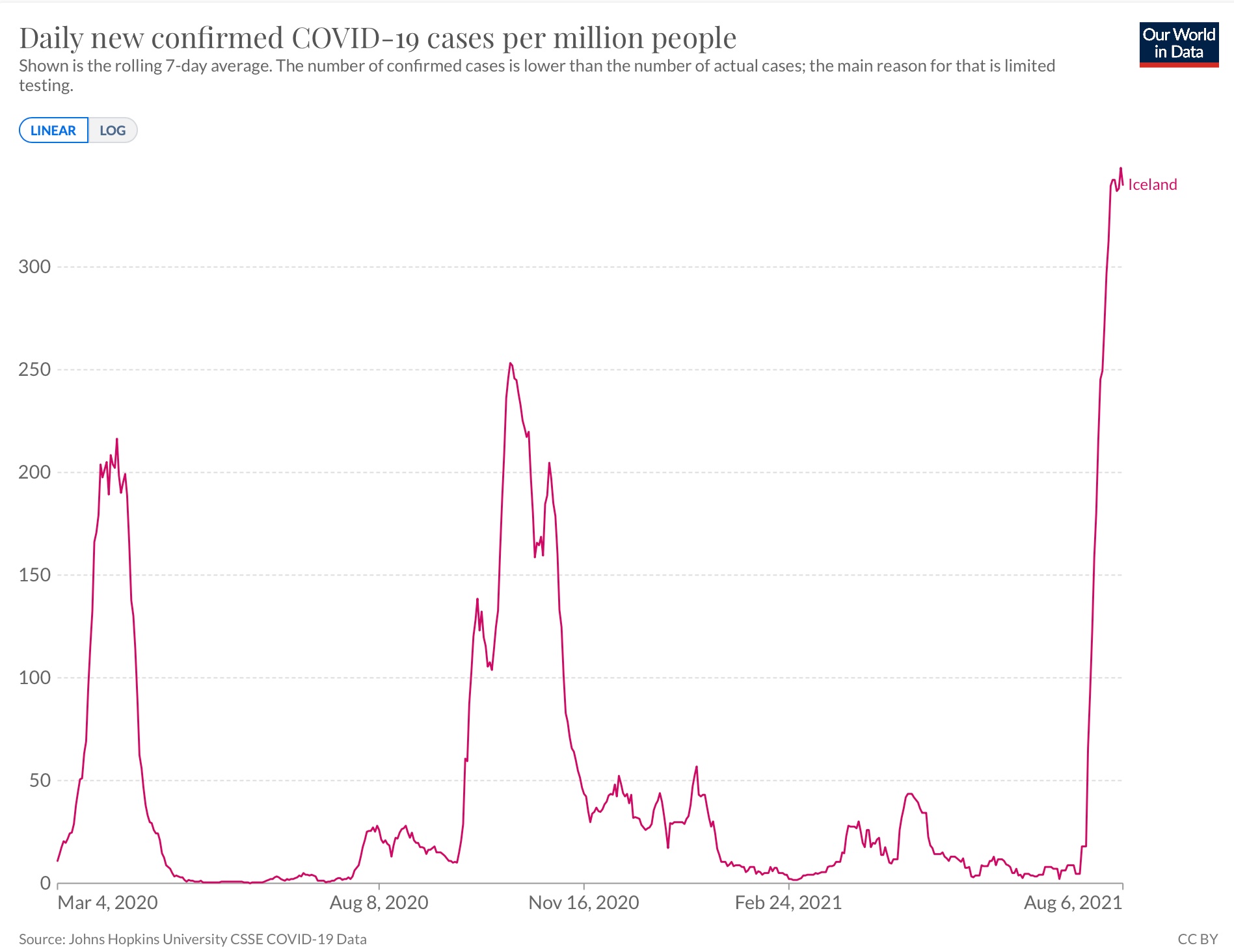
As you may know, Iceland is one of the most fully vaccinated countries in the world:

All via Eric Topol. No, I am not arguing we should give up or stop looking for policy and most of all biomedical improvements. All the more reason to do so! But…this does indicate we will need to find some way of living with such case numbers, without falling apart and pulling the plug on economic activity.
Masks and the Delta variant
I haven’t seen any systematic, data-based investigation of how well cloth masks work against the Delta variant, and it is too early to expect it. Nonetheless I tried to do some simple mental modeling of my own.
We do know that the viral load from Delta is much higher. That could make masks less effective, because perhaps they cannot stop the spewer from spreading the virus so easily. (Oddly, you don’t see many people admitting such an effect might be possible, as this seems to be a politically incorrect idea to present.)
Yet there is a countervailing factor. The Delta variant spreads far more rapidly than “classic Covid.” So a given “small effect” of a mask is more important. It used to be that a mask (sometimes) stopped the spread to one person, who in turn might spread to 1.3 others. Now, if your mask stops the spread to that person, it might be stopping the subsequent spread to seven other people (we don’t know the exact number, but yes I have heard “seven” bandied around as a possibility).
To be clear, in this scenario masks are still less effective than before in preventing Covid spread. But the rate of return on wearing a mask, relative to no mask, can be higher. It is simply that the whole curve has shifted downward in a disadvantageous way. But if the mask has any effectiveness at all, that effectiveness is now magnified greatly.
Under some plausible numbers the protective potency of wearing a mask might be about five times higher (seven divided by recent non-Delta R, or something like that). Unless masks are five times (or more) less effective in stopping spread, masking could become more important rather than less important.
But the net effect could go either way.
That said, seeing other people masked should make you feel less secure than it used to. The new potential upside “rate of return effect” from masking is choking off the greater second order effects of the more rapid spread. The “are you going to get Covid from this particular masked person near you?” calculus seems to be decidedly worse than before.
The FDA Is Still Much Too Strict
Here is just one bit from a superb post on the FDA by psychiatrist Scott Alexander at Astral Codex Ten.
I worry that people are going to come away from this with some conclusion like “wow, the FDA seemed really unprepared to handle COVID.” No. It’s not that specific. Every single thing the FDA does is like this. Every single hour of every single day the FDA does things exactly this stupid and destructive, and the only reason you never hear about the others is because they’re about some disease with a name like Schmoe’s Syndrome and a few hundred cases nationwide instead of something big and media-worthy like coronavirus. I am a doctor and sometimes I have to deal with the Schmoe’s Syndromes of the world and every f@$king time there is some story about the FDA doing something exactly this awful and counterproductive.
A while back I learned about Infant Short Bowel Syndrome, a rare condition with only a few hundred cases nationwide. Babies cannot digest food effectively, but you can save their lives by using an IV line to direct nutrients directly into their veins. But you need to use the right nutrient fluid. The FDA approved an early draft of the nutrient fluid, but it didn’t have enough fish oil, which is necessary for development, so a lot of the babies still died or ended up with permanent neurological damage. Around the late 90s/early 00s, researchers figured out what was going on and recommended adding fish oil to the IV fluid. The FDA responded that they had only approved the non-fish-oil version, it would take them a while to approve the new version, and until they did that adding fish oil was illegal. A bunch of babies kept dying and getting permanent neurological damage, and everyone knew exactly how to stop it, but if anyone did the FDA would take away their licenses and shut them down. Around 2010, Boston Children’s Hospital found some loophole that let them add fish oil to their nutrient fluid on site, and infants with short bowel syndrome at that one hospital stopped dying or ending up permanently disabled, and the FDA grudgingly agreed to permit it but banned them from distributing their formulation or letting it cross state lines – so for a while if you wanted your baby not to die you had to have them spend their infancy in one specific hospital in Massachusetts. Around 2015 the FDA said that if your doctor applied for a special exemption, they would let you import the correct nutritional fluid from Europe (where, lacking the FDA, they had just added fish oil to the fluid as soon as researchers discovered it was necessary), but you were only able to apply after your baby had already sustained serious damage, and the FDA might just say no. Finally in 2018 the FDA got around to approving the corrected nutritional fluid and now babies with short bowel syndrome do fine, after twenty years of easily preventable state-mandated deaths. And it’s not just this and coronavirus, I CANNOT STRESS ENOUGH HOW TYPICAL THIS IS OF EVERYTHING THE FDA DOES ALL THE TIME.
Read the whole thing! I actually had to read it in several sessions, it’s not that long but bouts of anger interspersed with moments of laughter made me have to put it down momentarily to recover. There is a lot more in the post on reforms.
Best quick intro to my views on the FDA is this post (follow the links) and my paper on off-label prescribing.
Addendum: Scott updates the infant fish oil story and provides much more detail. He got some things wrong and the FDA as an agency ends up looking better but the broad outline about the FDA system looks right. I am leaving the post up for posterity but this specific part isn’t correct.
How many children are killed by the schools anyway?
That is the topic of my latest Bloomberg column, here is one excerpt:
Of course, with or without Covid, some number of children die at school. But it is surprisingly difficult to find out how many. In 2020, there were more than 50 million students in public elementary, middle or high schools, yet there is no systematic national database of student deaths at school. School shootings have claimed up to 75 deaths annually in recent years, and there are many other possible causes of death, such as traffic or sports accidents.
It’s entirely plausible that a few hundred students die each year for reasons directly related to school attendance. If suicides induced by school bullying but occurring off campus are included, the number could be higher still. Some 4,400 young people in America commit suicide in a typical year, and surely many of those deaths are attributable, at least partially, to events at school.
Adding up all these admittedly indirect chains of causation, it’s possible that school attendance leads to at least 2,000 deaths every year in the U.S. And those have nothing to do with Covid.
Fortunately, it is not customary in normal times to debate whether it is worth opening schools knowing that it could result in the death of perhaps 2,000 students. The true toll of opening schools is unknown, much less debated, and if there is a discussion it is over school shootings, which ought to be preventable (or at least limited) by measures other than closing schools.
This “head in the sand” approach is highly imperfect. Still, it is preferable to panicking and closing the schools every year.
It is difficult to calculate how many children have died of Covid, but perhaps the best estimate comes from England, where it caused 25 deaths of people younger than 18 in the year ended in March. The final tally is certainly higher in the more populous U.S., but as of July seven states still were reporting zero Covid deaths among children. This recent estimate suggests 358 deaths, though it is based on only 43 states.
Yes, it is worth considering whether school reopenings will lead to unacceptably high levels of Covid in the non-school population. It is also worth pointing out that Covid is spreading very rapidly in states with low vaccination rates — without the schools playing a role. In any case, it does not justify focusing solely on the safety of children in discussions of school reopening.
Economists have long studied the tendency of people to assign more value to a “known life” than to a “statistical life.” When a baby is trapped down a well, for example, many millions of dollars will be spent trying to save her. Her photo will appear on the evening news and on social media. Yet when it comes to saving lives in the aggregate, such as by installing more and better smoke detectors, there is only modest interest.
Right now too many Americans are trapped: Because the pandemic has been so dramatic for so many, every life looks like a known life rather than a statistical life. We all need to start working our way back to a bit more emotional distance.
Recommended.
The Most Important Act of the Last Two Decades?
A good case can be made that Project Bioshield is the most important piece of legislation passed in the last twenty years. Passed under President Bush in 2004, Project Bioshield’s primary goal was to create advance market commitments to purchase countermeasures for chemical, biological, radiological or nuclear agents (CBRN). Several billion dollars have been spent in this area promoting anthrax and smallpox vaccines and various antitoxins for botulism and nuclear threats. The record on these advance market commitments is mixed with some notable failures.
The second thing the act did is to reduce some paperwork requirements on purchases and research funding. Those seem fine although the simplified procedure is itself too complex and the amounts such simplified procedures apply to are too small, e.g.
The Project Bioshield Act authorizes the HHS Secretary to use an expedited award process for grants, contracts, and cooperative agreements related to CBRN countermeasure R&D Activity, if the Secretary deems a pressing need for an expedited award exists. The authority is limited to awards of $1.5 million or less.
The third aspect of the act was not considered a big deal at the time but is the one that has proved to be the most important. Project Bioshield created the Emergency Use Authorization (EUA). In other words, prior to 2004 the FDA had no clear legislative authority to authorize an unapproved vaccine, drug or device. Without Project Bioshield and the EUA procedure the FDA might have eventually found some way to authorize vaccines before full approval. Britain, for example, used a temporary authorization procedure. Or the FDA might have sped up full approval but given the FDA’s lethargic record it’s easy to imagine that this would have taken months longer than the EUA process. As a result, the EUA procedure created by Project Bioshield probably saved 100,000 or more lives.
Important Addendum: It’s also worth mentioning that the EUA procedure doesn’t just apply to approvals it also allows changes in dosage and labeling. Susan Sherman, the senior attorney with the HHS Office of the General Counsel, noted in 2009 that a drug that had been approved for individual health in a non-emergency might have to be used very differently for public health in an emergency and that the EUA process could be used to adjust to these differences:
“You can change the labeling. You can change the information. You can change the dosage. You can give it to populations for which wasn’t approved.” She continued, “In some sense we had to match up in practice a public health response where you might not have the precise labeling that your physician would prescribe to you. There are a lot of variables that are necessary for the public health responders that don’t necessarily match what the approved drug would look like if you just went to your physician and got it because you had that illness.
In other words, the EUA process was made to allow for procedures such as fractional dosing. It’s too late for fractional dosing in the United States (but we should use it for boosters) but fractional dosing remains a vital tool to deal with the global shortage of vaccines.
Physical vs. mental ailments
A loyal MR reader asks:
Physical ailments generally lead to behaviors that offset or improve them, whereas mental ailments often seem to lead to behaviors that make them worse (eg it’s hard to exercise when you’re depressed)
This seems very odd to me; why would this be the case? Are there any physical diseases that lead to reinforcing rather than mitigating behavior? Does this imply that mental illness is a post-evolutionary phenomenon?
Model this, or do you dispute the stylized facts?
The incentives for Mexican hotel Covid testing
Yes you need a negative result on the test to return to the United States, but you never know the sensitivity of the test you are taking. It should be from an “approved provider,” but what does that mean? No authority from the United States can readily verify how good the test is.
Let us say you are a hotel owner, which kind of testing service do you wish to commission to send around to your rooms to test your American guests? A highly sensitive test that will yield periodic false positives, or a not very sensitive test that won’t generate false positives and might even result in some false negatives? And say some of your guests truly will be Covid-positive — do you wish to keep them in their rooms for another week or two, with all the attendant risks, or do you wish to send them along their way?
You don’t even have to imagine that the hotel owners are entirely cynical. They themselves can’t judge the accuracy of the tests, so a service that yielded a fair number of Covid positives could be seen as “they make too many mistakes and won’t let our guests leave, we don’t want them.” If the Delta variant is outracing publicity about the Delta variant, as was the case for a while in Tulum, such a hotelier reaction might be all the more likely.
I did in fact test negative. And the testers were very nice to me.
Our regulatory state is still, still, still failing us
The U.S. agency leading the fight against Covid-19 gave up a crucial surveillance tool tracking the effectiveness of vaccines just as a troublesome new variant of the virus was emerging.
While the Centers for Disease Control and Prevention stopped comprehensively tracking what are known as vaccine breakthrough cases in May, the consequences of that choice are only now beginning to show.
Here is more from Bloomberg, tragic and stupid throughout.
Welcome to the Club
Ashish Jha, dean of the School of Public Health at Brown University, has had it with the FDA:
Nearly all public-health authorities in the country are urging people to get vaccines. We see the incredible results that the vaccines have had and how many lives they’re saving, and still the F.D.A. has not offered full, permanent approval of the vaccine. President Biden suggested it might take several more months. How do you understand that, or how can that be defended, if it can be?
I find it incredibly puzzling what exactly the F.D.A. is doing. The F.D.A. says that it typically takes them six months or sometimes as much as a year to fully approve a new product. And, generally, we appreciate that. There are two components to that. One is that they want to see a large amount of data, and they want to go through that carefully, and I think that’s essential. Then the second is that there’s a process, which can take a while. This is a global emergency, and while all of us want to make sure that the F.D.A. does its job, most of us also feel that just operating on standard procedures may not be the right thing to do here, and that there are things that can be sped up. Just as with the development of vaccines, we didn’t cut any corners. We did all the steps, but we did it much, much faster. The F.D.A. has to go much, much faster.
The other thing about the data—the amount of data that the vaccines have generated, the number of people who’ve been vaccinated, and the scrutiny that the data has received. I mean, my goodness, this data has been scrutinized and looked over more than—
I’d imagine it’s more than any data in modern history, right?
Any therapy, any vaccine ever. These are the most highly scrutinized medical products we have ever had, and I don’t understand what the F.D.A. is doing.
I’m pleased that Jha and others like Eric Topol are becoming frustrated with FDA delay. But take it from an OG, the FDA is doing what it has always done. What has changed isn’t the FDA but that more people are paying attention now that they have something personal at stake.
I am reminded of this story from 2016:
Mary Pazdur had exhausted the usual drugs for ovarian cancer, and with her tumors growing and her condition deteriorating, her last hope seemed to be an experimental compound that had yet to be approved by federal regulators.
So she appealed to the Food and Drug Administration, whose oncology chief for the last 16 years, Dr. Richard Pazdur, has been a man denounced by many cancer patient advocates as a slow, obstructionist bureaucrat.
He was also Mary’s husband.
…When asked specifically how his wife’s illness had changed his work at the F.D.A., Dr. Pazdur said he was intent on making decisions more quickly.
“I have a much greater sense of urgency these days,” Dr. Pazdur, 63, said in an interview. “I have been on a jihad to streamline the review process and get things out the door faster. I have evolved from regulator to regulator-advocate.”
I do hope that when the pandemic is over we don’t forget that for patients with life-threatening diseases it’s always been an emergency.
Hat tip: John Chilton.
Richard Hanania on safety craziness
There are other complications too; some people are just low IQ, and maybe their dumb beliefs aren’t their fault. But if you believe in personal responsibility at all as a guide to policy, for reasons of utilitarianism or justice, you have to assess blame at some point. Incentivizing people to get free vaccinations is not the same as incentivizing those with IQs of 100 to be astrophysicists, or poor people to buy Teslas; this is clearly in the realm of possible, and mostly involves overcoming motivated reasoning and laziness. COVID-19 rates of infection vary across time, likely because people change their behavior depending on how much spread there is in their community, and there is nothing to indicate that the unvaccinated are incapable of considering costs and benefits at all when it comes to the decision over whether to get vaccinated. This means that private sector mandates are therefore an unalloyed good, as I’ve pointed out before, and Republicans should be ashamed of themselves for standing in their way, as they have in certain states.
…Unfortunately, we live under a government, and particularly a public health community, that can’t do cost-benefit analysis, and doesn’t have the stomach for personal responsibility either. So we’re going to have an entire generation robbed of a normal childhood, and perhaps other restrictions too that will remain permanent. The question is how we will deal with COVID-19 now that we know it will never go away
Here is his Substack link, recommended.
The vaccine lottery is a worthwhile investment
Conditional cash lotteries (CCLs) provide people with opportunities to win monetary prizes only if they make specific behavioral changes. We conduct a case study of Ohio’s Vax-A-Million initiative, the first CCL targeting COVID-19 vaccinations. Forming a synthetic control from other states, we find that Ohio’s incentive scheme increases the vaccinated share of state population by 1.5 percent (0.7 pp), costing sixty-eight dollars per person persuaded to vaccinate. We show this causes significant reductions in COVID-19, preventing at least one infection for every six vaccinations that the lottery had successfully encouraged. These findings are promising for similar CCL public health initiatives.
That is from a new paper by Andrew Barber and Jeremy West.
The Farrago of International Travel Restrictions
International travel restrictions are a farrago built on fear, statistical confusion, and out-dated information. The US, for example, is still requiring a virus test to enter the US but not proof of vaccination. In other words, a fully vaccinated citizen can now fly to Canada (with Canadian requirements) but if they want back in they need to have had a virus test. Ridiculous.
 Even more ridiculous, Chinese, European and British citizens are still not allowed into the United States. Why? China, for example, has almost no COVID cases–thus there is no reason to restrict Chinese citizens from traveling to the United States. Indeed, President Trump rescinded these restrictions at the end of his term but Biden reinstated them immediately. Why? Travel is now banned from many countries with low COVID and high vaccination rates while allowed from many countries with high COVID rates and low vaccination rates. There is no rhyme or reason to the travel bans and restrictions.
I propose we eliminate the farrago with a simple rule. Anyone vaccinated with a full dose of any WHO approved vaccine should be allowed to visit the United States without restriction. People on twitter responded “but even a vaccinated person could still be a carrier!” No kidding. So what? We cannot eliminate all risk. The logic of allowing vaccinated travelers into the United States is simple–a fully vaccinated visitor is safer than the average US citizen. Thus, allowing more vaccinated people into the United States is not especially risky and is having beneficial effects on the economy.
“Vaccine passports” became politically charged but what we have now is a bizarre combination of “testing passports” and “no passports.” In contrast, a vaccination requirement for travel is simpler, cheaper, more convenient and more effective than a test and it creates greater freedom than no passport at all. A vaccine requirement is no more difficult to enforce than a testing requirement. Indeed, the United States has in the past required vaccination prior to arrival so this would hardly be unprecedented. For special cases, a test could be allowed in lieu of a vaccine, especially if it was followed up with an airport vaccination but vaccination should be the primary requirement.
To recap: Anyone vaccinated with a full dose of any WHO approved vaccine should be allowed to visit the United States without restriction.
Addendum: A mix and match from any two WHO approved vaccines counts as a full dose!