Category: Political Science
Using AI in politics
Could AI be used to generate strategic advantage in politics and elections?
Without doubt. We used it to improve prediction of the true critical voters in 2016 (but not to improve the execution of digital marketing, per the Cadwalladr conspiracy) and the true critical voters and true marginal seats in 2019. Competent campaigns everywhere could already, pre-GPT, use AI tools to improve performance.
We did some simple experiments last year to see if you could run ‘synthetic’ focus groups and ‘synthetic’ polls inside a LLM. Yes you can. We interrogated synthetic swing voters and synthetic MAGA fans on, for example, Trump running again. Responses are indistinguishable from real people as you might expect. And polling experiments similarly produced results very close to actual polls. Some academic papers have been published showing similar ideas to what we experimented with. There is no doubt that a competent team could use these emerging tools to improve tools for politics and perform existing tasks faster and cheaper. And one can already see this starting (look at who David Shor is hiring).
It’s a sign of how fast AI is moving that this idea was new last summer (I first heard it discussed among top people roughly July), we and others tested it, and focus has moved to new ideas without ~100% of those in mainstream politics today having any idea these possibilities exist.
My Conversation with Anna Keay
A very good episode, here is the audio, video, and transcript. Here is part of the episode summary:
Tyler sat down with Anna to discuss the most plausible scenario where England could’ve remained a republic in the 17th century, what Robert Boyle learned from Sir William Petty, why some monarchs build palaces and other don’t, how renting from the Landmark Trust compares to Airbnb, how her job changes her views on wealth taxes, why neighborhood architecture has declined, how she’d handle the UK’s housing shortage, why giving back the Koh-i-Noor would cause more problems than it solves, why British houses have so little storage, the hardest part about living in an 800-year-old house, her favorite John Fowles book, why we should do more to preserve the Scottish Enlightenment, and more.
And here is one excerpt:
COWEN: Which are the old buildings that we have too many of in Britain? There’s a lot of Christopher Wren churches. I think there’s over 20.
KEAY: Too many?
COWEN: What if they were 15? They’re not all fantastic.
KEAY: They’re not all fantastic? Tell me one that isn’t fantastic.
COWEN: The Victorians knocked down St. Mildred. I’ve seen pictures of it. I don’t miss it.
KEAY: Well, you don’t miss something that’s not there. I think it’d be pretty hard to convince me that any Christopher Wren church wasn’t worth hanging on to. But your point is right, which is to say that not everything that was ever built is worth retaining. There are things which are clearly of much less interest or were poorly built, which are not serving a purpose anymore in a way that they need to. To me, it’s all about assessing what matters, what we care about.
It’s incredibly important to remember how you have to try and take the long view because if you let things go, you cannot later retrieve them. We look at the decisions that were made in the past about things that we really care about that were demolished — wonderful country houses, we’ve mentioned. It’s fantastic, for example, Euston Station, one of the great stations of the world, built in the middle of the 19th century, demolished in the ’60s, regretted forever since.
So, one of the things you have to be really careful about is to make a distinction between the fashion of the moment and things which we are going to regret, or our children or our grandchildren are going to curse us for having not valued or not thought about, not considered.
Which is why, in this country, we have this thing called the listing system, where there’s a process of identifying buildings which are important, and what’s called listing them — putting them on a list — which means that if you own them, you can’t change them without getting permission, which is a way of ensuring that things which you as an owner or I as an owner might not treat with scorn, that the interest of generations to come are represented in that.
COWEN: Why were so many big mistakes made in the middle part of the 20th century? St. Pancras almost was knocked down, as I’m sure you know. That would have been a huge blunder. There was something about that time that people seem to have become more interested in ugliness. Or what’s your theory? How do you explain the insanity that took all of Britain for, what, 30 years?
KEAY: Well, I think this is such a good question because this is, to me, what the study of history is all about, which is, you have to think about what it was like for that generation. You have to think of what it was like for people in the 1950s and ’60s, who had experienced, either firsthand or very close at hand, not just one but two catastrophic world wars in which numbers had been killed, places had been destroyed. The whole human cost of that time was so colossal, and the idea for that generation that something really fundamental had to change if we were going to be a society that wasn’t going to be killing one another at all time.
This has a real sort of mirror in the 17th century, during the Civil War in the 17th century. There’s a real feeling that something had to be done. Otherwise, God was going to strike down this nation, this errant nation. I think for that generation in the ’50s and ’60s, the sense that we simply have to do things differently because this pattern of life, this pattern of existence, this way we’ve operated as a society has been so destructive.
Although lots of things were done — when it comes to urban planning and so on — that we really regret now, I think you have to be really careful not to diminish the seriousness of intent of those people who were trying to conceive of what that world might be — more egalitarian, more democratic, involving more space, more air, more light, healthier — all these kinds of things.
Definitely recommended, with numerous interesting parts. And I am very happy to recommend Anna’s latest book The Restless Republic: Britain Without a Crown.
Lessons from the Baruch Plan for Nuclear Weapons
The invention of atomic energy posed a novel global challenge: could the technology be controlled to avoid destructive uses and an existentially dangerous arms race while permitting the broad sharing of its benefits? From 1944 onwards, scientists, policymakers, and other technical specialists began to confront this challenge and explored policy options for dealing with the impact of nuclear technology. We focus on the years 1944 to 1951 and review this period for lessons for the governance of powerful technologies, and find the following: Radical schemes for international control can get broad support when confronted by existentially dangerous technologies, but this support can be tenuous and cynical. Secrecy is likely to play an important, and perhaps harmful, role. The public sphere may be an important source of influence, both in general and in particular in favor of cooperation, but also one that is manipulable and poorly informed. Technical experts may play a critical role, but need to be politically savvy. Overall, policymaking may look more like “muddling through” than clear-eyed grand strategy. Cooperation may be risky, and there may be many obstacles to success.
That is by Waqar Zaidi and Allan Dafoe, at the Centre for Governance of AI, exactly the kind of work people should be doing.
The Nuclear Non-proliferation Treaty and existential AGI risk
The Nuclear Non-Proliferation Treaty, activated in 1970, has been relatively successful in limiting nuclear proliferation. When it comes to nuclear weapons, it is hard to find good news, but the treaty has acted as one deterrent of many to nation-states acquiring nuclear arms. Of course the treaty works, in large part, because the United States (working with allies) has lots of nuclear weapons, a powerful non-nuclear military, de facto control of SWIFT, and so on. We strongly encourage nations not to go acquiring nuclear weapons — just look at the current sanctions on Iran, noting the policy does not always succeed.
One approach to AI risk is to treat it like nuclear weapons and also their delivery systems. Let the United States get a lead, and then hope the U.S. can (in conjunction with others) enforce “OK enough” norms on the rest of the world.
Another approach to AI risk is to try to enforce a collusive agreement amongst all nations not to proceed with AI development, at least along certain dimensions, or perhaps altogether.
The first of these two options seems obviously better to me. But I am not here to argue that point, at least not today. Conditional on accepting the superiority of the first approach, all the arguments for AI safety are arguments for AI continuationism. (And no, this doesn’t mean building a nuclear submarine without securing the hatch doors.) At least for the United States. In fact I do support a six-month AI pause — for China. Yemen too.
It is a common mode of presentation in AGI circles to present wordy, swirling tomes of multiple concerns about AI risk. If some outside party cannot sufficiently assuage all of those concerns, the writer is left with the intuition that so much is at stake, indeed the very survival of the world, and so we need to “play it safe,” and thus they are lead to measures such as AI pauses and moratoriums.
But that is a non sequitur. The stronger the safety concerns, the stronger the arguments for the “America First” approach. Because that is the better way of managing the risk. Or if somehow you think it is not, that is the main argument you must make and persuade us of.
(Scott Alexander has a new post “Most technologies aren’t races,” but he doesn’t either choose one of the two approaches listed above, nor does he outline a third alternative. Fine if you don’t want to call them “races,” you still have to choose. As a side point, once you consider delivery systems, nuclear weapons are less of a yes/no thing than he suggests. And this postulated take is a view that nobody holds, nor did we practice it with nuclear weapons: “But also, we can’t worry about alignment, because that would be an unacceptable delay when we need to “win” the AI “race”.” On the terminology, Rohit is on target. Furthermore, good points from Erusian. And this claim of Scott’s shows how far apart we are in how we consider institutional and also physical and experimental constraints: “In a fast takeoff, it could be that you go to sleep with China six months ahead of the US, and wake up the next morning with China having fusion, nanotech, and starships.”)
Addendum:
As a side note, if the real issue in the safety debate is “America First” vs. “collusive international agreement to halt development,” who are the actual experts? It is not in general “the AI experts,” rather it is people with experience in and study of:
1. Game theory and collective action
2. International agreements and international relations
3. National security issues and understanding of how government works
4. History, and so on.
There is a striking tendency, amongst AI experts, EA types, AGI writers, and “rationalists” to think they are the experts in this debate. But they are only on some issues, and many of those issues (“new technologies can be quite risky”) are not so contested. And because these individuals do not frame the problem properly, they are doing relatively little to consult what the actual “all things considered” experts think.
My Conversation with Jonathan GPT Swift
Here is the transcript and audio, I have heard that video (no joke) is on the way. Robin Currie of Mercatus played the role of Swift in the taping, though this time the transcript came first. Here is part of the summary:
GPT Swift discusses his support for the Church of Ireland, his shift from the Whigs to the Tories, and his opposition to William Wood’s copper coinage in Ireland. He also talks about his works, including Gulliver’s Travels and A Modest Proposal, and his skepticism of moral and intellectual progress. Swift addresses rumors about his relationship with Esther Johnson and his fascination with scatological themes in his works. He also discusses his early life in England, his intellectual mentor Sir William Temple, and his jovial attitude towards death.
Here is one excerpt:
COWEN: Queen Anne: overrated or underrated? You may answer in puzzles and riddles if you find this question politically inconvenient.
SWIFT: As Jonathan Swift, I shall offer my perspective on Queen Anne in a veiled manner, employing a metaphor to express my thoughts:
Imagine a vessel navigating through troubled waters, with strong currents representing the shifting political landscape. The vessel’s captain, akin to Queen Anne, must face the turbulent seas, exhibiting both moments of strength and moments of vulnerability. Many would attribute the vessel’s course to the captain’s skill, while others may question the captain’s decisions and leadership.
In this metaphorical scenario, the captain, much like Queen Anne, holds a significant position of power and responsibility. However, the captain’s competence may be a subject of debate. Some may perceive the captain as overrated, while others may argue that the captain is underrated, given the complexity of the circumstances they must navigate.
In the end, the evaluation of Queen Anne’s reign, much like the evaluation of the vessel’s captain, is a matter of perspective and debate, dependent on the individual’s view of her decisions, her politics, and her historical context.
How about this for humor:
COWEN: Can you tell us a joke from your time, Jonathan Swift, a short but funny one?
SWIFT: I shall share a short jest that was popular during my time:
Why do we never tell secrets on a farm?
Because the potatoes have eyes and the corn has ears.
COWEN: So, what is a joke from your time that *you* would find funny?
SWIFT: My humor often leaned towards satire and irony. A jest from my time that I might find more appealing would be a humorous couplet from my own work, On Poetry: A Rhapsody:
“So geese in compass, figures may express, And teach dull censors to be more or less.”
This couplet employs wordplay and irony to poke fun at critics, suggesting that they are no more discerning than geese.
Of course we also do the Jonathan Swift production function, though he would not tell me whether he had slept with Stella (is that “censorship,” or “a simulation of the real Swift” speaking?). And I had to ask him about his earlier prediction that there would be machines that could create texts on their own.
As for method, here is TC:
Now what you’re going to hear and what you’re going to read on the transcript is very close to the actual exchange but there were a few small differences and edits we’ve made. Very often the GPT would begin the answer with, “As Jonathan Swift.” We simply took that out. Some of the longer answers, there were resummaries at the end. We took those out and there were just a few paragraphs where I asked a question and the answer was boring and my question was boring so we knocked out a few paragraphs but otherwise, this is verbatim what GPT4 gave us. I did not keep on repeating prompts trying to get the answer I wanted. This is really awfully close to the dialogue.
Do read the whole thing. It is too “textbook-y” in parts, but overall I was extremely impressed.
The Public Choice Outreach Conference!
The Public Choice Outreach Conference is June 9-11 in Arlington, VA near Washington, DC. Please apply (it’s free) and please encourage your students to apply. More details in the flyer (pdf).

Lots of announcements from Glen Weyl
Today may be the most important/culminating of my professional life. Together with dozens of colleagues and collaborators, I’m releasing/launching a series of papers, initiatives and other work. Thanks especially to one of my favorite journalists, @RanaForoohar,
— ⿻(((E. Glen Weyl/衛谷倫))) 🇺🇸/🇩🇪/🇹🇼 🖖 (@glenweyl) March 19, 2023
Why Matt Yglesias should be a classical liberal
Matt recently wrote a (gated) piece arguing that we should raise American taxes and increase the American welfare state. I never understand how this squares with this desire to reach one billion Americans in the not too distant future. To be clear, I also favor a much larger population.
If you ever have done hiring, and I believe Matt has at Vox, you will understand that so, so often selection is more important than ex post incentives. That is, you need to get the right people into your firm, start-up, media venture, non-profit, or whatever. And the right people can be very hard to find and attract, as I think Matt also has noted.
Now, on which basis do you wish to select people arriving into your country? Do you wish to offer them a lower-risk, more secure, more egalitarian, less upside option? Or do you want to reward ambition to a disproportionate degree? Don’t forget you are building up the home base for most of the world’s TFP!
To me it is obvious that you should prefer the structure of rewards that attracts the harder-working, more ambitious people. You want to send out the inegalitarian bat signal.
Of course, if America is headed toward one billion people (or even much less) in the foreseeable future, most of the country will end up being relatively recent immigrants and their descendants. So the selection of those immigrants really is of vital importance. The more open is immigration, the more important it is to have the right incentives for selection and to be sending out the right bat signal. Furthermore, the less immigration selects on formal credentials and a points system, the more important it is to attract the properly ambitious by setting the right incentives and the right bat signal in place.
Oddly, it is anti-immigration conservatives who should be more complacent about increasing welfare spending. If few people are entering, and if you require formal credentials to enter and stay, selection problems will be correspondingly smaller.
And that is why Matt should be a classical liberal. We are rebuilding the nation all the time, most of all if we listen to Matt Yglesias.
The roots of misinformation fears?
Alarmist narratives about the flow of misinformation and its negative consequences have gained traction in recent years. If these fears are to some extent warranted, the scientific literature suggests that many of them are exaggerated. Why are people so worried about misinformation? In two pre-registered surveys conducted in the United Kingdom (Nstudy_1 = 300, Nstudy_2 = 300) and replicated in the United States (Nstudy_1 = 302, Nstudy_2 = 299), we investigated the psychological factors associated with perceived danger of misinformation and how it contributes to the popularity of alarmist narratives on misinformation. We find that the strongest, and most reliable, predictor of perceived danger of misinformation is the third-person effect (i.e. the perception that others are more vulnerable to misinformation than the self) and, in particular, the belief that “distant” others (as opposed to family and friends) are vulnerable to misinformation. The belief that societal problems have simple solutions and clear causes was consistently, but weakly, associated with perceived danger of online misinformation. Other factors, like negative attitudes toward new technologies and higher sensitivity to threats, were inconsistently, and weakly, associated with perceived danger of online misinformation. Finally, we found that participants who report being more worried about misinformation are more willing to like and share alarmist narratives on misinformation. Our findings suggest that fears about misinformation tap into our tendency to view other people as gullible.
That is from new work by Sacha Altay and Alberto Acerbi, via the excellent Kevin Lewis.
That was then, this is now
From Taylor C. Sherman’s useful Nehru’s India: A History in Seven Myths:
Although Hindu nationalists had gained prominence in the run-up to partition, the new Congress leaders of the Government of India tried to sideline them. After Gandhi’s assassination on 30 January 1948, members of the Rashtriya Swayamsevak Sangh were arrested, and the Hindu Mahasabha declared it would not take part in politics. In short, though raging before partition, the flames of Hindu chauvinism were quickly doused after independence, at least according to the old nationalist narrative. Secondly, the reform of Hinduism was seen as an essential element of secularism. To this end, a prominent Dalit, Bhimrao Ramji Ambedkar, was put in charge of both writing the Constitution and overseeing reform of Hindu personal law. Within a short time after independence, so the myth goes, India had a secular state, and was on course to establish a sense of security and belonging for the two groups who had raised the loudest objections to Congress’s nationalism: Muslims and Dalits.
As with so many of the myths that have arisen about this period after independence, the myth of India secularism owes a great deal to Jawaharlal Nehru.
The book is both a good focused view of the Nehru era, but excellent background for current disputes.
Which political tweets do best?
Analyzing every tweet of all US senators holding office from 2013 to 2021 (861,104 tweets from 140 senators), we identify a psycholinguistic factor, greed communication [TC: basically accusing other people of greed], that robustly predicts increased approval (favorites) and reach (retweets). These effects persist when tested against diverse established psycholinguistic predictors of political content dissemination on social media and various other psycholinguistic variables. We further find that greed communication in the tweets of Democratic senators is associated with greater approval and retweeting compared to greed communication in the tweets of Republican senators, especially when those tweets also mention political outgroups.
That is from new research by Eric J. Mercadante, Jessica L. Tracy, and Friedrich M. Götz. Via David Lilienfeld.
My Conversation with Yasheng Huang
Here is the audio, video, and transcript, Yasheng is a China scholar and a professor at MIT. Here is part of the episode summary:
Yasheng joined Tyler to discuss China’s lackluster technological innovation, why declining foreign investment is more of a concern than a declining population, why Chinese literacy stagnated in the 19th century, how he believes the imperial exam system deprived China of a thriving civil society, why Chinese succession has been so stable, why the Six Dynasties is his favorite period in Chinese history, why there were so few female emperors, why Chinese and Chinese Americans have less well becoming top CEOs of American companies than Indians and Indian Americans, where he’d send someone on a two week trip to China, what he learned from János Kornai, and more.
And an excerpt:
COWEN: Now, in your book, you write of what you call Tullock’s curse— Gordon Tullock having been my former colleague — namely, embedded succession conflict in an autocracy. Why has Chinese succession been so stable up to now? And will we see Tullock’s curse whenever Xi steps down, passes on, whatever happens there?
HUANG: I do want to modify the word that you use, stable. There are two ways to use that term. One is to describe the succession process itself. If that’s the situation we’re trying to describe, it is not stable at all. If you look at the entire history of the PRC, there have been so many succession plans that failed, and at a catastrophic level. One potential successor was persecuted to death. Another fled and died in a plane crash. Others were unceremoniously dismissed, and one was put under house arrest for almost 15 years, and he died —
COWEN: But no civil war, right?
HUANG: Yes, that’s right.
COWEN: No civil war.
HUANG: That’s right. There’s another way to talk about stability, which is stability at the system level, and that, you are absolutely right. Despite all these problems with these successions, the system as a whole has remained stable. The CCP is in power. There’s no coup, and there were not even demonstrations on the street associated with the succession failures. So, we do need to distinguish between these two kinds of stability. By one criterion, it was not stable. By the other criterion, it is quite stable.
The reason for that is, I think — although it’s a little bit difficult to generalize because we don’t really have many data points — one reason is the charisma power of individual leaders, Mao and Xiaoping. These were founding fathers of the PRC, of the CCP, and they had the prestige and — using Max Weber’s term — charisma, that they could do whatever they wanted while being able to contain the spillover effects of their mistakes. The big uncertain issue now is whether Xi Jinping has that kind of charisma to contain future spillover effects of succession failure.
This is a remarkable statistic: Since 1976, there have been six leaders of the CCP. Of these six leaders, five of them were managed either by Mao or by Deng Xiaoping. Essentially, the vast majority of the successions were handled by these two giants who had oversized charisma, oversized prestige, and unshakeable political capital.
Now we have one leader who doesn’t really have that. He relies mostly on formal power, and that’s why he has accumulated so many titles, whereas he’s making similar succession errors as the previous two leaders.
Obviously, we don’t know — because he hasn’t chosen a successor — we don’t really know what will happen if he chooses a successor. But my bet is that the ability to contain the spillover effect is going to be less, rather than more, down the road, because Xi Jinping does not match, even in a remote sense, the charisma and the prestige of Mao Zedong and Deng Xiaoping. There’s no match there.
Recommended. And I am happy to recommend Yasheng Huang’s forthcoming book The Rise and Fall of the East.
Pre-order here: https://www.amazon.com/dp/0300266367?ref_=cm_sw_r_cp_ud_dp_CXCHDSQB8JBKEXM4J5BE
Competing for residents rather than businesses
Amazon is pulling back from its second headquarters expansion in Crystal City (yes I still call it that), and this will herald a new age of lesser competition for businesses and their main offices:
…the growing difficulty of courting corporations. If Amazon stiffs Northern Virginia, future politicians elsewhere may be less eager to promise tax breaks and infrastructure investments, not to mention spend their reputational capital. Politically speaking, it will be harder for urban and suburban leaders to rise to the top by attracting a new major corporate tenants. “Pro-business” local governments may be less common in the years to come.
Another relevant trend is the work-from-home and hybrid models. Why should a major corporation invest in more office space if a lot of that space will be used only part of the time?
It is worth thinking through how remote and hybrid work will affect regional evolution. There have already been “booms” in some relatively small resort areas, such as parts of Maine, Long Island and West Virginia. But there will be a more general impact as well. To the extent corporations give up on clustering their talent in big office buildings, people will spread out where they live. Not everyone will set down stake in the Hamptons or along the Irish coast. Plenty of people will want to live near family or where they were born, or perhaps a few hours away from the main office as part of a hybrid arrangement.
In this new world, it will be much harder for a well-governed region to rise to the top. Even if its leaders succeed in convincing a company to relocate, for instance, there may be fewer workers who do so. Or perhaps there will be the same number of workers but they will come into the office less frequently and live scattered in many directions, sometimes in other states or metropolitan areas.
There is nothing necessarily wrong with this outcome. But the potential parvenu region just won’t feel that exciting, and the level of activity won’t feed upon itself in terms of attracting more retail and cultural amenities.
And:
Overall, there may be less competition to attract corporations. At the same time, political competition for residents may become more intense, because more people will be able to choose where to live regardless of where they work. This competition could lead to improvements in schools and parks.
Here is the rest of my Bloomberg column.
Statement of Commitment to Academic Freedom and to Intellectual Merit
Academic freedom and intellectual merit are under attack in the United States, from both the left and the right. The norms of the university and intellectual life are fragile and need protecting because such norms are always in tension with political and economic power.
The undersigned members of the GMU Department of Economics express their commitment to academic freedom and to intellectual merit.
Addressed to the George Mason University (GMU) community and the public at large
~~~
American universities have professed allegiance to two ideals. First, the ideal of academic freedom – the right of students and faculty to express any idea in speech or writing, without fear of university punishment, and secure in the knowledge that the university will protect dissenters from threats and violence on campus.
Second, the ideal of intellectual merit – the right and duty of academic departments to hire and promote the most brilliant, creative, and productive faculty in their fields, and admit the most intellectually promising students, without pressures from the administration.
These ideals are the cornerstones of liberal education. They protect faculty and students who hold views unpopular on university campuses. Academic freedom protects existing students and faculty who dissent from current dominant academic opinion and ideology. No matter how unpopular their views, they know the university will protect them. As stated in the University of Chicago Statement on freedom of expression and as quoted in GMU’s “Free Speech at Mason” Statement:
[We must hold a fundamental commitment to] the principle that debate or deliberation may not be suppressed because the ideas put forth are thought by some or even by most members of the University community to be offensive, unwise, immoral, or wrong-headed.
Intellectual merit protects prospective students and faculty who speak and write against current dominant viewpoints. No matter how unpopular their views, they know that university administration will not obstruct or prejudice their admission, hiring, or promotion.
Recently, both of these ideals have come under attack. Pressure for conformity has intensified and universities have increasingly interfered with departments’ personnel decisions. For example, at some universities, one of the more egregious new practices is the requiring of written “diversity” statements by prospective students, staff, or faculty, then used to discriminate among candidates, often by quarters of the university with interests other than those of the department or unit. Such methods recall arrogations of the past, such as The Levering Act of 1950, used against radicals.
We strongly believe the attacks on academic freedom and intellectual merit are deeply mistaken. The classic rationales in favor of these ideals are sound. To protect them, viewpoint diversity must be celebrated and academic departments must maintain their ability to select, hire, and promote students and personnel based on intellectual merit. We insist that the degree of institutional autonomy that the GMU Department of Economics has traditionally enjoyed is vital to the health of viewpoint diversity not only within the university but within the academy writ large.
It is vital that every department in a university enjoys independence, so it can dare to be different and keep viewpoint diversity alive. George Mason University has excelled in supporting viewpoint diversity with a variety of diverse departments, centers and organizations. Viewpoint diversity at George Mason has benefited the university, the United States, and the wider intellectual world.
Indeed, some of the Department’s chief contributions have taught that all forms of authority can exert power to excess, and that guarding against such excess calls for the very ideals affirmed here, respect for dissent and intellectual merit.
We, the undersigned members of the GMU Department of Economics, look forward to continuing our independence to do good economics according to our judgment, guided by the ideals of academic freedom and intellectual merit.
Signed by the following GMU Department of Economics faculty (full-time & emeritus):
1. Jonathan P. Beauchamp
2. James T. Bennett
3. Donald J. Boudreaux
4. Bryan D. Caplan
5. Vincent J. Geloso
6. Timothy Groseclose
7. Robin D. Hanson
8. Garett Jones
9. Daniel B. Klein
10. Mark Koyama
11. David M. Levy
12. Cesar A. Martinelli
13. John V.C. Nye
14. Thomas C. Rustici
15. Vernon L. Smith
16. Alex Tabarrok
17. Karen I. Vaughn
18. Richard E. Wagner
19. Lawrence H. White
Matt Yglesias on depression and political ideology
The connection between Left thinking and high neuroticism (as a formal personality trait) is one of the most underdiscussed yet important themes in American politics (to be clear, the Right has its own pathologies as well). Here is one excerpt from Matt’s latest Substack (gated):
But I want to talk about something Goldberg mentions but doesn’t focus on: a 2021 paper by Catherine Gimbrone, Lisa Bates, Seth Prins, and Katherine Keyes titled “The politics of depression: Diverging trends in internalizing symptoms among US adolescents by political beliefs.” The CDC survey doesn’t ask teens about their political beliefs, but Gimbrone et. al. find not only divergence by gender, but divergence by political ideology. Breaking things down by gender and ideology, they find that liberal girls have the highest increase in depressive affect and conservative boys have the least. But liberal boys are more depressed than conservative girls, suggesting an important independent role for political ideology.
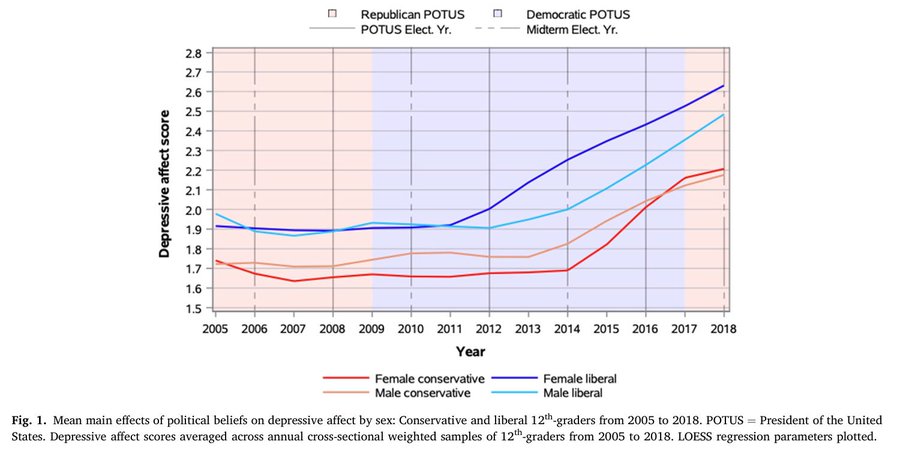
And:
Some of it might be selection effect, with progressive politics becoming a more congenial home for people who are miserable. But I think some of it is poor behavior by adult progressives, many of whom now valorize depressive affect as a sign of political commitment. The thing about depression, though, is that it’s bad.
And:
…progressive institutional leaders have specifically taught young progressives that catastrophizing is a good way to get what they want…
One of the best and most important pieces you will read this year. I would go as far to say that you cannot understand the American public intellectual sphere without a grasp of the close connection between Left thinking and high neuroticism. I would add that incorporating gender expectations into Matt’s analysis would give it yet more explanatory power. Once you see all this, you can never look away again and forget it…